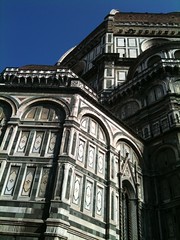
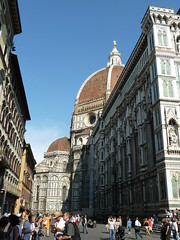
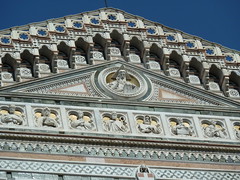
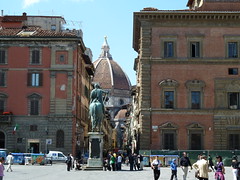
 After getting settled at our hotel, we stepped back out into the piazza, eager to enjoy the remainder of a beautiful warm sunny day, and started to head for the center of town. From the equestrian statue in the piazza, the Via dei Servi runs just a few long blocks toward the cathedral, and even though the avenue was a nearly unbroken line of four or five story Renaissance buildings, the great red dome could be seen peeking above at the end of the avenue. That just begins to give you a sense of the scale of the cathedral. The huge dome was an architectural phenomenon when it was built in the early 1400s, and remains the largest masonry dome in the world today. When viewed from hills outside the city, the cathedral dome completely dominates the Florence skyline. Inside the city, one catches glimpses of the dome along avenues that run toward the central piazza. Coming to the end of the avenue, which runs into the side of the cathedral, we were fully impressed by its scale and its beauty, as our gaze turned upward to take in the tall walls (about 150 feet from the ground to the roof of the nave) and their geometric patterns of the red, green, and white marble that lined them. As we walked along the side of the nave toward the front, I was mindful that the cathedral architecture was achieving its aim, to keep us looking up (heavenward) in awe.
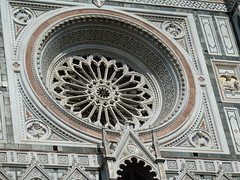
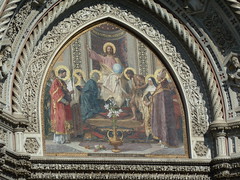
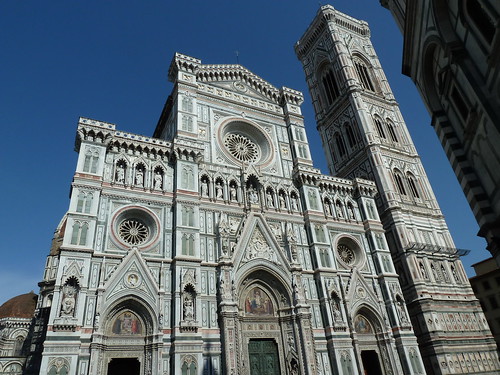 The feeling of awe and visual fascination only increased as we rounded the corner into the Piazza del Duomo, and turned back to view the façade. It is a dazzling display of neo-gothic architecture, taking the original tri-color geometric theme and kicking it up a notch into a wedding cake extravaganza of marble and statuary. The central part of the nave stands a full "head" above the "shoulders" of the aisles, and the façade keeps to that form. Unlike some cathedrals where the façade extends much higher than the actual structure behind it, this façade has substance behind it all the way up. It's hard to know where the begin to take it all in, but the design emphasizes the portals, a huge central one and two merely large ones on either side. Each has a deeply inset pointed arch (tympanum) filled with a mosaic, and above that a chevron-shaped pseudo-arch pointing up (heavenward, always), drawing your eye further up to the ornate rose window above. The whole pattern is echoed to scale in the secondary portals on either side. A gallery of niches with larger-than-life statues of the twelve apostles runs across the top of the "shoulders" and across the "neck". Four buttresses clamp onto the façade at the corners and the divisions, with double-lancet "windows" of green marble running all the way up. Above the rose windows is another gallery of quatrefoils filled with busts of great Florentines (mostly artists and architects, of course). No opportunity for a statue-filled niche or cornice is missed, decorated with borders of intricate inlay with the red, white, and green marble. Just when you think it can't get more baroque, you notice another level of detail of marble mosaic or busts of saints and popes worked into the pattern. Some people think that it's overwrought, but I think it suits a magnificent edifice of this grandeur. I mean, my God, it is one of the world's great cathedrals after all, it's entitled to be a bit overwrought.
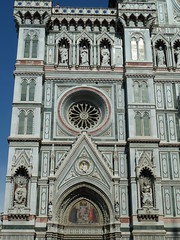 The façade is considered neo-gothic since, for various reasons, it wasn't added until the1870s, but it remains faithful to the gothic style of the cathedral, which was begun in 1296 and otherwise completed by 1469. To me, cathedrals in general and this one in particular are stunning human achievements, given that they are built over many generations and centuries, remaining (generally) faithful to an original vision. The men who began the cathedral knew they, their children, and their grandchildren would all be long dead before the cathedral was completed. The architects who began it did not know there would be sufficient resources and materials to finish it, and in the case of this cathedral, they didn't even possess the engineering know-how to erect what they envision, but merely had to go on faith that succeeding generations would somehow carry it out. The undertaking is as awesome a testament to faith as the structure itself.
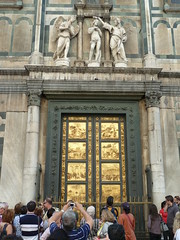 After taking in the façade for a while, we realized that we had our backs to the baptistry. This octagonal building is also done in white and green marble with geometric patterns, but its less ornate design and rounded rather than pointed arches indicate its Romanesque style. It's actually the oldest building of the cathedral complex, built between 1059 and 1128. Everyone from Dante to the Medicis, pretty much everyone who was anyone in Florence, was baptised here. But the big attraction of the baptistry are its gilded bronze doors, on the north, south, and east sides, which were the result of great artistic competitions in the Renaissance. In the early 1400s, Lorenzo Ghiberti won the honor of doing the north doors, which he labored on for 21 years. The doors were so beautiful that he was commissioned to do another set for the east doors, which took him 27 more years. These latter doors were even more beautiful than the first, and Michelangelo famously dubbed them the "Gates of Paradise", a name which has stuck to this day. The original doors have been taken indoors for restoration and preservation, but have been replaced with replicas so that the doors can be experienced on their original site. The doors are indeed marvelous. Of course being covered in burnished gold will make many things look marvelous, but beyond that, his artistry is exquisite. The bronze panels are deep relief, practically popping out in 3D. And Ghiberti fully exploits the Renaissance discovery of perspective to everything look realistic. (Before the Renaissance, art was generally flat and one-dimensional.) The doors comprise ten main panels, each featuring a major Old Testament biblical character. In most of the panels, all of the significant events in the life of the featured character are portrayed. For example, in one panel, Adam is created, Eve is created, they are tempted by the serpent, and they are booted out of Paradise, all in one fluid composition. Thus, not only are the panels 3D, they are 4D!(Check out highlights of our photos from Florence, or the complete set of first day pics on Flickr.)
Taking a cab from the airport to our hotel in Florence was like riding in a magical time machine. We began in unremarkable suburbs with McDonalds and other hallmarks of globalization, but as we approached the historic center, we began to see older buildings, arches, narrower streets. At one point, we started to catch glimpses of the great red cathedral dome which dominates the Florentine skyline, stirring anticipation, like kids seeing the Matterhorn and knowing Disneyland is near. When the cab pulled through an archway through an ancient wall into the Piazza della Santissima Annunziata, the time transport was complete. 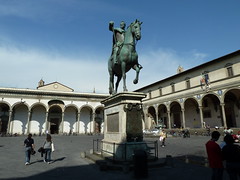 We were in a broad square stone-lined piazza, mostly blocked off from car traffic, surrounded on all sides by 15th and 16th century buildings in High Renaissance style. The square was mostly open and quiet, its most prominent feature a patinaed equestrian statue to one side, and two fountains. Not grand fountains, but the sort you imagine the residents of bygone centuries would come up to fill their water jugs from. On three sides, the piazza is bounded by buildings with loggias that run the width of the piazza. A "loggia" is a classically Italian architectural feature, a semi-enclosed corridor running along the front of a building, defined by columns and arches and open to the air in front. In fact, it turns out these may be the definitive loggias. When I just looked "loggia" up in Wikipedia, it shows a photo of the Ospedale degli Innocenti, designed by the great Brunelleschi himself in the early 1400s, which is one of the three buildings on this piazza. The form is very graceful and courtly, and the Florentines were so impressed by it that when Antonio da Sangallo the Elder designed a monastery for the Servi di Maria order on the opposite side of the piazza in the 1520s, he made it with a similar loggia. And likewise for the church that forms the north side of the piazza when it added a new façade.
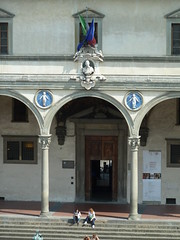
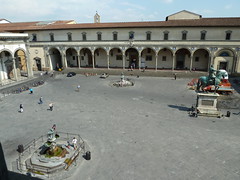
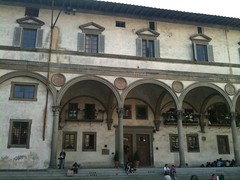
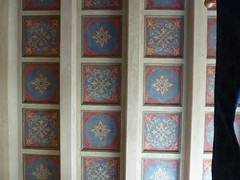
It was in front of the 1520 Servite monastery where the cab let us off, as that building has been renovated into a lovely hotel where we stayed the next three nights. Inside the Loggiato dei Serviti, the Renaissance charm has been preserved. Exposed beams, arches and niches with paintings and flowers adorn the halls and stairs, with common sitting rooms and reading rooms here and there making it feel like a large residence rather than a hotel. Amidst the old world feel, a few modern amenities (elevators, refrigerators, blow driers) have been thoughtfully added. Our third floor room featured a canopy bed, some classic wooden furniture, ceilings beautifully painted in intricate patterns, and a window overlooking that beautiful Renaissance piazza. A bouquet of fresh flowers and a bottle of sparkling wine in a silver ice bucket made for an elegant welcoming touch. We would enjoy our charming room and hospitable hotel staff quite a bit over the weekend.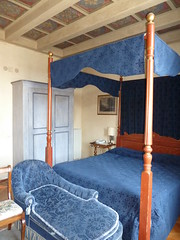
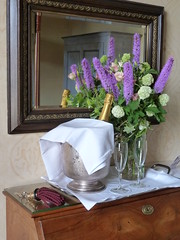 (Check out highlights of our photos from Florence, or the complete set of first day pics on Flickr.)
The Fox News headline read "Marines Chief Warns Most Are Uncomfortable Serving With Openly Gay Troops", and the article lead off with this sentence: "As many as 95 percent of Marines would be uncomfortable serving alongside openly gay troops, the retiring commandant of the Marine Corps told Fox News in an exclusive interview." This based on General Conway's survey of his troops. Of course, when you read further down in the article, it turns out the General's idea of the word "survey" means forming an impression based on various ad hoc occasions when he asked a group of Marines for a show of hands on the subject.
Now we learn from a leaked Pentagon report that an actual survey (you know, the real scientific kind) of 400,000 servicemembers showed that there is minimal risk to lifting the gay ban. More than 70% of the respondents thought that the change would be positive, mixed, or neutral. The Marine Corps was only slightly more resistant to the change, with about 40% expressing concern for unit cohesion. Nothing like General Conway's 95% based on his own "survey".
Am I the only one who's concerned that the leader of one of our military services trusts his personal impressions over actual data when it comes to making decisions?
 Of course we were busy posting on Facebook as we sat down to see The Social Network. But the film was more than engaging enough to keep our eyes off of our iPhones for the duration. In fact, I would call this story a Citizen Kane for the 21st century. It is a fascinating tale of a driven young man's rise to stunning success and riches, at the cost of betraying friendships and destroying relationships along the way, culminating in the ultimate irony: does the man who built a network of 500 million friends have any friends of his own? And of course it was impossible not to think of "Rosebud" when seeing the final scene. How closely the film hews to truthful biography is an open question, but it certainly makes for a landmark story. Facebook Founder Mark Zuckerberg is played impeccably by Jesse Eisenberg, who creates an Asperger-like intensity and unsocialized lack of filter in the main character, and as one of my friends (a Princeton classmate) said, "nailed the speech patterns and mannerisms of smartass Ivy League kids". Aaron Sorkin's script is beautifully written, from the opening scene in which we quickly get to know the Zuckerberg character as he is being dumped (for good reason) by his girlfriend, to the last scene (the Rosebud moment). The film tells the story of the events leading up to and through the founding of Facebook, interspersed with scenes from legal depositions from the various parties who later sued him, scenes which reflect on and illuminate the story. Zuckerberg comes off pretty much as a brilliant amoral jerk, though one of the young associates on his defense team sheds some sympathetic light on him, and I found myself cheering for him a little bit when he was being berated by the opposing attorneys and gave them a stinging comeback. (But then even Atila the Hun might be sympathetic when being berated by an attorney.) Justin Timberlake gives a great turn as Sean Parker, the erstwhile founder of Napster who insinuated himself into Facebook, portrayed here as a brilliant, charming, immature power-magnet with a penchant for drink and drugs and a talent for knowing who to flatter and charm. The whole story felt very realistic (again, whether it's true or not), and some scenes were giving me flashbacks to my own dot-com-founding experiences (which included a house which served as company dormitory and office space, though without so much drugs, wild parties, and funding). I predict Oscar noms for Eisenberg and Sorkin (course it's still early in the year for Oscar's short attention span).
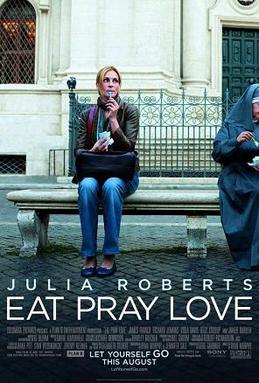 We'd heard mixed reviews of Eat Pray Love, but we were looking for something diverting last night, and figured: Julia Roberts, beautiful world travelogue, beautiful food, and some beautiful men (in that order) -- what's not to like? We were not disappointed and found the film thoroughly enjoyable. I had read the book, which is often a set-up for disappointment in the film. But I didn't go in expecting the film to be exactly like the book. While decorated by beautiful and exotic settings, the book is largely an internal journey which would be hard to translate into a visual medium. Nonetheless, I thought they did a really nice job. There was some amount of Liz the protagonist's voiceover (it would be impossible to make this film with none), but director/writer Ryan Murphy wasn't heavy-handed with it. He and co-writer Jennifer Salt did do a nice job adapting some of the book's great internal scenes. I particularly liked Liz's first attempt at meditating in the ashram, when her thoughts were totally scattered and even one minute of distracted meditation was exasperatingly slow. And the use of flashback and fantasy provided some lovely book-to-film translations such as the scene on the ashram roof when Liz "meets" and makes peace with her ex-husband. Of course in some dimensions, such as the beauty of the locations and the food, the film capitalized on the strength of visuals. A simple scene of Liz making eye-love to a simple but exquisite plate of spaghetti in a Roman café, with Mozart's Queen of the Night aria from the Magic Flute as soundtrack, was genius. As is inevitable, not every bit of the book can fit into a film, but I felt they stayed quite faithful to the book, and did their best to at least allude to memorable bits from the book. (One of my favorite chapters in the book is Liz attending an Italian football match and appreciating the Italian language in the stream of invective from the cheering and howling fans. It would be impossible, I think, to truly render that chapter on film, but they made a nice gesture to it, in a collage sequence interleaving scenes from fans at a soccer game with Liz and her friend trying on jeans that were a bit too tight.) It was also a pleasant surprise to find the casting so agreeable. To me, not a single character was discordant with how I had pictured them from the book, from James Franco as David, her rebound affair, down to Hadi Subiyanto as Ketut Liyer, an aged Balinese medicine man. Javier Bardem did a great job of bringing to screen such a complex character, who comes across as a bit of a playboy but who is actually a heart-broken divorcé and doting father. And Richard Jenkins did a brilliant turn as Richard in the ashram, a brusque Texan who kicks Liz's spiritual butt while becoming her best friend in India. (We remember him best from his outstanding lead role in The Visitor, though he's probably best known as the deceased father of the Fisher family in Six Feet Under.)
Sure, the film leaves out much of the more profound spiritual and emotional elements of the book, but there's only so much you can expect from a 2-hour movie, and there was a lot of ground to cover. Depth of emotional character development just wasn't going to fit. But as a romantic-comedy version of a journey of self-discovery set against a travelogue of beautiful places and exotic characters, we found it thoroughly enjoyable.
On our recent vacation to Canada, we learned a lot about the history of the settlement of "New France" in the 1600s, when French colonies were established in Québec in 1608 and Montréal in 1642. As with most cities, the great figures in their history, the founders of their civic institutions, are memorialized in statues and stained glass windows, and in the names of streets and squares. Such was certainly the case in Montréal, but as we wandered through the charming cobblestone streets of the old town, one thing slowly dawned on me as being rather unique. A number of those founders memorialized in statues and streets were women. And I'm not talking about some post-feminist politically-correct honoring of honorable women recently excavated from "herstory". I'm talking about women in leadership roles who founded major civic institutions from the very establishment of the colony, and were recognized from their time onward as founders.
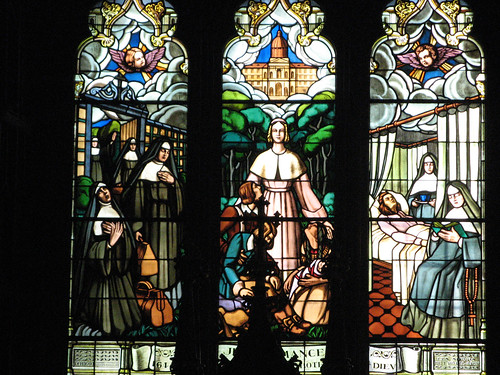 The first one that caught my attention was in the Notre-Dame Basilica, where a series of stained glass windows depict scenes from the history of the city, and one shows Jeanne Mance, founder of the city's first hospital. We came across the name again in a street name, rue Jeanne-Mance, which runs "north-south" from the convention center, past the Guy-Favreau and Desjardins shopping centers, past the Contemporary Art Museum and the Place des Arts, and up to the Hôtel-Dieu, the hospital that she founded, and which still exists (though not in its original location). Today the Hôtel-Dieu is one of Montréal's major hospitals, and is part of the Université de Montréal. There is a monument to Jeanne Mance in front of the hospital. And had the Place d'Armes (a central square in old town) not been under reconstruction, we would have seen a statue of Jeanne Mance as one of the five leading Montréal historical figures memorialized there. We learned that she was one of the original settlers on Montréal in 1642, along with Paul Chomedey de Maisonneuve, the first governor. Maisonneuve and Mance were both recruited by the Societé de Notre-Dame de Montréal, an organization incorporated to fund the establishment of a missionary colony in New France. As we visited Montréal's historical sites, we learned of the great hardships faced in its establishment, the often-dangerous voyages across the Atlantic, the attacks on the settlement by the Iroquois, occasional threats from the English, as well as natural threats from floods and disease. It clearly took great fortitude and courage to be a pioneer in such a place.
 Another prominent figure we learned of was Marguerite de Bourgeoys. If you visit the charming Notre-Dame-de-Bon-Secours church, you can't help but learn about her. Governor Maisonneuve returned to France to recruit someone to establish a school in Montréal, and he returned with Marguerite de Bourgeoys. Shortly after her arrival in 1653, she initiated construction of the Notre-Dame-de-Bon-Secours Chapel, and established Montréal's first school. She made a number of trips back to France in subsequent decades to recruit additional teachers and funding, and the women she brought back formed the Congregation de Notre-Dame, a unique community of uncloistered women who established and operated a number of schools for colonists and for native children. She was truly a courageous and remarkable leader.
In another part of town, we came across a couple of streets and a square all named for Marguerite d'Youville. Though she lived in the 1700s, nearly a century after the establishment of the colony, she too played a leading role in Montréal's civic life. After becoming a young widow when her drunkard bootlegger husband died, she answered a religious calling, and established the Order of Sisters of Charity of Montréal, a group that operated a home for the poor, and also took over operations of a bankrupt hospital outside the city walls, bringing it back to financial stability. The "Grey Nuns" (the common nickname for the order) carry on her legacy to this day, continuing to operate numerous women's shelters, food dispensaries, and other services for the poor.
 We also saw an obelisk in old town, erected in 1892, with a plaque listing the founders of the city, both those including Jeanne Mance who actively worked on site to establish the colony, but also those back in France who backed and funded the venture, such as one Angélique Fauré de Bullion, a wealthy widow who played an ongoing active investment role in the development of the colony. (She insisted on being identified only as "an unidentified benefactress" in records of her donations, and her role only came out after her death.) Several other female names appeared on this plaque, including the intriguing Madame La Chanceliere Louise Fabry, of whom I've not been able to find out more.
I'm just intrigued by this whole women pioneer thing, and wonder what unique combination of things made this happen in New France? Obviously, the whole pioneer thing is one factor. When founding a colony in a new world, obviously you need all hands on deck, and certainly the women who were among the original settlers in America (the settlement of "the West" as well as the English colonies) were strong and courageous. But I'm not aware of any of our American pioneer women having such leadership roles and establishing civic institutions in the same way. Generally, our streets are all named Washington, Jefferson, and Adams, and our statues are of men. (The nearest exception I can think of was Anne Hutchinson in Rhode Island.) And here in "New Spain" where I grew up, I don't even think the Spanish missionaries (and certainly not the soldiers who supported them) included women at all. So while establishing a new colony created a natural demand for leadership, most social structures of the time didn't enable women to rise to fill that demand. What then was different about New France? Another factor is the Catholic church, which distinguishes New France from New England (our Protestants didn't have the same tradition of nuns and orders that the Catholics had, cloistered or otherwise). And perhaps we have to distinguish the French Catholic church, since Spain too was Catholic. These French women pioneers certainly worked within the context of the church: Marguerite Bourgeoys started her own order of sorts (though an unconventional one that only finally received full church authorization near the end of her long life), and Marguerite d'Youville worked with the church to start her order. (Both of these women were eventually canonized a couple centuries later.) Jeanne Mance, though devout and religiously motivated, was and remained a laywoman, though her hospital was staffed with women of orders. What was it about 17th century Catholic France that enabled such women (and the wealthy widows who funded them) to take on such leadership roles?
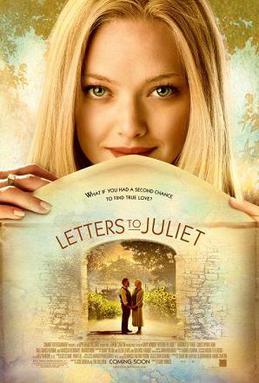 Yesterday afternoon, we saw Letters to Juliet, and as my husband said at the end of the film, "what a total cheese-fest!" And indeed it was, though if you like cheese (and we do), it was certainly a fine cheese. The plot was rather like a Nebraska Interstate: no turns, just a straight line that you could see for miles and miles ahead with the destination clearly sign-posted. Fortunately, the scenery was Tuscany rather than Nebraska, which one can look at with delight for a couple of hours, while being enchanted by Vanessa Redgrave, whose luminosity easily makes one forgive a weak plot. Amanda Seyfreid, with her blue eyes that you could swim in, along with handsome young Brit Christopher Egan and a frenetic Gael Garcia Bernal, charmingly inhabit their by-the-numbers characters, making the whole proceeding quite enjoyable, as well as easy on the eyes. The Vanessa Redgrave and Franco Nero backstory lends another layer of charm with the film's story echoing their real life "once and future" romance. So just turn off the critical part of your brain, and enjoy the fine cheese.
Last night George and I checked out Church & State. No idea where the name came from. It's not on the corner of Church and State, nor could I detect any disestablishmentarian themes in the cuisine or the venue. It's on the corner of Industrial and Mateo (near Alameda and 7th), in the bottom of the old National Biscuit Co building, in a tiny pocket of trendy lofts surrounded by gritty industrial stuff a few blocks beyond Little Tokyo. In other words, one of the green shoots of the new urbanization of downtown. We'd heard of the restaurant itself from mentions in LA foodie circles (Evan Kleiman, Jonathan Gold, the usual suspects), and our downtown friends were all onto it. With no plans for a Saturday night, we decided to be check it out. Though we were able to snag a table for two on very short notice, the place was pretty hopping the whole time we were there. There was no valet, and we had to park a couple blocks away, in front of the still-industrial looking stuff. We did get approached by one panhandler, but in the short walk to the restaurant, we noticed lights in windows of inhabited lofts, and a few nicely-tended urban landscapes on roofs or between buildings. Right near the restaurant, we noted another nice restaurant across the street, as well as a respectable-looking convenience market and a gym. Inside the restaurant, the scene was that of traditional French bistro furnishings placed in the industrial rehab context, with the extra-high ceiling leaving the construction unapologetically exposed, and strings of lights strung festively around. I thought it worked quite well, being true to both its urban setting and its Belle Epoque themes.
The menu is very traditional French bistro, with mussels, steak frites, frisée aux lardons, roasted chicken, and authentic country touches like pigs feet, pigs ears, roasted marrow bone, and charcuterie. I was delighted to discover a cassoulet on the menu, and was also intrigued to find a "cassoulet aux légumes". I was imagining a cassoulet filled with carrots, parsnips, broccoli, and peas, all cooked with the white beans in magical duck fat, which sounded just as marvelous and slightly healthier than the traditional cassoulet which is filled with wondrous artery-clogging sausages, duck legs, and other fatty bits. Alas, our waiter was unmistakably French, not only in his accent, but in his demeanor, and didn't really sell the vegetable cassoulet when I asked him to describe it. (It is not the style of the typical French waiter to be at all chatty the way American waiters are, nor to spontaneously compose paeans of praise when asked to describe a dish.)
We both started with salads, George with the frisée, and me with a "salade au marché, which had arugula, beets, pine nuts, and thin strips of charcuterie. Mine was delicious and George, while initially looking askance at how lightly poached the egg was (he's the sort that does not like his eggs runny), tucked in and left nothing. I was also intrigued by an item called "pois chiches" on the hors d'oeuvre menu, which was lightly fried green chick peas, so we gave that a try. They were tasty, with a nice seasoning on the outside, although a bit awkward to eat. Like edamame, the good stuff is inside a husk that you really don't want to eat. Unlike edamame, these didn't easily pop out, or if there was a neat trick to eating them, we didn't discover it, so we just squeezed the tasty soft center out in our mouths, while also getting the seasoning off the husk, and then awkwardly removed the crinkly husk. (Anyone have any tips on eating these?)
For mains, I went for the traditional cassoulet au Toulouse, which had succulent white beans, savory sausages that tasted like fresh ground lean pork with garlic and herbs, lardons, a crispy duck leg, and bread crumbs to texture the rich goodness of it all. George had a bit of a time making a selection, as the chef was being extra cautious about the gluten issue, and so steered him away from anything that went into the same frier that other stuff with flour had been in, and said to scratch the au jus on everything. So he ended up having steak frites with bearnaise sauce (but no au jus), and roasted potatoes instead of the usual frites. It was disappointing to have so many limitations, but it was appreciated that the chef was being conscientious (as opposed to another restaurant we'd been to recently that didn't take allergies seriously), and they did go to some effort to accommodate us. (The pois chiches are normally made in the frier, but the chef prepared a special batch for us in a separate frying pan.) The wine list was thoroughly French, and with a nice range of wines to choose from, including selections by the glass. I neglected to get the details (left my iPhone in the car), but George had a nice Medoc (cab-merlot blend) with his steak, and I was pleased to find a Languedoc wine offered by the glass, which was lovely with the cassoulet.
For dessert, the waiter presented us with a tempting display of tarts (the chocolate-raspberry tart looked particularly intriguing), but we decided to share a citron mousse which was lovely. The creamy mousse had a light lemon flavor which was contrasted with a topping of tart lemon shaved ice. It was light and refreshing, and the contrasting lemon/tart/sweet/creamy flavors tickled the tongue. On our way out, George caught sight of an interesting looking glass jar with two small spigots on either side. We asked the waiter who was carrying it, and he explained that it contained ice water and was part of a service for absinthe. Intriguing! We'll have to try that next time.
While the Health Care Reform bill is far from ideal, I think it's a big step in a mostly good direction. Let me explain why I think so.
First, I think the status quo was untenable, for two basic reasons: cost and structure. Health care costs currently represent 16% of our GDP (that's higher than any other nation), and have been rising at a rate nearly double the rate of inflation and much higher than GDP growth. For people who have insurance, the rising cost of health care is initially buffered by the insurance companies, although it is eventually reflected in rising premiums. For people who purchase their insurance directly on the individual market (a market in which they have no leverage), they are feeling the premium pain acutely. Several of my friends are among the Californians who got whacked with a 39% increase in their premiums from Anthem Blue Cross this year. For those lucky enough to work for a large employer, the insurance costs are partly absorbed by the employer and the rest buried in an automatic payroll deduction. But the employers are feeling the pain of the rising insurance premiums, which are rising even faster for small and medium-sized businesses than for the large ones. In one recent survey, large companies (more than 50,000 employees) saw their premiums increase 5% in 2009, while small (less than 5,000 employees) and medium-sized companies saw premiums rise as much as 10%. For the employees, that eventually translates into a lack of raises, and lack of new jobs. Some friends have experienced effective pay cuts due to no raises and increased payroll deductions for those rising insurance premiums.
Some would say that the answer to rising costs is less regulation and to let the free market do its thing. Now don't get me wrong, I'm generally a free market fan, but our current system of mostly-employer-provided health insurance bears little resemblance to a functional market. For one thing, I can think of no other segment of the economy where both the consumer and provider of a service are so dysfunctionally disconnected from the cost. Anyone who's on a PPO insurance plan like me is familiar with the insanity: you go to the doctor just for a basic office visit, maybe get some blood drawn and/or an X-ray. The result is three to five bills from your doctor, a lab, the X-ray technician, and maybe some other doctor who reviewed the labs or the films. Then you get a flurry of "explanation of benefit" statements from your insurer saying "the blood labs billed $750, but our negotiated rate with them is $300, of which $78 was unallowable (reference mysterious codes), $113 was covered, $63 goes against your deductible, and you owe 20% of the remaining $46." If I'd have just walked in off the street without an insurance card, that basic office visit would have had a nominal cost upwards of $1,000. (Of course part of that is because the doctor has to employ at least one full-time person just to keep the insurance billing sorted.) It's a bit like airline tickets, where you can find three people sitting on the same flight in the same row who paid $212, $756, and $1640 for their tickets. But at least on an airplane, you know the cost before you buy the ticket. With medical care, you don't know the cost, you usually don't even ask up front (cause you're not paying it), and you don't even know the destination or the length of the flight. When was the last time you cost-comparison shopped a doctor, or asked about the cost-effectiveness of a recommended test or treatment? So how exactly is the "unseen hand" going to get any grip on this?
You might say that you don't need to worry about cost, because your insurance company has done the cost comparisons and cost-effectiveness studies. That's somewhat true, but that just shifts the focus to the insurance market. There you have a number of factors at work. First, there is the negotiated cost of services, which comes down to the relative leverage between insurers and service providers (doctors and hospitals). In areas where an insurance provider has a large number of subscribers and there is a choice of hospitals, the insurance companies can negotiate more competitive rates with the hospitals. In areas where there are fewer hospitals (or the hospitals are nearly all owned by one company, e.g., as in northern California), and where an insurance company has less of a local market, they are in a weak negotiating position and can't get as competitive rates. The key observation to be made here is that increasing competition among insurance companies can work to drive costs up rather than down, insofar as it weakens their leverage to negotiate with service providers. Another factor is the market for selling health insurance, which is very uneven. Rather than a large market of individual consumers, the health insurance market is a lumpy amalgam of large companies buying group plans, small and medium businesses buying group plans, and individuals buying individual / family plans. Large companies obviously have the leverage to get relatively good rates. Small and medium businesses, not so much. And individuals totally get the shaft. These submarkets also operate under very different terms. In the large company sub-market, the insurance company typically agrees to accept all employees regardless of pre-existing conditions, while the company promises to enroll all employees in the plan. The scale creates a broad enough pool such that the insurance business model makes sense: you have enough healthy people in the pool to cover those who are sick. In the individual market, it's a different story. If people could buy individual health insurance policies at any time, regardless of pre-existing conditions, nobody would buy insurance until they got sick, and only sick people would buy insurance. Obviously, that would make the individual insurance pool unsustainable, which is why the insurance companies need to screen for pre-existing conditions to make the current system work.
This uneven insurance market incentivizes some counter-productive behavior in the labor market. Some employees may stick with a job for the sole reason that they can't give up the medical coverage. They may have a child with a pre-existing condition, and if they left their current job, they would be unable to replace the coverage. This may prevent them from moving to a more effective job, or it may prevent them from venturing out and starting a new business. Employee mobility is a key efficiency for an effective economy, and especially so in our modern information and services economy. We recognize the importance of entrepeneurship, and of small and medium business in job creation and economic growth. Our system of employer-provided healthcare insurance made more sense in the 1950s and 60s when the majority of people worked for large employers and often stayed with the same employer. Today, employer-provided insurance is not only a quaint relic of that bygone era, but it is a source of structural inefficiency and distortion in our modern economy, insofar as it hampers employee mobility and entrepeneurship. We'd be much better served by scrapping employer-provided insurance altogether, and creating a robust and level individual insurance market. But massive change like that is politically infeasible, and our economy is like a battleship that needs to be steered slowly.
The recent Health Care Reform bill is a positive step in that direction. By organizing the individual insurance market into state-run insurance exchanges, this key structural change will enable the individual insurance market to effect the same bargain as large group coverage: everyone participates in order to create a rational insurance pool and no one needs to be screened for pre-existing conditions. Those who had been urging incremental change failed to understand how these things need to come as a package in order to work. In order to eliminate pre-existing conditions, you need to make sure the insurance pool is rational by mandating that everyone be in the pool. And in order to make a mandate reasonable, you need to provide premium subsidies for those least able to afford them. The elimination of pre-existing condition screening only makes sense together with the mandate, and the mandate only makes sense with the subsidies. It could not have been done incrementally. (Likewise, those with hopes for a repeal are going to realize that you can't repeal the mandate without also restoring the pre-existing conditions screening.)
Thus, I see this as a positive step toward reforming the structure of our health care insurance market. Regretably, it appears not to address the overall healthcare cost problem, except for a few small but promising gestures (such as a Medicare pilot to explore alternatives to payment-for-service). Even so, I see it as a huge accomplishment. I think the opportunity to make such a change occurs only once or twice in a generation. The last grand attempt at healthcare reform was in 1994, and if this effort had failed, it would have been another 15 or 20 years before anyone would take it up again. The political process was messy, but Washington is messy on the best of days, and one can't expect filet mignon from a sausage factory. Despite the mess, I would say the process worked the way it is supposed to, in that a wide range of views were accommodated in the final bill. Anyone who thinks the entire Democratic delegation has a monolithic view that can be meaningfully labeled "the left" simply hasn't been paying attention. I was also glad to see that the final wrangling to get the needed votes in the House was focused on the actual substance of the bill, and we didn't see the kind of obscene special deals (like the Nebraska tax exemption -- shame on you Senator Nelson) that took place in the Senate. (Thankfully, the most egregious of those were deleted in the reconciliation.) Even the Republicans, with their complete stonewalling, played a role in shaping the bill, by forcing the Democrats to come to a complete consensus across their intra-party spectrum. (Tolkien tells us that even Golem had a role to play in the Lord of the Rings. I reckon the GOP played the Golem role here.)
Frankly, I'm puzzled by the people who are proclaiming that HCR represents the end of life as we know it, or that it implements some revolutionary radical leftist ideas. Compared to the fears many on the right have expressed -- of a government-run healthcare system, or the government as single payer -- what we got is not that, not even close. It didn't even include so much as a public option. What we got was a way to enable a viable independent insurance market without adverse selection and pre-existing conditions, preserving the framework of a free-market competitive private sector to provide the insurance and to provide the healthcare. Anyone who looks at that and sees "socialism" or "government takeover" is just deluded. This was a completely market-oriented reform. Even in the context of market-oriented reform, the reform wasn't all that revolutionary. It did not abolish employer-provided healthcare and immediately establish an individual market for everyone. It did not even tax employer-based health benefits (which I'd love to see them phase in, shifting the tax deduction to individuals). The reform was heedful of people who like what they have now, and it enabled the reform in a minimally disruptive way. Many of the significant reforms don't take effect for several years, allowing people and businesses to plan for the transition. Not exactly the French Revolution here.
What is sad is the apparently intense polarization of attitudes in this country along the alleged left-right divide, when in fact there are broad areas of agreement. I think most folks would agree that healthcare costs are out of control, that the practices of pre-existing condition screening (and rescission) are ugly, and that market-oriented solutions are better than government central planning. The Health Care Reform that passed, with an absolute zero of Republican support, contained many elements that Republicans themselves have pitched in the past. It's like the Republicans and the Democrats are about six inches apart in the middle of a twenty-foot ruler, and they're arguing about the dire chasm of "right" and "left" between them. How pathetic is that? In reality, it serves only to enrich the pundits who thrive on fanning the flames.
Some folks are offended by the idea of an insurance mandate, or question its constitutionality. On the practical side, I'd like to ask those folks: would you have preferred a single-payer system, or direct government-provided healthcare (a la Britain or Canada)? We could eliminate the mandate, and do one of those instead. We only need the mandate if we want to do a market-oriented reform. But if you're really bothered by that mandate, we can go Canadian style. No? I didn't think so. On the constitutional side, while I admit the idea of a mandate does chafe a bit at my libertarian bones, I also concede that it's not really outside our Constitution as it has been interpreted for quite some time. The government has the power to compel things: paying taxes, educating children, serving in the military. Like it or not, the Supreme Court has been pretty deferential to the constitutional power to regulate commerce, as well as the power to levy taxes. I know the challenges are already being filed, but it would be surprising if the Health Care Reform bill is found to have exceeded those well-established powers.
Some folks are just generally nervous about the growth of federal government, and I share that sentiment. But I do believe that it is the proper role of the government to regulate the healthcare market, to ensure that it functions effectively. Just as it is appropriate for government to have a significant role in infrastructure (think roads and airports), as a key enabler of a vibrant economy, I think that healthcare and education are the "infrastructure" of an information economy workforce. In the 1950s it made sense to everyone that your employer should provide your healthcare. It was a reasonable investment for the employer to make sure that the employees were healthy and secure. Today, almost nobody has a single employer their entire life. We move from job to job, place to place, career to career, re-train, start new ventures -- the labor mobility that an effective 21st-century economy requires. But it still makes sense to invest in the health and security of our workforce, so that people can focus on their work and not be distracted by health insecurity. It's just that employers are no longer the logical source for that investment. Given labor mobility, the government is the logical source for that investment, as it is the only stable long-term constant. I think this is what is required for the American economy to remain competitive in the 21st century.
So, that's why I am happy about the passage of the Health Care Reform bill.
 In his latest film Los Abrazos Rotos, director Pedro Almodóvar at times channels Alfred Hitchcock, and at other times, Luis Buñuel. The opening scene, a macro close-up on a single eye, is an explicit homage to Un Chien Andalou, and a tantalizing tip to film theorists that Almodóvar is going to artfully play with the theme of seeing and film. The main character is a famous film director who has lost his sight, as well as the love of his life, in a car accident. And one of the most stunningly beautiful visual scenes in this film is of the blind man "reading" the pixels in a grainy video of his last film as if it were braille. Layers of seeing and watching and filming are fascinatingly woven in this strange tale about a film being made, and the filming of the filming, part of which includes the secret surveillance by a jealous husband of his aspiring actress wife, which leads to the Hitchcock elements. While full of arty references that film theory students will eat up, this is no plotless Brakhage or Warhol film. There is an intriguing film noir plot of an affair abruptly ended by a suspicious death that may have been a murder, and there are some great Hitchcockian car scenes, suspenseful without any actual chase, just a creepy feeling of being watched. The plot lies buried in the blind man's past, and Almodovar lets it gently and mysteriously unfold, as we get to know his characters, all brilliantly cast: Lluís Homar as the haunted blind director Mateo Blanco (who forsook his name when he lost his sight and his love); Blanca Portillo as Judit García, his editor/manager and unrequited lover; Penélope Cruz as Lena, his passionate lover and not-very-talented star of his last film. The film within the film (and the filming of the film within the film) is used to great effect, without becoming too gimmicky. At times, the line between the inner film and reality blurs. There is a great scene when Lena's jealous husband is watching a soundless videotape of his wife making the film, as a hired lip-reader tells him what people are saying; then as Lena addresses the camera directly, the real Lena enters the room behind him and speaks the lines that her on-screen picture is enunciating. While the film was a bit slow to get going, I was thoroughly drawn in by the end with these intriguing characters, the mysterious story threads tying them all together, and the artful filmmaking.
I came across this book in an unusual way. I received an email from someone who regularly sends me the worst right-wingnut scare rumors, and this particular email was all panty-twisted over a photo of President Obama holding a book which, upon closer look had the title "The Post-American World", and it was written by a Muslim! "See," the email howled with horror, "look what Obama is reading! He really is part of a secret Muslim cabal intent on destroying America!" Being appropriately sceptical of such emails, I looked a bit closer and made out the partly-obscured name of the Muslim-terrorist author of this evil tome: Fareed Zakaria, international editor for Newsweek, and a widely respected expert on foreign policy. I immediately added the title to my list of books to read. So glad I did.
His provocative title, it turns out, is not about the fall of America, so muc as it is about the "rise of the rest". The book is a shrewd analysis of how America's role as the world's sole superpower is inevitably going to be soon eclipsed by China and India, and what that will and won't mean. I'd never read Zakaria before, but I found him to be tremendously insightful, as well as very knowledgeable. The book is eye-opening in its quantification and qualification of the rise of China and India (as well as other countries), but at the same time it is reassuring in its assessment that the surpassing of the US economy need not be the catastrophe many may fear. In fact, he cites Roosevelt's dictum that the only thing to fear is fear itself. Our worst possible policy choices in reaction to the rise of the rest of the world would be ones based on a fearful retrenchment into protectionism and isolation. Our best possible policy choices continue to embrace open trade and immigration, key drivers that have advanced America and can continue to do so. He compares and contrasts the present US situation not to Rome (as is so often done), but to the British Empire in its decline, which given where Britain is today was obviously not the end of the world. He offers some interesting observations about military might versus the soft power of legitimacy and being a center of ideas and innovation. And he had some interesting insights into econometrics, noting that our current measures of savings and consumption are based on an industrial economy. For example, spending on research and development, or a college education, gets measured as consumption, when it's really more of an investment, especially an in information economy.
I came away from this book feeling more realistic and also more optimistic about the future for America. And also very glad that our President is reading books like this one.
 I was raised on show tunes from a young age, and as a kid I can remember listening to my folks' reel-to-reel tapes, especially the great Lerner and Lowe musicals like Camelot and My Fair Lady. I'd never seen Camelot on the stage, and so when I heard that the Pasadena Playhouse was putting it up, I wanted to go see it. Then when I read that the Pasadena Playhouse -- beautiful historic theatre that has put up some truly great productions over the years -- was closing due to financial difficulties, I immediately went out to get tickets. That just added a whole layer of meaning to the experience, to see this play about the fateful demise of a wonderful ideal, as the very theatre was experiencing its own demise.
Not having seen any other productions of Camelot, I can't compare this one, but I found it utterly charming and moving. The set was simple and spare, a series of wooden poles and platforms, and the ensemble of eight players began the play in a self-conscious "we're about to tell you a story, so please indulge us with your imagination" manner (actually rather Shakespearean), and also a touch of self-deprecating humor -- "there was a majestic castle on a hill" as a picture of a castle is noisly unfurled and hung on one of the poles; "it was snowing" as an actress arches an eyebrow while tossing a handful of torn paper in the air. The self-conscious stuff added a nice laugh here and there, but was a light touch, and not overdone. The cast was terrific. Shannon Warne (Guinevere) reminded me of mezzo diva Jennifer Larmore, with a beautiful and powerful voice that glimmered like sunshine, and with a confident charm that commanded the stage. I think she could have got most every guy in the audience to joust against Lancelot for her! Shannon Stoeke (Arthur) did a marvelous job being a tentative idealistic boy-king in the beginning, maturing into a strong man with the conviction of his ideals even when it was torture for him to do so. Doug Carpenter brought a swaggering bearing and a rich deep baritone to realize the unself-consciously pompous Lancelot. The other three fun-loving knights and that deliciously wicked Mordred were all finely enacted too, rounding out a great ensemble. The director did a great job balancing the tone of the play, mostly light and charming with emotionally powerful moments. The climax at the end of Act I was particularly powerful, with Arthur making a desperate, passionate recommitment to his ideals, and then the breathtaking reveal of Lance and Jenny, naked in each other's arms. That was brilliant theatre. And of course I was totally charmed (as well as filled with warm nostalgic feeling) for the brilliant music and lyrics of Lerner and Lowe.
I was sad to see the show end, and sad to see the theatre close. I hope that they will be able to stage a comeback, and that the "(not so) brief shining moment" that was the Pasadena Playhouse will be the "once and future" stage.
 I really didn't know much about Tolstoy before seeing this historically-based film, but The Last Station certainly presents an intriguing character. Born into wealth and aristocracy (he was a count), and a celebrated author in his own lifetime, he was also a man of strong convictions about a utopian communal society, and a whole following of "Tolstoyans" grew up around him. This charming film is propelled by the conflict between his ideals and his actual life, a conflict which is illuminated and exacerbated by two other very strong figures in his life. His wife the Countess Sofya (powerfully portrayed by Helen Mirren), the love of his life and mother of his numerous children, as well as his sometime literary assistant and fulltime financial manager, is concerned with preserving a decent inheritance for her children, and is thus at odds with Tolstoy's best disciple Vladimir Chertkov, who convinces Tolstoy to divest his estate as well as his valuable copyrights to the people, as a grand Tolstoyan statement. Helen Mirren gives a brilliant performance as the passionate drama-queen countess, fierce and powerful with moments of vulnerability. And Christopher Plummer is marvelous as the larger-than-life author, with a huge passion for life, he is a presence of Shakespearean proportions. James McAvoy is charming as Valentin, the very young, idealistic man who becomes Tolstoy's personal secretary, and through whose eyes we become acquainted with this world, as both Chertkov (villainously played by Paul Giamatti) and the Countess attempt to use him to achieve their crossed purposes. There's a great moment where we realize how Tolstoy the idol has diverged from Tolstoy the man, when he and Valentin are taking a walk through the woods (beautiful classic Russian birch woods!), and Tolstoy is reminiscing about a woman he had a romantic affair with in his younger days. Valentin (who is a virgin, and is celebate as is part of the Tolstoyan philosophy) is a bit embarrassed, and apologizes for bringing up shameful memories. "Shameful!" Tolstoy exclaims with a huge, roaring laugh, "oh no, not at all. My boy, I'm afraid I'm not a very good Tolstoyan." In the end, the film really makes you think about how a great man's following can morph into something different than the man himself, and also how a man can become divided between who he is and who he thinks he ought to be. That makes the film sound more heady than it really is. Those are just the thoughts I was lead to in the aftermath, but the film itself was a compelling story of some very human characters.
 Writer/director Nancy Meyers delivers another winner with It's Complicated, a charming, thoughtful, very funny romantic comedy about divorce, exes with benefits, unfinished business, and moving on. (Not to mention, a romance for people more, ahem, our age.) And Meryl Streep is, as usual, totally outstanding, lighting up the screen, and making us forget for a couple of hours every other amazing character she's ever brought to life. She plays Jane, mother of three mostly grown kids, and ex-wife of Jake (charmingly played by Alec Baldwin) who left her for a younger woman whom he's now married to. As we know from the trailers, an affair ensues between Jane and Jake, just as an intriguing architect (Steve Martin) comes into her life. Though the style of the comedy is pure classic with tropes out of the traditional playbook, they're beautifully executed, the story is fresh, and the laughs are real and plentiful. And along the way, the story gently offers a little food for thought about whether the good parts of a former marriage might be rekindled when the conditions that brought on the bad parts (job stress, parenting stress) may have gone away. And speaking of food, though Jane bears no resemblance to Julia Child, she runs a charming bakery in Santa Barbara, is a great cook, and has a remarkably beautiful home that she might have bought from Julia Child, making one wonder why she'd ever want to remodel and expand it (except that it was "their" home and she's just now ready to make it into "her" home). This film is not just rom-com soufflé, it's the main course too.
I was captivated by Christopher Moore's Fool, wonderfully read by Euan Morton, from this opening sentence: "This is a bawdy tale. Herein you will find gratuitous shagging, murder, spanking, maiming, treason, and heretofore unexplored heights of vulgarity and profanity, as well as nontraditional grammar, split infinitives, and the odd wank . . . If that's the sort of thing you think you might enjoy, then you have happened upon the perfect story!"
What followed from there was not only eight and a half hours of the finest British humor, but an incredibly clever Shakespearean parody and pastiche. Fool takes the story of Shakespeare's King Lear and turns it inside out, as seen from the point of view of Pocket, the king's fool. Kind of like Rosencrantz and Guildenstern Are Dead, but much much funnier and much much more engaging. Not only does he work the Fool's story seamlessly into the existing story of King Lear, but he manages to weave an entirely new tale, full of politics, intrigue, a bit of magic (and yes, lots of shagging and bawdiness) into it. It was amazing, because if you know the story of Lear, you know how part of it is going to have to go, and yet you still don't know how it's going to get there, or even how it finally turns out. And it was so much fun to get there. The story is jam-packed with Shakespearean allusions, quotes, jokes, and even a few characters (like Macbeth's witches) shamelessly imported from other plays into this story. And the story would completely stand on its own, both for humor and intrigue, even if you didn't know much Shakespeare at all. What a rollicking great romp!
 We greatly enjoyed Culture Clash's previous work in Chavez Ravine, so we were intrigued to see their new play Palestine, New Mexico at the Mark Taper Forum. It was a powerful and intriguing dramatic work, with Culture Clash's unique quirky point of view brought to bear this time on world politics. The story all takes place on a tribal reservation in New Mexico, where an army captain has come from Afghanistan to talk to the chief about the death of his son, but the tribe is not at all eager to receive her. But this story, like onions and ogres, has many layers, and as they are dramatically peeled back through the captain's encounters with various members of the tribe, the medicine man, the widow of the dead soldier, and finally the chief, the story we finally learn about how the soldier died, what he was trying to do in Afghanistan when he died, and how it connects to a secret history of his family and his tribe, it is ultimately astonishing and thought-provoking. Ultimately we are left to ponder some fascinating parallels between rival tribes and rival families, in America, in Afghanistan, and in the Middle East, as we see the remarkable "culture clash" of New Mexico's rocky cliffs and mountains flashing to Afghanistan's mountainous terrain, and a Native American soldier's casket being lead by someone singing the Jewish mourner's kaddish. Once again, an evening of powerful and provocative drama at the Taper.
 Avatar is not the sort of film we typically go for, but we'd been hearing such buzz from so many people that we had to check it out. I have to admit I was a bit cynical going in, but was utterly captivated by the beauty of this imagined world. Such great imagination went into creating the exotic flora and fauna of Pandora, and the way of life of the Na'vi. Sure, it was clearly drawn from our own conceptions of Native American beliefs about the connected spirit in all of nature, but I thought it was very cool the sci-fi spin they put on it with a natural neural network of trees all connected at the roots, and the creatures who bond by entangling their organic fiber-optic cable ports. And sure, the story was clearly drawn from Pocahantas and Dances With Wolves and the like, but the thing about classic stories is that they hold up to retelling and recasting in creative ways. (Westside Story was derivative from Romeo and Juliet, but no less creative for it.) Granted, the story was short on real character development, with the characters being more allegorical ideas (the bad-ass macho military man, the greedy industrialist, the pure-hearted scientists, and the even purer-hearted native peoples) than real people. But damn, it was stunningly beautiful, and the story swept along, totally predictable yet totally spell-binding, like a mythic tide. I was as delighted as the next guy to see the epic forces of nature and the eco-in-tune people kick the butt of the evil military-industrial complex. The movie did not feel long at all to me, and I kept my 3D glasses on through the credits, hoping for a few more glimpses of that amazing planet.
As to the 3D thing, at first I found it slightly distracting, but I was pleased that it wasn't overly gimmicky, no projectiles hurtling straight into the camera or flying creatures hovering right in front of my face. And I think my brain adapted to it, because I realized by the end I was no longer conscious of it, and it felt pretty natural. But I think part of what made it work so well was the fantastic nature of the film. One friend of ours wondered whether this point in 3D technology might be a "game-changer" for movies in general, but I'm not so sure. Many films don't have to convince us of their reality in the same way that a sci-fi-fantasy film like Avatar does. Would Nine or A Single Man have been enhanced by high-quality 3D? I'm not so sure. But for Avatar, it was breathtaking.
 The Young Victoria presents an engaging story about Queen Victoria's early years, as a teenager and then as a young queen. For me, this was all new, as what I knew of Queen Victoria was mostly the length of her reign, her eponymous era and its morality, and the image of the corpulent old lady in the veil. It was fascinating to see her as the heir presumptive to the British crown, resisting attempts at control by her mother and her mother's lover, and warily keeping her head above the manipulation of others, including various royal uncles hoping to marry her off to various royal cousins. One of scene of Victoria playing chess with Prince Albert (then a suitor) provides a central metaphor for the film, as both of them are pawns in a larger game being played by the royal courts of Europe. (Albert's uncle, the King of the Belgians, desperately wants Albert to win Victoria, to cement an alliance between Britain and Belgium.) "You think I should find a husband to play the game for me?" she asks. "Not for you," he replies, "with you." It's charming to see the two of them develop genuine affection and admiration for one another, both of them willful and not particularly inclined to cave to the wills of their would-be manipulators. And of course the court politics is always a good soap opera. The film is not particularly a love story, a court intrigue, or a historic biography, but like real life, it's a melange of all of that. (On the historical side, I gather that it sticks fairly well to the facts, except for a fictional bullet wound.) And that keeps it all the more interesting to see how this unique couple works out their unique relationship issues (like what is a bright and passionate man to do when his only official job is "consort" to a strongly independent queen?). Emily Blunt presents a young Victoria both strong and self-controlled, and Rupert Friend is perfect as the lovelorn suitor and later the lover struggling to find his place. The cast is full of familiar faces from British stage and screen, including Miranda Richardson (as the controlling and controlled mother), Jim Broadbent (as a drinking and aging King William IV), Paul Bettany (the charming sometime Prime Minister, Lord Melbourne), and Harriet Walter (as the dowager queen). I enjoyed this portrait of an impressive queen and her impressive consort, and have new admiration for them.
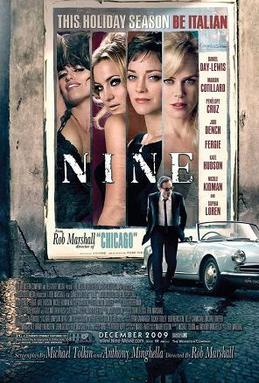 For New Years Eve, we caught Nine, which is a bunch of musical numbers set into a parodic parade of clichés about Italian men and Italian film. While I've never seen the original Fellini films that inspired the Broadway musical on which this film is based, Fellini is so seminal I feel as though I have. Who isn't familiar with the idea of the Italian man who adores his mother and loves his wife while loving other women on the side too, without seeing any problem with that, because, well, women are just so beautiful? I don't know how much of this actually was Fellini versus how much he invented his film persona, and how much La Dolce Vita inspired versus reflected a whole generation of Italian men. But it's that idea that is played with throughout this film, as the filmmaker-within-the-film, Guido Contini, wanders (both in his imagination and in real life) from one woman to another who has been significant in his life, each with their own musical number. At first, the film might seem to be idolizing Contini's status as a filmmaker of national heroic status, and excusing his treatment of the women in his life, but it soon becomes clear that Contini is a charicature of his own self-image, and as various minor characters gently impugn him, he starts to become aware of his own emptiness. Of course, it doesn't fully come clear to him until his wife leaves him. Who'd have thought that this Fellini-inspired film would turn out to be a subtle morality tale, quietly urging the superiority of conventional morals over La Dolce Vita. But that's all a soft-pedaled undercurrent, in what is otherwise a scaffolding of excuse for a series of musical numbers with great visual impact performed by a range of stars including Kate Hudson, Nicole Kidman, Penélope Cruz, Fergie, Marion Cotillard, Judi Densch, and Sophia Loren. The parodies are visual as well as thematic, with fun cliché shots of women in billowing dresses, Italian fountains, charming Italian moonlit streets, and it's a delight to watch as well as listen to all the numbers. There's also amusing homage to the cliché relationship of Italians to their Roman Catholic church, revering it while being faithless, kind of the same way they relate to their wives. Guido, at one point, goes to a bishop for guidance, and asks the bishop if he believes in God. At another point, a priest confesses that even though Contini's films are officially banned by the church as immoral, they all love them. The early ones, anyway. Contini's fans are always telling poor Guido how much they loved his early works. Daniel Day-Lewis gives a brilliant perfomance as Guido, showing once again how he just completely transforms himself into his characters. And the constellation of female co-stars surrounding him are all luminous. This parade of parody and numbers was a diverting way to welcome the new year.
 While everyone has been raving about the amazingly beautiful computer graphics of Avatar, we decided instead to see a smaller film of exquisite visual beauty that didn't require 3D glasses to appreciate. A Single Man, fashion designer Tom Ford's debut as a film director, is an intensely subjective and impressionistic film about a man contemplating suicide after the loss of his lover. The Christopher Isherwood novel that it was adapted from would not seem to lend itself easily to film, since nearly all of the action is internal. Externally, everything takes place in one apparently ordinary day: a man goes to work, teaches a class, goes to the bank, and has dinner with a friend. Internally, the man has all sorts of memories triggered, fits of imagination, and other wanderings of the mind as he contemplates his planned last day on earth. Tom Ford's designer eye vividly "makes it work", employing techniques, like extreme close-ups and enhanced sounds, more typical of music videos and perfume commercials, creating a sumptuously cinematic expression of this unlikely source material. The internality begins from the opening scene, of a man suspended or barely moving under water, which we soon learn is the main character's feeling of heartbreak and loss as sinking and drowning. I don't think I've seen as subjective a film since Bob Fosse's All That Jazz. When the man's attention is focused somewhere, the camera zooms in on it, and when the man's mind wanders, we follow it. The flashbacks give us enough brushstrokes to sketch the back story, but they are not lengthy excuses to shovel in some plot, they are very organic, the actual memories of the man on that day. They are very natural, the way that when you've lost someone, certain objects or experiences will prompt a memory of them. There's a very touching scene when he sees a dog in a car that is the same breed of dog that he and his lover had shared. He flashes back to a brief memory of his lover telling him about something funny the dog had done, while in the present moment trying not to get too emotional with this stranger's dog. Colin Firth is masterful in his performance as George, the bereaved English professor, showing outward British restraint while struggling with strong emotions inside, a brilliantly nuanced veneer of control with tears dangerously close to the surface. Julianne Moore also gives a great turn as his longtime friend and unrequited lover, and Nicholas Hoult is both haunting and tenderly charming in his role as a student who's attracted to George. But the real star here is the designer/director, who had a brilliant and beautiful vision for realizing this film, and whom, I suspect, executed it with the same meticulous attention to detail as seen in the main character, who neatly lays out the clothes he wants to be buried in and leaves a note instructing which knot should be used to tie his tie. Ford's visual symphony of subjectivity is enhanced by its sumptuous immersion in its place and time: Santa Monica, 1962. The property master for this film must have had quite a time finding all the period phones, clocks, hi-fis, cigarettes, and even the bottle of particular single malt whisky that George drank (North Port, which hasn't been made since 1983). Santa Monica 1962 was of course Isherwood's world, and we both noted that Don Bachardy, Isherwood's lifelong lover, was listed as a consultant in the credits. There were certainly glimmers of their real life in the story, and in the texture of this film, which I think Isherwood would have appreciated. An impressionistic film about suicide could easily veer into the maudlin, but Ford avoids that trap. Instead, the film inspires reflection on life with a clarity that reminded me of a Hemingway novel. Isherwood's story is thoughtful without being depressing, and Ford's carefully crafted view inside the main character's mind, combined with George's reserved personality, provides the right amount of detachment to keep it poignant but not ponderous, and ultimately a film of great beauty.
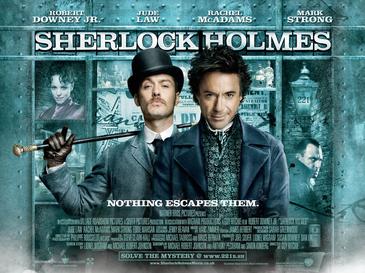 I thoroughly enjoyed the new Sherlock Holmes movie, which was a bit like a Victorian version of Indiana Jones. Some folks may sniff that this Holmes, who is as physically action-packed as James Bond, is not being true to the "real" Sherlock Holmes, but those folks are basing their vision of the deerstalker-capped cerebral detective on all the old films and not so much on the original Arthur Conan Doyle stories. I found Robert Downey Jr.'s realization of the character to be as genuine as it was mold-breaking. His portrayal of Holmes as a robust fighter, a savant with encyclopedic knowledge but sometimes thick social skills, master of disguise and diversion, and an occasionally reckless experimenter with all sorts of chemistry (including drugs), was all spot-on. And Jude Law made a great Doctor Watson, loyal friend, roommate, and partner in crime-fighting. This Watson was a bit smarter than the one in the books, but I think it made him more interesting, and the script's subplot of Watson becoming engaged to be married and moving out added an intriguing dimension to the relationship between Holmes and Watson. The main storyline was smartly conceived and action-packed, keeping you wondering how Holmes will crack this case. Some clues are presented along the way, but as with the original stories, while it's possible to guess at the denouement, you're never given enough to figure it all out yourself, you're only given enough to see how it all fits once the solution is presented. The plot is complicated by having a variety of players in addition to the main villain, including a cameo Professor Moriarty, and Holmes' great love and nemesis Irene Adler, smartly played by Rachel McAdams. Moriarty's goals are a lingering question until the end, and Irene Adler's motives and allegiances are intentionally and intriguingly ambiguous. The film nicely conveys the gritty feel of an industrial age late Victorian London, capturing the time and place. And director Guy Ritchie gives some tantalizing flashes of insight into Holmes' methods through "flash inwards", moments when the film jumps inside Holmes' head, and we see some past action that he has surmised from a clue, or we see some imminent action that he's anticipating. It's a creative cinematic technique that serves this film well. This was as much fun and almost as much action as a James Bond film. It leaves well-placed for a sequel if it does well, and that would be fine by me.
Good friends stand out in our best memories, having shared our happiest moments. Our best friends are those who were also there in less happy times, who stood by us with a strong shoulder when we needed support. But the greatest friends are those who planted seeds inside us, causing us to grow and blossom in new directions, not only enriching the quality of our lives, but altering their course. We are lucky who know even one or two such great friends in a lifetime, and I was so lucky to have known Dennis. He was my gay "big brother", my partner in the great Shakespeare quest, fellow traveler across three continents, my opera and classical music mentor, enthusiast of fine dining and cooking, fellow cyclist and snowboarder, rock solid shoulder to cry on when needed, the greatest friend and a huge part of who I am today.
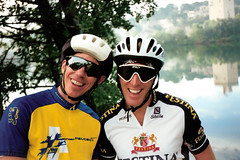 I first met Dennis on a sunny Sunday morning, Jan 6, 1991. He was the Vice President and Ride Coordinator for Different Spokes, a gay and lesbian bicycling club, and he was leading a 30-mile bike ride that day, the first of a series designed to get us in shape for the Solvang Century, a 100-mile ride in March. Denny's confidence and encouragement, not to mention his playful charm and dazzing smile, motivated me not only to do the whole series of rides, but to plunge into the bike club in a big way, eventually becoming an officer myself.
As we got to know each other, we quickly learned we had much more in common than cycling. I was enthralled by his wide-ranging and passionate interests, from cooking to music, from art to film to history. How often do you meet a friend who, when you say "Hey, they're doing an authentic staging of an ancient Greek tragedy outdoors at the Getty Villa", he says "Awesome! Let's go!". He was a consumate companion for a Shakespeare history play, because he knew his English history cold, and could fill me in on all the backstory of who's allied with whom because this one's grandfather got cheated by that one's uncle in the royal succession. And Denny's knowledge of music was vast and intense. I thought I knew classical music, but his contagious passion blew my mind open to whole new vistas, from opera to medieval chant, from Monteverdi to Shostakovich (not to mention jazz crooners and dance club mixes).
I learned so much from Dennis, and even when I was able to teach him new things, he would engage voraciously and take them to a whole new level. I taught him to snowboard, but he was the one who lead us into the snowboard park when Bear Mountain first put one in, and soon the two of us were hurtling ourselves off of ramps and into the air, alongside kids half our age. 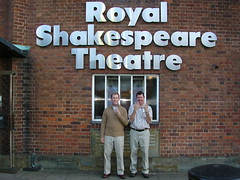 I took Dennis to his first Shakespeare play, but he was the one who came up with the idea of the quest. Standing on the steps of Royce Hall after we'd seen our second Shakespeare play, exhiliarated by the language, the drama, and the galvanic performance, I said, "So, you're really liking Shakespeare? We should see some more." Denny gave me an enthusiastic look, and said "Let's see them all! How many do you think there are? 20? 50? I'll find out. Let's make it a mission, a life quest!" So for the 14 years that followed, we sought out Shakespeare in theatres large and small around town, and even made trips to San Diego, Oregon, and New York to find the more obscure plays, until a few years ago when we made our triumphal pilgrimage to Stratford-upon-Avon to complete the quest.
 Denny had a genius for making things extraordinary. Anyone who's been to the Hollywood Bowl with him knows this. The pre-Bowl picnic was always an extravagant affair, and while lots of people bring picnics to the Bowl, the other picnickers would look on in awe as the tablecloth, the dinner service, the stemware, flowers, wine, and exquisite cuisine were spread out. And we had a number of decadent trips up to San Francisco to see the opera and dine at great restaurants. San Francisco is a dressier opera crowd than LA, so we often went up in black tie and tuxedos, which suited the classic beaux arts beauty of the SF Opera house. I remember one time we were flying up for a Friday night performance, and we were going to have to go straight to the opera from the airport, so we flew in our tuxes, and Denny was going to bring something to eat on the way up. I thought we'd just have sandwiches or something, but once we'd boarded (and this was before 9/11 of course), Denny pulls out his carry-on bag and, to the amazement of the flight attendants and surrounding passengers, starts unpacking cheese and pâté and caviar and wine. "Well, you didn't think we were going to eat peanuts, did you?"
 With Denny, even the ordinary could be extraordinary. I remember going over to his place one night for a "casual" dinner before I knew him really well. I thought maybe pasta or something. But I show up, and he's got prosciutto-wrapped melon for us to munch on, while I watch him pressing fresh sage leaves into veal medallions for saltimbocca, which he then flipped in the sautée pan with his signature flourish. Another casual evening, we had seen an afternoon movie in Westwood and were driving back to his place, when he says let's go catch the sunset at the beach. So we pull down to Santa Monica Beach, and watch what turned out to be one of the most spectacular sunsets either of us had ever seen, with red and orange and pink and gold, and I swear there was even a bit of green patina in it. And while we're sitting in his car, awestruck by this visual symphony, the most perfectly glorious music is playing, what sounds like choirs of angels singing in the perfect musical expression of this extraordinary sunset. After the sun went down, and we're driving back, I asked him "What was that music?" "Oh, you like it? That's John Rutter's Requiem. He writes some beautiful sacred choral music." So, not only an amazing sunset, but another expansion of my musical education. Just a casual Sunday with Dennis.
When we first met, I was just starting to venture out as a gay man, yet to have my first boyfriend, having no local gay friends, and making my first tentative forays into the gay community. As Dennis and I became friends, he took me under his wing like a gay "big brother", and held my hand as he introduced me to the world of West Hollywood, dance clubs, and circuit parties. I was intimidated by all the beautiful boys, never feeling like I belonged, but Denny was supremely self-confident and would plunge in anywhere. In a dance club, he immersed himself in the music, the lights, the freedom of motion, and the throbbing mass of bodies all moving to the same beat. His exhiliaration was contagious, and a bit of his confidence rubbed off on me when I was with him. Sometimes we'd dance together and other times we'd foray in independent directions. But like the great friend he was, he'd always give me a prod when I needed one -- "just go up to that guy!" -- and he'd just hang with me when I needed that. I felt secure knowing my loyal friend was always looking out for me.
 Denny was fearless. Not just in dance clubs or on the ski slopes, but throughout his life. When we were in France, he confidently drove our car along the windy corniche above Monaco, with its dangerous corners and steep cliffs. "Uh, Denny, aren't you worried, isn't this about where Princess Grace went off the road?" "Yeah, I think so, this is great!" He wasn't intimidated by Paris at rush hour either, even when we had to plunge into the notorious Place d'Etoile, a free-for-all where twelve major streets come together. He just grinned with delight as we went around it several times. When we were in Australia, he held my hand while gently laughing at me as I faced my fear of heights, first when we climbed the Sydney Harbor Bridge, along cables and catwalks over rushing cars and the harbor hundreds of feet below, and later when we rapelled down an 80' waterfall where the only way down the canyon was to grab a rope and step backwards over the edge of the falls.
 If I had to pick a single photo to represent our 18+ years of friendship, I know the one. It is Denny meeting me at the finish line of the AIDS Ride, pouring champagne over my head. I have just finished a 565-mile bike ride from San Francisco to Los Angeles, having raised over $3000 for AIDS care and services, a feat both physical and financial that a few years earlier I could not have imagined myself doing. I would not have ever done it without the seeds of change planted in my life by Denny -- the motivation to participate actively in the bike club, the inspiration for leadership in community organizations, and most of all the encouragement for reaching beyond my limits. So there he was, my faithful friend, cheering me on across the finish line, and playfully greeting me with a bottle of champagne, shaken up and sprayed all over me. I love his puckish grin in that photo, presiding over this moment of accomplishment, the fruition of seeds he planted, pouring champagne on my head, and pouring his benediction on my life.
Early on, I knew that Denny was a keeper. We'd talk sometimes about sitting together on the porch of some old folks home, looking back on a lifetime of friendship and adventure. We knew that we would be friends our whole lifetimes. I just thought it would be longer. We must remind ourselves, a life should be measured not by its length but by its depth. Every play we saw together, every castle explored, every bike ride through oak-studded California canyons, every ski run riding our boards like we were flying and dancing on the snow, every night spent dancing till dawn, every elaborate meal, and every extraordinary sunset with Dennis was a gift and a treasure. Dennis lived. He lived more life in his 54 years than many live in a much longer span.
They say you should end these things with a quote, and I would be remiss if I didn't read some Shakespeare. Denny read Shakespeare at my wedding, so I should read some Shakespeare here. In the final act of Hamlet, the prince is finally resolved to face his fate, and his loyal friend Horatio is giving him one last chance to change his mind. You don't have to face this, Horatio tells Hamlet, you can duck out the back, and I'll cover for you. But Hamlet says:
Not a whit, we defy augury: there's a special
providence in the fall of a sparrow. If it be now,
'tis not to come; if it be not to come, it will be
now; if it be not now, yet it will come: the
readiness is all: since no man has aught of what he
leaves, what is't to leave betimes?
So off Hamlet goes to meet his fate. A few flowery lines, a sword fight, and a bit of poison later, Hamlet, along with several others, are dying or dead. Hamlet asks his faithful friend to live on to tell his story, and then dies at his feet. Horatio says:
Now cracks a noble heart. Good night, sweet prince;
And flights of angels sing thee to thy rest.
 At the enthusiastic recommendation of neighbors, we decided to check out Parade at the Mark Taper. While the notion of a musical about a lynching doesn't sound very auspicious, it turns out to be surprisingly excellent theatre with some beautiful numbers in it. The story is lifted fairly intact from an actual historical incident in 1913 Atlanta, the drummed-up conviction of Leo Frank, a Jewish New Yorker factory boss, for the murder of a young teenage girl. The case proved to be a lightning rod for festering southern resentment of northern interference, bubbling out in vicious xenophobia. While the courtroom drama of a media-whipped, rumor-driven frame-up eventually unraveling provides the center of the story, much of the beauty of the musical comes from the development of the relationship between Leo Frank and his wife after he is imprisoned, when she proves her real mettle and he comes to realize how much he's taken his wife for granted. There are many memorable numbers: a charming early duet showing the young girl playfully holding a young suitor at bay ("The Picture Show"), a powerful ensemble number at her burial ("It Don't Make Sense"), the two testimonies of the dubious main witness ("That's What He Said"), and Leo and Lucille's "picnic" in his prison cell ("All the Wasted Time"). The cast was strong all around, lead by T.R. Knight as Leo Frank (who totally became his character and made me forget Gray's Anatomy for the evening) and Lara Pulver showing understated strength as his wife, and featuring a number of stage veterans -- Michael Berresse, Davis Gaines, Charlotte d'Amboise, David St. Louis, Christian Hoff, P.J. Griffith -- all masterfully handling multiple roles, and with young newcomers Curt Hansen and Rose Sezniak performing admirably with this strong cast. The choreography and stagecraft are wonderful, beautifully capturing the time, place, and spirit of the show. The parade of coached witnesses, and the enactment of some of the testimony and flashbacks were memorably visualized. The creative use of the simple set, augmented by a few furniture props and sliding panels in the stage floor, did a remarkable job of vividly conjuring a home, a courtroom, a street, a prison cell, a ballroom, a factory office, and a city street. This remarkable piece of theatre only ran for a couple of months when it opened on Broadway in 1998, but it also garnered a couple of Tony awards, and has since gained attention in revival, and last night, we could certainly see why.