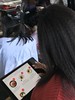
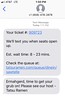
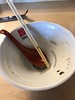
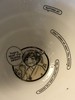
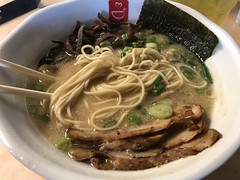
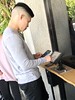
On a stretch of Sawtelle in West LA you can find dozens of Japanese restaurants with different specialties, one right next to another, up to six in a row in one strip mall. Of course there are places to get ramen. Today I tried the much-vaunted Tatsu. There was a line of people waiting, but this place processes people with Tokyo efficiency, starting with iPads on the sidewalk for automated self ordering, followed by text messaging to let you know when a table is available. I went for a bowl of “Old Skool” ramen, with slices of pork, woodear mushrooms, and green onions, all in a rich tonkotsu broth. The richness of the broth is a testament to the hours and hours that they boiled the pork bones. The noodles are thin but chewy and with a wheaty flavor, almost slightly undercooked, but that’s the traditional way it’s made in Fukuoka. I slurped up every last drop.
Friday, June 15, 2018
Friday, June 08, 2018
FOOD: Ostrich Farm
Lovely evening sharing a favorite new neighborhood restaurant
with a new friend. Ostrich Farm really showcases the wonderful produce we get at our
local farmers markets, along with a few things they grow in their own garden,
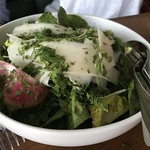
in fresh light preparations, doing much on the grill. The little gem salad is
crisp and fresh, with small shavings of fennel, large shavings of pecorino, thinly
sliced watermelon radishes for color and spice, and bits of fresh dill, lightly
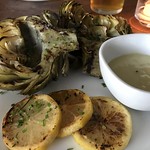
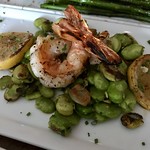
dressed. Artichokes are grilled with preserved lemon. Grilled prawns are served
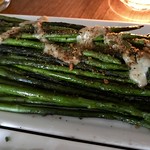
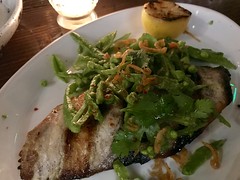
on a generous heap of fava beans. Long thin asparagus is lightly grilled,
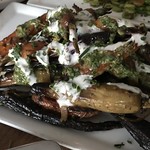
topped with panko gremolata and capers. Deeply roasted carrots are topped with
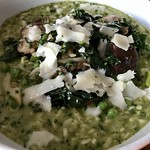
labneh and a pesto made from the carrot tops. A spring risotto is generously
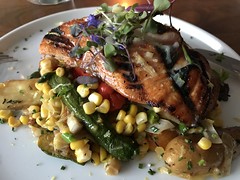
filled with chopped vegetables. And the Pacific salmon with its satisfying hearty
grill marks is served on a spring succotash of corn, zucchini, and red pepper. In
one departure from current trends, the portions here are rather generous. The “plates”
are almost too much for one person, and even the “small plates” give plenty to
share. So it’s good to bring a friend or two. For dessert we just shared the Eton
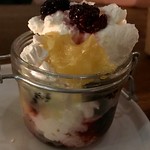
mess, a jar filled with blackberries, lemon curd, chunks of baked meringue, and
whipped cream.
Labels:
food
Saturday, June 02, 2018
FILM: RBG
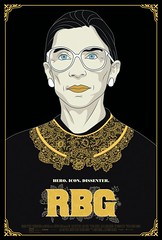
We really enjoyed RBG, a documentary about a national treasure and an inspirational life. Her pioneering experiences as one of the early women admitted to Harvard Law, her career with the ACLU Women’s Rights Project, her incredibly supportive mensch of a husband, her acing law school at the same time as being a new mother and taking care of a husband battling cancer. I mean wow, she is so amazing!
Saturday, May 26, 2018
FOOD: 71Above
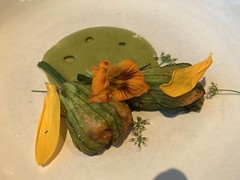
We have a fun Christmas tradition with our friends Chris and Carol where we gift each other with a fabulous dinner sometime in the next year. This means we get a good excuse to spend time together, to enjoy great dining, and celebrate Christmas several times a year. Win win win. Last night, we enjoyed such a “Christmas dinner” at 71Above – the stylish space with exquisite food and breathtaking views from the top of the US Bank Tower (the highest if not officially the tallest tower on the LA skyline). This was a great addition to the upper-end DTLA scene when it opened nearly two years ago. Chef Vartan Abgaryan (formerly at Cliff’s Edge) makes creative modernist takes on local ingredients, symphonies of flavor plated like works of art. We started with bubbly rose and an amuse bouche of three colorful and creative bites, including cucumber with sumac and passionfruit, and a lipstick radish with a dollop of soft cheese and ground pistachio. The hearty crusty wheat bread was warm and delicious, always a good harbinger. Our windowside table, looking east and north, overlooked downtown, the lights of Dodger Stadium, and the vast city stretching out in the distance. We started around 7pm, so enjoyed the last soft patches of sunlight and then watched the city transform into a jewel box nightscape as the evening went on. The menu is a prix fixe three-course dinner. Of course with four of us, we could share bites of different things. Our first courses included a fine gazpacho with thin slices of sour plum and cucumber; squash blossoms stuffed with rice, peanuts, and charred scallions with poblano chile and coriander; and oysters poached in champagne with fresh uni, caviar, and a tarragon leaf. Our second courses included a risotto with arugula, nettles, and preserved lemon, dramatically presented with sunflower petals around a center of ground olives; asparagus in black garlic honey and pea puree, with snap peas and pea tendrils; an almost dessert-like fois gras on brioche with macadamia, cocoa nibs, blueberry, and tarragon; and a handkerchief pasta with golden beets, goat cheese, and a pistachio pesto. Our third courses included spring lamb rack, loin, and croquette made from other lamb cuts with red walnuts and raisins; New York steak with a celery root bone marrow puree and onion jus; diver scallops with white asparagus and shaved fennel. Desserts included a coconut custard with tapioca pearls, puffed sweet basil rice, toasted coconut, young soft coconut meat, and matcha sorbet (like a modernist take on buko pie); a pistachio paste with pistachio sorbet and a colorful circus tent of white chocolate, cassis, and lemon cremeaux; and a caramel milk chocolate structure with a Sydney Opera House of hazelnut brittle, butterscotch shortbread, cocoa meringue, and brown butter hazelnut ice cream. In all, a fantastic evening of great food and great company. (See complete set of food pics here.)
Friday, May 25, 2018
FOOD: Manuela
Wonderful dinner downtown catching up with some old friends. We met at Manuela, a restaurant typifying the explosion of creative energy that is the DTLA Arts District. An old grain mill taking up an entire city block has been transformed into a Hauser & Wirth Gallery complex, with Manuela as a restaurant opening onto a central open courtyard. One side of the courtyard has been planted as the herb and vegetable garden for the restaurant, and the home for the chickens to provide fresh eggs. The old brick walls of the inside of the restaurant provide an organic extension of the art gallery to showcase rotating art displays. The food is Los Angeles farm- and dock-to-table, but with a Southern accent. Having just met the chickens, the deviled eggs are a must to start, yolks whipped with buttermilk and dill with a dash of red pepper on top. A cucumber sour cocktail (Hendricks gin, cucumber, parsley, egg white) was just the right note to toast Memorial Day weekend. “Barbecued” oysters were cooked just barely enough to melt the light dusting of Parmesan breadcrumbs while the oysters still tasted fresh and briny. Arugula with goat cheese and spiced pecans made a bed for the early peaches and cherries that are already in the market. Hot, light-as-air flaky cream biscuits, served on a board with mandoline-thin slices of country ham (like Virginia lardo), and honey butter, all together melting on the tongue with divine lightness. Most dishes here are quite conducive to sharing, so fortunately with four of us, we could get a good selection of the many great offerings. Local yellowtail was perfectly grilled with the tasty char of grill lines on the skin, served with tender young snap peas, green garlic, and shallots. A Peads & Barnett pork collar was beautifully charred on the outside and tender inside, rubbed with caramelized shallots, large-grain mustard, and a bit of rosemary. Diver scallops were butter-browned to light crispness on the outside, served atop grits with hen-of-the-woods mushrooms and little chunks of bacon. Roasted cauliflower was lightly sweetened and brightened with date vinegar and almonds. As the menu says, “you ain’t done yet”. For dessert, a rich chocolate torte came with popcorn ice cream and popcorn (cause who doesn’t like sweet and salty), and some light-as-air churritos came with a dulce de leche dipping sauce. Wonderful food, wonderful company, wonderful way to start the holiday weekend. (See complete set of food pics here.)
Jaffa, Kenneth Hahn Park Views, and Marilyn Sanders' Fierce Flowers
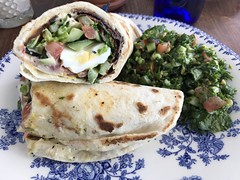
“Modern Israeli” is the latest flavor to hit the LA
restaurant scene, and Jaffa on 3rd St is a prime new example. If you
get to Jaffa early, as I did, you might have to wait a few extra minutes for
the lavosh to finish baking, but you’ll be glad you did. The fresh-baked
flatbread – warm, spongy, with browned spots, and good bready flavor – makes a
perfect wrap for the cornucopia of Israeli flavors, generally including a base
of Israeli salad (chopped greens, cucumbers, tomatoes, red onion), tahini
(sesame purée), zhug (a Yemenite condiment of hot peppers ground up with
coriander), and pickles. I tried the “sabich” which featured thinly sliced and
crisped eggplant, hard-boiled egg, hummus, and mango amba (a middle-Eastern savory
chutney). It had a nice fresh crunch against the soft bread, with different
bits of the complex flavors popping up in different bites. The accompanying
taboulleh was a very fresh tasting variety of finely chopped greens with bulgur
wheat in a citrus and light oil dressing. Oh, and that Jaffa shake! Made with
almond milk and tahini (maybe with bits of halveh?) and dates, with a drizzle
of date syrup on top. The space is lovely too. (I wish I’d taken a picture before
it got busy and it felt invasive to get a good scene shot.) There’s a covered
sidewalk patio area, but even the inside is largely opened up, with two
oversize windows with opened shutters and tables creatively built into the
sill, so that some people are literally sitting in the window. The décor palate
is mostly light/white and wood, with bold blue water glasses on every table and
blue bottles here and there adding a nice color pop, and fun blue and white
irregularly shaped dishes.
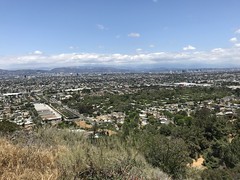
After lunch, I went to check out the Kenneth Hahn Park, atop
the Baldwin Hills, where I’d heard they have great views over the whole LA
basin. It seemed a lovely day for it, with just enough clouds to be scenic but
not obscure the views. Indeed it was a rewarding vista easily earned with a
short hike. While I didn’t find a complete 360-degree spot, I did find one spot
I could stand and take in at least 270 degrees, from Palos Verdes due south all
across the Santa Monica Bay to the west, the Hollywood Hills to the north and
around to the downtown LA skyline. It is amazing what you can see. Need to get
back here with my real camera, as the iPhone doesn’t do it justice. I could see
much of Catalina Island beyond Palos Verdes, and not just in silhouette. I
could see the distinctive Googie “theme restaurant” at LAX, and watch planes
landing and taking off. I could see the entire bay out to Point Dume. It is a
marvelous vista of this vast and vibrant city.
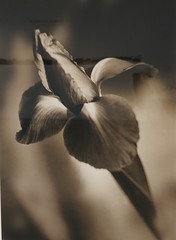
Descending from the park, I headed to the Fabrik Projects
gallery on La Cienega, to see a Marilyn Sanders photography exhibit called The Ferocity of Flowers. The flowers in these striking photos are very
recognizable, yet she makes you see them in new ways. Normally, color is one’s
dominant impression of flowers, but these photos are all sepia tone or silver
gelatin prints. Without color, one is drawn instead to contemplate their shape
and structure, and the way that light plays on them. On many of these, the play
of light is fascinating, as it is sometimes direct, sometimes reflected,
sometimes backlit translucence, or all of those interacting at once. Translucence
and reflection illuminate shape and structure in unexpected ways. The other
thing that makes these photos intriguing is the scale. She gets very close,
closer even than the usual flower macro shot, creating an intimacy and an
altered sense of proportion. Some of those pistils and stamens looked like
something I could reach out and dance with. Some of the petals looked
like a surface I could imagine sliding on or climbing. In one shot of lilies, a
light source from behind creates a thin glow along the edge of the petal, the
way one might see the first glow of dawn breaking over giant sand dunes in the
Sahara. I wanted to ascend it. Beautiful and fascinating.
See the complete set of photos from this day here.
Friday, May 18, 2018
Dumplings, Highland Park, and Beyond The Streets
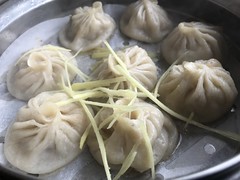
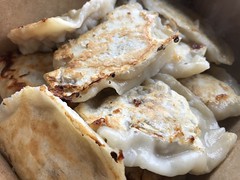
Today’s off-Friday exploration began at Mason’s Dumpling Shop, a new arrival in the increasingly happening Highland Park. These dumplings did not disappoint. The snow crab and pork soup dumplings had a delicate flavor that balanced both meats. The trick to soup dumplings, I learned today, is that the stock is chilled into a gelatinous aspic so it can be rolled up into a dumpling, and then the flavorful gel turns to soup when the dumpling is steamed. It is a test of chopstick skill to pick up the dumplings without piercing them and letting the soup spill out. Less delicate but even more flavorful were the pan-fried pork dumplings, spicy meat filling and the wrapper pleasingly browned and slightly crispy. I also had a seaweed salad with chili garlic dressing just to have a bit of green to go with my dough-and-meat fest.
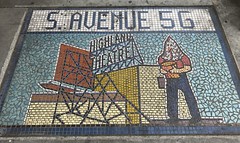
After lunch, I took a walk along Figueroa, one of the two main streets of Highland Park. This neighborhood is reminding me of what Echo Park felt like 10 or 15 years ago. There’s a layered history of a part of town once fashionable, falling out, and starting to rise again. Liquor stores and pawn shops are starting to be replaced by hot new foodie spots, trendy coffee, record stores, barber shops, and even one combo record store / barber shop. Abandoned once-grand buildings that lined this stretch of the classic Route 66 are getting new life. Some classics, like the Highland Theatre, are alive again, and some of the Route 66 era kitsch, like a giant plaster “Chicken Boy” can still be seen. Just recently, the sidewalks were graced with a series of 14 tile mosaic murals depicting historic scenes of Highland Park, including the original Tongva indigenous people, the Rancho San Rafael land grant, the Ebell Club, and the Judson Studio (famous for its stained glass). There’s even one of the Highland Theater and Chicken Boy. Wanting a warm drink on this “May gray” day, I almost stopped into a hipster coffee house, but then a sign in Spanish on an older generation establishment caught my eye advertising atol de elote, a warm Guatemalan drink made from ground corn and sweetened milk. That hit the spot.
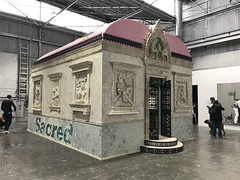
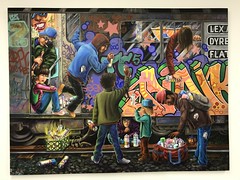
This survey of street art was a perfect prelude to my afternoon destination, an art exhibition called “Beyond The Streets”, just a couple miles down the arroyo in the industrial no-man’s land between Chinatown and Lincoln Heights. If you want to do an ambitious art installation that requires large sprawling spaces, a warehouse in this part of town seems to be the go-to spot. This provocative and at times immersive exhibit is all about street art and graffiti, including photographers who have chronicled street art, pop art inspired by graffiti, artists who grew up spray-painting walls and subway cars before moving to canvas and galleries, and even some actual graffiti. Parts of the show document “famous” graffiti and celebrate the anti-establishment attitude of the artists in a way that’s probably intentionally troubling to people like me who appreciate the artistry while also appreciating that there is a line where it crosses into vandalism. (Ironically, when you enter this exhibit, you are asked to explicitly state that you do not intend to damage or add to the art in any way, and you’re not allowed to bring in your own spray paint.) If you have any appreciation for pop art, you would enjoy this show, and some of the installations are truly impressive. Lee Quiñones, who became notorious for painting murals on schools and handball courts around New York City, has recreated one of his handball courts here, life size, and you’re free to play handball on it if you like. Several of the exhibits you can completely enter into, including a “gangsta garden”, an ironic version of a barrio strip mall church, a “temple” that reinterprets classic European sacred spaces, and recreation of the Venice Beach skateboarding pavilion that you’re welcome to skate on. Some exhibits were massive, such as a 30+ foot high wall that formed a large half circle, completely and intricately painted. Many were quite eye-popping, some amusing, some a bit challenging. I ended up spending three hours wandering this vast sprawling exhibition. It’s on through July 6, and then it heads to New York. Check it out! (See complete photo album here.)
Saturday, May 05, 2018
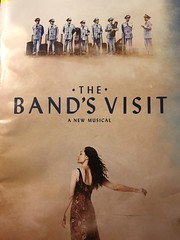
STAGE: The Band's Visit
Saw another wonderful musical this evening, The Band’s Visit, along a similar theme to yesterday’s show, of a small town unexpectedly hosting foreign visitors. In this case, an Egyptian police orchestra heading for an Israeli cultural exchange program ends up in the wrong town, and spends the night. It’s an inventive excuse for some great Arab music, charming vignettes of characters in a remote town, and sultry songs.
Friday, May 04, 2018
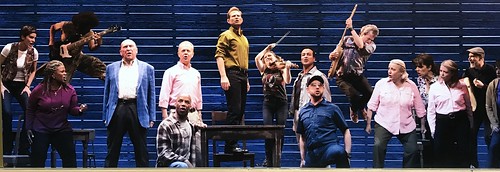
STAGE: Come From Away
Another fantastic musical this evening, Come From Away. In the immediate aftermath of 9/11, dozens of airplanes were diverted to the small town of Gander, Newfoundland, a remote part of Canada, where a town of 7000 people unexpectedly hosted thousands of confused passengers for several days before US airspace was reopened. This moving and charming musical tells that story, as a great ensemble of a dozen actors plays several dozen roles. Who knew such a heartfelt evening of theatre, and such a heartwarming tale of hospitality could come from the world’s worst air travel experience. After the show hanging out at the stage door to greet the actors, we met a couple who traveled from Newfoundland to see this show. They were getting the cast to autograph a Newfoundland flag. Such nice people, just like in the show!
Thursday, May 03, 2018
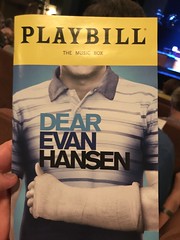
STAGE: Dear Evan Hansen
This evening we saw Dear Evan Hansen, the winner of last year’s Tony for Best Musical and five other Tony awards. The award-winning lead actor was recently replaced by Taylor Trensch, who we’d seen in The Curious Incident of the Dog in the Nighttime. Don’t know what that other guy was like, but the new guy is outstanding. What a great show, very moving, an original gripping story, and great performances all around. Of course we hung out at the stage door to greet the stars.
(Update 10/2018: We loved this show so much we saw it again when it came to LA.)
Saturday, April 28, 2018
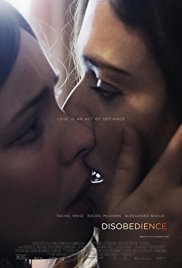
FILM: Disobedience
Some great performances from Rachel Weisz and Rachel McAdams, and an interesting situation: the daughter of a beloved orthodox rabbi, broken away from the community after a youthful lesbian affair, returns for her father's funeral. I found it interesting, though not completely satisfying in the end. I did like that the portrayal of the orthodox characters wasn't completely monochromatic heavies. But I wasn't sure what the principal characters really wanted, or why they made some of the choices they made, or what really happened in the end. The film began and ended with a rabbi pondering man's unique gift and responsibility of freedom, suggesting that the film had a point to make about that, but if it did, I left unsure what the point was. And perhaps in keeping with Jewish tradition, it's more about the questions than the answers.
Friday, April 27, 2018
ART: LACMA: Hockney Portraits, Teotihuacan, Young Il Ahn, and the Coronation Carpet
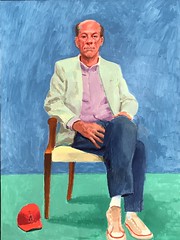
There’s a trove of things going on at LACMA. The Hockney show “82 Portraits and 1 Still Life” is fascinating and distinctively colorful. The artist did this series of portraits over a couple of years, inviting a variety of people to sit for him, ranging from big names in the art world to the artist’s dentist, his housekeeper, and her daughter, subjects ranging in age from 8 to 80s. Each subject sat in the same chair in the same setting for three days for Hockey to capture what he playfully called a “20-hour exposure”. The result makes you really appreciate the portraits, what is unique about each, and how personality is expressed in the face, the hands, the way each one sits in the chair. The colors are all Hockney’s signature vibrant colors.
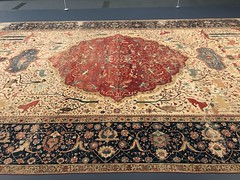
Then walk across from BCAM to the Resnick Pavilion and step back 500 years to see a palatial Persian carpet from the early 1500s when Persian carpets really started to become a national industry. This particular carpet features a central medallion in red, a field of cream richly decorated with trees, vine, and animals, corner scenes on red, and an ornate deep blue border. This particular carpet is called the Coronation Carpet, as it was used in front of the throne at the coronation of King Edward VII of Britain.
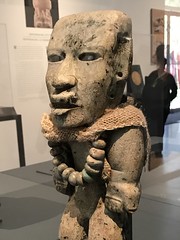
Then step into the next series of rooms and back another 100 years or more to see “City and Cosmos: The Arts of Teotihuacan”. This fascinating exhibition presents a large collection of artifacts from the ancient Mesoamerican city of Teotihuacan, which flourished in the first few centuries CE, a thriving cosmopolitan city of 125,000 people at its height. The city was divided into districts dedicated to different gods and with different types of crafts. The exhibit is similarly arranged, to show the different artifacts in proximity which part of the city they were found in. I was quite taken with the expressive statues and masks, ceramics and stoneware, and the murals, many of which are surprisingly vivid even today. Their colors were mixed into plaster in way that allowed the colors to endure, and apparently the city was brightly colored with a lot of murals.
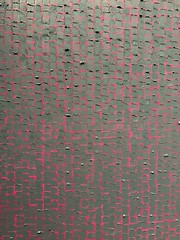
Over in the Hammer Building, I flashed back to the present time, with a showing of Korean-American abstract artist Young Il Ahn. His “Water” series plays on a theme of “unexpected light”, with a very large panels of what appear to be monochrome colors from a distance, but on approaching, appear to crack, and an underlying color of unexpected light breaks through. The hidden colors have such a luminous quality that the paintings almost appear to be backlit, and it is surprising to see the previously unseen colors emerge as you get closer. It reminded me of being on Hawaii and seeing a lava flow at dusk, dark volcanic rock with an eerie orange light glowing through the cracks from below.
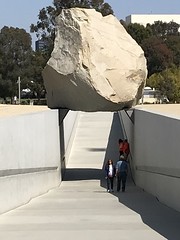
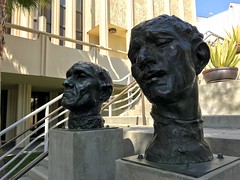
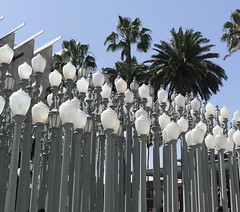
And of course I had to visit all my perennial favorites: Chris Burden’s “Metropolis” (the most amazing track for Matchbox cars ever) and “Urban Light” (the most Instagramable collection of lampposts) , Tony Smith’s “Smoke”, Michael Heizer’s “Levitated Mass” (the giant boulder suspended overhead), and the Cantor Sculpture Garden full of Rodin and Bourdelle sculptures.
Then walk across from BCAM to the Resnick Pavilion and step back 500 years to see a palatial Persian carpet from the early 1500s when Persian carpets really started to become a national industry. This particular carpet features a central medallion in red, a field of cream richly decorated with trees, vine, and animals, corner scenes on red, and an ornate deep blue border. This particular carpet is called the Coronation Carpet, as it was used in front of the throne at the coronation of King Edward VII of Britain.
Then step into the next series of rooms and back another 100 years or more to see “City and Cosmos: The Arts of Teotihuacan”. This fascinating exhibition presents a large collection of artifacts from the ancient Mesoamerican city of Teotihuacan, which flourished in the first few centuries CE, a thriving cosmopolitan city of 125,000 people at its height. The city was divided into districts dedicated to different gods and with different types of crafts. The exhibit is similarly arranged, to show the different artifacts in proximity which part of the city they were found in. I was quite taken with the expressive statues and masks, ceramics and stoneware, and the murals, many of which are surprisingly vivid even today. Their colors were mixed into plaster in way that allowed the colors to endure, and apparently the city was brightly colored with a lot of murals.
Over in the Hammer Building, I flashed back to the present time, with a showing of Korean-American abstract artist Young Il Ahn. His “Water” series plays on a theme of “unexpected light”, with a very large panels of what appear to be monochrome colors from a distance, but on approaching, appear to crack, and an underlying color of unexpected light breaks through. The hidden colors have such a luminous quality that the paintings almost appear to be backlit, and it is surprising to see the previously unseen colors emerge as you get closer. It reminded me of being on Hawaii and seeing a lava flow at dusk, dark volcanic rock with an eerie orange light glowing through the cracks from below.
And of course I had to visit all my perennial favorites: Chris Burden’s “Metropolis” (the most amazing track for Matchbox cars ever) and “Urban Light” (the most Instagramable collection of lampposts) , Tony Smith’s “Smoke”, Michael Heizer’s “Levitated Mass” (the giant boulder suspended overhead), and the Cantor Sculpture Garden full of Rodin and Bourdelle sculptures.
Labels:
art
Saturday, April 21, 2018
FILM: Isle Of Dogs
Wes Anderson is always so creative and this latest film was no exception. Wonderfully original and completely off-the-wall story, gorgeous animation, great voice characterizations from the troupe of talented actors who follow Anderson wherever his inventive mind leads. Thoroughly enjoyed every minute.
Friday, April 13, 2018
BOOKS: Born A Crime
South Africa, both under apartheid and after it, is such a different place to anything I have experienced, making Trevor Noah’s autobiographical “Born A Crime” such a fascinating book. Even for South Africans, Noah’s perspective is rather unique. His title “Born A Crime” comes from the fact he was born of a white father and a black mother, which violated anti-miscegenation laws still active on the books at the time he was born. My eyes were opened to so much about South African society. I hadn’t understood and appreciated how blacks are so divided by tribes with distinct languages (a situation ingeniously and insidiously exploited by the apartheid system to discourage blacks coming together), nor how people were divided not only black and white, but also an intermediate category called “colored”, which included people of mixed ancestry, Indians, and other arbitrary distinctions (for example, Japanese people were officially “white” while Chinese people were officially “colored”). Noah was raised by his mother, an extraordinarily strong and independent woman who was pushing boundaries even before apartheid was abolished. She taught him English and Afrikaans as well as several tribal languages, sent him to private schools, and gave him a window on many parts of society, living at times in a black township or middle-class neighborhoods, attending white churches. His mixed-race status, many languages, and varied experiences made him someone who could fit in anywhere but belong nowhere. He thus grew up developing keen insight into the complex society around him as can only be gained by someone who is “insider” enough to understand and sympathize but also “outsider” enough to make objective appraisals. His stories are packed with humor, understanding, insight, and at times a challenge to see the world a different way. In one story, he thoughtfully unpacks why among South African blacks the name “Hitler” doesn’t have anything like the infinitely negative charge we assume should be universal, and how that lead to a colossal misunderstanding with a black dance troupe performing at a Jewish school hosting a multicultural diversity festival. Through other stories, he explains life in the township and life in what we would call “the ‘hood”, and why they may think about crime a bit differently than you do. Other stories are just generally human, experiences growing up in various schools trying to fit in, getting a date for the prom, and so on, all told with great charm and humor. And his keen insight is also brought to bear on abuse and alcoholism, in stories of how his step-father abused his mother. This is a fantastic book, and it is even better as an audiobook, since it is read by the author. He has the gift of writing the way he talks, which since he is a comedian (and now the host of the Daily Show) is quite engaging. Hearing him do all the voices, the dialects, and even occasionally the languages (including those Xhosa clicks) as he tells his stories brings them even more to life in vivid color.
Saturday, April 07, 2018
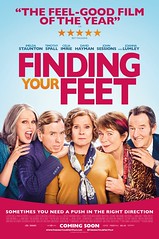
FILM: Finding Your Feet
Yes, it's fun. Go in expecting nothing more than simple enjoyment, don't examine it too closely, and let these superb actors enlivening a work-the-stops script play you like a violin, and you'll leave happy.
Saturday, March 24, 2018
BOOKS: Behind The Beautiful Forevers
In Behind The Beautiful Forevers, author Katherine Boo renders a fascinating slice of, as her subtitle has it, “life, death, and hope in a Mumbai undercity”. The slum called Annawadi lies on a patch of empty land between the Mumbai International Airport and a row of gleaming high-end airport hotels, a crowded community of people struggling to stay alive and perhaps get just a little bit ahead, living precariously in improvised shacks on land they have no legal claim to, which could be bulldozed at any time. In this community lies a rich tapestry of dreams, schemes, motivations, crushing circumstances, corruption, prejudice, envy, and surprising wellsprings of hope and perseverance. This is a work of narrative non-fiction. It is non-fiction in that all of the characters are real people, using their real names, and the incidents described are real. The author spent years visiting, interviewing, getting to know, and following a number of people over many years. She witnessed some events herself, gathered other events from interviews, cross-checked, and verified where possible with public records, with a journalistic diligence. Boo’s descriptions of the characters and their circumstances are vivid, and she skillfully weaves them into an engaging narrative by using a pivotal event – a woman who sets herself on fire, with lasting repercussions on several families – as a through line to propel a sense of story. I was rapt in the stories of these people, their lives so foreign to my own experience, and appalled at some of the things they suffer. I think what I found most unexpected was how much these people who have so little are regular targets of extortion by corrupt police, corrupt doctors, and corrupt teachers. Many of them work hard at what they can, a few actually claw their way ahead, but all are so buffeted by larger random circumstances that any connection between hard work and getting ahead is quite tenuous. Larger events, like the construction of the airport, the 2008 Mumbai terrorist attacks, and the 2008 Great Recession in America, all had their ripples in this fragile slum. A century ago, Sholem Aleichem vividly described the struggles of Jewish life in 19th century Russian shtetls (tales which inspired Fiddler on the Roof). Boo brings that same kind of sensitivity to precarious lives in tenuous tenements, combined with the accuracy of a journalist, in painting this portrait of Annawadi and its inhabitants.
Saturday, March 17, 2018
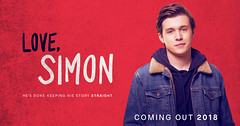
FILM: Love, Simon
We thoroughly enjoyed Love, Simon, a sweet coming-out romantic comedy that just “came out” this weekend. Those of my generation will remember John Hughes films, and how he so poignantly captures the characters and the drama of high school, all the angst and awkwardness of figuring out who you are and finding your place in the teenage world. Director Greg Berlanti captures that same kind of authenticity in this Sixteen Candles meets You’ve Got Mail with a gay coming out twist. It’s especially heartwarming to see coming out films like this, so different from the coming out films of when I was coming out. Back in my day, coming out itself was the drama. In this film, I think it’s fair to say that it’s a regular teenage rom com, where coming out just makes for an inventive new plot device that drives the inevitable complications of a good rom com. He has a great family, great friends, and a school where the teachers and the administrators all do the right thing when some students behave poorly. Granted not everybody has that even today, but supportive parents, friends, and schools are not nearly the unicorns they were when I was coming out 35 years ago. When Greg Berlanti directed The Broken Hearts Club back in 2000, that was mostly an art house film appreciated by mostly gay audiences. Now in 2017, most of our gay friends who watched Love, Simon reported cinemas filled with teenage girls. And this film was noted as the first major studio release focusing on teen gay romance. One reviewer used the phrase “revolutionary normalcy” in describing the film, and I think that really hits it. In the context of the progress of gay acceptance, it does feel surprisingly revolutionary in its just being a sweet, light, enjoyable, mainstream rom com that happens to have a gay lead, with mainstream audiences all cheering him on. After all these many years of visibility, I didn’t think we had new breakthroughs yet to be had, until I saw this, and it was like “Oh! This! Yeah, we haven’t actually seen this before.” It just seems to be a moment of this new level of mainstream visibility between Call Me By Your Name and Love, Simon. And I got the same feeling from Romil and Jugal, a charming Bollywood web series with a revolutionary-normal coming out romance. There’s a line in the film where Simon’s Mom says she didn’t know that he was gay, but she knew that he had something heavy on his mind, “It seems like you’ve been holding your breath for years. Now you finally get to exhale.” Sometimes you don’t realize how long you’ve been holding your breath until you exhale. And this film is such fresh air.
Friday, March 09, 2018
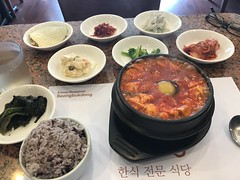
ExploreLA: Korean Tofu Soup and the Marciano Art Foundation
More off-Friday explorations of Koreatown, today at SeongBukDong. This bubbling cauldron is yachae soondubu, soft tofu soup with veggies, 🌶 🌶, and an egg for richness. Served with a lovely array of banchan (little dishes of pickled turnips, cabbage, greens, and other veggies). The spice-heat is selectable, and I braved “medium” which I enjoyed with some tears and sweat. I was the only non-Korean in the place - love that.
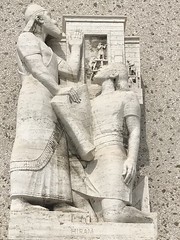
After lunch in Koreatown, today’s off-Friday adventure took me to check out the new Marciano Art Foundation on Wilshire. Maurice and Paul Marciano, the brothers who founded the Guess clothing business, were avid supporters of the contemporary art scene in Los Angeles, and wanted to share their collection with the public. They bought the old Scottish Rite Masonic Temple on Wilshire, which was basically abandoned since 1994, and have repurposed it as a modern art museum while preserving features of the historic building. Before going inside, I wandered around the outside of the building, a mostly windowless giant travertine box adorned with enough mysterious Masonic symbology to inspire Dan Brown’s next Robert Langdon novel. A series of monumental travertine sculptures depict a curiously diverse set of figures including Imhotep, Zerubabel, Hiram, the “Saints John”, someone “de Reims”, Christopher Wren, and George Washington. A giant mosaic mural depicts the history of temple building, with an equally curious selection of cities starting with Jerusalem, Babylon, Acre, and Rome, and ending with Boston and Sacramento. (Sacramento? Apparently the first Grand Lodge in California was established there in 1850.) The building was constructed in 1961, designed by artist and architect (and Mason) Millard Sheets, who was famous for his mosaic murals including many Home Savings bank buildings throughout southern California.
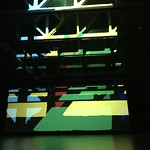
Inside the building, the many large spaces of the old temple have been nicely repurposed for display of the Marcianos’ collection and other exhibitions, many of which are quite large and need this kind of space. On the first floor, the cavernous hall that used to be the theater has been given over to a special exhibition called Reality Projector. Artist Olafur Eliasson designed this dynamic work specifically for this space. The vast three-story hall is empty like a warehouse, with concrete floors and exposed steel rafters, and is dark when you enter, illuminated only by the projection of abstract shapes in primary colors on the far wall. The shapes slowly move across the wall, intersecting each other in a way that gives depth in the sense that some shapes seem to be in front of or behind others, and the shapes are transiently obscured by large moving shadows. The projected light intentionally hits the exposed rafters as well, using them as a fragmented, layered screen. You’re invited to sit on a bench in the back of the room, or wander into the middle, or just drop down on the concrete and sit or lie down and watch this oddly fascinating light show pass by, like clouds on a windy day, if the clouds were painted by Ellsworth Kelly or Piet Mondrian. All of this is accompanied by a soundtrack of indistinct ambient noises and sounds. The combinations of shapes and colors seemed random and non-repeating, and I actually stayed in there a fair while, and revisited later on an upper mezzanine overlook.
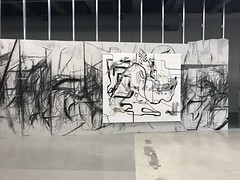
On the second floor is another special exhibition called “Line Packers”, featuring the work of two German artists, Peppi Botrop (1986-) and Albert Oehlen (1954-). Botrop, who hails from the Ruhr region of Germany (picture an old coal and steel industrial area, something like the German equivalent of Allentown, Pennsylvania), made a series of works alluding to those roots, using large slabs of Fermacell (an industrial material used like sheetrock in institutional buildings), charcoal to make dark visceral lines, and then carving and scraping the sheetrock. Oehlen, beginning in 1992, created a series of works exploring the possibilities of computer drawing, with sheets of black on white graphics printed from a Texas Instruments computer, lightly enhanced with black paint. Multi-artist exhibitions will often talk about the “dialog” between works of different artists exhibited adjacent to each other. But here, they’ve done something I’d never seen before: they created an actual mash-up of these two artists’ works, displaying them on top of each other, in a way that invites not only comparison but a contemplation of relationship and visual continuity between these two artists of different generations.
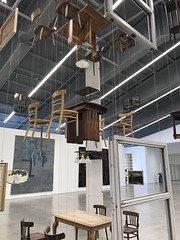
On the third floor is the permanent collection of the Marciano Foundation, mostly paintings with a few sculptures, with a large well-lit space suiting the large scale of most of the works. Many of the works are quite abstract, explorations of texture as much as color and shape. One artist, Jennifer Guidi, has a series made of paint mixed with sand that she could layer on the canvas thickly, and then poke, scrape, and mound up in interesting ways. The sort of works that you want to regard from a distance for their visual impression, and then look at up close and from the side to admire the technique. Then there are other works that are a bit more representational, or at least symbolic. Two giant works by Lari Pittman are filled with bold colors and a fascinating medley of recognizable forms and really good Rorschach tests that made me want to figure out what all is going on in them. Another large mural by George Condo seems at first just to be a bunch of lines, until as you look, more and more organic shapes – eyes, teeth, arms, coats and ties – begin to emerge from the apparent chaos. Perhaps my favorite work was a large sculpture in the center of the large main gallery that was essentially a bunch of furniture and home goods suspended in air by wires. The playful Architecture Without Architects by Damián Ortega is like a CAT scan of a multistory apartment building. Imagine three apartments, one above the other, with all of the walls, floors, and ceilings removed, but all of the furniture, lights, and stuff magically floating in place. Doors float without their door frames, with doormats floating in front of them, and perhaps a pair of shoes on a mat. Paintings float as if hung on invisible walls. Flowers in vases, glasses of water, and cigarettes in ashtrays rest on tables floating in space. I found it amusing and fascinating.
The mezzanine, between the ground and “second” floor, is also worth a stop. That’s where I found the balcony overlook for a second look with a new perspective at the Reality Projector light show. There’s also a fun mural along all four sides of the atrium lobby by Alex Israel, celebrating the streets and sidewalks of Los Angeles, with all sorts of native plants befitting an atrium, but also parking meters, newsstands, street signs, and other urban ephemera. It’s charming. The other thing worth a peek on this level is the library, where they have a bunch of artifacts from the Masonic temple on display, including the funny hats, costumes, and more mysterious symbology.
This exciting new addition to the LA art museum scene is open Wed-Sun. Admission is free and the parking is free too (check that out, Getty Foundation!), but you should reserve a timeslot by getting a free ticket on their website. Line Packers is on display through June, and Reality Projector through August. Check it out! (See full album of photos here.)
After lunch in Koreatown, today’s off-Friday adventure took me to check out the new Marciano Art Foundation on Wilshire. Maurice and Paul Marciano, the brothers who founded the Guess clothing business, were avid supporters of the contemporary art scene in Los Angeles, and wanted to share their collection with the public. They bought the old Scottish Rite Masonic Temple on Wilshire, which was basically abandoned since 1994, and have repurposed it as a modern art museum while preserving features of the historic building. Before going inside, I wandered around the outside of the building, a mostly windowless giant travertine box adorned with enough mysterious Masonic symbology to inspire Dan Brown’s next Robert Langdon novel. A series of monumental travertine sculptures depict a curiously diverse set of figures including Imhotep, Zerubabel, Hiram, the “Saints John”, someone “de Reims”, Christopher Wren, and George Washington. A giant mosaic mural depicts the history of temple building, with an equally curious selection of cities starting with Jerusalem, Babylon, Acre, and Rome, and ending with Boston and Sacramento. (Sacramento? Apparently the first Grand Lodge in California was established there in 1850.) The building was constructed in 1961, designed by artist and architect (and Mason) Millard Sheets, who was famous for his mosaic murals including many Home Savings bank buildings throughout southern California.
Inside the building, the many large spaces of the old temple have been nicely repurposed for display of the Marcianos’ collection and other exhibitions, many of which are quite large and need this kind of space. On the first floor, the cavernous hall that used to be the theater has been given over to a special exhibition called Reality Projector. Artist Olafur Eliasson designed this dynamic work specifically for this space. The vast three-story hall is empty like a warehouse, with concrete floors and exposed steel rafters, and is dark when you enter, illuminated only by the projection of abstract shapes in primary colors on the far wall. The shapes slowly move across the wall, intersecting each other in a way that gives depth in the sense that some shapes seem to be in front of or behind others, and the shapes are transiently obscured by large moving shadows. The projected light intentionally hits the exposed rafters as well, using them as a fragmented, layered screen. You’re invited to sit on a bench in the back of the room, or wander into the middle, or just drop down on the concrete and sit or lie down and watch this oddly fascinating light show pass by, like clouds on a windy day, if the clouds were painted by Ellsworth Kelly or Piet Mondrian. All of this is accompanied by a soundtrack of indistinct ambient noises and sounds. The combinations of shapes and colors seemed random and non-repeating, and I actually stayed in there a fair while, and revisited later on an upper mezzanine overlook.
On the second floor is another special exhibition called “Line Packers”, featuring the work of two German artists, Peppi Botrop (1986-) and Albert Oehlen (1954-). Botrop, who hails from the Ruhr region of Germany (picture an old coal and steel industrial area, something like the German equivalent of Allentown, Pennsylvania), made a series of works alluding to those roots, using large slabs of Fermacell (an industrial material used like sheetrock in institutional buildings), charcoal to make dark visceral lines, and then carving and scraping the sheetrock. Oehlen, beginning in 1992, created a series of works exploring the possibilities of computer drawing, with sheets of black on white graphics printed from a Texas Instruments computer, lightly enhanced with black paint. Multi-artist exhibitions will often talk about the “dialog” between works of different artists exhibited adjacent to each other. But here, they’ve done something I’d never seen before: they created an actual mash-up of these two artists’ works, displaying them on top of each other, in a way that invites not only comparison but a contemplation of relationship and visual continuity between these two artists of different generations.
On the third floor is the permanent collection of the Marciano Foundation, mostly paintings with a few sculptures, with a large well-lit space suiting the large scale of most of the works. Many of the works are quite abstract, explorations of texture as much as color and shape. One artist, Jennifer Guidi, has a series made of paint mixed with sand that she could layer on the canvas thickly, and then poke, scrape, and mound up in interesting ways. The sort of works that you want to regard from a distance for their visual impression, and then look at up close and from the side to admire the technique. Then there are other works that are a bit more representational, or at least symbolic. Two giant works by Lari Pittman are filled with bold colors and a fascinating medley of recognizable forms and really good Rorschach tests that made me want to figure out what all is going on in them. Another large mural by George Condo seems at first just to be a bunch of lines, until as you look, more and more organic shapes – eyes, teeth, arms, coats and ties – begin to emerge from the apparent chaos. Perhaps my favorite work was a large sculpture in the center of the large main gallery that was essentially a bunch of furniture and home goods suspended in air by wires. The playful Architecture Without Architects by Damián Ortega is like a CAT scan of a multistory apartment building. Imagine three apartments, one above the other, with all of the walls, floors, and ceilings removed, but all of the furniture, lights, and stuff magically floating in place. Doors float without their door frames, with doormats floating in front of them, and perhaps a pair of shoes on a mat. Paintings float as if hung on invisible walls. Flowers in vases, glasses of water, and cigarettes in ashtrays rest on tables floating in space. I found it amusing and fascinating.
The mezzanine, between the ground and “second” floor, is also worth a stop. That’s where I found the balcony overlook for a second look with a new perspective at the Reality Projector light show. There’s also a fun mural along all four sides of the atrium lobby by Alex Israel, celebrating the streets and sidewalks of Los Angeles, with all sorts of native plants befitting an atrium, but also parking meters, newsstands, street signs, and other urban ephemera. It’s charming. The other thing worth a peek on this level is the library, where they have a bunch of artifacts from the Masonic temple on display, including the funny hats, costumes, and more mysterious symbology.
This exciting new addition to the LA art museum scene is open Wed-Sun. Admission is free and the parking is free too (check that out, Getty Foundation!), but you should reserve a timeslot by getting a free ticket on their website. Line Packers is on display through June, and Reality Projector through August. Check it out! (See full album of photos here.)
Subscribe to:
Posts (Atom)