Saturday, May 14, 2011

Climbing Brunelleschi's Dome

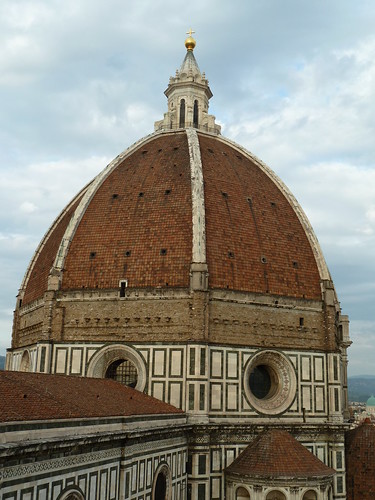
View of Il Duomo from CampanileThe Renaissance in Florence was a time of dazzling accomplishments, not only in art but also in architecture, and the (literally) crowning achievement is Brunelleschi's dome atop the Florence cathedral. When the cathedral was begun in 1296, Arnolfo di Cambio, the original architect, built a scale model to illustrate his design, which included a huge dome on an octagonal drum. The design was audacious, in that no one at that time had any idea how to build such a structure without it collapsing under its own weight. Nonetheless, the patrons of the cathedral clung to that bold vision, and when the nave was completed in 1380, they would wait for 40 more years with a huge hole in the ceiling of their cathedral until an architectural genius arrived on the scene with a solution. Filippo Brunelleschi devised ingenious solutions to numerous challenges that stood in the way of building the dome. First, there was the structural problem. While a perfectly round dome, like Rome's Pantheon, can support itself because of the special properties of circles and spheres to evenly distribute their weight stress, Florence's dome was meant to be octagonal rather than round in its footprint, and elongated in its height. These design elements make the dome especially graceful in appearance, but also make it inherently unstable. The solution was to build an interior dome which was more spherical, to bear the weight, and then an outer dome with the more graceful (but non-self-supporting) proportions resting on the inner dome. That design would be stable once it was built, but the next problem was how to support it as it was being constructed. Often, domes would be supported with a temporary wooden scaffolding while they were being built, but the scale of the cathedral's dome made that impossible. The opening at the base of the dome was 170 feet off the ground and spanned nearly 150 feet across. There were not trees enough in all of Tuscany to erect a scaffolding that big. Brunelleschi devised more creative solutions, including a herringbone pattern of laying brickwork that could support its own weight across an incomplete arch while the mortar was not yet dry. And he came up with many new mechanical inventions in order to hoist the 37,000 tons of brick and marble up to the height of the dome. The beauty of the dome and the genius of its construction are one of the greatest marvels of the Renaissance. It remains the largest masonry dome in the world.
Cathedral interior
Looking down from base of dome


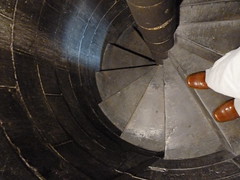
Spiral staircaseThere's no better way to get a true appreciation of the scale and the construction of the dome than to climb it. There's almost always a line, but it's well worth the wait. After briefly viewing the vast interior of the cathedral, the climb begins inside the stone walls of the transept, ascending the first 150 feet mostly in tight spiral staircases of medieval stone. Near the top of this part, you enter a large room built into the transept that houses some of the original statuary from the façade that has been brought inside to protect it. In the equivalent room on the downside (you descend the opposite transept), some of Brunelleschi's hoisting inventions are on display.
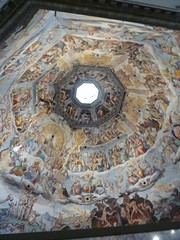
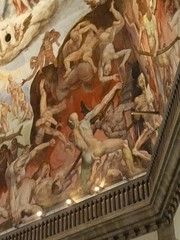
Last Judgment (inside the dome)Last Judgment (inside the dome)At this point, you are at the level of the base of the dome, and you emerge to a walkway open to the interior of the church. Over the railing, you look down on the vast open church floor 170 feet below, while looking up into the dome, you have a ringside seat for the cavernous Last Judgment fresco. Swirling high above your head, rising toward the lantern of the dome, you see God in judgment, Christ, Mary, all the saints, choirs of angels, and symbolic representations of virtues, beautitudes, and signs of the end-times. Discomfitingly closer to where you stand is the darker underbelly of the apocalypse, with demons pulling wretched souls down to torture and damnation amidst symbols of sin and Hell. The enormous fresco, nearly 40,000 square feet of surface, is jam-packed with apocalyptic imagery. It was designed to be impressive when viewed from the pews 170 feet below, so you can imagine how fearsome it is when standing right at the base of it.
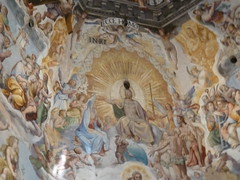
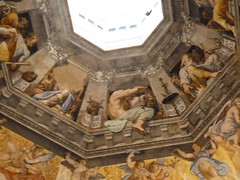
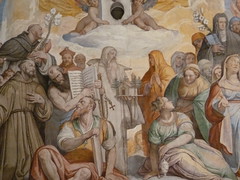
Last Judgment (inside the dome)
Looking up into the lantern
Last Judgment (inside the dome)


After walking partway around the base, you enter the interior of the dome itself, in passages that navigate between the internal dome and the external dome. At first, as you walk around, the curvature is slight, but as you ascend, the curvature closes in on you, with the passage not only bending more sharply, but with the walls of the passage leaning further and further in. Near the top, when you can't go around any more, the passage makes a turn straight for the center going up and across to the top of the dome. Along the way, you get to see pieces of Brunelleschi's techniques: the herringbone brickwork, the wooden and metal chains that function like the hoops on a barrel. And the whole inner/outer dome design is completely apparent because you're walking between the two.
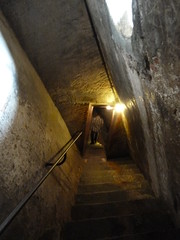
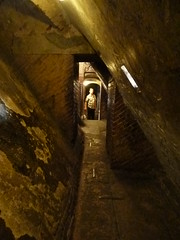
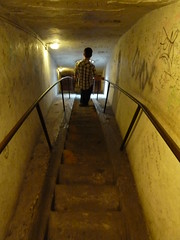
Descending inside the dome


On finally emerging at the top of the dome, you can walk around the base of the lantern topper, 350 feet above the ground, with commanding views of Florence and the surrounding countryside. This breathtaking panorama of the city, coupled with the fascinating insight into the architecture, is well worth climbing 463 stone steps.
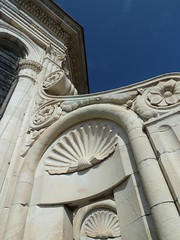
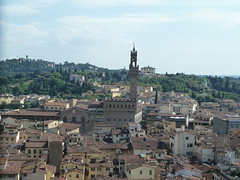
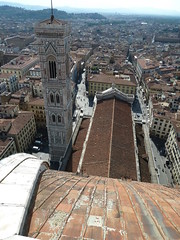
On top of Il Duomo
Views from top of Il Duomo

Friday, May 13, 2011

Along the Arno and the Ponte Vecchio

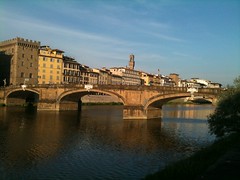
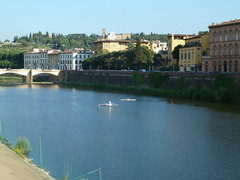
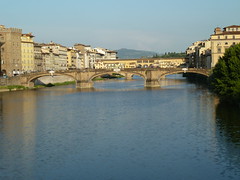
Arno RiverOne of the simple pleasures of Florence is walking along the Arno. The principal river of the region bisects the city, with the historic center of the city on the north bank and the "Oltr'arno" (the "other side of the Arno") on the south. Historically, the river was extremely variable, and could go from a placid flow to a raging torrent in just a few days. It's had its share of floods over the years, most recently in 1966, when it overflowed its banks and filled many of the historic buildings with water and mud. (In the church of Santa Croce, they display photos of the immediate aftermath of the '66 flood, which were fascinating and horrifying.) These days, thanks to modern dams upstream, it is a more regulated flow. The Arno as we found it was tranquil, with water gently passing under historic bridges and sunlight sparkling on its smooth surface, broken only by a few kayaks. On both sides, the river is lined with a bit of wild green growth below tall stone walls. On the north side, a street runs right up next to the river wall. On the south side, some blocks have a street beside the river while other blocks have buildings that back right up to the river. The buildings along the river are mostly 3 to 5 story buildings, some shade of yellow or orange (seems to be required in Florence -- Home Depot here must have a whole aisle just for yellow paint), with green shutters.

Arno River
Arno late in the day
Arno River


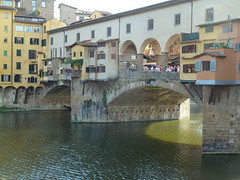
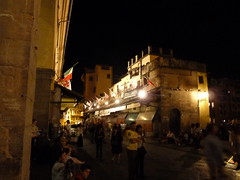
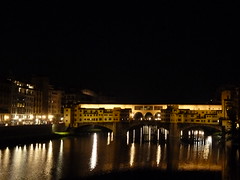
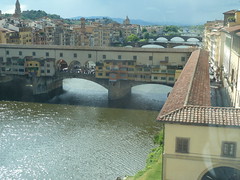
Ponte VecchioThere are several charming bridges that cross the river in various parts of the historic center of Florence, but the star is the Ponte Vecchio, the famous bridge lined with shops on either side. Various bridges have stood in this spot probably since Roman times, with previous bridges being washed away by the Arno's notorious floods. In 1345, a few years after the last bridge had washed away, they built the current one using three stone segmented arches, a design which has stood the test of time. (Segmented arches are wide and shallow, not a complete semi-circle, and allow high water to pass more easily.) Originally the bridge was filled with butcher shops, but these days the shops peddle jewelry, art, and souvenirs. In the center of the bridge, there is a gap in the shops on either side, affording views of the river, and a small square often taken up with street musicians. At night, the shops are closed up, but there are still plenty of people enjoying the romance of the bridge.

The Arno at night
Ponte Vecchio at night
The Arno at night


Ponte Vecchio / Vasari CorridorAbove the shops on the upstream side of the bridge is the Vasari Corridor, a secret passage connecting the Pitti Palace to the Uffizi and Palazzo Vecchio. When the Medicis moved into the Pitti Palace on the south side of the Arno in the mid-1500s, they wanted to be able to walk to the government offices without having to go out in the street. (Having seen assassination attempts against their ancestors -- Lorenzo the Magnificent was stabbed and his brother Giuliano killed in the cathedral during the Easter service in 1478 -- you can understand the reluctance of the later Medicis to go out in the street.) If you look carefully around central Florence, you can see bits of the corridor, connecting the Palazzo Vecchio to the Uffizi, running along the river for a stretch to get to the bridge, and then along houses on the south side of the river. At one point on the south side, it passes through the church of Santa Felicita, with a balcony opening onto the interior of the church, allowing the Medici to observe the church service from a safe vantage.

Piazza della Signoria

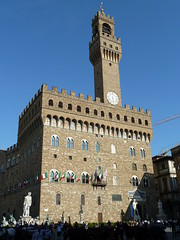
Palazzo VecchioIf the cathedral is the sacred center of Florence, then the Piazza della Signoria is the civic center of Florence. It's just a few minutes walk down the broad Via dei Calzaioli from the front of the cathedral to the Piazza della Signoria, where you first catch sight of the Palazzo Vecchio, the historic town hall and capital building from when Florence was a city-state. While the implied message of the cathedral's design is "be filled with awe and look up at heaven", the implied message of the Palazzo Vecchio is "we're a powerful city-state, so don't even think about messing with us". The Palazzo is a massive stone fortress with a sturdy tall bell tower and clock, dating from the early 1300s. While the design has definite beauty, it exudes strength and defensibility. The stone walls are obviously thick, with few windows on the lower floors and only one large door. The crenellation along the top looks graceful, but also provides the perfect combo of cover and opening for archers. Many of the upper arches contain small openings for dropping rocks or hot oil on unwelcome people outside the walls.

Palazzo VecchioThe sense of history in this square is palpable. The great leaders of Florence, like the Medicis, held court in that palazzo, made great decisions, kept prisoners. It was in this piazza that Savanarola (a 15th century religious zealot a la Jerry Falwell who became a political leader for a time) conducted his infamous "bonfire of the vanities", where books and works of art deemed irreligious were burned in a great pyre in the square. When the city soon grew tired of his extremism, Savanarola was himself ultimately burned here too. (An inscription on a flat circular stone amidst the other cobblestones of the piazza marks the spot.)

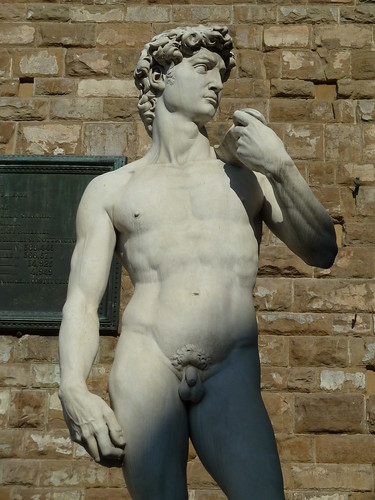
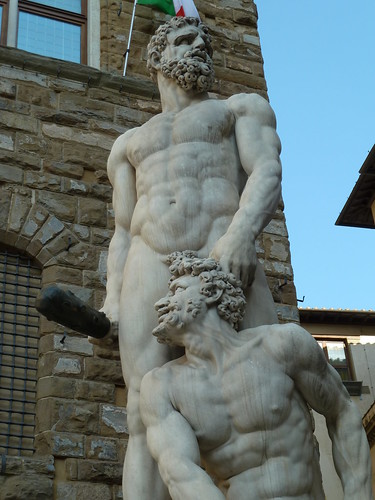
Upon approaching the palazzo, even from a distance one can't help but notice the two monumental statues that flank the large entrance. One is Michelangelo's David, and the other is a statue of Hercules vanquishing Cacus (a fire-breathing cattle thief). Both statues are solid marble, mounted on pedestals, and about 16-17 feet tall (not counting the pedestal), a rather imposing three times life size. David, looking like he eats nothing but steamed veggies and brown rice, naked and armed only with his sling, represents spiritual strength. Unlike the typical composition of David with his foot on top of Goliath's head, Michelangelo chose to sculpt him in the moment before the famous battle, looking pensively but determinedly toward his foe. In his placement here, his gaze is south toward Rome. Hercules, on the other hand, looking like he eats nothing bt raw meat and steroids, represents physical strength. He too is naked but armed with a club, and appears to be pausing, perhaps deciding whether he's sufficiently subdued his foe or not. He may also be reflecting the confusion of the time, as in the time this was sculpted (1525-34), there was much political turmoil in Florence, and the Medicis were in power, then out, then in again, and the commission of the sculpture was redirected a couple times. So whether Hercules represents Florence vanquishing her rival city-states or merely the Medicis vanquishing their political rivals is a matter of who's telling the story. In any case, anyone approaching the palazzo should be quite impressed by the stone guards at the door.
Michelangelo's David
Hercules and Cacus


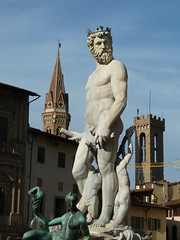
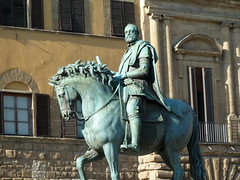
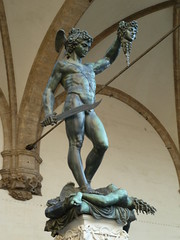
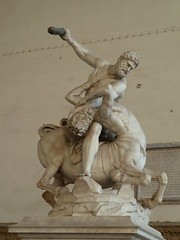
Rape of the Sabine WomenAs if that weren't enough, the square boasts a number of other rather muscular sculptures. At the corner of the palazzo, Neptune presides over a fountain, looking like he and Hercules would make a good cage match. Further in that direction is a regal bronze equestrian statue of Cosimo I Medici. On the opposite side of the square is the Loggia dei Lanzi, an outdoor sculpture gallery with various Roman and Renaissance works. As if more were needed to put the fear of Florence into approaching strangers, the collection includes Cellini's "Perseus with the Head of Medusa", an impressive bronze of Perseus, sword in right hand with Medusa's severed head held aloft in his left, and Medusa's fallen bare-breasted body at his feet, with guts gushing out of her open neck. Giambologna has a couple of great works here. Hercules, not pausing this time, but in stop-frame action actively clubbing a centaur. The sculpture is so active it is literally taut with tension, looking like it might unfreeze at any moment. And the Rape of the Sabine women, a fascinating work said to be the first multi-figure statue in European history with no single dominant viewpoint. The dynamic composition, of one man lifting up a woman while a fallen man cowers below him, has a twisting movement that impels you walk around the statue and view it from all sides. While the David is a replica (the original was moved indoors for restoration and preservation from the rain, soot, and bird poop), most of these other statues are the originals, and you can just walk among them, as it was in the 1500s when so many great artists flourished here.
Fountain of Neptune
Cosimo I Medici
Perseus with the head of Medusa
Hercules and the Centaur


(Check out highlights of our photos from Florence, or the complete set of first day pics on Flickr.)

First Look at Piazza del Duomo

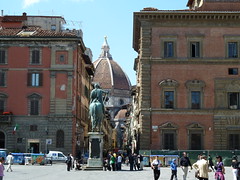
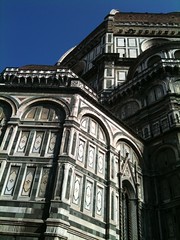
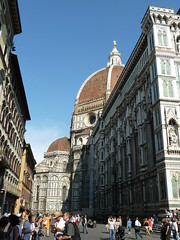
Piazza d. Santissima AnnunziataAfter getting settled at our hotel, we stepped back out into the piazza, eager to enjoy the remainder of a beautiful warm sunny day, and started to head for the center of town. From the equestrian statue in the piazza, the Via dei Servi runs just a few long blocks toward the cathedral, and even though the avenue was a nearly unbroken line of four or five story Renaissance buildings, the great red dome could be seen peeking above at the end of the avenue. That just begins to give you a sense of the scale of the cathedral. The huge dome was an architectural phenomenon when it was built in the early 1400s, and remains the largest masonry dome in the world today. When viewed from hills outside the city, the cathedral dome completely dominates the Florence skyline. Inside the city, one catches glimpses of the dome along avenues that run toward the central piazza. Coming to the end of the avenue, which runs into the side of the cathedral, we were fully impressed by its scale and its beauty, as our gaze turned upward to take in the tall walls (about 150 feet from the ground to the roof of the nave) and their geometric patterns of the red, green, and white marble that lined them. As we walked along the side of the nave toward the front, I was mindful that the cathedral architecture was achieving its aim, to keep us looking up (heavenward) in awe.

Looking up at Il Duomo
Il Duomo


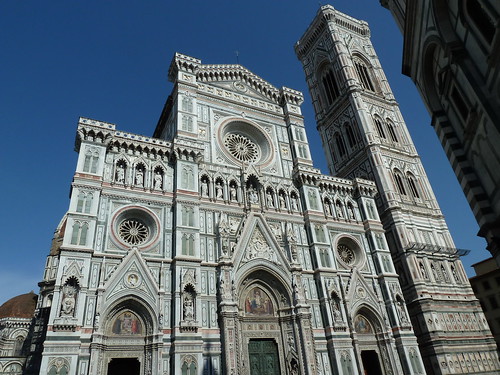
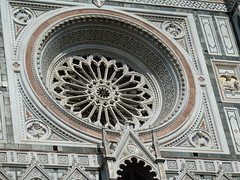
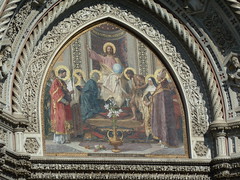
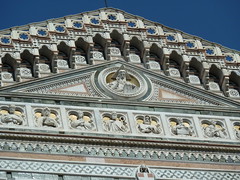
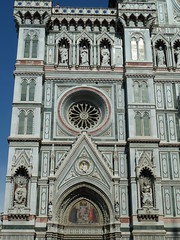
Il Duomo facadeThe feeling of awe and visual fascination only increased as we rounded the corner into the Piazza del Duomo, and turned back to view the façade. It is a dazzling display of neo-gothic architecture, taking the original tri-color geometric theme and kicking it up a notch into a wedding cake extravaganza of marble and statuary. The central part of the nave stands a full "head" above the "shoulders" of the aisles, and the façade keeps to that form. Unlike some cathedrals where the façade extends much higher than the actual structure behind it, this façade has substance behind it all the way up. It's hard to know where the begin to take it all in, but the design emphasizes the portals, a huge central one and two merely large ones on either side. Each has a deeply inset pointed arch (tympanum) filled with a mosaic, and above that a chevron-shaped pseudo-arch pointing up (heavenward, always), drawing your eye further up to the ornate rose window above. The whole pattern is echoed to scale in the secondary portals on either side. A gallery of niches with larger-than-life statues of the twelve apostles runs across the top of the "shoulders" and across the "neck". Four buttresses clamp onto the façade at the corners and the divisions, with double-lancet "windows" of green marble running all the way up. Above the rose windows is another gallery of quatrefoils filled with busts of great Florentines (mostly artists and architects, of course). No opportunity for a statue-filled niche or cornice is missed, decorated with borders of intricate inlay with the red, white, and green marble. Just when you think it can't get more baroque, you notice another level of detail of marble mosaic or busts of saints and popes worked into the pattern. Some people think that it's overwrought, but I think it suits a magnificent edifice of this grandeur. I mean, my God, it is one of the world's great cathedrals after all, it's entitled to be a bit overwrought.

Il Duomo facade rose window
Il Duomo facade tympanum detail
Il Duomo facade top


Il Duomo facadeThe façade is considered neo-gothic since, for various reasons, it wasn't added until the1870s, but it remains faithful to the gothic style of the cathedral, which was begun in 1296 and otherwise completed by 1469. To me, cathedrals in general and this one in particular are stunning human achievements, given that they are built over many generations and centuries, remaining (generally) faithful to an original vision. The men who began the cathedral knew they, their children, and their grandchildren would all be long dead before the cathedral was completed. The architects who began it did not know there would be sufficient resources and materials to finish it, and in the case of this cathedral, they didn't even possess the engineering know-how to erect what they envision, but merely had to go on faith that succeeding generations would somehow carry it out. The undertaking is as awesome a testament to faith as the structure itself.

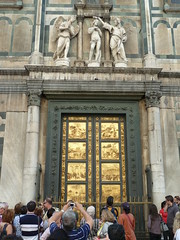
Ghiberti's Gates of ParadiseAfter taking in the façade for a while, we realized that we had our backs to the baptistry. This octagonal building is also done in white and green marble with geometric patterns, but its less ornate design and rounded rather than pointed arches indicate its Romanesque style. It's actually the oldest building of the cathedral complex, built between 1059 and 1128. Everyone from Dante to the Medicis, pretty much everyone who was anyone in Florence, was baptised here. But the big attraction of the baptistry are its gilded bronze doors, on the north, south, and east sides, which were the result of great artistic competitions in the Renaissance. In the early 1400s, Lorenzo Ghiberti won the honor of doing the north doors, which he labored on for 21 years. The doors were so beautiful that he was commissioned to do another set for the east doors, which took him 27 more years. These latter doors were even more beautiful than the first, and Michelangelo famously dubbed them the "Gates of Paradise", a name which has stuck to this day. The original doors have been taken indoors for restoration and preservation, but have been replaced with replicas so that the doors can be experienced on their original site. The doors are indeed marvelous. Of course being covered in burnished gold will make many things look marvelous, but beyond that, his artistry is exquisite. The bronze panels are deep relief, practically popping out in 3D. And Ghiberti fully exploits the Renaissance discovery of perspective to everything look realistic. (Before the Renaissance, art was generally flat and one-dimensional.) The doors comprise ten main panels, each featuring a major Old Testament biblical character. In most of the panels, all of the significant events in the life of the featured character are portrayed. For example, in one panel, Adam is created, Eve is created, they are tempted by the serpent, and they are booted out of Paradise, all in one fluid composition. Thus, not only are the panels 3D, they are 4D!


(Check out highlights of our photos from Florence, or the complete set of first day pics on Flickr.)

Arriving in Florence

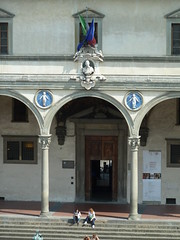
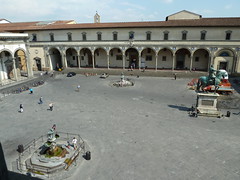
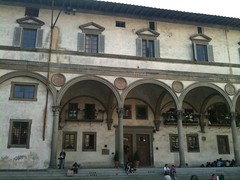
Taking a cab from the airport to our hotel in Florence was like riding in a magical time machine. We began in unremarkable suburbs with McDonalds and other hallmarks of globalization, but as we approached the historic center, we began to see older buildings, arches, narrower streets. At one point, we started to catch glimpses of the great red cathedral dome which dominates the Florentine skyline, stirring anticipation, like kids seeing the Matterhorn and knowing Disneyland is near. When the cab pulled through an archway through an ancient wall into the Piazza della Santissima Annunziata, the time transport was complete. Piazza della Santissima AnnunziataWe were in a broad square stone-lined piazza, mostly blocked off from car traffic, surrounded on all sides by 15th and 16th century buildings in High Renaissance style. The square was mostly open and quiet, its most prominent feature a patinaed equestrian statue to one side, and two fountains. Not grand fountains, but the sort you imagine the residents of bygone centuries would come up to fill their water jugs from. On three sides, the piazza is bounded by buildings with loggias that run the width of the piazza. A "loggia" is a classically Italian architectural feature, a semi-enclosed corridor running along the front of a building, defined by columns and arches and open to the air in front. In fact, it turns out these may be the definitive loggias. When I just looked "loggia" up in Wikipedia, it shows a photo of the Ospedale degli Innocenti, designed by the great Brunelleschi himself in the early 1400s, which is one of the three buildings on this piazza. The form is very graceful and courtly, and the Florentines were so impressed by it that when Antonio da Sangallo the Elder designed a monastery for the Servi di Maria order on the opposite side of the piazza in the 1520s, he made it with a similar loggia. And likewise for the church that forms the north side of the piazza when it added a new façade.
Ospedale degli Innocenti View from our hotel room Loggiato dei Serviti
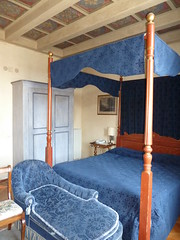
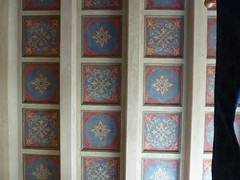
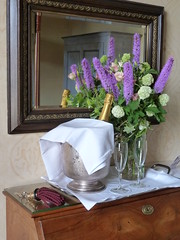
It was in front of the 1520 Servite monastery where the cab let us off, as that building has been renovated into a lovely hotel where we stayed the next three nights. Inside the Loggiato dei Serviti, the Renaissance charm has been preserved. Exposed beams, arches and niches with paintings and flowers adorn the halls and stairs, with common sitting rooms and reading rooms here and there making it feel like a large residence rather than a hotel. Amidst the old world feel, a few modern amenities (elevators, refrigerators, blow driers) have been thoughtfully added. Our third floor room featured a canopy bed, some classic wooden furniture, ceilings beautifully painted in intricate patterns, and a window overlooking that beautiful Renaissance piazza. A bouquet of fresh flowers and a bottle of sparkling wine in a silver ice bucket made for an elegant welcoming touch. We would enjoy our charming room and hospitable hotel staff quite a bit over the weekend.


Our hotel room Ceiling of our hotel room Fresh flowers and bubbly

(Check out highlights of our photos from Florence, or the complete set of first day pics on Flickr.)

Thursday, November 11, 2010

Marine Corps Commandant Demonstrates Ignorance of Scientific Method

The Fox News headline read "Marines Chief Warns Most Are Uncomfortable Serving With Openly Gay Troops", and the article lead off with this sentence: "As many as 95 percent of Marines would be uncomfortable serving alongside openly gay troops, the retiring commandant of the Marine Corps told Fox News in an exclusive interview." This based on General Conway's survey of his troops. Of course, when you read further down in the article, it turns out the General's idea of the word "survey" means forming an impression based on various ad hoc occasions when he asked a group of Marines for a show of hands on the subject.

Now we learn from a leaked Pentagon report that an actual survey (you know, the real scientific kind) of 400,000 servicemembers showed that there is
minimal risk to lifting the gay ban. More than 70% of the respondents thought that the change would be positive, mixed, or neutral. The Marine Corps was only slightly more resistant to the change, with about 40% expressing concern for unit cohesion. Nothing like General Conway's 95% based on his own "survey".

Am I the only one who's concerned that the leader of one of our military services trusts his personal impressions over actual data when it comes to making decisions?

Saturday, October 02, 2010

FILM: The Social Network

Of course we were busy posting on Facebook as we sat down to see The Social Network. But the film was more than engaging enough to keep our eyes off of our iPhones for the duration. In fact, I would call this story a Citizen Kane for the 21st century. It is a fascinating tale of a driven young man's rise to stunning success and riches, at the cost of betraying friendships and destroying relationships along the way, culminating in the ultimate irony: does the man who built a network of 500 million friends have any friends of his own? And of course it was impossible not to think of "Rosebud" when seeing the final scene. How closely the film hews to truthful biography is an open question, but it certainly makes for a landmark story. Facebook Founder Mark Zuckerberg is played impeccably by Jesse Eisenberg, who creates an Asperger-like intensity and unsocialized lack of filter in the main character, and as one of my friends (a Princeton classmate) said, "nailed the speech patterns and mannerisms of smartass Ivy League kids". Aaron Sorkin's script is beautifully written, from the opening scene in which we quickly get to know the Zuckerberg character as he is being dumped (for good reason) by his girlfriend, to the last scene (the Rosebud moment). The film tells the story of the events leading up to and through the founding of Facebook, interspersed with scenes from legal depositions from the various parties who later sued him, scenes which reflect on and illuminate the story. Zuckerberg comes off pretty much as a brilliant amoral jerk, though one of the young associates on his defense team sheds some sympathetic light on him, and I found myself cheering for him a little bit when he was being berated by the opposing attorneys and gave them a stinging comeback. (But then even Atila the Hun might be sympathetic when being berated by an attorney.) Justin Timberlake gives a great turn as Sean Parker, the erstwhile founder of Napster who insinuated himself into Facebook, portrayed here as a brilliant, charming, immature power-magnet with a penchant for drink and drugs and a talent for knowing who to flatter and charm. The whole story felt very realistic (again, whether it's true or not), and some scenes were giving me flashbacks to my own dot-com-founding experiences (which included a house which served as company dormitory and office space, though without so much drugs, wild parties, and funding). I predict Oscar noms for Eisenberg and Sorkin (course it's still early in the year for Oscar's short attention span).

Sunday, September 05, 2010

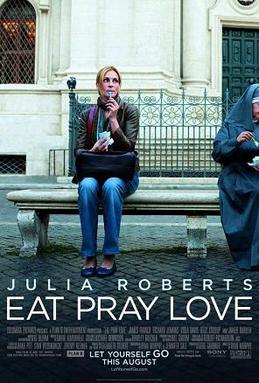
FILM: Eat Pray Love

We'd heard mixed reviews of Eat Pray Love, but we were looking for something diverting last night, and figured: Julia Roberts, beautiful world travelogue, beautiful food, and some beautiful men (in that order) -- what's not to like? We were not disappointed and found the film thoroughly enjoyable. I had read the book, which is often a set-up for disappointment in the film. But I didn't go in expecting the film to be exactly like the book. While decorated by beautiful and exotic settings, the book is largely an internal journey which would be hard to translate into a visual medium. Nonetheless, I thought they did a really nice job. There was some amount of Liz the protagonist's voiceover (it would be impossible to make this film with none), but director/writer Ryan Murphy wasn't heavy-handed with it. He and co-writer Jennifer Salt did do a nice job adapting some of the book's great internal scenes. I particularly liked Liz's first attempt at meditating in the ashram, when her thoughts were totally scattered and even one minute of distracted meditation was exasperatingly slow. And the use of flashback and fantasy provided some lovely book-to-film translations such as the scene on the ashram roof when Liz "meets" and makes peace with her ex-husband. Of course in some dimensions, such as the beauty of the locations and the food, the film capitalized on the strength of visuals. A simple scene of Liz making eye-love to a simple but exquisite plate of spaghetti in a Roman café, with Mozart's Queen of the Night aria from the Magic Flute as soundtrack, was genius. As is inevitable, not every bit of the book can fit into a film, but I felt they stayed quite faithful to the book, and did their best to at least allude to memorable bits from the book. (One of my favorite chapters in the book is Liz attending an Italian football match and appreciating the Italian language in the stream of invective from the cheering and howling fans. It would be impossible, I think, to truly render that chapter on film, but they made a nice gesture to it, in a collage sequence interleaving scenes from fans at a soccer game with Liz and her friend trying on jeans that were a bit too tight.) It was also a pleasant surprise to find the casting so agreeable. To me, not a single character was discordant with how I had pictured them from the book, from James Franco as David, her rebound affair, down to Hadi Subiyanto as Ketut Liyer, an aged Balinese medicine man. Javier Bardem did a great job of bringing to screen such a complex character, who comes across as a bit of a playboy but who is actually a heart-broken divorcé and doting father. And Richard Jenkins did a brilliant turn as Richard in the ashram, a brusque Texan who kicks Liz's spiritual butt while becoming her best friend in India. (We remember him best from his outstanding lead role in The Visitor, though he's probably best known as the deceased father of the Fisher family in Six Feet Under.)
Sure, the film leaves out much of the more profound spiritual and emotional elements of the book, but there's only so much you can expect from a 2-hour movie, and there was a lot of ground to cover. Depth of emotional character development just wasn't going to fit. But as a romantic-comedy version of a journey of self-discovery set against a travelogue of beautiful places and exotic characters, we found it thoroughly enjoyable.

Sunday, August 29, 2010

Founding Mothers of New France

On our recent vacation to Canada, we learned a lot about the history of the settlement of "New France" in the 1600s, when French colonies were established in Québec in 1608 and Montréal in 1642. As with most cities, the great figures in their history, the founders of their civic institutions, are memorialized in statues and stained glass windows, and in the names of streets and squares. Such was certainly the case in Montréal, but as we wandered through the charming cobblestone streets of the old town, one thing slowly dawned on me as being rather unique. A number of those founders memorialized in statues and streets were women. And I'm not talking about some post-feminist politically-correct honoring of honorable women recently excavated from "herstory". I'm talking about women in leadership roles who founded major civic institutions from the very establishment of the colony, and were recognized from their time onward as founders.

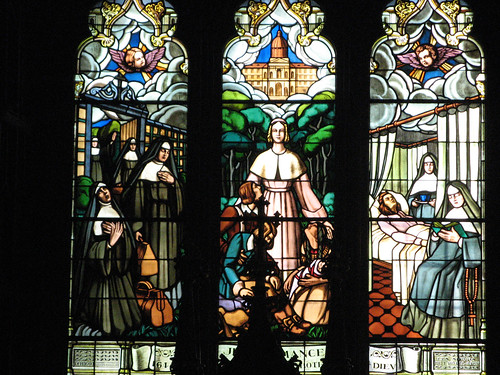
The first one that caught my attention was in the Notre-Dame Basilica, where a series of stained glass windows depict scenes from the history of the city, and one shows Jeanne Mance, founder of the city's first hospital. We came across the name again in a street name, rue Jeanne-Mance, which runs "north-south" from the convention center, past the Guy-Favreau and Desjardins shopping centers, past the Contemporary Art Museum and the Place des Arts, and up to the Hôtel-Dieu, the hospital that she founded, and which still exists (though not in its original location). Today the Hôtel-Dieu is one of Montréal's major hospitals, and is part of the Université de Montréal. There is a monument to Jeanne Mance in front of the hospital. And had the Place d'Armes (a central square in old town) not been under reconstruction, we would have seen a statue of Jeanne Mance as one of the five leading Montréal historical figures memorialized there. We learned that she was one of the original settlers on Montréal in 1642, along with Paul Chomedey de Maisonneuve, the first governor. Maisonneuve and Mance were both recruited by the Societé de Notre-Dame de Montréal, an organization incorporated to fund the establishment of a missionary colony in New France. As we visited Montréal's historical sites, we learned of the great hardships faced in its establishment, the often-dangerous voyages across the Atlantic, the attacks on the settlement by the Iroquois, occasional threats from the English, as well as natural threats from floods and disease. It clearly took great fortitude and courage to be a pioneer in such a place.

Another prominent figure we learned of was Marguerite de Bourgeoys. If you visit the charming Notre-Dame-de-Bon-Secours church, you can't help but learn about her. Governor Maisonneuve returned to France to recruit someone to establish a school in Montréal, and he returned with Marguerite de Bourgeoys. Shortly after her arrival in 1653, she initiated construction of the Notre-Dame-de-Bon-Secours Chapel, and established Montréal's first school. She made a number of trips back to France in subsequent decades to recruit additional teachers and funding, and the women she brought back formed the Congregation de Notre-Dame, a unique community of uncloistered women who established and operated a number of schools for colonists and for native children. She was truly a courageous and remarkable leader.

In another part of town, we came across a couple of streets and a square all named for Marguerite d'Youville. Though she lived in the 1700s, nearly a century after the establishment of the colony, she too played a leading role in Montréal's civic life. After becoming a young widow when her drunkard bootlegger husband died, she answered a religious calling, and established the Order of Sisters of Charity of Montréal, a group that operated a home for the poor, and also took over operations of a bankrupt hospital outside the city walls, bringing it back to financial stability. The "Grey Nuns" (the common nickname for the order) carry on her legacy to this day, continuing to operate numerous women's shelters, food dispensaries, and other services for the poor.

We also saw an obelisk in old town, erected in 1892, with a plaque listing the founders of the city, both those including Jeanne Mance who actively worked on site to establish the colony, but also those back in France who backed and funded the venture, such as one Angélique Fauré de Bullion, a wealthy widow who played an ongoing active investment role in the development of the colony. (She insisted on being identified only as "an unidentified benefactress" in records of her donations, and her role only came out after her death.) Several other female names appeared on this plaque, including the intriguing Madame La Chanceliere Louise Fabry, of whom I've not been able to find out more.

I'm just intrigued by this whole women pioneer thing, and wonder what unique combination of things made this happen in New France? Obviously, the whole pioneer thing is one factor. When founding a colony in a new world, obviously you need all hands on deck, and certainly the women who were among the original settlers in America (the settlement of "the West" as well as the English colonies) were strong and courageous. But I'm not aware of any of our American pioneer women having such leadership roles and establishing civic institutions in the same way. Generally, our streets are all named Washington, Jefferson, and Adams, and our statues are of men. (The nearest exception I can think of was Anne Hutchinson in Rhode Island.) And here in "New Spain" where I grew up, I don't even think the Spanish missionaries (and certainly not the soldiers who supported them) included women at all. So while establishing a new colony created a natural demand for leadership, most social structures of the time didn't enable women to rise to fill that demand. What then was different about New France? Another factor is the Catholic church, which distinguishes New France from New England (our Protestants didn't have the same tradition of nuns and orders that the Catholics had, cloistered or otherwise). And perhaps we have to distinguish the French Catholic church, since Spain too was Catholic. These French women pioneers certainly worked within the context of the church: Marguerite Bourgeoys started her own order of sorts (though an unconventional one that only finally received full church authorization near the end of her long life), and Marguerite d'Youville worked with the church to start her order. (Both of these women were eventually canonized a couple centuries later.) Jeanne Mance, though devout and religiously motivated, was and remained a laywoman, though her hospital was staffed with women of orders. What was it about 17th century Catholic France that enabled such women (and the wealthy widows who funded them) to take on such leadership roles?