Friday, March 08, 2019

X'tiosu and Hsi Lai Temple: Lunch on the border of Lebanon and Oaxaca, afternoon in Taiwan

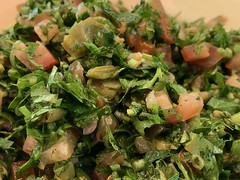
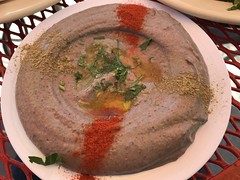
For lunch, I traveled to the border of Lebanon and Oaxaca (actually Boyle Heights), where a new restaurant called X'tiosu Kitchen has popped up recently. A couple of brothers came from Oaxaca, cut their cooking chops in Lebanese restaurants in Santa Monica, and now are fusing those skills with their native flavors to create "comida libanesa estilo oaxaqueña". That turns out to be a chicken shawarma taco, with a double layer of corn tortillas to give the heft of a pita, grilled chicken, a bright pickled turnip, and the rich tahini sauce dancing with a hot smoky salsa made from chile de arbol and guajillo peppers. That means that their tabbouleh blends lots of fresh parsley and tomato with nopalitos (cactus) instead of bulgur. It means hummus is whipped from black beans instead of chick peas, and graced with olive oil, paprika, and cumin. It means you're lucky to live in Los Angeles, where magic like this can happen.

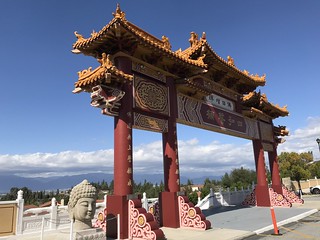
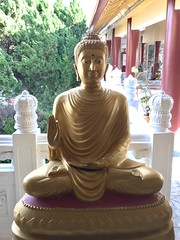
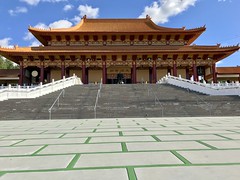
After lunch, I went to Taiwan for the afternoon (actually Hacienda Heights). The spectacular Fo Guang Shan Hsi Lai Temple is built dramatically into a hillside, so that you ascend through a series of temple structures, symbolic of the Buddhist journey of enlightenment. From the height of the main temple, looking out over the golden rooftops of the other structures, and further out over a brilliant blue sky with dramatic clouds, I felt like I could have been in Tibet if not Taiwan. I wandered the gardens and grounds filled with fantastic images of buddhas, boddhisatvas, and other revered figures. I saw monks in their robes, and watched people praying. I lit some incense as I saw others doing. Several helpful people offered to answer any questions. I stepped inside the main temple and marveled at literally thousands of buddhas. On the opposite wall facing you as you enter are three gigantic buddhas. As your eyes adjust, you realize that the columns are made up of stacked niches, about 2-foot square, each with its own buddha figure in it. Then you realize that the walls between the columns are filled with even smaller niches, each with buddhas in them, and each with a unique name. The whole experience was fantastically serene, which I suppose is the goal. I am so lucky to live in LA, and have the world in my city!

Thursday, March 07, 2019

FOOD: Farewell to PYT

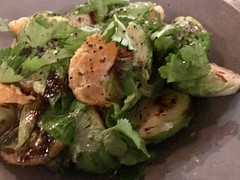
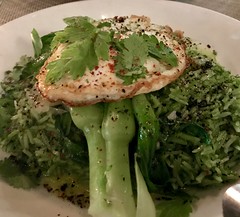
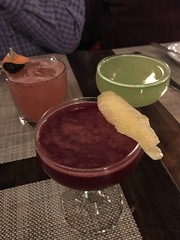
The inevitable downside of LA’s hot dynamic restaurant scene is that restaurants, even good ones, will close. On Thursday, we ate a farewell meal on the last night of service at PYT, Chef Josef Centeno’s restaurant that lead the charge on the wave of vegetable-forward cuisine in LA. When Jonathan Gold compiled a list of the top 10 dishes of 2016, nearly half of them were vegetables, and one of them was Centeno’s roasted turnip, roasted for hours in a salt casing wrapped in a hoja santa leaf. I never got to try the turnip, as they had moved on to other delicious vegetables in their changing seasonal menu. I was hoping they might have brought it back for their last hurrah, but no luck. What we enjoyed instead was very fine consolation. We started an amuse bouche of oro blanco segments in a puddle of charred shallot oil, sprinkled with dukkah, singing on our tongues with various notes of sweet, acid, and umami. Here, even the cocktails showcase vegetables. Our table sampled the Beet It (beet, bourbon, kombucha, lemon, sugar), the Cara Cara Crush (rye whiskey, raspberry, orange juice, ginger), and a Celery Margarita (tequila, celery, lime, agave). We began with a kanpachi crudo (the only animal protein in our meal) in a bright carrot-turmeric aguachile that I wanted to soak up every drop of. For salads, we had a zucchini “noodle” slaw with chimichurri spice, pomegranate, and lemon, and roasted baby beets with chicory greens in a buttermilk-oregano vinaigrette that added a novel tang to the sweet beets. Then came the main part of the meal – all vegetables. Grilled cauliflower and romesco were made earthier by a truffle cream, punctuated by yuzu zest. Charred Brussels sprouts were bathed in brown butter vinaigrette and coriander leaves, with a sweet acid punch from satsuma mandarin segments. Green piri-piri rice, its herbaceousness reinforced with fresh herbs, came with bok choy and an over-easy egg for richness. And a crispy eggplant was battered in cornmeal (gluten-free!) and mozzarella, served in a tangy-sweet tomato-plum sauce. Anyone who thinks you can’t make a full hearty meal of vegetables hasn’t eaten here. For dessert, we enjoyed a rich thick peanut budino in a salty caramel cream with candied pepitas and coconut.


We’re sad that that would be our last meal at this innovative and delicious venue, but are glad for the impact it has had on LA’s food scene. Chef Centeno still has at least three other restaurants within a stone’s throw of this one (someday perhaps the corner of 4th and Main St will be named Josef Centeno Square), and he has said that his best vegetable-forward dishes may migrate to Orsa & Winston, his more upscale tasting menu restaurant. The chef said the closure was not due to the business going down, but to getting a great offer on the space. Rumors are that the people behind Lock and Key (a Koreatown speakeasy) and Nightshade (new pan-Asian spot in the Arts District) plan to open something here. The dynamism of our food scene means things keep changing, so we’ll be eager to see what comes next.

Tuesday, March 05, 2019

FILM: Roma

I had heard a broad range of reactions from friends who’d seen Roma, from “beautiful” to “like watching paint dry”, and I think it depends what you want from a film. If you’re looking for a clever plot, laughs, or great action, you’ll find Roma very unsatisfying. But if you appreciate a film that shows you a slice of life in a way that really makes you think, or if you appreciate a film that genuinely evokes a time, a place, a mood, then you’ll find much to appreciate. And if you’re the sort of film fan who loves the art of film -- someone who loved Linklater’s Boyhood, who reveled in the opening scene of Altman’s The Player, who can discourse on the technique of Orson Welles and Alfred Hitchcock -- you’ll be loving this film from its opening scene: water repeatedly surging and receding across some unlocatable pavement, eventually coming to stillness reflecting an opening onto a piece of sky in which an airplane slowly flies across. One viewer’s masterpiece is another viewer’s paint drying. Me, I appreciated watching the paint. Some of the scenes were almost painterly, like “Pageant of the Masters” in their composition, and yet completely natural. I found everything worked to create a complex impression. There was the sense of childhood, its innocence, and the nostalgia of its recollection for the children in this family, as you watch them being happy and oblivious as serious things happen to the adults they love and feel close to. You can sense the director being reflective of his own childhood experiences in that time and place. There was the ambiguous relationship of the nanny to the family, some fuzzy place between employee-servant and beloved family member, both attached and detached. There was the comfort of this home and this neighborhood, with social and political unrest just scraping the side of the car occasionally as they ride through their lives. And it was beautiful.

Saturday, March 02, 2019

OPERA: The Clemency of Titus

We thoroughly enjoyed the soprano-fest at LA Opera’s The Clemency of Titus. It was the last opera Mozart wrote, and it was scored not only for two sopranos for the female roles, but a soprano castrato and a soprano en travesti (cross-dressing) playing two male roles. In modern times, since castrati are in short supply, those two “trouser roles” are sung by mezzo-sopranos. With soldierly costumes and fake beards, they were quite effective and affecting. There were some lovely duets between the “men” and the women, and one between the two “men”. The orchestration included harpsichord and some period instruments called basset clarinet and basset horn, each of which had a featured “duet” with a soprano. The voices were all strong. Elizabeth DeShong, demonstrated great range and emotion as Sesto, a young Roman nobleman who is goaded by the object of his love to turn against his dear friend. Guanqun Yu was vibrant and beguiling as Vitellia, the conniving beauty who manipulates Sesto to evil ends. Russell Thomas’ rich tenor voice rang true as the virtuous Emperor Titus who, Camelot-style, who is betrayed both personally and in his ideals by those he most trusts and loves. The opera was commissioned for the occasion of the coronation of King Leopold II of Bohemia in 1791, mindful of the terrors in France, wanting to encourage the new Holy Roman Emperor with themes of noble and benevolent leadership. Some details of the historical Titus, who was a magnanimous emperor, are shown in the opera: when subjects give him gold to build a great statue in tribute to him, he requests that the riches instead be diverted to needy citizens in his realm recently affected by natural disaster. A number of themes and notes in the opera had unexpected relevance in contrast with our own current experience of national leadership. As we’ve come to expect to be spoiled by with LA Opera, not only did we get top notch singers, orchestra, and chorus, but also gorgeous set design and costumes, evoking the grandeur of a fantasy of Imperial Rome, in splendor and opulence, and later in flames and ruin. (Fun fact: La Clemenza di Tito premiered in 1791 at the Estates Theatre in Prague, which I’ve had the pleasure to visit, and which is the only theatre still standing where Mozart performed.)

Sunday, February 24, 2019

STAGE: America Adjacent

Being the home of “the industry” and thanks to actor’s union rules, LA is blessed with a bounty of 99-seat theatres, often providing high quality productions. I was treated to some of that on Sunday at the Skylight Theatre in Los Feliz. America Adjacent is set in a small one-bedroom apartment somewhere near Hollywood, packed with six Filipino women and a couple of babies, all confined to the apartment. The women are all pregnant or recently delivered, coming to America so their children will have the advantage of US citizenship. While such a play could have easily verged into polemic, this script (by Boni Alvarez) focuses on the very human stories of these women, why they came, what they hope, and how they cope with being confined in such close quarters. Their backgrounds and situations vary. One is rural and naïve, one is religious, one is more educated, some are conformists and peacemakers while others are risk takers and rule breakers, but all share sacrificing for the sake of their children. It is engaging and moving, and I am glad I saw it.

On Sundays, Skylight Theatre presents a conversation series immediately after the show, and this Sunday’s guest was none other than Jose Antonio Vargas, whose book Dear America I had just read. Being a Filipino undocumented immigrant, he clearly had much to relate to in this play, and talked about the experience of being “TNT”. The Tagalog phrase tago ng tago, which means being in constant hiding (literally “hiding and hiding”), abbreviated TNT, is slang for an undocumented person. Until you hear stories like these women or Vargas being TNT, you don’t appreciate the psychological toll it can take. In the conversation, several people also spoke of how powerful it was for them to see a play with Filipino actors playing Filipino characters, not something often seen. (As a gay man of a certain age, I can relate to that.)

Saturday, February 23, 2019

FOOD: Redbird

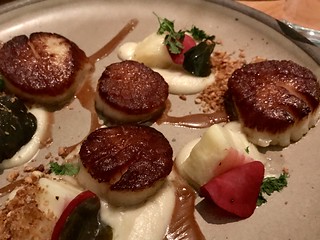
We enjoyed a marvelous dinner at Redbird with some friends, which is the best way to do it, as sharing plate meals work well here, and the staff will deftly time them into nice rounds of courses. Our starter round began with a salad of little gems with avocado wedges, smoked bacon, and a buttermilk blue cheese vinaigrette. It’s a great salad, similar to a classic steakhouse wedge salad in its crisp body, but with more interesting lettuce, more interesting dressing, and the avocado and smoked bacon to amp up the flavor and texture complexity. Roasted baby red beets were served chilled with chèvre, citrus, pistachios, again taking a standard and adding something special. Likewise with the seared shishito peppers, with a dusting of toasted quinoa for crunch and bottarga (an Italian cured fish roe) for salty zing. A superbly fresh hamachi crudo was seasoned with hijiki (a dried sea herb), minced Asian pear, minced ginger, and a housemade ponzu balancing salt with a bit of sweet. As a bonus, with a group of six, there will likely be someone else who wants to share that one thing that doesn’t appeal to most, and so two of us enjoyed a large halved marrow bone topped with snails in a rich brown bordelaise sauce and served with grilled sourdough toast. In the second round of courses, we enjoyed scallops perfectly browned in brown butter on celery root purée with sunchokes. Lobster risotto with fines herbes was distinguished with a Meyer lemon cream. Small garnet yams were roasted and then made extraordinary with tart pomegranate arils, dukkah (a middle Eastern nut-and-spice blend), and honey. A 24-ounce bone-in Red Wattle (heirloom breed) pork chop made a dramatic presentation, pre-sliced but still with the bone and bits, along with taleggio polenta, and arugula with hazelnuts. Gemelli (loosely twisted hand-rolled pasta ropes) was spicily sauced with braised goat, rapini, fresno chili to add heat, and breadcrumbs and poached egg to mellow it out. Brussels sprouts came with a red curry aioli and chicharrones. And the sommelier steered us to a 2014 Lutum Santa Rita Hills pinot noir that beautifully complimented this feast. Finally, for dessert we share a couple of sweet bites. A flourless chocolate cake was rich but not heavy, and punctuated by pomegranate arils. A light crustless cheesecake was brightened by passionfruit and topped with pistachio brittle. (See all the pics here.)

FILM: Oscar-Nominated Animated Shorts 2019

In recent years, we’ve discovered the pleasure of seeing the Oscar-nominated short films when the Academy Awards are coming around. Usually we’ll catch the live action and the animated shorts, but this year we didn’t have time to catch both, and some friends tipped us off that the live actions were brutally heavy this year. So animation is it was, and what a great crop this year! The first two shorts both, in the span of 10 minutes each, moved me to warm sweet tears. Bao, the Pixar entry, draws a poignant and humorous sketch of a Chinese mother who raises a son and then is reluctant to let him go when he’s grown up. Using food as a metaphor, it includes some beautifully rendered images of food and cooking. Late Afternoon (from Ireland), in simple hand-drawn lines and colors, shows the experience of an old woman whose memories are becoming slippery as she slides down memory holes like falling into water. Animal Behaviour wasn’t high art, but was an amusing gag about a counseling support group spanning the animal kingdom from a slug who can’t let go of a co-dependent relationship to an ape in denial about anger management issues. Then came the lushly painted Weekends, the subjective experience of a young boy being shuttled back and forth between separated parents, with gorgeous imagery that wordlessly brought emotions to life. One Small Step sweetly tells the story of a girl raised by a single father finding the determination to follow her dreams to the stars. Those were the five official nominees, but they usually throw in a couple of bonus shorts to fill out a feature-length program. Wishing Box was another gag offering stronger on amusement than artistry but certainly a good laugh. Tweet-Tweet, on the other hand, was more deserving of nomination – a CGI offering that entranced me with its simplicity and beautiful imagery, showing the cycle of life as a dance along a tightrope lead by a small bird.

Monday, February 11, 2019

BOOKS: Dear America

Jose Antonio Vargas’s memoir Dear America is a very timely and compelling coming out story. Growing up, he just assumed he was like everyone else, and at age 16 when he discovered the truth about himself, it really unmoored him and he wondered what his future could be like. He buried himself in being a top student and extracurricular overachiever, hoping to hide his secret. (Many gay men will recognize “best little boy in the world” syndrome.) Staying in the closet would take a big emotional toll on him, even as he went on to an impressive career as a journalist, including winning a Pulitzer. Vargas happens to be gay, but that’s not the crux of his story. His life has been shaped by discovering that he was an undocumented immigrant. This book should be essential reading for all engaged Americans. So often our current debates about immigration are based in abstractions and stereotypes, without knowing the actual people affected by our policies. Vargas opens a window onto the life of an undocumented person in America by telling his own story. It is illuminating, and at times moving and surprising. This book is not a political essay, it is a personal memoir. But as we gay people have learned, sharing your own story can be the most compelling argument of all.

Friday, February 08, 2019

FOOD: Botanica in Silver Lake

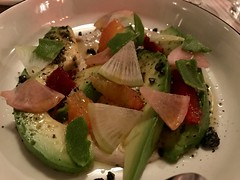
Botanica in Silver Lake is another great example of the vegetable-forward cuisine going on in LA. It’s not pure vegetarian – meat and fish is on offer for those who want it – but you could make a great hearty meal without it, especially if you came with friends and did sharing plates. It's also extremely gluten-free friendly. Market-fresh ingredients are paired here with Middle Eastern notes like tahini, za’atar, and sumac. We went with a neighbor and had this great meal. The fresh market vegetables started with the cocktails: mezcal was paired with beet juice, lime, and cilantro; Spanish vermouth was splashed with blood orange juice and soda. Little gem lettuce was complimented with pistachios, smoked California cheddar, and a balsamic vinaigrette. Avocado and citrus was sliced and served with mint leaves on a light smear of hummus. Broccoli di cicco was prepared with Calabrian peppers and fresno chilies, fresh basil and mint, and miso. Chicken is seasoned with za’atar (a middle Eastern herb blend) and served with wilted greens and caramelized carrots on a carrot purée. Roasted cauliflower is fragrant with turmeric yogurt and punctuated with crunchy candied pepitas. Lamb kofte kebabs (grilled seasoned ground meat) are covered in an herb salad and served on a smear of dill-sumac yogurt. Fort dessert we enjoyed the wine-roasted apples in sweet vermouth with cashew-date purée, and a rich tahini dark chocolate mousse brownie topped with sesame-whiskey caramel whipped cream and cocoa nibs. We left very satisfied with all these delightfully intriguing flavors. (See complete set of photos here.)

ART: Ai Weiwei and Yayoi Kusama at the MAF

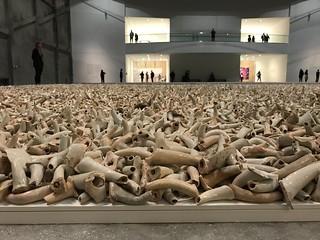
After lunch in Koreatown, in another of my off-Friday pairings of food and art explorations, I got to see a couple of impressive art installations at the Marciano Art Foundation. (If you haven’t yet been to the MAF, it’s a fantastic recent addition to the LA modern art scene, completely free including parking, but you need to make online reservations, and it’s currently booked out about a month out.) The first was a set of massive installations by Ai Weiwei. I’ve gotten to know this artist in the last year, not only through a previous exhibition, but also through his impressive documentary film Human Flow, about refugees and mass migrations, and it’s interesting to see the themes that connect his works. He is fascinated with scale and replication, and one of the things he likes to do is create large installations comprised of large numbers of the same kind of object, inviting you to look at an overall mass, contemplating vastness and large numbers, but at the same time to look closely at individuals and see what appear to be replicas actually have individual differences and characteristics. In the previous exhibit, he did that with antique Chinese stools filling a large open gallery. The Marciano offered an even bigger space to fill, and he’s filled it with two installations of this sort. One, called Spouts, is a nearly 2000-square foot rectangle filled with the spouts of antique porcelain teapots. These are broken fragments of pottery from various Chinese dynasties, some as much as 1000 years old. The shapes and colors vary, though they’re mostly shades of white and ivory. Given that the artist has spent time in Chinese prison and under house arrest, one can imagine this mass of teapot “mouths” to be a comment on the freedom of speech for all the people in China. The other, called Sunflower Seeds, is an even bigger square, over 4000 square feet, filled with sunflower seeds. Not real ones, but lifesize porcelain replicas. There are about 50 million of them, made by over 1600 artisans in Jingdezhen, a town with a long tradition of porcelain craftswork. Thinking about the fact that each of these seeds was handmade by an artisan, and looking at this vast field of millions of them, makes you think about the value of handicraft and the price of labor in China.
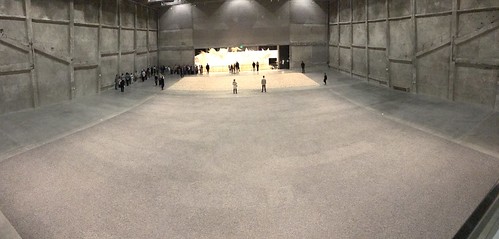
The large field in fore are the 50 million porcelain sunflower seeds. The ivory rectangle beyond that are the antique teapot spouts.
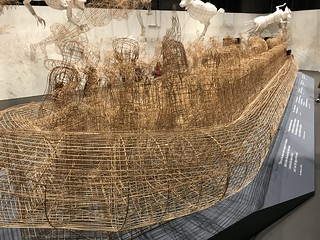
Beyond these two fields is another space that houses a bunch more works by Ai Weiwei, these works all made of bamboo and silk, using the techniques of traditional Chinese kite-making. In the center of the space is the featured Life Cycle, a lifesize large inflatable Zodiac-style boat filled with human figures, made entirely of slender bamboo sticks. If you’ve seen his film, or if you’ve seen any documentary footage of refugees crossing the Mediterranean Sea trying to reach Europe, you will recognize the scene immediately. These are the sort of boats refugees often use, filled to dangerous overcapacity. Sometimes they even capsize. The figures in this boat are all facing inward, and you can see that the center is filled with figures too. A child peers over the front. The transparent bamboo construction of the figures makes them ghostly, just outlines of people, hard to make out. These boats often make their desperate runs at night. After a while you notice that while most of the figures are human, every so often the artist has topped a human body with the head of animals from the Chinese zodiac, an ox here, a rooster there. Perhaps that’s a play on Zodiac, the most common maker of these inflatable boats. Perhaps it suggests the hope that there might be some guiding spirits or angels traveling with these desperate boats. In any case, it’s a powerful piece.

Surrounding the Life Cycle, on the walls around it, and suspended in the rafters above it, are a myriad of bamboo-and-silk kite-like works. The ones flying above are all fantastic mythical creatues drawn from an ancient Chinese mythological text called the Shanhaijing. These creatures have arms and wings, fins and tails, some have multiple heads. The white silk creatures lit up against very high rafters that disappear into darkness create a fantastic effect, like constellations floating in a night sky. The works along the wall draw on myth, on modern art, and on themes from the artist’s life and work. In one section I smiled to recognize the three-legged stools echoing another work I had seen last fall.

This alone would have been treat enough, but on another floor, MAF was hosting another large scale installation by a fascinating artist. Yayoi Kusama, the Japanese artist whose amazing Infinity Room has been such a hit at The Broad, has another immersive installation here. This one is entitled With All My Love For The Tulips, I Pray Forever. The title gives you a hint of the playful fantasy to expect. This work comprises several monumental potted tulips in a large room, where the tulips themselves, along with the entire room – walls, ceiling, floor – have been painted bright white with large bright red polka dots. It is a fantastic effect, and as you don shoe coverings to be able to walk into this joyful artwork, I think it is impossible not to smile. With absolutely everything in your field of view the same bright colored pattern, Kusama plays with your sense of depth and dimension, while the fancifully shaped oversize tulips create a Wonderland effect. Just how big are those tulips? Wait, have I shrunk? With nothing around you but bright dots, fantastic flowers, and smiling spectators, this exhibit most definitely sparks joy.
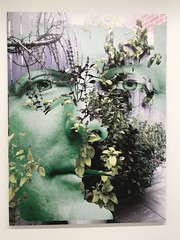
Beyond this, there was still more to explore. The MAF has a large permanent collection that they rotate through exhibition, and judging by the very recent dates on some of the works I saw today, they are actively continuing to expand their collection. Mimi Lauter has a gorgeous 8-panel abstract painting in brilliant peacock hues. A wall full of different colored mirrored windows forms the “clockwork for oracles” by Ugo Rondinone. Photographer Catherine Opie has a fascinating series of intimate photos from inside Elizabeth Taylor’s home (not of Ms. Taylor, just of her home and her stuff). Urs Fischer has created a series of intriguing self-portraits spliced onto scenery, using cuts and color washes and creative construction. These are just some of the highlights. This museum is really such a treat.
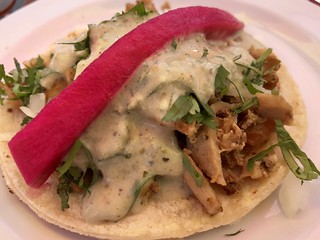
FOOD: Galbi at Sun Nong Dan in Koreatown

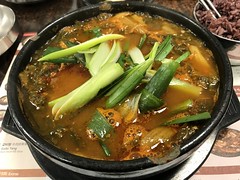
Today I lunched at the famous Sun Nong Dan in Koreatown. It lies in a strip mall at 6th and Alexandria, amdist a handful of restaurants, each with distinct specialty dishes. I tried the oo guh ji galbi tang, a bubbling pot of hot chili broth with some beef short rib and “dried cabbage” (seemed more like collard greens). It came with some nice banchan -- chili scallions, kimchi, chili turnips. I’d heard that the galbi jjim is the thing to get, but I need to bring friends next time, cause the smaller serving size feeds three or more. It was pretty awesome seeing it at other tables when they topped it with cheese and melted it with a blowtorch.

Saturday, February 02, 2019

FILM: The Wife

We had missed this last fall, but with Oscar nominations out, it's back on the big screen, and I'm glad we got the chance to see it. Everyone has been buzzing about Glenn Close's performance in The Wife, and rightly so. Jonathan Pryce is also brilliant as her husband, the Nobel-winning writer, but even if the title hadn't clued us in that we should be watching her, Close's character Joan, tautly rendered and slowly revealed, would command our attention. This fascinating character story examines what it takes to be a great writer, but examines it by showing us this moment of winning the Nobel, and the life that lead up to it. One of the scenes, where Joan spontaneously agrees to have a drink with a persistent would-be biographer (Christian Bale) who is trying to wheedle dirt out of her, reminded me of a similar scene from years ago of Olympia Dukakis in Moonstruck, where she rebuffs a proposed affair, "because I know who I am."  Likewise, Joan knows who she is. There's a writerly line from James Joyce that crops up a few times in this film, "His soul swooned slowly as he heard the snow falling faintly through the universe and faintly falling, like the descent of their last end, upon all the living and the dead."  The film culminates in Stockholm in December for the Nobel ceremony, and there are just enough graceful set shots of the stark beauty of that city in winter. In a shot near the end, there is a close-up of Joan's face, and through the window behind her, we see the snow falling faintly, just the way Joyce said it would. I haven't read the book that this film came from, but I'm sure it must have been quite a job to adapt such inherently literary, non-cinematic material. Yet it is deftly done, with fine acting conveying much beyond the words.

Monday, January 28, 2019

BOOKS: Boy Erased

Often it works well to see the movie first and then read the book, as a book has scope to describe so much more, especially what’s going on inside people’s heads. Boy Erased was absolutely such a book. I really enjoyed the film, but I also left with some unsatisfied curiosity about his internal journey of self-understanding. The film showed us what it was like to suffer through the fraudulent travesty that is “ex-gay ministry”. The book filled in more, not only of that experience, but of what it was like to grow up a boy in a close faith community, and by coming out as gay, lose not only his community but his faith. His account was impressionistic, not strictly following a timeline, but a chain of memories and reflections in a stream of consciousness. It was an emotionally faithful way to convey the sense of someone whose life picture was shattered, and he’s picking up the pieces and trying to make sense of how they might fit together again. Many of these memories he’s undoubtedly replayed countless times in his head, sometimes reinterpreting old things in new ways. I’m glad he had the integrity to get through it and tell this remarkable story.

Saturday, January 26, 2019

FILM: BlacKkKlansman

BlacKkKlansman is the horrifying and riveting story of audacious rookie cop Ron Stallworth, the first black cop in the Colorado Springs Police Department in the 1970s, and his stunning infiltration of the Klu Klux Klan, with the help of a Jewish partner. The film is all the more impactful for being, as the film itself declares in an opening title, “based on some fo’ real, fo’ real shit.” The story initially touches on his challenges being the first black cop in the police department, and being assigned to go under cover at black nationalist rallies. The film nicely captures the 1970s era and its racial dynamics. Though the film has a period feel, the dynamics are uncomfortably familiar. Stallworth’s “double consciousness” about being a black cop becomes even more fraught when he starts dating the president of the local college black students organization. But the film really gets intense when Stallworth starts to infiltrate the KKK, posing on the phone as a racist who wants to join them, but forgetting to use an alias instead of his real name. When the local Klansmen want to meet him in person, he has to recruit a colleague to pose as the “white racist Ron Stallworth”. The two “Ron Stallworths” work hard to keep their stories straight, but the wheels come dangerously close to coming off the rails. It doesn’t help that the white colleague also happens to be Jewish, and if the KKK hate anyone as much as the blacks, it’s the Jews. When the grand wizard David Duke himself (uncannily portrayed by Topher Grace) comes into town to preside over Ron’s Klan initiation ceremony at the same time as the black student organization is hosting a revered civil rights icon (and creating a tempting terrorism target for the Klansmen), the intensity and suspense in this film go to 11. Here director Spike Lee has created a masterful extended sequence of the two mindbogglingly concurrent but dissonant scenes – the Klan ceremony and the civil rights leader’s speech – sometimes cutting back and forth and sometimes showing both split-screen. It fires on multiple levels at once, with the dissonance of the two diametric views of national justice compounding on the double procedural suspense of the terror plot and the undercover operation ready to unravel at any moment. I was breathless. The denouement is equally brilliant, managing to be both profoundly satisfying and provocatively jarring. Just when you might be tempted to feel a comfortable distance from another era when times were different, Spike Lee throws ice cold water in your face, saying “that was then, but that is also now.”

Saturday, January 19, 2019

FILM: Green Book

The film Green Book is named for the Negro Motorist Green Book, a publication something like a special Auto Club guide for black people that allowed them to travel safely across America during the Jim Crow years. (Gay people my generation and older will be familiar with the concept from Damron or Spartacus Guide books.) Those of us lucky enough never to have suffered Jim Crow laws may not have thought about the pragmatic burdens for people of color making road trips in that era, finding a place to stay, or eat, or whole towns best to avoid. This film shows us all of that in uncomfortable detail, but in the course of a very engaging road trip story with two intriguing characters. Dr. Don Shirley (superbly portrayed by Mahershala Ali), a black man, is a renowned concert pianist with exquisite diction in multiple languages and a rather affected manner. Tony Vallelonga (perfectly embodied by Viggo Mortensen) is an Italian-American night club bouncer who gets hired by Dr. Shirley to be his driver and bodyguard on a concert tour across the Midwest and South in 1962. What transpires between those two in the course of that trip is an education for them both, and a fascinating story to watch. It’s a great reminder as a nation of where we have come from, a prompt for thinking of present struggles we still need to work through, and an inspiration for how that progress is slowly won through personal interactions across our divides.

Saturday, January 12, 2019

FILM: On The Basis Of Sex

Not one but two films this year illustrate what a fascinating and dramatic life Ruth Bader Ginsberg has lived. In June, we loved RBG the documentary, but last night we really enjoyed On The Basis Of Sex, a dramatization of formative episodes in her early years. The film begins with a great shot of a sea of young white men in dark suits striding into Harvard Law School, and then amidst them, one woman in a blue dress. We get to see young Ruth in law school, and what it was like being one of a handful of women in one of the first years women were admitted at all. Including a scene where the dean of the law school asks her to explain why she chose to go to law school and take up a spot that could have been given to a man! We heard some of these same stories in the documentary, but it’s something else to see them dramatized. We see her own experiences of sex discrimination challenges and indignities in her own early job search, her being a law professor at Rutgers teaching progressive young students in the 1960s, and then her first case with the ACLU that was the genesis of her later amazing career in a string of cases challenging gender discrimination. But the heart of the film is the whole family dimension, the amazing way that she and her husband Marty supported each other, and their relationship with their growing daughter and son, for whom Ruth and Marty wanted to set a great example as well as make a better world. While the climax is a dramatic courtroom procedural, strong in its own right, it gains even more emotional heft from the family and love story behind it.

Friday, January 11, 2019

ART: La Cienega Gallery Crawl: Kwame Brathwaite, Dana Weiser, Farrah Karapetian

There’s a stretch of La Cienega Blvd, just south of the 10 but above Washington, lined with single-story brick buildings lacking windows, a light industrial look that wouldn’t draw attention. But a closer look and it turns out that many of those are small private art galleries, and this is a whole art district, its non-descript walls concealing a great variety of creative work just waiting to reward those who venture in. I’d driven past it countless times, but the KCRW Art Talk podcast urged me to check it out. I was glad I did.

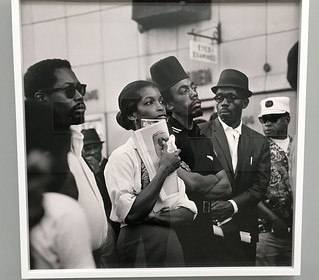
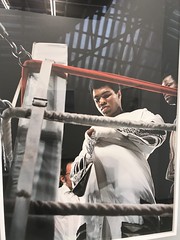
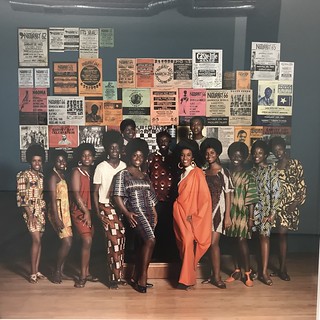
The first gallery I’d ventured into was Philip Martin, featuring an exhibit called “Kwame Brathwaite: Celebrity & Everyday”. This retrospective looks at the early part of the American photographer’s career in the 1960s and 70s when he came to prominence organizing pageants of exclusively black models, and popularizing the phrase “black is beautiful”. The show included a good selection of works representing his photos of celebrities, of models, and of Harlem street life. The model photos are full of beautiful African-American women posing in 1960s African-inspired fashions, proudly claiming their natural beauty and heritage. Many of the celebrity photos, in contrast, are unposed and unstaged, catching candid and sometimes even vulnerable moments. He catches a surprisingly vulnerable glimpse of Muhammad Ali in a boxing ring. James Brown is on stage, with the light in the photo catching him in a moment of soulful expression, a synesthetic image that almost makes you hear the note he is singing. At Garvey Day parades in Harlem, Brathwaite’s eye is more on the crowd than on the parade itself, catching fascinating arrays of spectators and just people on the street, and conveying a mood, the feel of the street.


Just up the street, Walter Maciel Gallery was showing “If There Were Tigers” by Dana Weiser. The work shows a young artist who has thought deeply about her identity, as well she might, being ethnically Korean but adopted by a white family in Minnesota. In a series of works, she has taken traditional Korean hanbok dress material and traditional Korean folk art patterns of embroidery, but infused it with themes and objects from her American life. Some may appear as a traditional still life at first glance, but then you notice the speaker, the sunglasses, or the toy helicopter. They are thoughtful and playful at the same time. One captivating piece called “Mystical Lineage” contemplates unknown ancestors as traditional costumes worn by invisible bodies. Another more provocative series are self-portraits entitled “Enacting My Koreanness”, in which she recreates some traditional masks in make-up on her own face, very expressive about perceived expectations. (I couldn’t help but think about Margaret Cho’s bit about Asian chicken salad.)


Across the street at Von Lintel Gallery, Farrah Karapetian’s “Collective Memory” installation evoked her memories of LA’s last lesbian bar, the recently closed Oxwood Inn. This immersive show not only included highly rendered photography, photograms, and works incorporating text, but also a glass pool table, a glass brick wall, and recreated parts of a bar and a restroom. The glass brick wall had some graffiti on it, and black sharpies nearby invited the gallery viewer to add to the art. (With some active encouragement from the gallery staff, I added my own bit of graffiti.) Red neon lighting enhanced the sense of place being created. This gallery turned nightclub memory provided an atmospheric showcase for Karapetian's works.

FOOD: Destroyer

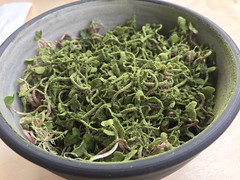
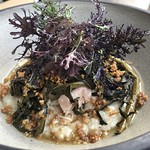
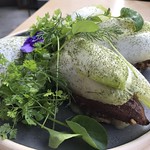
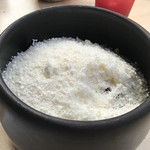
If you're daunted by a $$$$ tasting menu at Vespertine, fortunately you can sample some of Chef Jordan Kahn's inventive cuisine at the much more casual Destroyer across the street. As you're standing in line to place your order (yes, it's that casual), you can peruse the menu, projected on the wall, divided into categories of "cold", "hot", "sweet", and "ready". And while you'll recognize nearly all of the individual words and ingredients in the menu descriptions, the way they are composed will be completely unfamiliar. Smoked egg cream? Pickled mushroom? Roasted strawberry? Berries paired with meats and vegetables? You just need to pick something you're not allergic to, and trust in the mad genius of the chef. When the food arrives, it mostly comes in ceramic bowls, and you learn that Kahn likes to layer things, with a top cover so that all is not revealed at once. It adds to the sense of discovery that you can't immediately recognize what you're looking at, and you probably have to dig under one ingredient to see the rest. You ordered chicken and it appears they brought you a salad? Dig down. Under those spiky greens (spigarello), you'll pull up forkfuls of tender chicken confit with a flavor that's really good, but you can't quite put your finger on it. That's because you've never before tasted what happens when chicken is mixed with heirloom grits and roasted strawberries. Another bowl arrives, and it too looks like a salad. But plunge in, and you'll find beef tartare lurking beneath those radish sprouts, with pickled mushrooms and smoked egg cream. A third bowl arrives, a dark bowl with a heap of creamy white powder that looks like a bowl full of finely grated parmesan. A tentative taste of the mysterious substance and you discover that it is cold, like snow, and has a little bite, as if snow were made not of water but of frozen horseradish cream. Catching on to the game, you dig under the snow drift to discover chunks of beets. But wait, there's something sweet too. It's blackberries. And that crunchy bit? Pumpkin seeds. You contemplate the comparison of vegetable sweetness with fruit sweetness, punctuated by pumpkin seeds and spiked by creamy horseradish. And the frozen horseradish snow keeps the whole thing chilled, which, you realize, affects the brightness of the taste, because it would be different if it were all warm. The roasted yams come on a plate with avocado, but you don't see either of those things right away, because the avocado is covered by yogurt and the yams are carefully concealed under endive leaves, along with a handful of fresh green herbs and a flower, in a very Instagrammable presentation. Kahn has referred to his flagship Vespertine as a spacecraft, and as you gaze across the street at that remarkable architecture, you begin to see why. But as you enjoy the delicious tastes of things you'd never have imagined meeting in the same bowl – vegetables and fruits, cooked and raw – you also realize he's transporting you to a whole new planet, fundamentally composed of known elements, but in otherworldly formations. (Fittingly, this whole neighborhood in the northeast corner of Culver City is filled with dot-com hipster ultramodern architecture, so as eye-popping as Spacecraft Vespertine is, it's not out of place.) Go with a sense of discovery.