Saturday, April 28, 2018

FILM: Disobedience

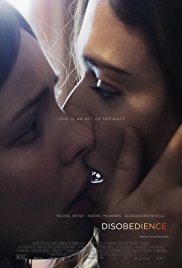
Some great performances from Rachel Weisz and Rachel McAdams, and an interesting situation: the daughter of a beloved orthodox rabbi, broken away from the community after a youthful lesbian affair, returns for her father's funeral. I found it interesting, though not completely satisfying in the end. I did like that the portrayal of the orthodox characters wasn't completely monochromatic heavies. But I wasn't sure what the principal characters really wanted, or why they made some of the choices they made, or what really happened in the end. The film began and ended with a rabbi pondering man's unique gift and responsibility of freedom, suggesting that the film had a point to make about that, but if it did, I left unsure what the point was. And perhaps in keeping with Jewish tradition, it's more about the questions than the answers.

Friday, April 27, 2018

ART: LACMA: Hockney Portraits, Teotihuacan, Young Il Ahn, and the Coronation Carpet
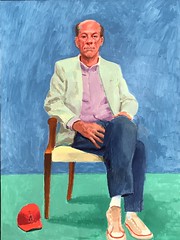
There’s a trove of things going on at LACMA. The Hockney show “82 Portraits and 1 Still Life” is fascinating and distinctively colorful. The artist did this series of portraits over a couple of years, inviting a variety of people to sit for him, ranging from big names in the art world to the artist’s dentist, his housekeeper, and her daughter, subjects ranging in age from 8 to 80s. Each subject sat in the same chair in the same setting for three days for Hockey to capture what he playfully called a “20-hour exposure”. The result makes you really appreciate the portraits, what is unique about each, and how personality is expressed in the face, the hands, the way each one sits in the chair. The colors are all Hockney’s signature vibrant colors.

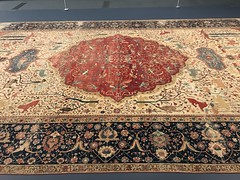
Then walk across from BCAM to the Resnick Pavilion and step back 500 years to see a palatial Persian carpet from the early 1500s when Persian carpets really started to become a national industry. This particular carpet features a central medallion in red, a field of cream richly decorated with trees, vine, and animals, corner scenes on red, and an ornate deep blue border. This particular carpet is called the Coronation Carpet, as it was used in front of the throne at the coronation of King Edward VII of Britain.
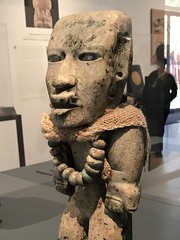
Then step into the next series of rooms and back another 100 years or more to see “City and Cosmos: The Arts of Teotihuacan”. This fascinating exhibition presents a large collection of artifacts from the ancient Mesoamerican city of Teotihuacan, which flourished in the first few centuries CE, a thriving cosmopolitan city of 125,000 people at its height. The city was divided into districts dedicated to different gods and with different types of crafts. The exhibit is similarly arranged, to show the different artifacts in proximity which part of the city they were found in. I was quite taken with the expressive statues and masks, ceramics and stoneware, and the murals, many of which are surprisingly vivid even today. Their colors were mixed into plaster in way that allowed the colors to endure, and apparently the city was brightly colored with a lot of murals.
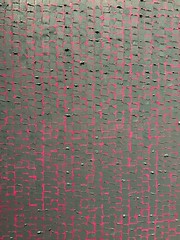

Over in the Hammer Building, I flashed back to the present time, with a showing of Korean-American abstract artist Young Il Ahn. His “Water” series plays on a theme of “unexpected light”, with a very large panels of what appear to be monochrome colors from a distance, but on approaching, appear to crack, and an underlying color of unexpected light breaks through. The hidden colors have such a luminous quality that the paintings almost appear to be backlit, and it is surprising to see the previously unseen colors emerge as you get closer. It reminded me of being on Hawaii and seeing a lava flow at dusk, dark volcanic rock with an eerie orange light glowing through the cracks from below.

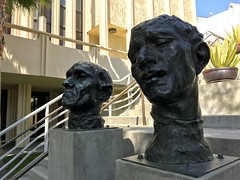
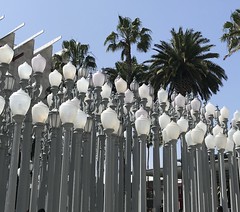
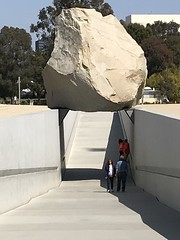
And of course I had to visit all my perennial favorites: Chris Burden’s “Metropolis” (the most amazing track for Matchbox cars ever) and “Urban Light” (the most Instagramable collection of lampposts) , Tony Smith’s “Smoke”, Michael Heizer’s “Levitated Mass” (the giant boulder suspended overhead), and the Cantor Sculpture Garden full of Rodin and Bourdelle sculptures.
Saturday, April 21, 2018

FILM: Isle Of Dogs

Wes Anderson is always so creative and this latest film was no exception. Wonderfully original and completely off-the-wall story, gorgeous animation, great voice characterizations from the troupe of talented actors who follow Anderson wherever his inventive mind leads. Thoroughly enjoyed every minute.

Friday, April 13, 2018

BOOKS: Born A Crime

South Africa, both under apartheid and after it, is such a different place to anything I have experienced, making Trevor Noah’s autobiographical “Born A Crime” such a fascinating book. Even for South Africans, Noah’s perspective is rather unique. His title “Born A Crime” comes from the fact he was born of a white father and a black mother, which violated anti-miscegenation laws still active on the books at the time he was born. My eyes were opened to so much about South African society. I hadn’t understood and appreciated how blacks are so divided by tribes with distinct languages (a situation ingeniously and insidiously exploited by the apartheid system to discourage blacks coming together), nor how people were divided not only black and white, but also an intermediate category called “colored”, which included people of mixed ancestry, Indians, and other arbitrary distinctions (for example, Japanese people were officially “white” while Chinese people were officially “colored”). Noah was raised by his mother, an extraordinarily strong and independent woman who was pushing boundaries even before apartheid was abolished. She taught him English and Afrikaans as well as several tribal languages, sent him to private schools, and gave him a window on many parts of society, living at times in a black township or middle-class neighborhoods, attending white churches. His mixed-race status, many languages, and varied experiences made him someone who could fit in anywhere but belong nowhere. He thus grew up developing keen insight into the complex society around him as can only be gained by someone who is “insider” enough to understand and sympathize but also “outsider” enough to make objective appraisals. His stories are packed with humor, understanding, insight, and at times a challenge to see the world a different way. In one story, he thoughtfully unpacks why among South African blacks the name “Hitler” doesn’t have anything like the infinitely negative charge we assume should be universal, and how that lead to a colossal misunderstanding with a black dance troupe performing at a Jewish school hosting a multicultural diversity festival. Through other stories, he explains life in the township and life in what we would call “the ‘hood”, and why they may think about crime a bit differently than you do. Other stories are just generally human, experiences growing up in various schools trying to fit in, getting a date for the prom, and so on, all told with great charm and humor. And his keen insight is also brought to bear on abuse and alcoholism, in stories of how his step-father abused his mother. This is a fantastic book, and it is even better as an audiobook, since it is read by the author. He has the gift of writing the way he talks, which since he is a comedian (and now the host of the Daily Show) is quite engaging. Hearing him do all the voices, the dialects, and even occasionally the languages (including those Xhosa clicks) as he tells his stories brings them even more to life in vivid color.

Saturday, April 07, 2018

FILM: Finding Your Feet
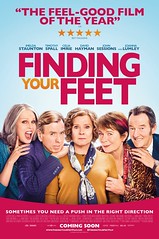
Yes, it's fun. Go in expecting nothing more than simple enjoyment, don't examine it too closely, and let these superb actors enlivening a work-the-stops script play you like a violin, and you'll leave happy.

Saturday, March 24, 2018

BOOKS: Behind The Beautiful Forevers

In Behind The Beautiful Forevers, author Katherine Boo renders a fascinating slice of, as her subtitle has it, “life, death, and hope in a Mumbai undercity”. The slum called Annawadi lies on a patch of empty land between the Mumbai International Airport and a row of gleaming high-end airport hotels, a crowded community of people struggling to stay alive and perhaps get just a little bit ahead, living precariously in improvised shacks on land they have no legal claim to, which could be bulldozed at any time. In this community lies a rich tapestry of dreams, schemes, motivations, crushing circumstances, corruption, prejudice, envy, and surprising wellsprings of hope and perseverance. This is a work of narrative non-fiction. It is non-fiction in that all of the characters are real people, using their real names, and the incidents described are real. The author spent years visiting, interviewing, getting to know, and following a number of people over many years. She witnessed some events herself, gathered other events from interviews, cross-checked, and verified where possible with public records, with a journalistic diligence. Boo’s descriptions of the characters and their circumstances are vivid, and she skillfully weaves them into an engaging narrative by using a pivotal event – a woman who sets herself on fire, with lasting repercussions on several families – as a through line to propel a sense of story. I was rapt in the stories of these people, their lives so foreign to my own experience, and appalled at some of the things they suffer. I think what I found most unexpected was how much these people who have so little are regular targets of extortion by corrupt police, corrupt doctors, and corrupt teachers. Many of them work hard at what they can, a few actually claw their way ahead, but all are so buffeted by larger random circumstances that any connection between hard work and getting ahead is quite tenuous. Larger events, like the construction of the airport, the 2008 Mumbai terrorist attacks, and the 2008 Great Recession in America, all had their ripples in this fragile slum. A century ago, Sholem Aleichem vividly described the struggles of Jewish life in 19th century Russian shtetls (tales which inspired Fiddler on the Roof). Boo brings that same kind of sensitivity to precarious lives in tenuous tenements, combined with the accuracy of a journalist, in painting this portrait of Annawadi and its inhabitants.

Saturday, March 17, 2018

FILM: Love, Simon

We thoroughly enjoyed Love, Simon, a sweet coming-out romantic comedy that just “came out” this weekend. Those of my generation will remember John Hughes films, and how he so poignantly captures the characters and the drama of high school, all the angst and awkwardness of figuring out who you are and finding your place in the teenage world. Director Greg Berlanti captures that same kind of authenticity in this Sixteen Candles meets You’ve Got Mail with a gay coming out twist. It’s especially heartwarming to see coming out films like this, so different from the coming out films of when I was coming out. Back in my day, coming out itself was the drama. In this film, I think it’s fair to say that it’s a regular teenage rom com, where coming out just makes for an inventive new plot device that drives the inevitable complications of a good rom com. He has a great family, great friends, and a school where the teachers and the administrators all do the right thing when some students behave poorly. Granted not everybody has that even today, but supportive parents, friends, and schools are not nearly the unicorns they were when I was coming out 35 years ago. When Greg Berlanti directed The Broken Hearts Club back in 2000, that was mostly an art house film appreciated by mostly gay audiences. Now in 2017, most of our gay friends who watched Love, Simon reported cinemas filled with teenage girls. And this film was noted as the first major studio release focusing on teen gay romance. One reviewer used the phrase “revolutionary normalcy” in describing the film, and I think that really hits it. In the context of the progress of gay acceptance, it does feel surprisingly revolutionary in its just being a sweet, light, enjoyable, mainstream rom com that happens to have a gay lead, with mainstream audiences all cheering him on. After all these many years of visibility, I didn’t think we had new breakthroughs yet to be had, until I saw this, and it was like “Oh! This! Yeah, we haven’t actually seen this before.” It just seems to be a moment of this new level of mainstream visibility between Call Me By Your Name and Love, Simon. And I got the same feeling from Romil and Jugal, a charming Bollywood web series with a revolutionary-normal coming out romance. There’s a line in the film where Simon’s Mom says she didn’t know that he was gay, but she knew that he had something heavy on his mind, “It seems like you’ve been holding your breath for years. Now you finally get to exhale.” Sometimes you don’t realize how long you’ve been holding your breath until you exhale. And this film is such fresh air.

Friday, March 09, 2018

ExploreLA: Korean Tofu Soup and the Marciano Art Foundation

More off-Friday explorations of Koreatown, today at SeongBukDong. This bubbling cauldron is yachae soondubu, soft tofu soup with veggies, 🌶 🌶, and an egg for richness. Served with a lovely array of banchan (little dishes of pickled turnips, cabbage, greens, and other veggies). The spice-heat is selectable, and I braved “medium” which I enjoyed with some tears and sweat. I was the only non-Korean in the place - love that.

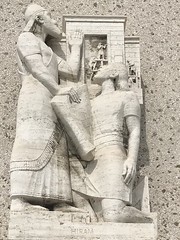
After lunch in Koreatown, today’s off-Friday adventure took me to check out the new Marciano Art Foundation on Wilshire. Maurice and Paul Marciano, the brothers who founded the Guess clothing business, were avid supporters of the contemporary art scene in Los Angeles, and wanted to share their collection with the public. They bought the old Scottish Rite Masonic Temple on Wilshire, which was basically abandoned since 1994, and have repurposed it as a modern art museum while preserving features of the historic building. Before going inside, I wandered around the outside of the building, a mostly windowless giant travertine box adorned with enough mysterious Masonic symbology to inspire Dan Brown’s next Robert Langdon novel. A series of monumental travertine sculptures depict a curiously diverse set of figures including Imhotep, Zerubabel, Hiram, the “Saints John”, someone “de Reims”, Christopher Wren, and George Washington. A giant mosaic mural depicts the history of temple building, with an equally curious selection of cities starting with Jerusalem, Babylon, Acre, and Rome, and ending with Boston and Sacramento. (Sacramento? Apparently the first Grand Lodge in California was established there in 1850.) The building was constructed in 1961, designed by artist and architect (and Mason) Millard Sheets, who was famous for his mosaic murals including many Home Savings bank buildings throughout southern California.

Inside the building, the many large spaces of the old temple have been nicely repurposed for display of the Marcianos’ collection and other exhibitions, many of which are quite large and need this kind of space. On the first floor, the cavernous hall that used to be the theater has been given over to a special exhibition called Reality Projector. Artist Olafur Eliasson designed this dynamic work specifically for this space. The vast three-story hall is empty like a warehouse, with concrete floors and exposed steel rafters, and is dark when you enter, illuminated only by the projection of abstract shapes in primary colors on the far wall. The shapes slowly move across the wall, intersecting each other in a way that gives depth in the sense that some shapes seem to be in front of or behind others, and the shapes are transiently obscured by large moving shadows. The projected light intentionally hits the exposed rafters as well, using them as a fragmented, layered screen. You’re invited to sit on a bench in the back of the room, or wander into the middle, or just drop down on the concrete and sit or lie down and watch this oddly fascinating light show pass by, like clouds on a windy day, if the clouds were painted by Ellsworth Kelly or Piet Mondrian. All of this is accompanied by a soundtrack of indistinct ambient noises and sounds. The combinations of shapes and colors seemed random and non-repeating, and I actually stayed in there a fair while, and revisited later on an upper mezzanine overlook.

On the second floor is another special exhibition called “Line Packers”, featuring the work of two German artists, Peppi Botrop (1986-) and Albert Oehlen (1954-). Botrop, who hails from the Ruhr region of Germany (picture an old coal and steel industrial area, something like the German equivalent of Allentown, Pennsylvania), made a series of works alluding to those roots, using large slabs of Fermacell (an industrial material used like sheetrock in institutional buildings), charcoal to make dark visceral lines, and then carving and scraping the sheetrock. Oehlen, beginning in 1992, created a series of works exploring the possibilities of computer drawing, with sheets of black on white graphics printed from a Texas Instruments computer, lightly enhanced with black paint. Multi-artist exhibitions will often talk about the “dialog” between works of different artists exhibited adjacent to each other. But here, they’ve done something I’d never seen before: they created an actual mash-up of these two artists’ works, displaying them on top of each other, in a way that invites not only comparison but a contemplation of relationship and visual continuity between these two artists of different generations.
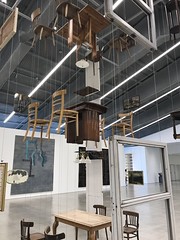
On the third floor is the permanent collection of the Marciano Foundation, mostly paintings with a few sculptures, with a large well-lit space suiting the large scale of most of the works. Many of the works are quite abstract, explorations of texture as much as color and shape. One artist, Jennifer Guidi, has a series made of paint mixed with sand that she could layer on the canvas thickly, and then poke, scrape, and mound up in interesting ways. The sort of works that you want to regard from a distance for their visual impression, and then look at up close and from the side to admire the technique. Then there are other works that are a bit more representational, or at least symbolic. Two giant works by Lari Pittman are filled with bold colors and a fascinating medley of recognizable forms and really good Rorschach tests that made me want to figure out what all is going on in them. Another large mural by George Condo seems at first just to be a bunch of lines, until as you look, more and more organic shapes – eyes, teeth, arms, coats and ties – begin to emerge from the apparent chaos. Perhaps my favorite work was a large sculpture in the center of the large main gallery that was essentially a bunch of furniture and home goods suspended in air by wires. The playful Architecture Without Architects by Damián Ortega is like a CAT scan of a multistory apartment building. Imagine three apartments, one above the other, with all of the walls, floors, and ceilings removed, but all of the furniture, lights, and stuff magically floating in place. Doors float without their door frames, with doormats floating in front of them, and perhaps a pair of shoes on a mat. Paintings float as if hung on invisible walls. Flowers in vases, glasses of water, and cigarettes in ashtrays rest on tables floating in space. I found it amusing and fascinating.

The mezzanine, between the ground and “second” floor, is also worth a stop. That’s where I found the balcony overlook for a second look with a new perspective at the Reality Projector light show. There’s also a fun mural along all four sides of the atrium lobby by Alex Israel, celebrating the streets and sidewalks of Los Angeles, with all sorts of native plants befitting an atrium, but also parking meters, newsstands, street signs, and other urban ephemera. It’s charming. The other thing worth a peek on this level is the library, where they have a bunch of artifacts from the Masonic temple on display, including the funny hats, costumes, and more mysterious symbology.

This exciting new addition to the LA art museum scene is open Wed-Sun. Admission is free and the parking is free too (check that out, Getty Foundation!), but you should reserve a timeslot by getting a free ticket on their website. Line Packers is on display through June, and Reality Projector through August. Check it out! (See full album of photos here.)

Saturday, February 24, 2018

ExploreLA: Myung In Dumplings and Robert Irwin at the Sprüth Magers Gallery

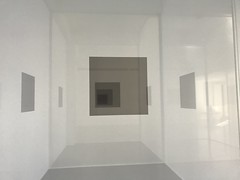
Fun off-Friday explorations. Lunch of Korean dumplings at Myung In in K'town. A variety of delicious steamed and fried dumplings, and those "wang mandoo" gigantic soft doughy bao stuffed with ground pork, shrimp, and veggies! Then wandered down to Mumu Bakery, where they make these filled brioche -- fresh and warm, sweet and flaky, filled with cream cheese or red bean or nutella or apple-mango. Then for some art, we headed to the Sprüth Magers Gallery in mid-Wilshire, where a Robert Irwin installation has taken over the whole place. They knocked out interior walls, opened up exterior windows, and put in these white scrims with black boxes. This simple device has a fascinating effect that just makes you want to walk all around and view it from all different angles just to see how the translucent boxes juxtapose in different ways.

See complete photo album here.

Friday, February 09, 2018

ExploreLA: An Afternoon In India (via Chino Hills and Artesia)
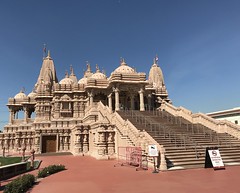
With an unexpected day off of work, I thought I would go to India for the afternoon. Or at least to the BAPS Sri Swaminarayan Mandir (Hindu temple) in Chino Hills. This temple was absolutely stunning from the elaborately carved teak of the haveli (visitor center) to the Rajasthani pink stone of the mandir (temple). And then the interior (no shoes, no photos) is even more breathtaking, as elaborate but all of white Carrera marble. By luck, I was there when an arti (devotional service) was about to start, so I was invited to join others who were starting to sit cross-legged on the floor in the midst of this temple, facing some teak doors. I sat next to an old Hindu and just tried to follow his lead. With a waft of incense some lively musical chanting began, and we clapped in a beat. The doors opened to reveal dazzling brightly colored murtis (statues of deities), with saffron-robed monks waving candles in front of them. After a while the monks set down the candles and did some ritual prostration (looked like flow yoga) while someone brought the candles around to us on the floor, where each person held their hands over them to feel the heat. After this was done, the monks came to the edge of the altar and I followed as others formed a receiving line to greet the monks by first bending down to touch their bare feet and then shaking their hands.

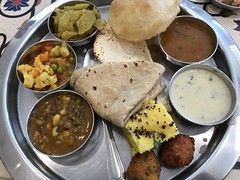
After exploring the temple, I drove to the "Little India" neighborhood of Artesia to have lunch at Rajdhani, a place known for thali, which is like the Gujarati version of dim sum. Thali is literally the word for the metal tray with little metal bowls that servers come around and endlessly fill with soups and stews and breads and rice. There was a spicy lentil curry soup with peanuts, a yogurt soup with herbs, fried green mango, cauliflower and peas, beans. All veg of course. And breads to soak it all up - puffy fried puris and flat rotis. After lunch I wandered the neighborhood to check out the shops with saris and other fashions, “cash and carry” markets with exotic produce, spices, and all sorts of stuff. So awesome to go to India for a day. I love LA.

(See complete photo album here.)

Friday, February 02, 2018

Why I'm Captivated by Romil and Jugal

To the makers of Romil and Jugal: Thank you for this wonderful creation of yours. I have been captivated by it for the last two weeks, and many scenes authentically touched me and flooded me with emotional memories of when I was Romil and Jugal’s age and just coming out myself. When Romil says he felt as a young boy like he had some sort of “manufacturing defect”, I remember that feeling. I had times when I thought I was some kind of alien. And when he talks about being “on top of the world one moment and scared shitless the next”, oh I so remember that! My first romantic encounter was an exhilarating revelation, and I thought “This! This is what I was supposed to be feeling with girls but never did, and now this feels so right!” And then wondering the next morning how to make sense of it all, and what the heck was I going to do. When Romil and Jugal are on the mountain wondering what their future could possibly be like, that takes me back too. I always tell people that we gay people grow up with the same hopes and dreams as everyone else. I imagined a life getting married to a woman, having children of my own. Then when I discovered I was gay, my picture of my future was torn into a thousand pieces, and I had no idea what to put in its place. At that time in my life, in America in the 1980s, there was nothing to point the way, nobody I knew, no characters in film or on TV, no picture at all. But I was so much like Jugal, unshakably convinced that what I was feeling was right and good and true, despite everything in society telling us otherwise. Even though I could scarcely imagine how two men loving each other could openly fit into the world, I knew I would somehow make it work, even if I had to change the world. Coming out with integrity takes real courage, and I loved your portrayal of that. When Romil kisses Jugal in the café, that takes me back too! I remember well when kissing in a public place was a calculated risk, a self-conscious activism, never just innocent affection. But those small acts are the kind of thing that slowly change the world, and I know that your web series will have an impact in changing the world for the better. I do not know India, but I do know what it is to come out as gay, and I promise you that there will be countless young gay boys across India who will be so encouraged by this. Love is love in any language, as I proved by watching your show. I speak not a word of Hindi, and I didn’t discover until the 10th episode that there was an option for English captions, but I was still gripped by your story. The acting, the expressions, the tone of voice, and the occasional English words were enough to tell the story (although I’ve gone back and re-watched with captions to pick up more of the nuances). I should also add that the Shakespeare rehearsal scene, when Jugal steps in for Rosie, was especially magic for me. Those very lines were read at my own wedding in 2001, before marriage was legal anywhere in the world. Later in 2008 when it became legal in California, Juliet’s banter about whether vows once given can be given again became quite real for us, as we did just that before a judge. Even though my own experiences were in a very different time and place, and though I was fortunate enough not to have to face a choice between family and integrity, I know the challenges you depict are still all too real in too many places today. Thank you for helping to change the world!

Wednesday, January 24, 2018

TV: Romil and Jugal

I blame our friend Nitin. He started me on this. While everybody else is binge-watching The Crown or Stranger Things, what have I got hooked on? Romil and Jugal. It’s loosely inspired by Romeo and Juliet, except the star-crossed lovers are two college boys in a hill station town in northern India. Their families aren’t so much feuding, although the fathers are rivals at work, and there’s a north/south Indian culture thing I’m just learning about, with Romil’s family being flambuoyant northerners while Jugal’s family are buttoned-up “Tam-Brahms” (the highest caste from Tamil Nadu). But of course the real crossed stars are the love that dare not speak its name. Sodomy is still a crime on the books in India (though the Supreme Court may reconsider the infamous “Section 377” this year). Romil and Jugal was originally planned as a feature film but they feared it would be butchered by the censor board that regulates films in India. Instead it was produced for streaming media which is less regulated. Not that it’s very racy at all, certainly by American standards. It’s a light-hearted soap opera, a little goofy, sweet in its earnestness, the boys are adorable, and it’s hard not to root for them. Of course I would think that, but judging by fan comments I’ve read, it really appears to be winning over a new generation in India. I saw many comments from people confessing they’d had negative attitudes about homosexuality but seeing this show helped them realize that love is love. This is exactly the sort of thing that turns tides, recognizing that love transcends arbitrary human bounds. Speaking of love stories crossing boundaries, there is one little hitch I should point out if you’re tempted to check it out. I’m watching it in Hindi. You can also get it in Tamil, Telugu, or Malayalam, but not in English. Not that I understand any Hindi, but it turns out that the way a lot of people naturally speak in northern India is more like “Hinglish”, Hindi with a lot of English mixed in. Between the action, expressions, tone, and the partial English, you can follow along enjoyably enough without knowing any Hindi. Love is love in any language. (Also, the first five episodes are free, but then you have to spring a few rupees.)

(Update: After watching 9 episodes without translation, I discovered there's an option for English captions by hitting a button on the lower right corner of the browser.)

Friday, January 19, 2018

Nobody Knows The Day Or The Hour
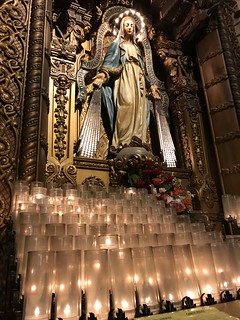
Nobody knows the day or the hour. Plans and dreams can be swept away in a blink. Cherish the people in your life and be grateful for every day you live. I lit candles and said prayers today for two friends. Both about my age, living well, every outward expectation of many good long years ahead. One received a grim diagnosis last month and is now in the ICU. The other had seemed to be putting breast cancer behind her, but went into the hospital unexpectedly a couple days ago and passed away this morning. Cancer sucks.

ExploreLA: Holbox and St. Vincent de Paul

Today was my first encounter with the legendary foodie cluster near USC called the Mercado La Paloma. Lots of good choices to try, but I zeroed in on Holbox, a mariscos bar serving some amazing fresh shellfish and fish. This is what Jiro might have dreamt of if he grew up in San Felipe instead of Tokyo. The place is arranged like a sushi bar, with patrons sitting around three sides of the prep area watching the master ceviche makers at work. I had a yellowtail ceviche tostada with avocado below and chile morita salsa on top, wonderfully fresh and the lime and salsa just make it pop. Then I treated myself to a half dozen patas de mula or "blood clams", dark bivalves with a shell containing hemoglobin. Until a few years ago, their import had been prohibited and you could only find them in Baja California. With minced onion, salsa, and fresh herbs, these were mouth-pleasing flavor bombs.


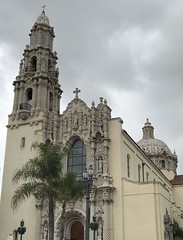
After lunch, I wandered in search of a couple of landmark churches I'd been wanting to visit. Strolling past the Galen Center, with its brick relief murals of sports figures, the classic Automobile Club building, and the classic mid-century Felix Chevrolet neon sign, I came to the St. Vincent de Paul church, facing diagonally to the corner of Figueroa and Adams. It's quite visible from the 110 freeway, and I've often admired it on my commute. It was dedicated in 1925, designed by noted architect Albert C. Martin (who also designed LA City Hall and the Million Dollar Theater building), and largely financed by oilman Edward Doheny whose mansion was nearby. The architectural style is called Churrigueresque, a very ornate Spanish Baroque style originally popular in the early 1700s, and notably revived in the buildings for the 1915 Exposition in Balboa Park, San Diego. The church's intricate plaster ornamentation and multicolored tile domes are striking. Entering through the oversized dark wood doors, one finds the interior is every bit as grand as the exterior. The vaulted cathedral-like space is lined with light-colored stone (travertine?), with rounded arches and dark wood exposed beam rafters. An impressively ornate guilded reredos lies in front, with richly carved wood altars in the side chapels. If you want someplace solemn to light a candle (and I did want that today), this is the place.

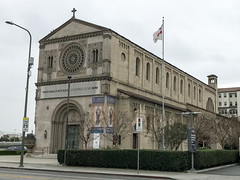
After spending time appreciating the beauty of this sacred space, I wandered just a block up Adams to see how St. John's, the Episcopal Cathedral of Los Angeles, would compare. Also built in 1925, and also grand in its way, though more restrained in its Romanesque Revival style. Its basic structure is more rectangular and austere, though it has some lovely ornamentation etched into its stone. A banner declares it a "house of prayer for all people", though apparently not at all days or hours, as, unlike the Catholic church, it did not appear to be open on a Friday afternoon. I'll have to find another time to discover what the interior looks like.

(See full album of photos from this day.)

Saturday, January 06, 2018

FILM: The Post
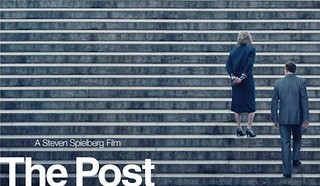
Outstanding! What a great story, and tremendous performances from both Streep and Hanks. Not only a great story about the crucial role of a free press in checking government abuse, but the transformation of a socialite wife into a formidable publisher. A story of nearly 50 years ago, and yet sharply relevant to the present moment.

Saturday, December 16, 2017

FILM: Darkest Hour
We really enjoyed it. Great performance from Gary Oldman, who really captured the mercurial Churchill, who could be mumbling through his cigar one moment and thundering orator the next. The film really zeroes in on a moment in time, just before Britain had really committed itself to the war against Germany, and when some people thought the better course was to stay out of it and pursue peace talks with Hitler. Very interesting to see how the decision came about. And to see some of the truly hard decisions leaders may have to make. The film had a special resonance for George and I, as just last year, we had toured the Churchill War Rooms as well as Buckingham Palace, so it was fun to see historic locations in the film that we'd recently visited in person.

Tuesday, November 28, 2017

FILM: Call Me By Your Name

What an achingly beautiful film. Oh to be 17 again, and to experience such an idyllic summer of first love, first sex, and first heartbreak, in an charming Italian village, surrounded by cosmopolitan liberal intellectuals, with nothing to do but read, play the piano, ride bikes, swim, dance, and pick fresh fruit. And make love, of course. Never mind that it's 1983, and that the central love affair of the film is between two young men. These boys, and everyone else around them, seem delightfully insouciant about homosexuality. If there is even a whiff of stigma in their world, they're more self-conscious about being Jewish than they are about being gay. Their summer of discovery has only its own lovely complications, completely free of external worldly cares, as unburdened as the dappled sunlight coming through the leaves of the peach and apricot trees. The story is as fresh and as sweet as the just-squeezed apricot juice they drink, and the metaphor of summer love being as pure, sweet, and perishable as summer fruit pervades the film. You will cry tears of wistful joy when the summer inevitably ends. And you will never look at a peach the same way again.

Saturday, November 11, 2017

FILM: God's Own Country

Comparable to Brokeback in a beautiful portrayal of two men in a very rural situation stumbling onto a relationship without words or models of how it's supposed to work. Much is conveyed by the actors without a lot of words. (Which is good, because when some of those Yorkish people speak, it's scarcely recognizable as English. I wanted subtitles at times!) Outstanding performances. Bleakly beautiful Yorkshire Dales countryside. And some unflinching footage of farm life (imagine Tarantino doing "All Creatures Great And Small"). I'd recommend it. Some of the wordless scenes felt very authentic to me and took me right back to my own very early experiences (lying next to someone, pretending to sleep but not sleeping, desperately longing to make a move but not knowing how or if I should), while other minimally worded scenes with his parents seemed a bit elliptical or pat - how did they get to understanding or acceptance so quickly. Maybe that's just the Yorkshire way, working things out with very few words.

Saturday, August 19, 2017

About those Confederate monuments

So let's talk about Robert E. Lee. Certainly he was an important historical figure as the leading general of the Confederacy. And by most accounts I've read, he worked honorably after the war, both as president of what is now Washington and Lee University, and toward the cause of reconciling the union. He is reported to have said “before the war, I was a Virginian, but after the war, I was an American.” In his own time, Lee was opposed to erecting monuments valorizing himself or other Confederate leaders. If he were alive today, he would most likely be appalled by the misappropriation of his good name and likeness as a symbol of white supremacy, and he would be pulling down those statues himself.

Let's be frank. Those monuments are not about honoring a valorous general, and they're certainly not about his honorable post-war deeds. Most (not all, but most) of those monuments were erected during the Jim Crow era as a way to send a message to southern blacks to know their place. At the same time, reverence for a Confederate battle flag was invented as a more genteel daytime cloak for those who wear sheets and robes at night. And the monuments are just a coded form of a burning cross with the plausible deniability of “heritage”. People have varying degrees of conscious complicity in this, but this form of “Southern pride” is at best a kind of collective willful amnesia about the ugly message being sent here. Look too closely through the veneer of nostalgia, and at its most charitable interpretation the message is “we liked it better before the war, and we wish we could go back to that”. Think it through, and it's hard to avoid the implication: “unchained blacks have no place here”.

Those who think it's really more innocent than that need to ask themselves a number of questions. If this is not about valorizing the Confederacy itself, why all the monuments to Jefferson Davis, the not particularly competent president of the Confederacy? Or Roger Taney, the Supreme Court Justice who gave us the ignoble Dred Scott decision? General Lee may be statue-worthy, but what's up with those guys? Why were so many of these monuments erected in the 1910s, 20s, 30s, and even the 1950s? What do you suppose it really meant to erect such monuments in the 1950s? And why statues for every general and colonel in the Civil War? Is there a reason those men should be honored way more than southern generals in other wars? Why are there overwhelmingly more statues of Lee than there are of Admiral Nimitz or Black Jack Pershing, both southerners? And if it's about the singular importance of the Civil War in our history, why are there way more statues of Lee than there are of Grant in the north? And if it's about “southern pride”, then why aren't southerners anywhere near as proud of their great explorers (Lewis and Clark), authors (Faulkner, Harper Lee, Tennessee Williams), inventors and scientists (George Washington Carver, McCormick Bros, Michael DeBakey), and other honor-worthy people (Helen Keller, Chuck Yeager)? There is clearly a peculiar fixation on Confederate leaders that is not just about “history” and “heritage”. We need to call this out for what it is.

When Hungary finally broke free of Communism, Budapest was adorned with monumental statues of Lenin, Marx, and other Communist heroes. They rightly wanted no longer to give those a place of honor in their city, so they built a place called Memento Park on the outskirts of town, where all of these old Communist monuments are on display in a kind of outdoor museum, where that part of their history can be preserved, but with the proper detachment and no inappropriate place of honor. That's what we need to do with all of this Jim Crow era “heritage”. Segregated water fountains are part of that same heritage too, and a few of those should be preserved as well, in museums, for history sake. Confederate flags and Confederate monuments should be viewed no differently than segregated water fountains.

Meanwhile, we need a reboot, “Southern Pride 2.0”. There is much worth honoring that has come from the South (see list above of statue-worthy Southerners, of which that is only a start). Let's honor that, and ditch this disingenuous nostalgia for a “peculiar institution”.

Sunday, April 16, 2017

Remembering Fred Borsch


I was saddened to read of the passing of Fred Borsch, whose mark left on the world is beautifully described in this LA Times obituary. I loved the story of him bringing the Archbishop of Canterbury into one of LA's sketchiest neighborhoods to give him a new perspective. I was acquainted with Rev. Borsch at Princeton, where he was the Dean of the Chapel when I studied there in the early 1980s, and his son Ben was a classmate. He was a kind, gentle-spoken man who did indeed ask people to call him Fred. If you picture someone like Father Mulcahy on the old MASH TV series, you wouldn't be far off. But I think he made a mark wherever he went. I will always be grateful that, under the sponsorship of the Borsch's Office of the Chapel, a space in the basement of Murray-Dodge Hall was set up to create a café, where tea and fresh baked goods and occasional live music were on offer, but more importantly, an alternative social space for people who for various reasons didn't entirely fit into Princeton's regular social scene. That doesn't sound like any big thing today, but it's hard to project ourselves back to a time before there was any Starbucks, before there was a ubiquitous Internet, and before Princeton had a Gay and Lesbian Center (actually before Princeton even had a real student center at all). Back then, that café was a haven for, among others, a whole circle of students tiptoeing to terms with their homosexuality. It was quietly subversive and essential. And looking back, I think that Borsch probably understood that even better than I did at the time.

Flash forward 20 years to 2001, and I just missed meeting Borsch again, although I discovered his handprints when I moved to Echo Park, a now trendy but then rather edgy barrio near downtown Los Angeles. As an Angeleno, I had been well aware of the construction in the 1990s of the controversial Catholic Cathedral of Our Lady of the Angels downtown, a dramatic modernist architectural landmark. But it wasn't until I moved to Echo Park that I became aware of the Episcopal Cathedral Center of St. Paul, also constructed in the 1990s, a modest set of buildings that wouldn't draw particular attention to drivers-by let alone international tourists. I think the Catholic and the Episcopal churches both have strong traditions of "high church" majesty as well as social justice. But I find it emblematic that while then-Archbishop (now Cardinal) Mahoney was building his grand edifice on the hill downtown, Archbishop Borsch was rolling up his shirtsleeves and getting to work in the barrio. I've been to services in both places, and there's no question which one feels more warm and welcoming to me.

The world is a notably better place for Fred Borsch having been in it.