Showing posts with label life. Show all posts

Sunday, January 05, 2025

Remembering Beryl

When I was growing up in the 1960s in the northern San Fernando Valley, we lived on a newly developed suburban neighborhood street filled with young families like ours. One family in particular, who lived two doors down the street, became my parents’ closest friends. My brother and I played with their two kids about the same age, and the parents became “Auntie Beryl and Uncle Gary” to us. We were back and forth at each other’s houses almost like a second home. On Monday nights when Dad and Uncle Gary worked late, Mom and Auntie Beryl would take turns cooking dinner for both families. They swapped recipes clipped from Sunset Magazine and the LA Times. I remember one, burger trittini, being a favorite. On weekends, the grown-ups would sometimes go out together, or make a nice dinner in and play bridge and drink wine. Auntie Beryl had a musical voice, and I remember the sound of her laughter when the “grown-ups” were having a good time. I remember the minced meat pies that Beryl (who grew up in England) made at Christmastime, from her mother’s recipe. She was very musically talented, and not long after I started school, I also started taking piano lessons from her. She persuaded me to sing in the children’s choir at the Methodist Church that they attended, as a further musical education. She was a good teacher and a rigorous one, emphasizing the importance of theory and giving a great understanding of music history while teaching the technique of the keyboard. She was very involved in the Music Teacher’s Association of California, and all of her students took annual exams as well as performing regular recitals at the studio they had built into their home. The piano lessons were strict, but she also took time with me (and I suspect with all of her students) to show a personal interest in how we were doing, and sharing a little life advice. I have one memory of her telling me, “a handsome face and a fun time can attract you, but you also need to ask yourself is this person someone you’ll want to get up and have breakfast with every day.” The way she said it was as someone who was happy with the choices she had made, and wanting to share that – it was sweet. (It’s also one of those things I probably appreciate much more now than I did as a young teen.)

They eventually moved away, moving to the Oregon coast when Uncle Gary retired, but they and my parents always stayed in touch and visited one another. I’d sometimes enjoy getting to see them at my parents’ house when they were visiting. Not long after George and I married, we had a trip up to Portland, and they invited us to stay with them a few days in their beautiful home at Salishan overlooking Siletz Bay. Beryl and Gary (who told me I was old enough to just call them by their first names) showed us all around and we had a lovely visit, including going to their church where we heard Beryl sing a solo and in the choir. Toward the end of our visit, she caught me alone a moment and told me “I’ve been watching and listening and asking George questions, and I think you’ve found a very good husband. We’re very happy for you.” I was really touched, and it reminded me of the little life lessons that sometimes came with the piano lessons. In recent years they had moved to Washington to be closer to their daughter in Bremerton, and Alzheimer’s disease had started to take its toll. On New Year’s Day, Dad got the call from Gary that Beryl had passed. We’re sad for Gary to have lost his wife, for Diane and David who have lost their mother, and for the grandsons who have lost their grandmother. With a tear in my eye, I’m glad to have known her, she will always be a grace note in the score of my life.

Saturday, August 31, 2024

Letter To Candy

When I was first getting to know George, I soon learned how close he was to his family, and how much he looked up to his older sisters. I heard earfuls about Candy and Linda’s homes and gardens, their cooking and crafts, all of the effort that makes a house into a home, taken to an art form with care and attention to detail. We used to laugh about which of you was more Martha Stewart than the other. When I first learned how Linda made hand-crafted caramel corn every Christmas, I thought she was the most Martha. But I think you forever took the lead the first time I had Thanksgiving at your house in Paradise, where the table was beautifully set and the decoration included acorns, collected from your yard, subtly dusted with gold sparkle. As I learned, in the process of collecting and gold-dusting those acorns, the caps got separated from the “corns”, and had to be put together again like a puzzle, having to find the right cap to go with each acorn, all to add a subtle touch of beauty beside the napkin rings and candlesticks.

You all (George very much included) inherited your passion for aesthetics from your mother. (Are any of us surprised that some of Katie’s last words in her increasingly aphasic twilight months were “Candy, that’s a cute outfit.”) But you took it to a whole new level. Just the way you would wrap each Christmas gift was a wonder, not only thoughtfully chosen paper and beautiful ribbon or string, but adorned with small lovely things from your home or garden, with old Christmas cards cut up and refashioned as tags. I came to appreciate that your devotion to such aesthetics went far deeper than a mere concern for appearances. It was an expression of utmost care for those of us lucky enough to enjoy your home and your hospitality. From my own experience cooking, I know how preparing a thoughtful meal is a way of expressing love. Your love language is much broader: delicious family meals (carefully catered to so many different allergies and preferences!), beautifully set tables, jars of jam from your fig or plum tree, exquisitely wrapped and thoughtfully chosen gifts, artfully arranged flowers – these were all your expressive way of making the world more beautiful and delicious for all of us.

You were also thoroughly down to earth. Much as you loved a cute pair of shoes, you were perfectly happy with no shoes at all, bare feet in the sand at Balboa Island, or just in your garden. You were proud to be a farmer’s daughter. I only knew your father after his stroke, and wished I’d known him before, because everyone always spoke so highly of him. I remember on one of our many weekends packing up the house in Lodi, you were telling me about your father — his service on so many community boards, how they valued his even temper and down-to-earth advice. In those stories you were telling, the resemblance struck me, and I said “you really are your father’s daughter.”  You just lit up, and said “oh, you don’t know how happy that makes me!” 

When your father passed, and I reflected on what I’d learned about his life, I observed that he was not just a farmer of grapes, but a farmer of community institutions — he helped grow a school, a hospital, and a church. In reflecting on your life, I think you’ve been not only a great gardener of fruits and flowers, but a gardener of family and friendships. You carefully tended the valued relationships with your extended family (as we can see by so many cousins here today). And when you planted a new home in Paradise, you set down deep roots there, nurturing new friendships and connections through the school, the hospital, and the church. I was always amazed at the exuberant abundance of Christmas cards you received, and you could tell me all about all of those people because you’d taken the time and care to keep up with them all. In raising your children, you instilled in them the value and practice of maintaining relationships, and they flourished, developing their own deep-rooted friendships, some going back to their school days. You watered your friendships with regular phone calls, cards, and visits, and you fertilized your family with rituals like Thanksgiving and Christmas, annual Balboa Island weeks, and Lodi visits. You showered your grandchildren with care, and it’s wonderful to see the joy it brings you to spend time with them. George and I are profoundly grateful that you rooted us so deeply in your family garden. 

There are so many things that will always make us think of you — a beautifully set table, a well-wrapped gift, homemade jam from backyard fruit. But for me, the epitome of you will be those gold-dusted acorns, humble and down-to-earth yet extraordinary and thoughtful. Like those gold-dusted acorns, you were ultimately ephemeral and gone too soon. Like those acorns, you are imprinted indelibly on our memories and in our hearts. 


Monday, March 18, 2024

Remembering Bev

My heart goes out to the Stern family upon hearing of the passing of Bev — wife, mother, and grandmother, and adoptive mother of countless lucky people. She was the mother of my friend and college roommate Hal, and I met her during parents’ weekend of our freshman year at Princeton. She was one of those people with a smile that lights the world, and a warmth that makes you feel like she’s your Mom too. Fittingly, she was a school nurse for many decades, and I’m certain there’s a whole generation of kids who grew up in Freehold, New Jersey who think she’s their “other mother” too. She was a fount of boundless encouragement, her children’s greatest cheerleader, propelling her family to be both happy and highly accomplished through force of will, power of love, and no shortage of her famous kugel(*). She lead not just by encouragement but by example, being a strong and accomplished woman herself. Hal was not the first Ivy Leaguer in his family; she had graduated from Penn. And by the end of her school nurse career, she was leading the nursing program for the district and establishing best practices that were adopted statewide. In her later years, she was organizing things at the assisted living community that she and Joel had moved to. She was also social media savvy and doing her best to make Facebook a more benevolent place with her uniformly positive messages. While wholeheartedly Jewish herself, she was open-hearted to good people of all faiths, and always made a point to send out good wishes for Christmas and Easter and other religious holidays for all who observe. One of the silver linings of the Covid pandemic for me was that I was able to join the Stern family seder via Zoom where I was welcomed like family. In a beautiful funeral service this morning (which I was also able to attend thanks to Zoom), it was so moving to hear her children and grandchildren all remember her so vividly and lovingly. I loved seeing just how much of Bev lives on in them — the way they speak, the way they laugh, the way they support and hold each other up. I hope they draw comfort in those moments when they recognize a glimpse of the parts of her living on in themselves and each other. May her memory be a blessing to them and to all of us who knew her.

(*) Hal reminded us this morning that his mother’s kugel recipe was one of the first things to go viral on the Internet, more than 30 years ago, long before Google, Facebook, or any of that. Try Googling “Mom Stern’s noodle kugel”. It still comes up, just one indicator of her lasting positive impact on this world.

Friday, February 12, 2021

Christen Lost Too Soon

Today I mourn the loss of Christen Smith Herman, who was a good friend through junior high and high school. We bonded in French class, and in high school, I remember a tree well where Christen, Pat Ruffino, and I would always meet at recess and lunch, more comfortable being with each other than at any of the more popular lunch tables. She was a vegetarian and into yoga decades before those were as cool and widespread as they are now. I think her fandom of George Harrison may have lead her to Ram Dass and Paramahansa Yogananda, her love of music flowing naturally into an Indian spirituality that I think she came to authentically and just found herself in tune with. I remember her carrying around “Be Here Now”, and her teaching me how to draw an “om” (which we used to decorate our yellow Pee-Chee folders that were ubiquitous in our day). I remember that she would always look carefully before sitting down at the tree well because she valued life, even insects, and didn’t want to accidentally squash any ants. She had a brilliant smile and wore it often. She played guitar and had a beautiful mezzo-soprano voice. Her voice and passion for music would become a career, singing in the St. John’s Cathedral Choir, and joining a trio called Voxfire who sang medieval music (Hildegard of Bingen!). We lost touch after high school but loosely reconnected about 20 years ago. I probably saw her a half-dozen times, a few times intentionally, and a few times just bumping into each other (which happens more often around Los Angeles than one might expect). We once literally bumped into each other at St. Paul’s Cathedral in London, as we were both looking up in amazement at its awesome heights. And thanks to social media, we were able to keep a sense of what each other was up to. I got to know her first and second husbands and watch her two kids grow up through her posts (though I did get to meet all of them in real life at least once). I’d been enjoying her artistic eye capturing the beauty of the San Juan Islands, where she had moved a few years ago. I had been planning to visit her last July on the way to an Alaska cruise, but Covid canceled those plans. And now we may reschedule that trip next year, but she won’t be there to visit. It’s hard to believe she’s gone so suddenly and too soon. My heart goes out to Paul, Kaija, Peter, and Martin. Their loss is unfathomable, but I’m glad her husband and children had the opportunity to bring her home and be with her as she passed.

Saturday, December 26, 2020

Christmas Shadow

In a normal year, the shadow of my mother’s death would have cast a pall, her absence keenly felt at this first Christmas without her. Yet damned Covid robs us even of normal grief. How can you miss someone around the family Christmas dinner table when we’re all dining alone? How can you see a shadow when everything is already dark? I thought of that most exquisite expression of grief, W. H. Auden’s poem “Stop All The Clocks”. But what would Auden say now?
Close the restaurants and theatres, shut down the world.
Let the forests of a nation burn blazing red,
Smoke blackening the sky declaring She Is Dead.
Put cloth masks round the mouths and noses of the public doves,
Let the ICU nurses wear N-95s and latex gloves.
Done and done. What could Auden say now, when all the clocks are already stopped? How could one ask the whole world to grieve one loss when two million families had a newly empty seat at their virtual Christmas tables tonite? How could our cries of grief be heard when two million families are wailing? And yet we cry. Though the sun be dismantled and the world is dark, we still perceive the shadow of her loss. Though the world mourns two million other losses, the whole world laments her end, for to us she was the world.

Sunday, November 24, 2019

Remembering Unc

From my earliest memories and throughout my life, my Unc Hal was a presence in my life that embodied what family meant. If you asked me at any point in my life who my “close family” was, after my Mom, Dad, and brother, there was no question that it was Tante Elayne and Unc Harold, and their kids, my cousins Donna and Victor. My mother and her sister were not to be separated, so when my Mom got married and settled in Los Angeles, Tante and Unc uprooted their young family and moved from New York to be close to us. Thus, when I was growing up, they were just always part of our family life. Most days, we were over at their house or they were over at ours. I know I had other aunts and uncles and cousins in Indiana and New York and Washington, and we loved them too, but more abstractly. Tante and Unc and Donna and Victor were my familiar family, the ones I just took as a given that we saw all the time, so that when you say “uncle”, I can’t help but picture Unc Hal.

When they first moved to California, Unc drove a delivery truck for Frito Lay, and as a very little kid, I have memories of Unc’s truck parked in the driveway, and sometimes being allowed to go into the truck and pick out a bag of Fritos. (In those days, the delivery trucks were not huge, more like the size of neighborhood ice cream trucks.) Among the Dads in our family and the neighborhood, I think he was the most likely to get down in the grass and wrestle and tumble with us on the front lawn. He had a growly voice, but teddy bear growly, not scary growly. He was mostly soft spoken, although he was certainly capable of raising the volume when the discussion around the family dinner table got loud, and he and Tante had no trouble shouting to each other across supermarket aisles (“ELAYNE! DO WE NEED MORE COOKIES?”). (Unc did love his cookies, and there was always a well-stocked cookie jar at their house.) At some point in my childhood, Unc quit the FritoLay truck and started his own business washing windows for shops and restaurants, a job he would work until he retired. As a kid, I only understood that he had to get up crazy early in the morning because he had to drive to far-flung locations all over the city, and that his clients preferred their windows get washed before their open business hours. I also came to understand that some of the places he went were parts of town that the rest of us might be apprehensive to go to, but Unc was unassuming and approachable, the sort of guy who could talk to pretty much anybody. And he’d sometimes come back with funny stories. I remember one time, he asked us “Did you know that ‘bad’ can mean ‘good’?” Turns out he was washing windows at a furniture store, and while he was there, a couple of black women were there on the sidewalk looking in the windows and saying “Look at all that baaad furniture!” After they’d said this a couple of times, he got curious and asked them, “did your family have a bad experience buying furniture here?”, and they laughed and gave him a lesson in Inglewood street slang. His openness to talk to anyone extended even beyond borders and language barriers. When Tante and Unc traveled to Paris with my parents, at one point when they needed directions, Unc was the one who, despite any useful French, was willing to go up to someone and ask directions. He went to ask a nearby vendor whether they spoke English, but his attempt at “Anglais?” must have come out more like “une glace”. When he returned and the others asked what he had found out, he laughed and said “I still don’t know where we are, but I got this ice cream cone.”

Our family liked our routines and little traditions: Saturday night was always “restaurant night”, and we would always meet up with my aunt, uncle, and cousins at a neighborhood restaurant for a dinner out. Usually nothing fancy, except for birthday celebrations which were diligently observed. Sunday nights were “hamburger night” when I was young, and later evolved to “family dinner night” after the kids had all grown up and left home. Sunday nights alternated between my parents and Tante & Unc’s house, with whichever “children” were not out of town expected to show up. Conversations ranged from politics to family news/gossip to just the minutiae of our lives, as you do when you see someone so regularly. Unc and my Dad also shared an interest in business and investments, and would talk about that until Mom would scream “Are you two still talking about IRAs??”. (You can’t dispute that Unc must have saved and invested prudently, as he leveraged his modest window-washing business toward paying off a house in the suburbs, raising a family comfortably, and having enough retirement savings that his children never had to worry about paying for his care.) I’ve been grateful to have these family routines as steady markers throughout my life, something I could always count on even when other things changed. Except for the few years I lived on the east coast, and until he moved to Virginia just a year and a half ago, Unc has celebrated every one of my birthdays with me, and we’ve had a meal together probably three out of every four weekends my entire life. It’s only now looking back across all those years, realizing that our last birthday or family dinner together is passed, that I fully appreciate how remarkable that is.

When Tante passed three years ago, we kept up our Sunday nights, either bringing in take-out food to Unc’s or driving him over to my folks’ house. But after a while, he was becoming less capable and more depressed, so we convinced him to move to Virginia where he could be near his daughter Donna and her three grown children. Though we missed him in California, it was a great move because he got to see Donna and his grandchildren all the time, and he got to celebrate their family events together. He lived to see his granddaughter Brenna have a baby boy, and just days before he passed, he got to meet his newborn great-granddaughter. He saw his granddaughter Rachel regularly through her pregnancy, and was eager to meet the baby, excited to be a twice great-grandfather. It seemed he was hanging on just for that, before going to his rest after a good long life (just a couple months short of 90). Thanks, Unc Hal, for showing me what an uncle is, and for the gift of your faithful presence throughout my life.

Sunday, July 22, 2018

Remembering Jonathan Gold

I was immensely saddened last night to learn of the untimely passing of Jonathan Gold. I regret never meeting him, but we shared a love of food and of our city, and Los Angeles will not be the same without his intelligent, insightful guidance on our dynamic food scene. As a regular guest on the KCRW “Good Food” podcast with Evan Kleiman, his voice was a regular guest in my car. His column in the LA Times food section was the first thing I would consume on Saturday mornings. Los Angeles has become one of the most vibrant food scenes in the world, and if any one person could claim credit for making that happen, Jonathan would be a top contender. This vast and dynamic city, fueled by the confluence of streams of human migration from the south and the east, a megalopolis of ethnic pockets, ever-transitioning neighborhoods, and cultural mash-ups, has a staggering array of food cultures on offer that can be bewildering and overwhelming. Jonathan provided us a map. For his avid readers, he inspired us to visit unfamiliar neighborhoods, enter establishments sometimes beyond our comfort zone, persevere past menus in languages we couldn’t always read, and put things in our mouths we never dreamt of before (but would dream of after). When he started writing, food critics generally only paid attention to white table cloth, mostly French or “Continental” restaurants, measuring shortness against a particular idea of perfection, their prose often filled with attitude and the caustic cleverness of a Scalia dissent. Jonathan smashed that mold. While he appreciated and lauded the finest high-end restaurants, he could find equal appreciation and praiseworthiness in the craft of an immigrant who sells street corn from a cart on a corner in Lincoln Heights made in the specific style of the particular region in Mexico that he came from. He famously started his career by eating at literally every establishment on Pico Boulevard (one of LA’s long boulevards that stretches 15 miles from downtown to the beach). And by the time he was done, he no longer spoke of Mexican food or Chinese food, but had taught himself -- and went on to teach us -- about the wonderful differences between the styles of Oaxaca, Jalisco, or Guerrero, or the specifics of Chengdu distinct from other parts of Sichuan. He was a scholar and guide to the food regions of Thailand, Korea, and Vietnam, and the subtleties of Honduran vs Guatemalan vs Salvadoran foods. He probably knew more about Korean food than most Koreans in Koreatown. His infectious enthusiasm inspired non-Koreans to venture into K-town, and non-Latinos to venture into East LA. He fomented an openness and an invitation to cross-cultural exploration in this city, and I might venture that he did as much as anyone to cultivate the appreciation and create the cultural space for someone like Roy Choi to take LA by storm with his Kogi truck, mashing up Korean and Mexican food. And Jonathan’s smashing of the cult of the white table cloth paved the way to a city where some of our top-rated restaurants are food trucks whose location you need to follow Twitter to pin down. I am deeply grateful for how much he has enriched my own life, as he has countless Angelenos, with his insights, his encyclopedic knowledge, his contagious enthusiasm, and his delightful prose. His death – way too soon – leaves a huge hole in the heart of our city.

Friday, January 19, 2018

Nobody Knows The Day Or The Hour

Nobody knows the day or the hour. Plans and dreams can be swept away in a blink. Cherish the people in your life and be grateful for every day you live. I lit candles and said prayers today for two friends. Both about my age, living well, every outward expectation of many good long years ahead. One received a grim diagnosis last month and is now in the ICU. The other had seemed to be putting breast cancer behind her, but went into the hospital unexpectedly a couple days ago and passed away this morning. Cancer sucks.

Sunday, April 16, 2017

Remembering Fred Borsch


I was saddened to read of the passing of Fred Borsch, whose mark left on the world is beautifully described in this LA Times obituary. I loved the story of him bringing the Archbishop of Canterbury into one of LA's sketchiest neighborhoods to give him a new perspective. I was acquainted with Rev. Borsch at Princeton, where he was the Dean of the Chapel when I studied there in the early 1980s, and his son Ben was a classmate. He was a kind, gentle-spoken man who did indeed ask people to call him Fred. If you picture someone like Father Mulcahy on the old MASH TV series, you wouldn't be far off. But I think he made a mark wherever he went. I will always be grateful that, under the sponsorship of the Borsch's Office of the Chapel, a space in the basement of Murray-Dodge Hall was set up to create a café, where tea and fresh baked goods and occasional live music were on offer, but more importantly, an alternative social space for people who for various reasons didn't entirely fit into Princeton's regular social scene. That doesn't sound like any big thing today, but it's hard to project ourselves back to a time before there was any Starbucks, before there was a ubiquitous Internet, and before Princeton had a Gay and Lesbian Center (actually before Princeton even had a real student center at all). Back then, that café was a haven for, among others, a whole circle of students tiptoeing to terms with their homosexuality. It was quietly subversive and essential. And looking back, I think that Borsch probably understood that even better than I did at the time.

Flash forward 20 years to 2001, and I just missed meeting Borsch again, although I discovered his handprints when I moved to Echo Park, a now trendy but then rather edgy barrio near downtown Los Angeles. As an Angeleno, I had been well aware of the construction in the 1990s of the controversial Catholic Cathedral of Our Lady of the Angels downtown, a dramatic modernist architectural landmark. But it wasn't until I moved to Echo Park that I became aware of the Episcopal Cathedral Center of St. Paul, also constructed in the 1990s, a modest set of buildings that wouldn't draw particular attention to drivers-by let alone international tourists. I think the Catholic and the Episcopal churches both have strong traditions of "high church" majesty as well as social justice. But I find it emblematic that while then-Archbishop (now Cardinal) Mahoney was building his grand edifice on the hill downtown, Archbishop Borsch was rolling up his shirtsleeves and getting to work in the barrio. I've been to services in both places, and there's no question which one feels more warm and welcoming to me.

The world is a notably better place for Fred Borsch having been in it.

Monday, June 27, 2016

Remembering Tante

A few memories of Tante Elayne. We called her Tante, which means aunt in French and German and Yiddish.


Tante was a proud New Yorker. Her heart never left New York, and neither did her voice. Both Tante and Unc lived her over 50 years and never lost their New York accents. We'd say, Tante, we saw a hawk in our yard this morning. A what? We'd show her the picture and she'd say oh, you mean a hawwk. When you said 'hock' I thought you were talking about a piece of ham.

Tante was a vocal right-winger. When asked about her politics, she'd smile and say You know Attila the Hun? I'm to the right of him. My grandfather was a Republican, she growled proudly, he hated FDR even from when he was governor of New York. Like Archie Bunker, she was blunt and not the least "politically correct", but like Archie, she was a lovable curmudgeon. Sunday night family dinners were always lively, as we knew well how to push each other's buttons. She was often outnumbered, but she always stood her ground.

Tante was not an early adopter of technology. It was ages before she was convinced to get an answering machine (not voicemail, mind you, but the machine with the cassette tape in it), and it was only a couple years ago she finally conceded to allow a microwave oven into her kitchen. There's no room on my counter. When the Fresh & Easy market went in down the street, with exclusively self-service check-out, the manager got to know Tante & Unc very well, because they'd always call him over and say we don't know how to do this machine thing, you have to do it for us. As inquisitive and interested in the news as Tante was, you would think she would love the Internet, but when we suggested it, she got such a pained, horrified look on her face. What on earth would I do with the Internet? She was content enough for us to bring our iPhones to Sunday dinner so we could show her pictures from Facebook of what her grandchildren were up to. And she'd ask us to look things up for her. Mostly about her favorite radio personalities. It's no small irony that we were hampered in sharing the Internet with Tante by the fact that this house is a total dead zone for AT&T, as if there's an anti-technology force field protecting the house.

Tante claimed to be anti-social. She didn't use that word, she had better SAT words. She taught me the word dour when I showed her a photo of some 19th century ancestors who looked particularly stern and forbidding. Look at those dour expressions, she said approvingly, my kind of people. If you asked her if she liked meeting people, she would say no, dear, I am a misanthrope. In truth, though, she would talk to anybody, and she loved getting people's stories. When we'd go out to eat, as soon as she finished, she'd excuse herself to go smoke a cigarette out behind the restaurant, and she'd often come back having met someone, and she'd have gotten their whole life story. She would meet friends of mine even just once or twice, and she'd interrogate them, learning things I didn't always know. She wasn't just being polite, she was interested, and she would remember. Not names, so much, but she'd remember stories. Even years after she'd met someone once, she'd ask about them -- whatever happened to your friend the architect, or that one with the young daughter with cataracts, how is she? Some misanthrope.


Tante loved eating. She ate with gusto. And she was a gracious guest. She would always compliment the meal, earnestly and enthusiastically. Even at our very casual Sunday family dinners, she would exclaim with delight about knockwurst and cabbage, as if she were trying the dish for the first time. Of course, my Mom's knockwurst and cabbage is really good. We all love it, but Tante was always the first one to say so. She had a gift for expressing appreciation. “Oh George, you're clearing dishes again, you don't have to do that, you're such a help.” “Oh Thomas, you brought me blueberries, I love blueberries, and so good for you!” A couple years ago, when they needed some extra help, their granddaughter Rachel chose to take her spring break out here helping them. Rachel, you must have heard that appreciation. We sure heard it afterwards. “Oh that Rachel, she's such a help! And such a good cook!” Part of that might have just been a good upbringing by Elayne's mother, who never left the house without her hat and gloves. But Tante always expressed her appreciation so heartily, as if you were the first person to ever clear a dish or bring her an apple. It was a gift, and a good lesson.

Sunday night dinners will never be the same without Tante oleha sholom, v zichronah livrakha (peace be upon her, and may her memory be for a blessing).

Tante Elayne -- Life Sketch

Elayne was born on Feb 18, 1931, in the Bronx, New York City, the daughter of Paul and Rhea Taylor. Her mother's side of the family, the Brantmans, were Jewish. Her grandparents, Louis and Betty Brantman, were eastern European immigrants who met in New York City, and re-enacted Fiddler on the Roof with their family of five daughters, each daughter pushing the boundaries of their father's traditional views a bit further. Paul Taylor, from a line of Taylors going back nearly to the Mayflower, and ancestry entirely English and Scottish, was obviously not Jewish, and not Louis' idea of a perfect match for his daughter, but when Paul agreed to study for two years to convert to Judaism, Louis consented to the match. When Elayne was born, her grandfather registered her birth in temple, where she was given the Jewish name Sarah.

Elayne with her mother and sister
Elayne was Paul and Rhea's first daughter. A year and a half later came Cecile, and for their whole lives, those two would be as close as any two sisters ever were. Their early childhood was the midst of the Great Depression, and their family was as hard hit as any. Paul was an accountant working in Manhattan, and in the late 1920s, when the stock market looked like it could only go up, he had put most of his and his family's money into it. When the girls were very young, Rhea's parents both passed away, and Paul moved his family to New Jersey, where they could be closer to Paul's parents, and his brothers Frank and Don. For a time, the whole extended Taylor family was sharing one house, but later in the 1930s, Paul found steady work at a casting company, and the family had their own home in Great Notch. The girls had a good time there, and used to play on the train cars parked at the station near their house.

By 1941, Elayne's father, who had gone to a military school, was eager to take his part in World War II. The US hadn't joined the war yet, so Paul went up to Canada and enlisted with the Royal Canadian Artillery, where he soon shipped out and spent the rest of the war in the European theater. Rhea, left alone with two young daughters, moved to an apartment in Kew Gardens in Queens, where she could be closer to her sisters Nina and Fanny, and their families. For a time, Aunt Fanny and Uncle Sam lived upstairs in the same building. Nina had two daughters, Carol and Betty, just a bit younger than Elayne and Cecile. After the war, Paul chose to stay in Canada rather than return to his family. Rhea, Elayne, and Cecile lived in that same apartment in Queens throughout the 1940s and most of the 1950s. Elayne and Cecile had happy teenage years there, spending time with family, attending Forest Hills High School, going to social events at the Jewish Community Center, and sometimes going in to the city with their mother, who reportedly never left the house without hat and gloves. When Elayne was about 20 years old, it was at one of those events at the Jewish community center that she met Harold Hess, the handsome elder son of a shopkeeper in Forest Hills. No one remembers exactly how long they courted. Unc Harold says "We met at the party, she invited me home to meet her mother, she was nice, and that was it." The one thing that Harold and Cecile both remember is that when Elayne brought Harold home to meet the family, he offered to fix a broken window shade, but ended up pulling the whole thing down on his head.


Elayne and Harold were married in August 1952, with a reception at the Forest Hills Inn, attended by family including all four of their parents. They moved into a small house on Harmony Drive in Massapequa on Long Island, nearby to her cousin Dottie Stetter and her young family. They enjoyed life in Massapequa, and made a lasting friendship with a neighboring family, the Amendolas. By the end of the 1950s, they had two children, Donna and Victor.

Meanwhile, Elayne's sister Cecile had moved out west, where she met her husband Rod Chatt, and settled in Granada Hills, where the suburbs of LA were just starting to push into the orange groves of the San Fernando Valley. Much as Elayne loved New York, she didn't want to be apart from her sister, and so in 1964, the Hesses moved to Granada Hills. They lived briefly in an apartment on Devonshire, and then moved into this house that is still their home after 50 years. Donna and Victor went to the elementary school right across the street, then Frost Jr High, and Kennedy High, which was built just in time for Donna to attend. The Hesses found more lifelong friends in this neighborhood, including the Hagawaras and the Hillbergs. (Like the Hesses, the Hillbergs are settled people, still here after 50 years.)


While Harold established his window-washing business, Elayne became quietly involved in the community, attending neighborhood watch meetings, and volunteering to be precinct captain of the local election board. But she mostly devoted herself to three great passions. One, she cleaned her house. Constantly. Her house was always immaculate. Two, she listened to conservative talk radio. She never quite warmed to the TV. The TV was fine for Masterpiece Theatre, for Jeopardy, and for Dancing with the Stars. But when it came to politics, for her, all the best people worth listening to were on the radio.

Elayne's third and greatest passion, of course, was rescuing animals. For the first 15 years they lived here, there was just a big open field from here to Balboa, at the end of the valley, a place where thoughtless people would dump unwanted pets. Her first rescue was Penny, an orange tabby who showed her love by bringing her mother trophies she'd catch in the field: birds, rats, gophers, all were no match for Penny. Elayne was particularly fond of Staffordshire bull terriers, more commonly known as the much-maligned "pit bull", and she took in several pit bulls over the years that had been mistreated by prior owners. When her house was filled with pets, she then filled her sister's house too. Many of the Chatts' pets were Elayne's rescues. And if you've seen their menageries, you know that clearly Donna and Victor have both inherited their mother's big heart for animals.

Elayne liked her life guided by routine. 9pm phone calls every night with her sister. Going out every Saturday night with the Chatts. Family dinner every Sunday at the Chatt or the Hess home. Getting together the whole family on Thanksgiving and Christmas. Visits every summer by Donna and her kids. I think she would like to be remembered simply, as faithful to her family, as a good neighbor and citizen, and as a lover of animals. And for 85 good years, that's exactly what she was.

Monday, May 30, 2016

Remembering Kathryn

On Saturday, a large crowd gathered at our church to remember our dear friend Dr. Kathryn Nelson Magarian. We were heartened (but not surprised) to see how many came, many from far away, to celebrate the life of a much beloved soul. Kathryn was one of those rare people who literally radiated joy and positivity. She beamed, often, with a room-lighting smile and a voice near song that made you feel like the most special person in the world, and she had the gift of making everyone feel special. When she met you, she would say that she was so glad to meet you, or so glad to see you, and she said it in a way that was so genuine and so not an automatic pleasantry that the words would strike you fresh, like you'd never heard them that way before, and you'd think "wow, she really is glad to see me!" At the end of church services, a crowd would always gather around her regular pew in the front-left, and her caregiver would have to wait patiently, as everyone wanted to spend a little time with Kathryn.

George and I first got to know her in 2008, when some mutual friends asked if we could give her a ride to their wedding in Redlands. Kathryn suffered from a degeneration of the cerebellum that gave her tremors and had made her unable to drive herself any longer. We were happy to oblige, and of course a long car ride can be a great way to get to know someone. She had lived a very full life and was full of great stories. She was recently retired from a 37-year career as a pediatrician at the White Memorial Hospital, having started as a legal secretary and then putting herself through med school in her thirties. She had traveled the world and been on great adventures, including hunting wild game in Africa (for the sake of spending quality time with her father, though she had the game trophies in her home to prove it). But as much as she had done and seen, she was also a great listener and eager to know all about us. At the end of that day, we knew we had made a great new friend.

There's an adage that one way to judge someone on a date is to see how they treat the waiter. Kathryn's contagious joy in people extended to everyone, and that was very clear if you ever took her to a restaurant that she had frequented before. All the staff would light up to see her, because they would all remember her, and she remembered them, often by name, knew their stories, asked about their families. Everyone was special to her, and made to feel special. In recent years, when she was spending more time in the hospital, it was the same story there. It was clear that all the nurses and staff had a special affection for Dr. Kathryn. At her memorial, Dr. Beth Zachary, the CEO of Adventist Health Southern California Region, spoke about how it was difficult just to move Kathryn around in the hospital, because they couldn't get very far down any hallway before they'd run into someone she had cared for as a doctor, and they'd light up to see her, and she'd light up to see them, remembering their names, their stories, their families, like they were the most special person in the world. As this remembrance was shared, hundreds of us smiled and nodded knowingly, having seen it ourselves.

Her radiant joy was a miracle in itself, but it was all the more amazing when I think about the great hardships she faced in her life. I'd mentioned the debilitating cerebellar degeneration. Recurrent cancers were piled on top of that. And she endured other brutal non-medical hardships I won't detail. She had more cause than most anyone to complain or to question her faith, and yet she did not do either. She remained unceasingly faithful in God, and unfailingly joyful in life. This loving woman, who probably would have loved to have had children of her own, was not given that. Yet when asked if she had children, she would reply with no sorrow and a genuine bright smile, "I was a pediatrician for 37 years, I have hundreds of children." And she adopted more as she went. We felt like she adopted us. That was just her nature to see the positive in everything, to find some cause for joy in each day, and to share it. Our world is a bit dimmer now without her light in it. She was an inspiration, and I hope I can honor her memory by striving to find joy in everything and share it with those around me.

Sunday, February 28, 2016

Remembering Gladys

This weekend, we celebrated the life of our friend Gladys, who passed away last week just two months shy of her 106th birthday. (Yes, that was not a typo. When Gladys was born in 1910, William Howard Taft was President, Edward VII was on the throne, and the fictional events of Downton Abbey's first season wouldn't happen for a couple of years yet.) I first met Gladys when George and I were dating, and he started bringing me to his church in Glendale, where Gladys and her husband Gene were stalwart congregants. Not only did they attend Glendale City Seventh-day Adventist every Saturday, as Gladys had grown up Adventist, but they also attended the Methodist church every Sunday, where Gene, now retired, had been a pastor. George had been going to Glendale City Church because it had quietly established a reputation as a safe and accepting place for gay Adventists, and had a growing gay attendance. There were a few rows in the rear center section that had become the "pink pews". Gladys noticed the growing group of members in those rows, and decided that she and Gene should be welcoming, and that they were going to sit with us. So this octagenarian double-church-going couple made it their mission to sit with "all those nice young men". They had a midwestern friendliness about them, and Gladys became like an adopted grandmother to all of us, greeting everyone with hugs and always checking in on us, and asking after anyone who had missed a week or two. She had a sweet, grandmotherly way of cupping your face in her hand. Then after this had gone on some time, an awkward conversation happened. Gladys said to one of the guys, "you know, some people in this church have been spreading malicious gossip that you boys are all homosexuals, but I told them it's not true, and they shouldn't talk about 'my boys' like that." To which came the reply, "Um, Gladys, actually it is true." This threw her in a quandary. She was torn between what she had been taught about homosexuality and sin, and "her boys" whom she had come to love. She had a long talk with our pastor, telling him "I'd always been taught that it's wrong, but they're wonderful young men and I just can't reject them." She decided that "loving the gays" was her calling, which she undertook with zeal for the rest of her long life. She adopted us and we adopted her, and love made us all family.

Saturday, July 07, 2012

Gordon Hadley: Exemplar of Christian service

I knew practically nothing about Adventists before I met my husband. As I've learned more about the faith and the Adventist culture, one of the things I've come to truly admire is the emphasis on Christian service that is embedded in their values. This is evidenced by the overwhelming majority of Adventists going into professions of service, such as doctors, teachers, and pastors. Health professions are particularly chosen, because of an Adventist emphasis on health as well as service. Any place you find any concentration of Adventists, there will be a hospital, a school, or especially a medical school. This dedication to health and service was exemplified in the life of Dr. G. Gordon Hadley, who not only was a teaching doctor and later dean of the Loma Linda University School of Medicine, but also taught medicine in Vellore, India, managed the establishment of a hospital in Hangzhou, China, and had an instrumental role at the Kabul University School of Medicine in Afghanistan. At Loma Linda, where he was dean for nearly 10 years, he was renowned for his personal interest in each student, knowing every student by face and name. In Afghanistan, he leaves a lasting legacy having made numerous mission trips there over the course of more than 40 years from 1960, until his last trip in 2002. He set up the first pathology department and laboratory at Kabul University in 1960, and his rigorous work to establish high-quality standards of medical education earned him such high respect among the Afghanis, that he was invited to return again and again, even as the rule in Afghanistan shifted from a king to regional warlords, to the Taliban, and to its current tenuous post 9/11 democracy. That a Christian doctor would be requested, even by the Taliban, is a testament to Dr. Hadley's brand of mission. His faith lead him to serve and teach others, and to simply live a Christian example by his actions, without explicitly proselytizing. In an LA Times article recounting Dr. Hadley's extraordinary service in Afghanistan, a Harvard-educated Afghan doctor had this to say about him: "Like Albert Schweitzer, he is dedicated to the human cause… With his deeds he is a missionary of ethics and proper behavior that is necessary for a medical practice." His devotion to service was life-long. He was in his 70's when he accepted the post to lead the newly established Sir Run Run Shaw Hospital in Hangzhou, China, and he was 80 when he made his last trip to Afghanistan. We'd heard that even as recently as a few weeks ago, at age 90, he was wanting to do more, concerned that "God still had work for him to do". We should all admire and hope to come close to emulating Gordon Hadley's remarkable embodiment of the concept of Christian service.

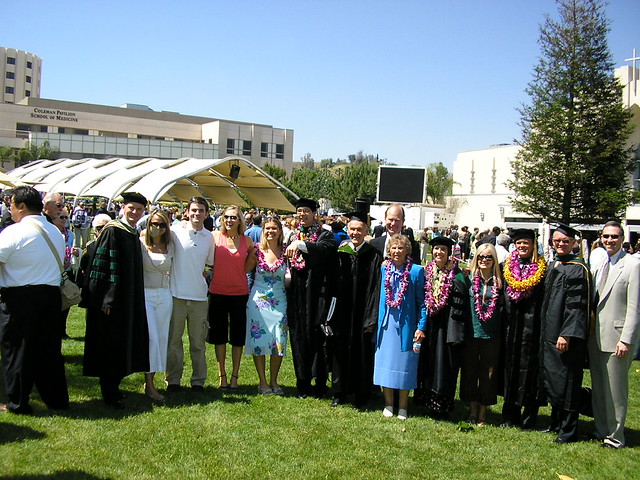
Dr. Gordon Hadley (center) with three generations of Hadley doctors.

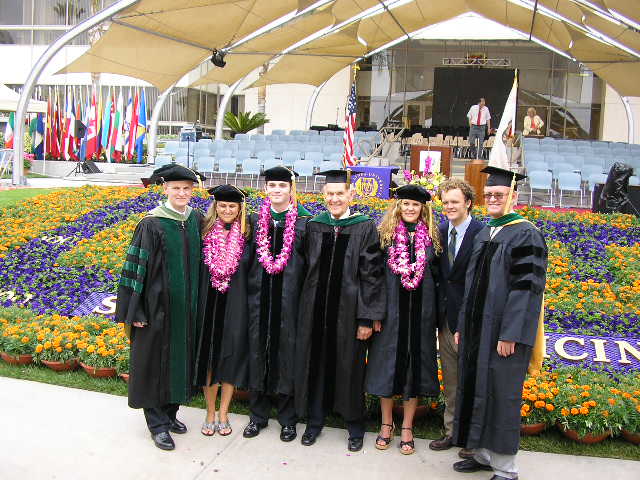
Dr. Gordon Hadley (center) at the 2006 Loma Linda University School of Medicine graduation ceremony,
with his wife Alphie and most (but not all) of their children, grandchildren, nephews, nieces, grand-nephews,
and grand-nieces who are graduates of LLU School of Medicine, Dentistry, or Allied Health.

Sunday, December 06, 2009

Remembering Denny: Now Cracks a Noble Heart

Good friends stand out in our best memories, having shared our happiest moments. Our best friends are those who were also there in less happy times, who stood by us with a strong shoulder when we needed support. But the greatest friends are those who planted seeds inside us, causing us to grow and blossom in new directions, not only enriching the quality of our lives, but altering their course. We are lucky who know even one or two such great friends in a lifetime, and I was so lucky to have known Dennis. He was my gay "big brother", my partner in the great Shakespeare quest, fellow traveler across three continents, my opera and classical music mentor, enthusiast of fine dining and cooking, fellow cyclist and snowboarder, rock solid shoulder to cry on when needed, the greatest friend and a huge part of who I am today.

I first met Dennis on a sunny Sunday morning, Jan 6, 1991. He was the Vice President and Ride Coordinator for Different Spokes, a gay and lesbian bicycling club, and he was leading a 30-mile bike ride that day, the first of a series designed to get us in shape for the Solvang Century, a 100-mile ride in March. Denny's confidence and encouragement, not to mention his playful charm and dazzing smile, motivated me not only to do the whole series of rides, but to plunge into the bike club in a big way, eventually becoming an officer myself.

As we got to know each other, we quickly learned we had much more in common than cycling. I was enthralled by his wide-ranging and passionate interests, from cooking to music, from art to film to history. How often do you meet a friend who, when you say "Hey, they're doing an authentic staging of an ancient Greek tragedy outdoors at the Getty Villa", he says "Awesome! Let's go!". He was a consumate companion for a Shakespeare history play, because he knew his English history cold, and could fill me in on all the backstory of who's allied with whom because this one's grandfather got cheated by that one's uncle in the royal succession. And Denny's knowledge of music was vast and intense. I thought I knew classical music, but his contagious passion blew my mind open to whole new vistas, from opera to medieval chant, from Monteverdi to Shostakovich (not to mention jazz crooners and dance club mixes).

I learned so much from Dennis, and even when I was able to teach him new things, he would engage voraciously and take them to a whole new level. I taught him to snowboard, but he was the one who lead us into the snowboard park when Bear Mountain first put one in, and soon the two of us were hurtling ourselves off of ramps and into the air, alongside kids half our age. I took Dennis to his first Shakespeare play, but he was the one who came up with the idea of the quest. Standing on the steps of Royce Hall after we'd seen our second Shakespeare play, exhiliarated by the language, the drama, and the galvanic performance, I said, "So, you're really liking Shakespeare? We should see some more." Denny gave me an enthusiastic look, and said "Let's see them all! How many do you think there are? 20? 50? I'll find out. Let's make it a mission, a life quest!" So for the 14 years that followed, we sought out Shakespeare in theatres large and small around town, and even made trips to San Diego, Oregon, and New York to find the more obscure plays, until a few years ago when we made our triumphal pilgrimage to Stratford-upon-Avon to complete the quest.

Denny had a genius for making things extraordinary. Anyone who's been to the Hollywood Bowl with him knows this. The pre-Bowl picnic was always an extravagant affair, and while lots of people bring picnics to the Bowl, the other picnickers would look on in awe as the tablecloth, the dinner service, the stemware, flowers, wine, and exquisite cuisine were spread out. And we had a number of decadent trips up to San Francisco to see the opera and dine at great restaurants. San Francisco is a dressier opera crowd than LA, so we often went up in black tie and tuxedos, which suited the classic beaux arts beauty of the SF Opera house. I remember one time we were flying up for a Friday night performance, and we were going to have to go straight to the opera from the airport, so we flew in our tuxes, and Denny was going to bring something to eat on the way up. I thought we'd just have sandwiches or something, but once we'd boarded (and this was before 9/11 of course), Denny pulls out his carry-on bag and, to the amazement of the flight attendants and surrounding passengers, starts unpacking cheese and pâté and caviar and wine. "Well, you didn't think we were going to eat peanuts, did you?"

With Denny, even the ordinary could be extraordinary. I remember going over to his place one night for a "casual" dinner before I knew him really well. I thought maybe pasta or something. But I show up, and he's got prosciutto-wrapped melon for us to munch on, while I watch him pressing fresh sage leaves into veal medallions for saltimbocca, which he then flipped in the sautée pan with his signature flourish. Another casual evening, we had seen an afternoon movie in Westwood and were driving back to his place, when he says let's go catch the sunset at the beach. So we pull down to Santa Monica Beach, and watch what turned out to be one of the most spectacular sunsets either of us had ever seen, with red and orange and pink and gold, and I swear there was even a bit of green patina in it. And while we're sitting in his car, awestruck by this visual symphony, the most perfectly glorious music is playing, what sounds like choirs of angels singing in the perfect musical expression of this extraordinary sunset. After the sun went down, and we're driving back, I asked him "What was that music?" "Oh, you like it? That's John Rutter's Requiem. He writes some beautiful sacred choral music." So, not only an amazing sunset, but another expansion of my musical education. Just a casual Sunday with Dennis.

When we first met, I was just starting to venture out as a gay man, yet to have my first boyfriend, having no local gay friends, and making my first tentative forays into the gay community. As Dennis and I became friends, he took me under his wing like a gay "big brother", and held my hand as he introduced me to the world of West Hollywood, dance clubs, and circuit parties. I was intimidated by all the beautiful boys, never feeling like I belonged, but Denny was supremely self-confident and would plunge in anywhere. In a dance club, he immersed himself in the music, the lights, the freedom of motion, and the throbbing mass of bodies all moving to the same beat. His exhiliaration was contagious, and a bit of his confidence rubbed off on me when I was with him. Sometimes we'd dance together and other times we'd foray in independent directions. But like the great friend he was, he'd always give me a prod when I needed one -- "just go up to that guy!" -- and he'd just hang with me when I needed that. I felt secure knowing my loyal friend was always looking out for me.

Denny was fearless. Not just in dance clubs or on the ski slopes, but throughout his life. When we were in France, he confidently drove our car along the windy corniche above Monaco, with its dangerous corners and steep cliffs. "Uh, Denny, aren't you worried, isn't this about where Princess Grace went off the road?" "Yeah, I think so, this is great!" He wasn't intimidated by Paris at rush hour either, even when we had to plunge into the notorious Place d'Etoile, a free-for-all where twelve major streets come together. He just grinned with delight as we went around it several times. When we were in Australia, he held my hand while gently laughing at me as I faced my fear of heights, first when we climbed the Sydney Harbor Bridge, along cables and catwalks over rushing cars and the harbor hundreds of feet below, and later when we rapelled down an 80' waterfall where the only way down the canyon was to grab a rope and step backwards over the edge of the falls.

If I had to pick a single photo to represent our 18+ years of friendship, I know the one. It is Denny meeting me at the finish line of the AIDS Ride, pouring champagne over my head. I have just finished a 565-mile bike ride from San Francisco to Los Angeles, having raised over $3000 for AIDS care and services, a feat both physical and financial that a few years earlier I could not have imagined myself doing. I would not have ever done it without the seeds of change planted in my life by Denny -- the motivation to participate actively in the bike club, the inspiration for leadership in community organizations, and most of all the encouragement for reaching beyond my limits. So there he was, my faithful friend, cheering me on across the finish line, and playfully greeting me with a bottle of champagne, shaken up and sprayed all over me. I love his puckish grin in that photo, presiding over this moment of accomplishment, the fruition of seeds he planted, pouring champagne on my head, and pouring his benediction on my life.

Early on, I knew that Denny was a keeper. We'd talk sometimes about sitting together on the porch of some old folks home, looking back on a lifetime of friendship and adventure. We knew that we would be friends our whole lifetimes. I just thought it would be longer. We must remind ourselves, a life should be measured not by its length but by its depth. Every play we saw together, every castle explored, every bike ride through oak-studded California canyons, every ski run riding our boards like we were flying and dancing on the snow, every night spent dancing till dawn, every elaborate meal, and every extraordinary sunset with Dennis was a gift and a treasure. Dennis lived. He lived more life in his 54 years than many live in a much longer span.

They say you should end these things with a quote, and I would be remiss if I didn't read some Shakespeare. Denny read Shakespeare at my wedding, so I should read some Shakespeare here. In the final act of Hamlet, the prince is finally resolved to face his fate, and his loyal friend Horatio is giving him one last chance to change his mind. You don't have to face this, Horatio tells Hamlet, you can duck out the back, and I'll cover for you. But Hamlet says:
Not a whit, we defy augury: there's a special
providence in the fall of a sparrow. If it be now,
'tis not to come; if it be not to come, it will be
now; if it be not now, yet it will come: the
readiness is all: since no man has aught of what he
leaves, what is't to leave betimes?
So off Hamlet goes to meet his fate. A few flowery lines, a sword fight, and a bit of poison later, Hamlet, along with several others, are dying or dead. Hamlet asks his faithful friend to live on to tell his story, and then dies at his feet. Horatio says:
Now cracks a noble heart. Good night, sweet prince;
And flights of angels sing thee to thy rest.

Tuesday, June 24, 2008

Remembering a 1993 Gay Wedding

In response to my friend Jeff Hersh's request, I have unearthed the comments I made at his wedding in 1993. Some things have changed a great deal (it's no problem today to register two grooms at Williams-Sonoma, for instance), but many fundamentals haven't changed.

Almost exactly fifteen years ago, I not only attended my first gay wedding, but I was asked to speak as part of the ceremony. The ceremony was well-attended by family on both sides, including cousins, nieces, nephews, and an 84-year old great-grandmother, about 120 people in all. The ceremony included speeches by both grooms, and by the judge who presided. It concluded with the grooms' signing of a calligraphed parchment which was a legal contract including exchange of durable powers of attorney, then duly notarized by a lesbian friend and notary public, and then signed by all guests in attendance as legal witnesses. And both grooms stomped on wine glasses simultaneously as the crowd cheered "Mazel Tov!".

In my introduction speech, I attempted to explain the full meaning of this event to this largely straight and Jewish gathering...


June 19, 1993
Croton-on-Hudson

Most of us here, myself included, have never seen the wedding of two men before. In fact, neither have Doug and Jeff. They're making it up as they go along. In some ways, this is a traditional wedding like any other---two people who are exchanging vows of lifelong love and commitment. Obviously, in other ways, it is non-traditional. I'd like to try to explain some of the special significance that this wedding holds.

There is a movement in modern Judaism called the Reconstructionist movement. The Reconstructionists are like Reform Jews in that they do not accept tradition without questioning: they do not want rote ritual devoid of modern personal meaning. For them, "because the book says so" or "because my grandparents did it that way" are not sufficient reasons for religious practice. Yet many Reconstructionists end up looking like Conservative Jews, continuing a great many of the traditional practices by coming up with modern symbolic interpretations for the old ways. A Reconstructionist is someone who takes all of the items of their faith, and considers each one, whether it is truly meaningful or whether it should be abandoned---just as someone packing to move to a new home goes through each of their possessions and decides whether to keep it or whether to leave it behind.

To be gay is to be Reconstructionist about one's whole life. All of us---gay or straight, Jewish or not Jewish---receive from our culture ideas about how we will live our lives. We come to know the expectations of our society, as we see the examples of how our family and friends live, and as we learn the hopes and dreams they have for themselves and for us. And from this rich pool of ideas, we come to shape our own vision of how we will live our lives.

But some of us have a crisis point in our lives that calls everything into question. For the first 20 years of my life, I had always pictured myself growing up to lead a life not unlike my parents: being a career engineer like my father, falling in love with a woman, getting married, having children. Then I discovered that I was gay. Every hope, every dream, every idea I had ever had about how my life would unfold seemed shattered beyond repair. And there was nothing to replace it. Family, friends, society offered no examples, no visions of what a good life for a gay man might be like. Slowly, after months and years of coming out to friends and family, of discovering a whole gay community, and of discovering that some of my own friends were also gay (including the boy who grew up next door), I have rebuilt a positive vision of what my life could and should be like.

Thus, coming out as a gay man or woman means being a Reconstructionist in a radical way. It is more than moving to a new home and sifting through your old possessions. It is like having your home burn down to the ground. While losing your home and all your worldly possessions is obviously traumatic, it is also a unique opportunity to measure which things in your life are truly essential. When a new home is built out of the ashes, every piece is carefully considered and nothing is taken for granted. While the new home is necessarily different from the old one, old ideas which are still good are reconstructed in the new. Thus, Doug and Jeff, in constructing their vision of living as gay men, have chosen to incorporate the tradition of marriage and a wedding.

Unlike many couples, Doug and Jeff do not marry today because it was expected of them or encouraged. It was not. They will not live their lives as a married couple because it will be easy, a well-worn path of least resistance. It will not be easy. Some of you, like my mother, may have encountered some trouble trying to find their wedding gift registry at Williams-Sonoma. It seems their computers and their personnel get a bit flustered when there are two grooms and no bride. This is just a small taste of the hundreds of denials and discountenances that Doug and Jeff will face. They have given their decision to wed a great deal of reflection and consideration, and they are here today, not because it is easy or expected or encouraged, but only for the best of reasons. Despite the difficulties they may face, they freely and knowingly choose to celebrate their love and their lifelong commitment to each other in loving partnership. As friends and family, we are an important part of this ceremony. Since the state will not recognize this marriage, and society will not encourage it, we must vow to give them our encouragement, our love, and our support in their commitment.

Jewish tradition teaches us that we have a special purpose in this world called tikun olam, the completion of creation. The rabbis say that when G*d created the world, He intentionally created it unfinished, so that we would have this purpose in our lives: to complete the job of creation. The world is like a huge, brilliant, beautiful jigsaw puzzle that G*d created, but left for us to assemble. Only at the end of time will the puzzle be completed and the whole picture revealed, but through our lives, each of us will contribute a part, will put a piece in place, and another part of the picture will become clear. Doug and Jeff's marriage is a fulfillment of the Jewish mission of tikun olam. The satisfaction they have found in their union is the satisfaction of two puzzle pieces being put together. Just as two pieces assembled show more of the picture than either piece by itself, the union of these two men will contribute more to the world than could two individuals separately. And as the picture revealed by two assembled pieces increases the momentum to put more pieces together, Jeff and Doug's example will provide a light to others and contribute a new positive gay vision to our culture. Today in their marriage, we witness and we celebrate the further creation of the world.

Sunday, June 22, 2008

Celebrating a Marriage and Marriages in General

Despite unseasonably sweltering heat, West Hollywood Park was humming yesterday with the celebration of marriages on the first weekend that same-sex marriages are legal here in California. A great number of gay couples who have waited years for that opportunity were joyously seizing it. The City of West Hollywood anticipated the high demand, and set up a city park to handle the ceremonies. They had a registration tent, where several people who had been deputized by the County Clerk processed the marriage license paperwork, and then a half-dozen white canopies set up under the trees for ceremonies to take place.

It was in that setting that we were delighted and honored to witness the wedding of our friends Tom and Art, who have been together for 16 years. In some sense, they have been married for many years, and I witnessed their marriage in San Francisco in 2004 (those marriages were officially annulled by the court). And in that sense, today's ceremony was really a "renewal of vows" or a "state recognition ceremony". (Tom and Art viewed it as their second, and hopefully last, civil ceremony, and intend to have a church wedding with the big reception after November.) But despite those technicalities, and the inevitable sense of making a political statement, once it got down to it, it was clear to all of us there, including the participants, that this was a wedding, with all the same solemnity and all the joy of weddings everywhere. We all got choked up at the vows, and caught up in watching two people reaffirm their commitment to each other, and to an ideal celebrated by us all -- to love, honor, and cherish, for better or for worse, so long as they both shall live. There's something about the public declaration of a high noble purpose that strengthens and ennobles the declarers, and better enables them to reach their lofty aim. I think that's part of what makes weddings so emotional, that they are positively transformative.

That ideal, of a lifetime together through better and worse, is one of the highest and most celebrated in our culture. And there's nothing gay or straight about it. It is a human ideal, a calling of the values we were raised with, gay and straight alike. One thing that has struck me about the gay weddings I have seen is how not different they are from straight weddings. The content of the ceremony -- the promises and vows exchanged, the prayers, the blessing of the rings -- is identical. The form is entirely familiar. The joy, the solemnity, and the emotion are the same. The only notable differences are the additional emotion of long-awaited justice (in every ceremony last week, there was a big whoop when they got to the "by the power vested in me by the State of California" part), and in the duration of the relationships of most of the couples getting married. With most straight weddings, the vows are entered into with hope at the outset of their lifetime together. With most gay weddings (at this point in time, though it will change in the future), the vows entered into have substantial years of proof behind them backing up the hope for the future. Couples like Tom and Art (together 16 years), or our friends Steve and Scott (together 14 years) who married earlier in the week, or the many other couples we've seen in the papers who have shared decades (like the women in San Francisco who'd been together 55 years!), those couples know a thing or two about what it takes to stay together for better or for worse. And many of those in our community know too well about "in sickness and in health". Often at the beginning of a wedding ceremony, the celebrant will say something about how marriage is a solemn estate, not to be entered into lightly or unadvisedly. We know. Some of us have been practicing marriage for quite some time. And we do not enter into it lightly.

Monday, December 31, 2007

Mitch Henson, Radical Christian

Pastor Mitch HensonJust a couple days after Christmas, we received the news that Mitch Henson, our beloved pastor at Glendale City SDA Church, passed away following complications from a surgery. It wasn't supposed to be this way. This past year, he had been battling brain cancer, but he was getting excellent care, and he was winning that battle. The surgery was unrelated to his cancer, and the fatal complications so unexpected. Our whole church family is greatly saddened by his untimely passing, and Mitch's wife, children and grandchildren remain in our prayers.

One of my earliest recollections of Mitch's sermons was one where he was preaching about the acceptance of all. I'm paraphrasing, but I remember it something like this:
All are welcome in this church, all are accepted. We have no guards at the door, checking for moral worthiness. All are welcome. It's not "all except those who are divorced, except those who are single parents, except those of a different faith, or a different orientation, except those who have deviated in any way from moral codes and social customs". Have I left anybody out? Have I left anybody in? Here, it's not "all except". It's "all". All are welcome here. Which part of "all" don't you understand?
That sermon was about seven years ago, but I still remember those words because it felt like Mitch was talking directly to me. I was a newcomer to the church, a non-Christian with little knowledge of Adventism, attending only because my fiancé regularly attended and brought me along. So I initially came in feeling like a total outsider, but I was warmly welcomed by the congregation. And when Mitch preached his sermon, his message spoke right to me, reassuring me that there were no "outsiders" at Glendale City Church.

It's a simple message, but it's a radical one, and it was one of Mitch's fundamental themes. He saw judgmentalism as one of the greatest and most devious of temptations, and he found in the gospels a radical rejection of judgmentalism. As Mitch once observed, Christ was radical in his day, and because of his radical message of acceptance of all, he was not allowed to speak in the temple, he could only teach outside of it. Christ ministered to the lepers, the tax-collectors, the prostitutes and the outcasts, rather than the scribes and Pharisees. In following Christ's example of radical acceptance and anti-judgmentalism, Mitch found his calling, and in his 23 years of ministry at Glendale, he made the City Church a haven for those who felt unwelcome in other places. Under his leadership, City Church has a remarkable following. We have people who regularly drive over 70 miles to attend our church, and we have members all over the country who have chosen to make Glendale their "home" church, because they have felt ostracized (or been actually "disfellowshipped") from their local church. The spirit of compassion and inclusiveness is pervasive in City Church's membership, but it has been Mitch's courageous leadership that has set the tone, and made City Church a shining beacon of Christian compassion, and a spiritual liferaft for the outcasts of more judgmental churches.


Pastor Mitch Henson at our weddingMitch undertook many special ministries, but the one that has touched me most directly is his ministry to gay people. I think Mitch recognized gay people as the contemporary equivalent of lepers in the gospels, unjustly despised and outcast as unclean, and worthy of compassion and acceptance. City Church is not a "gay church", but it has a healthy gay attendance (about 5-10% of the congregation, representative of the general population) because it's one of the few churches where gay people are not treated like lepers. The very first time I met Mitch, it was at a picnic for SDA Kinship, a support group for gay Adventists, and he was there to show his support. George (my fiancé) introduced me to Mitch, and we told him that we were planning a wedding ceremony, and asked him if he would be willing to take some part in it. We didn't ask him to officiate the ceremony, as we knew this could place him in professional jeopardy with the conference, but we invited him to do a Bible reading, or whatever part he felt comfortable doing. Taking any part at all was risky for him, but he readily agreed. We gave him a copy of our ceremony, with a place indicated for a New Testament reading, and asked him to pick whatever scripture he felt was appropriate. We didn't know what he would say, but when the day came, and it was his turn to do his reading, in his own characteristic style, he not only gave us a reading (Matthew 18:18-20) but spun it into a whole homily, personal comments, and a blessing. It was a wonderful gift to us, and a very courageous thing for him to do, given the denomination's official position on gay marriage. But he was being true to his calling, doing what he thought was the Christian thing to do, knowing that someday years in the future the official denomination will catch up. (Mitch was years ahead of the Adventist mayor of Philadelphia, for instance.)


Mitch performed many courageous ministries and righteous deeds, but he often did them quietly, sometimes partly out of professional prudence, but more out of his inherent humility. He was never one to trumpet his good deeds, to brandish his righteousness, or to think he was better than anyone else. His personal style of preaching, wandering around the dais, just talking extemporaneously from a few notes, points illustrated with homespun stories from his own family and life experiences, in his disarming North Carolina drawl, had a way of putting everyone at ease even while giving us something to think about. He delivered his sermons just like a regular guy talking to his peers. His informality of tone and off-the-cuff delivery often belied the depth of thought that went into his preparations. We'll always remember his excitement at discovering new insights in old passages ("stay with me now", "fasten your seatbelts", he'd say). He always spoke to his congregation genuinely, humbly, and personally.


Among so many others, my life has been touched by Pastor Mitch. I will always remember him for his compassion, his courage, and his humble righteousness. He was truly a radical Christian.

Thursday, October 25, 2007

George Donald Scheideman, Farmer of Lodi

Early Sunday morning we got the call that we'd been reluctantly expecting. George's father, George Sr., had passed away, quietly and at home. He had been declining for the past week or so, no longer eating, and we knew that the end was approaching. He was 88 years old, and he leaves behind his wife of 60 years, a son, a daughter, three sons-in-law, two grandchildren, several nieces and nephews, and numerous loving friends and relatives.

I've known George for seven years, and at the same time I never really got to know him. He had suffered a stroke a year or two before I met him, and although he still had his mind and his voice, he had lost a great deal of mobility, and was a much more subdued man than he had been. The only George I got to know directly was an elderly man who lived in a hospital bed set up in his home, aside from occasional wheelchair excursions to church, to his daughter's home, or to his own dining room for larger family gatherings. I'm not sure what he thought about me, this guy who just started showing up with "Georgie" (as my husband is known in his family to distinguish from his father) to all the family gatherings, but he seemed to just accept me. I was always greeted with a handshake, and was always included by name when he asked the blessing before a family meal (I was always touched by that). We never talked about much, as he was not long on conversation. He could hear and understand well enough, and could give appropriate answers, but he would usually say just enough to answer, and it was apparent that it was an effort to produce the words. Conversation with George really depended on the visitor to hold up most of it. My brothers-in-law could rally longer than I could, as they shared his interest in golf and football. (Me discussing the SF Giants is a painfully short conversation.) I have few memories of him initiating a topic of conversation. When he did, it was usually a paternal concern about the safety of our travel: "How was the road? You be careful. The road's dangerous." (It was sweet that he worried about us. Our mention in grace was usually along those lines too: "thank you Lord for bringing George and Tom safely to us".) Such was the George I got to meet personally. But it was very clear that that George was but a shadow of the George who had lived a good full 80 years before the stroke. That other George was someone I only got to know indirectly, in the reflected light of his family's stories, of old photos and films, of the traits he instilled in his children and the traits he shared with his siblings, and of the evidence of his community contributions.


To explain my understanding of who George was, it's necessary to back up and describe his home town, the town he lived in from age 2 until last Sunday. Lodi lies in central California's San Joaquin Valley, farming heartland. Though today it looks more like a growing suburb of 60,000+ residents, you don't have to drive far to see the vineyards and orchards that tell its deep agricultural roots. When the Scheideman family moved to Lodi in 1921, the population was a few thousand. Just a couple years earlier, at a parade for returning World War I veterans, A&W Root Beer was first sold (for a nickel at a roadside stand). It was the kind of American town Normal Rockwell would have recognized. A few things gave Lodi its distinct character: German immigrants, Seventh Day Adventists, and flame tokay grapes. The first German immigrants settled in Lodi in 1897, and many followed in the early decades of the 20th century. George's family moved there from Kansas. His father, also George, grew up in Kansas, but was actually born in the village of Norka, a German colony on the Volga River deep in Russia. (George B. Scheideman, as he was known in America, was actually christened as Johann Georg Scheidemann.) His mother, Rachel Reuscher, was born in Kansas, but both of her parents were also from Norka. The Scheidemans came, children, parents, grandparents, aunts and uncles, cousins, along with many other German immigrant families of similar origins. Into Lodi they brought their values of hard work, self reliance, strong close families, and tight-knit communities. And their devotion to their Christian faith, with their church being the center of their community. In particular, they were Seventh Day Adventists. I haven't figured out how they got involved in Adventism (which was an American innovation, and certainly not something they brought with them from the old country), but it is clear that the growth of the Adventist church in Lodi was linked with the growth of the German community. The first Adventist services in Lodi were held in a home in 1905, the first church was built the next year, and by 1908 a second church was built which became the "English" church, as the first church became the "German" church. In those early years, the services were all in German, and it wasn't until 1942 that they completely switched to English. Adventism is more than a religion, it is a culture, and many of its values -- close families and communities, strong generational ties and traditions -- fit perfectly with the German immigrant values. And to those family values, Adventism made its own unique contributions, including its distinctive emphasis on health, and on careers of service. An amazing proportion of Adventists go into a health or teaching profession (or both). It's a calling, often reinforced by family tradition. Find an Adventist community, and you're bound to find a school and a hospital. Thus Lodi Academy was founded in 1908 as a boarding school. The hospital would come later, in 1952, as these first generation German-immigrant Adventists were not doctors, they were farmers. And they took root and flourished in Lodi's fertile soil. Many things were farmed in Lodi, including wheat, watermelons, and fruit orchards, but the local pride was the Flame Tokay grape, a varietal nearly unique to the Lodi area. It is said that the variety developed its distinctive "flaming red" hue in Lodi's soil, and the skin of that grape grown elsewhere does not attain that color. The Flame Tokay was traditionally a table grape. It has good "structure" for wine (that is, a good balance of high sugar and high acidity), but a fairly neutral flavor, making it best suited as a blender in fortified or sparkling wines, rather than a standalone wine varietal. Those who know the taste of this grape prize it, but alas in the present day it is nearly extinct commercially, as the market for table grapes with seeds is nearly vanished. Meanwhile Lodi has cultivated a reputation for excellent zinfandel in recent years, leading local vineyards to rip out the old tokay vines and plant the more profitable zin instead. But in any case, for over a century, Lodi has been all about the grape. (One Lodi public high school is Tokay High, and Lodi High's team is the Flames.)

Thus, George grew up the youngest of two sons and three daughters, on a vineyard on Stockton Street, with his grandparents on their vineyard on the same street. (According to the 1930 census, the Scheidemans owned their own farms, as one would expect of this self-reliant hard-working immigrant stock.) A bio of George would later say, "his father was a vineyardist, and George was raised with a thorough background in farming a vineyard." In other words, he was not unacquainted with digging an irrigation ditch, pruning a vine, or harvesting the grapes by hand using a small curved knife as they did it back then. Come September, one would expect the whole family to be involved in the harvest. The good Adventist parents made sure the children all got a good education. George graduated from Lodi Academy in 1938, and went on to attend Pacific Union College (an Adventist college in Angwin, California, just above the Napa Valley) and Stanford University. When the US entered World War II, the Scheideman family answered the call to civic service. George enlisted on 30 Jan 1942, and his brother Lee enlisted 6 months later. His sister Doris served as a nurse, and even his father registered at age 55. George served in the US Army medical corps, with much of his service in the China-Burma-India theater of war, in the 71st Field Hospital. He said it was like the TV show MASH, except much more transient and portable. (I once asked George what India was like, and mostly what he recollected was that it was oppressively hot.)

After the war, George returned to Lodi where he successfully combined his college studies of business administration with his background in farming. With his partner Luke Tonn, he founded the East Side Fruit Growers, a cold storage and fruit shipping business. The storage plant, adjacent to a railroad siding at Kettleman Station in Lodi, enabled the fruit of Lodi's vineyards and orchards to be shipped by train to more distant markets. The East Side Fruit Growers established itself as a brand, along with other trade names such as "Pola-Kiss" emphasizing the freshness offered by their cold storage, which was state-of-the-art for the time. Their colorful labels marked many a fruit shipping crate. George made his trade not by farming himself, but as an "agri-businessman". He would buy farmers' crops in advance on contract, taking on the risk of whether it would be a good or bad year, but then owning all the upside market potential. His involvement in the local grape-growing industry lead to his service as a Commissioner of the California Table Grape Commission from 1968-1985. In his early years on the Commission, he had his work cut out for him, as the reputation of table grapes had suffered from the boycotts organized by the United Farm Workers, even after a labor contract was reached and the boycott officially called off in 1971. George often appeared on TV news programs when they wanted the viewpoint of the grape farmer. In 1979 he sold East Side Fruit Growers, and became "semi-retired", although he continued to be involved in the local grape business. He was recognized by the Lodi District Chamber of Commerce as Agriculturist of the Year for 1981, a commendation that was echoed in a resolution by the California Assembly.

George's career was impressive, but even more impressive are the many ways he served his community. It seems like every time I visited Lodi, I would learn of another civic institution that George was involved in. We would see the physical "fruits" of his service all over town. "There's the bank that Dad was on the Board of Directors of," my husband would point out. On another trip, "there's the hospital. Dad was Chairman."
And the school board. And the church. It was amazing. There was the Farmers and Merchants Bank of Central California. It's one of the major banks in the greater Lodi area, and during the years that George served on the board of directors, the bank expanded out of Lodi and into nearby communities of Galt, Elk Grove, and Stockton. Such was their respect for him that they asked George to stay on the board for a couple of years after his stroke. Then there's the hospital. In 1952, Lodi Memorial Hospital was established, named in honor of fallen World War II veterans. George served on the hospital board from the late 1960s thru the 1980s, and was Chairman from 1982 to 1987. During his tenure on the board, the hospital undertook several significant expansions, including an $8.5 million expansion adding 47,000 square feet (about a 50% increase in capacity) in 1982. While George was Chairman, the hospital successfully transitioned into the era of intermediary payors like Blue Cross and HMOs, and remained viable at a time when many hospitals were failing (Medicare and Medicaid were chronically underfunded in the 1980s, driving hundreds of hospitals under). Then there's the school. George was chairman of the school boards for both the Lodi SDA Elementary School and the Lodi Academy. George's children attended the Academy, as he himself had. (It's the sort of place long on family tradition, where the parents of your classmates were probably classmates of your parents. And the Scheideman family originally came to Lodi so their children could attend the Academy.) The Academy originally included a boarding school, with its own dairy and printing press, but times changed and demand for the boarding aspect decreased. By 1968, Lodi Academy was exclusively a day school. In recognition of his accomplishments and contributions, George was named Lodi Academy Alumnus of the Year in 1992. Then there's the church. George was a lifelong member of the Fairmont SDA Church (or its previous incarnations as the Lodi-German church and the Hilborn church). The present church on Fairmont Avenue was dedicated in 1960, and underwent major renovations in 1993. George served on many church committees over the years, including the Building committee (which his father had also served on) overseeing the church's construction and renovation. It should come as no surprise that George was also a longtime member of the local Rotary Club.


My husband had always described his father as a grape farmer, but when we were putting together the obituary for the newspaper, his mother objected to describing him as a farmer. "He wasn't a farmer," she insisted, "he was an agri-businessman." I see her point. But I think in a metaphorical sense, he really was a farmer. But he didn’t farm grapes so much as he "farmed" the grape business. And he tilled his community as a farmer tills the soil. In fact, George "planted" a lot of things in the fertile soil of Lodi's community, and made them flourish. He was a farmer of community institutions. He cultivated a bank, a hospital, two schools and a church. (Those were not vines he himself planted, but he cultivated the old vines that had been planted before him, and made them thrive and produce new fruit.) And he cultivated a family. He sustained a loving and devoted marriage of 60 years, and he raised three children in whom he cultivated the Adventist German-immigrant farmer values that had been bred into him. I'd say he truly was a farmer of Lodi.