The cemetery that I visited for Dia de los Muertos was an especially interesting cemetery. Evergreen Cemetery was established in 1877 and is one of LA’s oldest. Many LA scions and pioneers have prominent stones here, names you would recognize from streets and towns like Van Nuys, Lankershim, Bixby, and Hollenbeck. Joseph W. Robinson (department store founder) is here, as is George Ralphs (grocery store founder). But this cemetery represents LA in all its facets. It is notable for never having banned African-Americans from being buried here, unlike many other cemeteries of its time. I visited the grave of Biddy Mason, a remarkable woman I’ve written about before who began life as a slave and ended it as a wealthy philanthropist who co-founded the First AME Church in LA. And I visited James Banning, an aviation pioneer who was the first black pilot to fly coast-to-coast. Many Japanese are interred here, including the Garden of the Pines, a section for the Issei (first-generation immigrants), and an impressive monument to the Japanese heroes of the 442nd Regiment in World War II. Many Armenians are here, and from the dates on their stones, I could see that many were from their first generation of immigrants fleeing the WWI-era genocide in their homeland. Many generations of Mexican-American families are here. The only marginalized group were the Chinese-Americans, who were forced to use a corner of the “potter’s field”, a large area on the east end of the cemetery where indigent people were buried in mostly unmarked graves. They were allowed to build a small shrine in their corner of the potter’s field, which from 1888 is the oldest surviving structure of Chinese settlement in LA. In 2005, when the Metro Gold Line extension was being put through along 1st Street, the excavations uncovered skeletal remains of 174 people who forensic analysis determined were all Chinese. The remains were interred near the shrine, and a memorial was erected, with 174 stones containing messages in Chinese, English, and Spanish of remembrance and blessing. This whole sprawling cemetery is such a great capsule of our city’s demographic history. (See full album of photos.)
Showing posts with label exploreLA. Show all posts
Friday, November 01, 2019
Dia de los Muertos, East LA
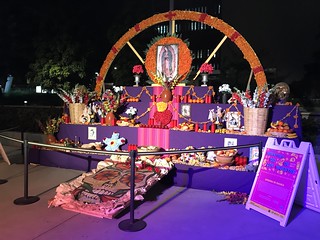
I spent much of today in a cemetery in Boyle Heights (an East LA neighborhood with a traditionally Mexican-American population) seeing how people there were marking Dia de los Muertos. While it was a large cemetery, the bright orange marigolds specific to the Mexican tradition, used in abundance, made it easy to spot the graves that had been decorated for the occasion. The bright orange flowers, both whole and strewn petals, were arranged to illuminate a path for the souls to make their way back to earth for one night. It is presumed that the souls would be thirsty from their journey, so bottles of water, or perhaps the deceased’s favorite beverage (beer, tequila) would be left on the grave. Candy was common as well, and at one grave, I even saw fries and chicken strips awaiting one returning soul. I saw a number of people in the graveyard visiting loved ones and decorating their graves. The mood is somehow both reflective and festive. I saw whole families with children, some setting up umbrellas and making a picnic of it, some blaring Nortense music from their car. There was an elderly couple visiting some graves, the man in a wheelchair and his wife reading inscriptions to him. (I helped them back to their car when I saw she was having trouble maneuvering his wheelchair through the uneven grass.) As I always do in graveyards, I get lost in reading the inscriptions on the stones, finding little pieces of stories. In this cemetery, many had died way too young, and some had married and parented quite young too. Others lived good long lives and were mourned by generations. I like the attitude of this holiday. It reminds us all that we are a thread in a larger tapestry, a thread with a beginning and an end, but which finds a larger meaning woven together with the threads that came before us, and that have touched us, and that we will touch.
In my Dia de los Muertos tour, I also made a couple of other stops. Self Help Graphics & Art is a community art center in Boyle Heights, and in October, it’s an ofrenda factory. You can find it easily by the murals covering the building on East 1st St. While most of their handiwork is now on display in Grand Park, there were a few community-themed ofrendas still here. One was an altar to those who had died suffering the stigma of mental illness. Another was an altar to children who had died trying to cross the border, with a “sea” of messages of encouragement written by local school children on construction paper fish. Yet another was a tribute to passed heroes, where people left photos and notes to those who had inspired them, some famous figures and some very personal. My other stop was La Monarca Bakery, a Boyle Heights tradition, where I sampled pan de muertos, a mildly sweet bun with hints of orange zest, with crossed bones on top. They had piled boxes of these, which many people will bring to the graveyard tonight and tomorrow, or just to other Dia de los Muertos celebrations. And they also had an ofrenda, remembering those passed in the La Monarca family. (And of course this altar had pan de muerto on it!)
(See full album of pictures from my Dia de los Muertos tour.)
In my Dia de los Muertos tour, I also made a couple of other stops. Self Help Graphics & Art is a community art center in Boyle Heights, and in October, it’s an ofrenda factory. You can find it easily by the murals covering the building on East 1st St. While most of their handiwork is now on display in Grand Park, there were a few community-themed ofrendas still here. One was an altar to those who had died suffering the stigma of mental illness. Another was an altar to children who had died trying to cross the border, with a “sea” of messages of encouragement written by local school children on construction paper fish. Yet another was a tribute to passed heroes, where people left photos and notes to those who had inspired them, some famous figures and some very personal. My other stop was La Monarca Bakery, a Boyle Heights tradition, where I sampled pan de muertos, a mildly sweet bun with hints of orange zest, with crossed bones on top. They had piled boxes of these, which many people will bring to the graveyard tonight and tomorrow, or just to other Dia de los Muertos celebrations. And they also had an ofrenda, remembering those passed in the La Monarca family. (And of course this altar had pan de muerto on it!)
(See full album of pictures from my Dia de los Muertos tour.)
Friday, August 30, 2019
Exploring Westwood Memorial Park
For years I had heard about this quiet little cemetery hidden behind tall buildings in the middle of Westwood, which boasts the graves of many Hollywood luminaries, perhaps the most notable being Marilyn Monroe. You really have to know that it's there, because it isn't visible from any street, and the only entrance is a modestly marked driveway between two buildings. There's a nice lawn area in the center with all flat stones, and some columbariums and a few mausoleums around the edges. Marilyn, as I learned, is in an above-ground niche which you can locate by looking for a niche with lots of lipstick kisses on it. While Marilyn's niche may have a kiss or two, it is the adjacent niche belonging to Hugh Hefner that's covered in kisses. It seems that Hefner laid out big bucks to be forever beside his first Playboy centerfold, even though the two never actually met in life. There are a lot of stories here. In another above ground niche, I found Truman Capote interred with Joanne Carson, ex-wife of Johnny Carson. They were apparently best friends, and Capote died in a room at Carson's home where he did a lot of his writing. It's not clear to me whether his ashes are actually in there, as I found at least one story claiming that his ashes were sold at auction by Carson's estate. Some stones celebrate comedians who gave us laughs to their very end. Rodney Dangerfield's grave is inscribed "there goes the neighborhood", while Merv Griffin's grave says "I will not be right back after this message". Some graves, like Don Knotts, have lovely graphical tributes. Some, like Bob Crane and his wife and Hogan's Heroes co-star Sigrid Valdis, have entire obituaries with photos. Others, like Donna Reed, are very simple and easy to miss. I found many stars just on my random walk, but I need to go back, as there were many that I missed, including Natalie Wood, Fanny Brice, Dean Martin, Jack Lemmon, Eva Gabor, Billy Wilder, Carroll O'Connor, Walter Matthau, George C. Scott, and more.
Labels:
exploreLA
Friday, August 23, 2019
Sonoratown, St Vincent Court, The Last Bookstore, and Biddy Mason Park
With the 2019 Masa Madness Tortilla Tournament down to its Suave Sixteen, I was reminded that I had yet to taste the winner of last year’s tournament, the legendary flour tortillas of Sonoratown. So this morning I headed to DTLA to rectify that. Arriving at 11:05am, I found there was already a line out the door and down the street, but it was a beautiful morning and the delicious aroma from the grill wafted out onto the street to give those of us in line a hint of tastes to come. The reward came on a plate with a taco de costilla (grilled slices of beef rib), a chorizo quesadilla, and a small bean and cheese burrito. I appreciated that the items are modestly sized, enabling me to sample three different expressions of their flour tortillas without being too much of a pig. Yes, flour tortillas are what it’s all about here, in the style of Sonora (northern Mexico), pressed thin, supple, and made extra delicious with generous brown stripes from the grill. An excellent complement to the grilled beef with a hint of mesquite smoke, and the crispy chorizo with its chile heat. This was all enjoyed with an horchata (they use coconut milk to make the rice starch creamier) and norteño music. Close your eyes and you could be in the chef’s hometown of San Luis Rio Colorado, just south of the Arizona border. Open your eyes, and see the line of people a multicolored array of Hispanic, African, Asian, Middle Eastern, and European ancestry, and you know you’re in LA.
After brunch, I explored a few DTLA sites I’d heard about. If you’re walking along 7th St between Broadway and Hill, there’s a mid-block service alley that at some point got transformed into a kitschy little faux European street called St. Vincent Court. The alley is paved in brick, and it is lined with brightly painted shopfronts with sidewalk tables and chairs. It’s as if you stepped through a portal from DTLA to Solvang, but less specific about which European country, with bits of Italian, French, German all quaintly jumbled. Behind the cute storefronts lie a couple of delis, a half-dozen kebab places (I’m guessing that the clientele from the surrounding jewelry markets must be heavily middle-Eastern), a pizzeria, and Café Bonjour (with its hospitable Asian proprietor), where I took an espresso and enjoyed watching the life on this quirky little street.
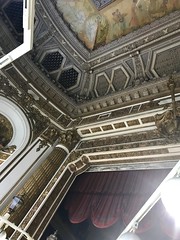
I wandered up to Broadway, and took a peek at the old Warner Brothers Theater. Broadway is full of the remains of once-grand movie houses, and you can see remnants of the marquees and the terrazzo in the sidewalk. What used to be the Warner Brothers Theater is now the Theater Jewelry Exchange, a marketplace of jewelry shops and stalls. But walk into the stalls and look up, and you can see the ornate ceiling of the classic movie palace. Here and there you can spot brass fixtures and chandeliers. The big red curtain is even still there. It’s an odd juxtaposition with its present use, stalls set up where the audience would have sat 80 years ago.
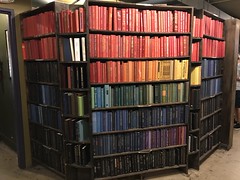
At 5th and Spring, I came to The Last Bookstore, an impressive independent bookstore occupying a good quarter of a downtown block on two floors, filled with new and used books, the shelves peppered with comfy chairs. (Admittedly, it’s not Powell’s, but it’s pretty good.) It has some fun curiosities as well: a tunnel made of old books stacked into a long arch, an old bank vault housing the horror section, and several shelves of “decorative books”, organized by color and size.
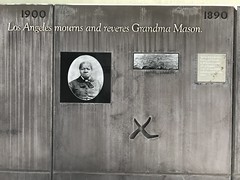
In the block between Spring and Broadway and 3rd and 4th, I found an open space amidst the buildings with some plantings, a fountain, some nice places to sit, and a long granite wall memorializing a rather remarkable woman named Biddy Mason. She was born a slave in Mississippi in 1818, followed with her owner’s family on a Mormon migration to Utah and then California, where she petitioned for and won her freedom. She worked in Los Angeles as a nurse and midwife, delivering hundreds of babies. She saved diligently and invested in real estate near downtown Los Angeles (including the land where this small park is), making a small fortune, and becoming a major philanthropist as well as a co-founder of the First African Methodist Episcopal Church of Los Angeles and the first elementary school for black children in Los Angeles. The granite wall has a timeline of the 1800s with events in Biddy Mason’s life aligned with events in the growth of this part of Los Angeles. What an impressive woman!
Location:
208 E 8th St, Los Angeles, CA 90014, USA
Friday, August 09, 2019
The Velaslavasay Panorama and the Cristo del Arbol de la Calle 22
So on Friday, I checked out a few of LA’s lesser known attractions. The Velaslavasay Panorama is a kind of a throwback to a previous century before movies, when some creative artists recreated the travel experience by means of a large 360-degree panoramic painting, augmented with model-train-like scenic dioramas in front of the painting. If you remember the old “America The Beautiful” 360-degree movie at Disneyland, these panoramas are something like that, but with a painting rather than a movie. The experience is enhanced with dynamic lighting and a soundtrack, so that as you wander around the panorama, you hear ambient sounds – people talking, birds, crickets, street noise, passing trains – and over the course of a half-hour you might see day turn to night and back again. It’s quaint and charming (think of the Disneyland Railroad diorama), and for people 100 years ago who didn’t have benefit of the Travel Channel, the device can give you a surprisingly decent sense of place. The currently installed panorama is of Shengjing, a city in the Northeast of China, as it was circa 1920. It had been installed in an old Chinese restaurant in Hollywood, but the whole thing has been installed now at the Union Theatre in West Adams, itself a bit of local history: built in 1910 as one of the first movie houses, it was later used as a play house, and then a hall for the tile workers’ union local. The main theatre space still looks as it did in 1920, with an old organ about to accompany the silent film, and a side stage for a puppet show at intermission. The panorama is above. You enter via a spiral staircase that comes up in the middle, where you suddenly find yourself atop a hill in the middle of northern China. After enjoying the panorama, the funky Asian garden in back, and another diorama of an Arctic trading post, I was about to head home when I learned I was only a couple blocks away from the Cristo del Arbol de la Calle 22. Of course I had to see what that was. Apparently, on a modest West Adams residential street, there was an old dead tree between the sidewalk and the curb that some guy looked at and saw possibility. So he carved the crucified Jesus out of the tree. From the waist down, you still see the tree trunk, but above you see a nice folk art carving of Jesus, two branches in the perfect configuration for his outstretched arms, painted with stigmata. It’s become a local shrine, with a protective covering, and offerings of flowers and toys left for Jesus of the Tree of 22nd Street.
Labels:
exploreLA
Friday, March 08, 2019
X'tiosu and Hsi Lai Temple: Lunch on the border of Lebanon and Oaxaca, afternoon in Taiwan
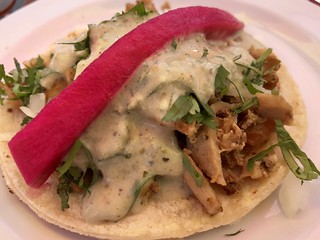
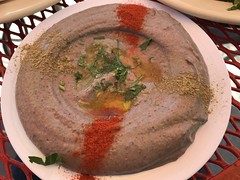
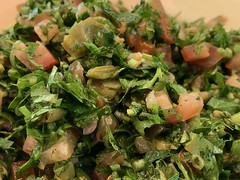
For lunch, I traveled to the border of Lebanon and Oaxaca (actually Boyle Heights), where a new restaurant called X'tiosu Kitchen has popped up recently. A couple of brothers came from Oaxaca, cut their cooking chops in Lebanese restaurants in Santa Monica, and now are fusing those skills with their native flavors to create "comida libanesa estilo oaxaqueña". That turns out to be a chicken shawarma taco, with a double layer of corn tortillas to give the heft of a pita, grilled chicken, a bright pickled turnip, and the rich tahini sauce dancing with a hot smoky salsa made from chile de arbol and guajillo peppers. That means that their tabbouleh blends lots of fresh parsley and tomato with nopalitos (cactus) instead of bulgur. It means hummus is whipped from black beans instead of chick peas, and graced with olive oil, paprika, and cumin. It means you're lucky to live in Los Angeles, where magic like this can happen.
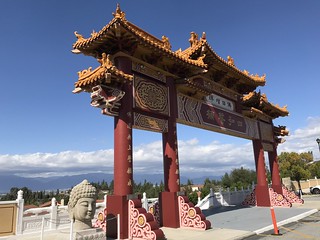
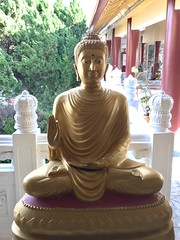
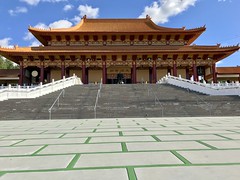
After lunch, I went to Taiwan for the afternoon (actually Hacienda Heights). The spectacular Fo Guang Shan Hsi Lai Temple is built dramatically into a hillside, so that you ascend through a series of temple structures, symbolic of the Buddhist journey of enlightenment. From the height of the main temple, looking out over the golden rooftops of the other structures, and further out over a brilliant blue sky with dramatic clouds, I felt like I could have been in Tibet if not Taiwan. I wandered the gardens and grounds filled with fantastic images of buddhas, boddhisatvas, and other revered figures. I saw monks in their robes, and watched people praying. I lit some incense as I saw others doing. Several helpful people offered to answer any questions. I stepped inside the main temple and marveled at literally thousands of buddhas. On the opposite wall facing you as you enter are three gigantic buddhas. As your eyes adjust, you realize that the columns are made up of stacked niches, about 2-foot square, each with its own buddha figure in it. Then you realize that the walls between the columns are filled with even smaller niches, each with buddhas in them, and each with a unique name. The whole experience was fantastically serene, which I suppose is the goal. I am so lucky to live in LA, and have the world in my city!
Friday, February 08, 2019
ART: Ai Weiwei and Yayoi Kusama at the MAF
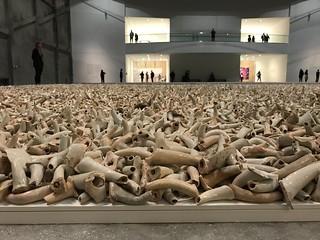
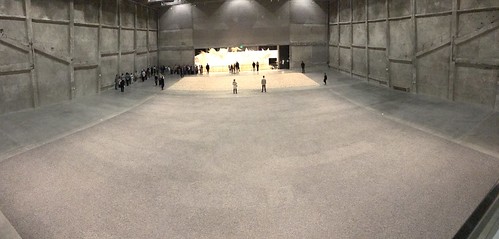
After lunch in Koreatown, in another of my off-Friday pairings of food and art explorations, I got to see a couple of impressive art installations at the Marciano Art Foundation. (If you haven’t yet been to the MAF, it’s a fantastic recent addition to the LA modern art scene, completely free including parking, but you need to make online reservations, and it’s currently booked out about a month out.) The first was a set of massive installations by Ai Weiwei. I’ve gotten to know this artist in the last year, not only through a previous exhibition, but also through his impressive documentary film Human Flow, about refugees and mass migrations, and it’s interesting to see the themes that connect his works. He is fascinated with scale and replication, and one of the things he likes to do is create large installations comprised of large numbers of the same kind of object, inviting you to look at an overall mass, contemplating vastness and large numbers, but at the same time to look closely at individuals and see what appear to be replicas actually have individual differences and characteristics. In the previous exhibit, he did that with antique Chinese stools filling a large open gallery. The Marciano offered an even bigger space to fill, and he’s filled it with two installations of this sort. One, called Spouts, is a nearly 2000-square foot rectangle filled with the spouts of antique porcelain teapots. These are broken fragments of pottery from various Chinese dynasties, some as much as 1000 years old. The shapes and colors vary, though they’re mostly shades of white and ivory. Given that the artist has spent time in Chinese prison and under house arrest, one can imagine this mass of teapot “mouths” to be a comment on the freedom of speech for all the people in China. The other, called Sunflower Seeds, is an even bigger square, over 4000 square feet, filled with sunflower seeds. Not real ones, but lifesize porcelain replicas. There are about 50 million of them, made by over 1600 artisans in Jingdezhen, a town with a long tradition of porcelain craftswork. Thinking about the fact that each of these seeds was handmade by an artisan, and looking at this vast field of millions of them, makes you think about the value of handicraft and the price of labor in China.
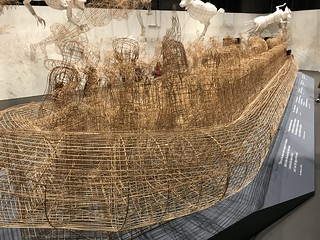
Beyond these two fields is another space that houses a bunch more works by Ai Weiwei, these works all made of bamboo and silk, using the techniques of traditional Chinese kite-making. In the center of the space is the featured Life Cycle, a lifesize large inflatable Zodiac-style boat filled with human figures, made entirely of slender bamboo sticks. If you’ve seen his film, or if you’ve seen any documentary footage of refugees crossing the Mediterranean Sea trying to reach Europe, you will recognize the scene immediately. These are the sort of boats refugees often use, filled to dangerous overcapacity. Sometimes they even capsize. The figures in this boat are all facing inward, and you can see that the center is filled with figures too. A child peers over the front. The transparent bamboo construction of the figures makes them ghostly, just outlines of people, hard to make out. These boats often make their desperate runs at night. After a while you notice that while most of the figures are human, every so often the artist has topped a human body with the head of animals from the Chinese zodiac, an ox here, a rooster there. Perhaps that’s a play on Zodiac, the most common maker of these inflatable boats. Perhaps it suggests the hope that there might be some guiding spirits or angels traveling with these desperate boats. In any case, it’s a powerful piece.
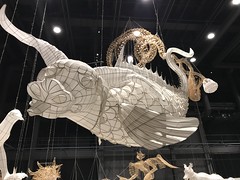
Surrounding the Life Cycle, on the walls around it, and suspended in the rafters above it, are a myriad of bamboo-and-silk kite-like works. The ones flying above are all fantastic mythical creatues drawn from an ancient Chinese mythological text called the Shanhaijing. These creatures have arms and wings, fins and tails, some have multiple heads. The white silk creatures lit up against very high rafters that disappear into darkness create a fantastic effect, like constellations floating in a night sky. The works along the wall draw on myth, on modern art, and on themes from the artist’s life and work. In one section I smiled to recognize the three-legged stools echoing another work I had seen last fall.
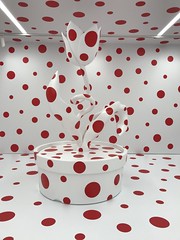
This alone would have been treat enough, but on another floor, MAF was hosting another large scale installation by a fascinating artist. Yayoi Kusama, the Japanese artist whose amazing Infinity Room has been such a hit at The Broad, has another immersive installation here. This one is entitled With All My Love For The Tulips, I Pray Forever. The title gives you a hint of the playful fantasy to expect. This work comprises several monumental potted tulips in a large room, where the tulips themselves, along with the entire room – walls, ceiling, floor – have been painted bright white with large bright red polka dots. It is a fantastic effect, and as you don shoe coverings to be able to walk into this joyful artwork, I think it is impossible not to smile. With absolutely everything in your field of view the same bright colored pattern, Kusama plays with your sense of depth and dimension, while the fancifully shaped oversize tulips create a Wonderland effect. Just how big are those tulips? Wait, have I shrunk? With nothing around you but bright dots, fantastic flowers, and smiling spectators, this exhibit most definitely sparks joy.
Beyond this, there was still more to explore. The MAF has a large permanent collection that they rotate through exhibition, and judging by the very recent dates on some of the works I saw today, they are actively continuing to expand their collection. Mimi Lauter has a gorgeous 8-panel abstract painting in brilliant peacock hues. A wall full of different colored mirrored windows forms the “clockwork for oracles” by Ugo Rondinone. Photographer Catherine Opie has a fascinating series of intimate photos from inside Elizabeth Taylor’s home (not of Ms. Taylor, just of her home and her stuff). Urs Fischer has created a series of intriguing self-portraits spliced onto scenery, using cuts and color washes and creative construction. These are just some of the highlights. This museum is really such a treat.
![]() |
| The large field in fore are the 50 million porcelain sunflower seeds. The ivory rectangle beyond that are the antique teapot spouts. |
Surrounding the Life Cycle, on the walls around it, and suspended in the rafters above it, are a myriad of bamboo-and-silk kite-like works. The ones flying above are all fantastic mythical creatues drawn from an ancient Chinese mythological text called the Shanhaijing. These creatures have arms and wings, fins and tails, some have multiple heads. The white silk creatures lit up against very high rafters that disappear into darkness create a fantastic effect, like constellations floating in a night sky. The works along the wall draw on myth, on modern art, and on themes from the artist’s life and work. In one section I smiled to recognize the three-legged stools echoing another work I had seen last fall.
This alone would have been treat enough, but on another floor, MAF was hosting another large scale installation by a fascinating artist. Yayoi Kusama, the Japanese artist whose amazing Infinity Room has been such a hit at The Broad, has another immersive installation here. This one is entitled With All My Love For The Tulips, I Pray Forever. The title gives you a hint of the playful fantasy to expect. This work comprises several monumental potted tulips in a large room, where the tulips themselves, along with the entire room – walls, ceiling, floor – have been painted bright white with large bright red polka dots. It is a fantastic effect, and as you don shoe coverings to be able to walk into this joyful artwork, I think it is impossible not to smile. With absolutely everything in your field of view the same bright colored pattern, Kusama plays with your sense of depth and dimension, while the fancifully shaped oversize tulips create a Wonderland effect. Just how big are those tulips? Wait, have I shrunk? With nothing around you but bright dots, fantastic flowers, and smiling spectators, this exhibit most definitely sparks joy.
Beyond this, there was still more to explore. The MAF has a large permanent collection that they rotate through exhibition, and judging by the very recent dates on some of the works I saw today, they are actively continuing to expand their collection. Mimi Lauter has a gorgeous 8-panel abstract painting in brilliant peacock hues. A wall full of different colored mirrored windows forms the “clockwork for oracles” by Ugo Rondinone. Photographer Catherine Opie has a fascinating series of intimate photos from inside Elizabeth Taylor’s home (not of Ms. Taylor, just of her home and her stuff). Urs Fischer has created a series of intriguing self-portraits spliced onto scenery, using cuts and color washes and creative construction. These are just some of the highlights. This museum is really such a treat.
FOOD: Galbi at Sun Nong Dan in Koreatown
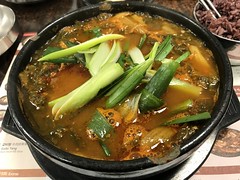
Today I lunched at the famous Sun Nong Dan in Koreatown. It lies in a strip mall at 6th and Alexandria, amdist a handful of restaurants, each with distinct specialty dishes. I tried the oo guh ji galbi tang, a bubbling pot of hot chili broth with some beef short rib and “dried cabbage” (seemed more like collard greens). It came with some nice banchan -- chili scallions, kimchi, chili turnips. I’d heard that the galbi jjim is the thing to get, but I need to bring friends next time, cause the smaller serving size feeds three or more. It was pretty awesome seeing it at other tables when they topped it with cheese and melted it with a blowtorch.
Friday, November 02, 2018
Dia de los Muertos Festival in Grand Park DTLA
After dinner downtown, George and I wandered up to Grand Park where a Dia de los Muertos festival has been going on. The park is filled with offrendas, altars to departed loved ones piled with photographs, favorite foods, flowers, and memories. The first large, colorful one we came upon was by the local Oaxacan community. A few were personal, to a single person or family. But most of them were made by various civic groups, connecting specific remembrances to general themes, like one from a Latino LGBT group remembering those who had been ostracized by their family and had died way too young. Some extended the theme outside its original cultural roots, like one from a local group of Yemeni immigrants remembering their family members who have died back in war-torn Yemen. It reminded me a bit of the AIDS Quilt, in the power of a large scale built up out of particulars. So many photos of beloved grandparents or those cut off young, each with their own story. And it was also wonderful to see the people wandering the park engaging with these offrendas. Many of them were dressed up, in white skeleton faces, black dresses and suits, women with marigolds in their hair. I saw a father with a young son, the little boy in skeleton face and red hoodie, looking just like the kid from Coco, and the little boy was at an altar reading a placard with the story of the person pictured. It was so sweet. So glad that we came upon this. (View photo album.)
Samgyetang and Ai Weiwei

Today’s off-Friday explorations took me to Koreatown for lunch, and then to the Ai Weiwei: Zodiac exhibition at the new Jeffrey Deitch Gallery. In Koreatown, as I’ve learned, many of the really good places have one dish that they specialize in, and which may be all they offer. Today was one of those. Buil Samgye Tang (the signage was mostly in Korean) serves only samgye-tang, a chicken rice soup loaded up with all sorts of roots and herbs that are meant to cure colds and hangovers and assure good health. The basic model is a hot iron pot of boiling broth with a ginger-and-garlic-stuffed whole young chicken, rice, mung beans, jujube (a Korean date), and ginseng. The more deluxe versions add various other folk pharmaceuticals such as milk vetch (an herb) and ground deer antlers. A bowl of sea salt on the table allows you to season to taste. And as if a whole chicken rice pot isn’t enough, the meal comes with a traditional Korean plate of banchans to start – kim chee, pickled turnips, chicken gizzard bites, and crudites with a spicy-sweet soy paste. Ginger tea is served to wash it all down. The Korean staff were assiduously polite, with lots of smiling and bowing.
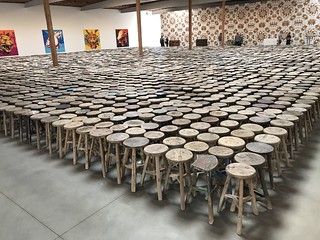
After lunch, I headed to the new Jeffrey Deitch Gallery in Hollywood. The gallery is in a former warehouse space that has been lightened up with paint and indirect natural light for optimal viewing in one very large space. Which is just what the featured Ai Weiwei work, Stools (2013), required. The work comprises nearly 3,000 wooden stools from the Ming and Qing dynasties collected from northern China. Most of the stools have the same basic three-legged design with a round seat, but every so often one varies in shape, design, or material. There are subtle differences in dimension, age, wear, and so on. The work fills an area 72-feet square. It gives the impression of a crowd where at first everyone in the crowd looks the same, but then you start to notice subtle differences. Its vastness invites you to engage with it from all sides, and to approach it at different levels, the pattern of its ordered arrangement creating all sorts of lines. It's surprising what a simple concept can do.
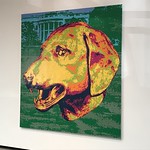
On two walls enclosing the stools are twelve very large works representing the twelve signs of the Chinese zodiac overlaid on world landmarks from major cities. These works read initially as paintings, but a closer examination reveals them to be constructed from LEGOs. One wonders if there is particular meaning in which animal overlays which city. The dragon overlays Beijing, with a small self-portrait of the artist worked in, swearing. A rather rabid looking dog overlays the White House. Hmm. On a third wall is a work entitled The Animal That Looks Like a Llama But is Really an Alpaca (2015), which is literally wallpaper. At first glance, it looks like classic French ormolu patterns, gilded objects in ornate designs. On closer inspection, one discovers that the objects are handcuffs and surveillance cameras, an ominous illustration of the artist's years of house arrest in his native China. Along this wall are five sculptural works, each a cube exactly one cubic meter in dimension, but each of different materials. Here Weiwei plays with the concept of a cubic meter, a standard measurement for shipping cargo, but each cube is of very different materials. One is wooden and forms an elaborate puzzle box. Another is a dark mass, which when you get close enough to see and smell it, turns out to be a huge block of tea. Another is perhaps the world's largest crystal, perfectly transparent, and bending light in all sorts of fun ways that beg for investigation. A solid white marble cube has brain coral-like carvings in it to give it texture. The fifth cube is a frame, made of exquisite blue-patterned porcelain. Near the front, Grapes (2017) takes a few more of those wooden stools, but reassembles them into an integrated spheroid, legs all radiating outward, looking almost like a creature that could start rolling. It's fascinating to look closely at how the stools were integrated, like a chain of Siamese twins, with the third leg of one being the first leg of another, and so on.
I was thrilled to enjoy these works of such a remarkable artist, and to enjoy them in an appropriately lit and capacious space, and frankly to have had the gallery nearly to myself for a time. Though I have to confess I'm still new to the private art gallery thing, and a bit intimidated. I mean, it's not a public museum, so isn't it really meant for people who might conceivably be thinking of purchasing thsee works? But in exhibitions like these, are the works even really on offer? I mean, some of them are monumental. If one is rich enough to buy something like Stools from a world-renowned artist, then I suppose one is rich enough to build a space to house it? Off to one side of the gallery entrance, there was a small desk where sat Jeffrey Deitch himself (I recognized the former MOCA director from photos in the LA Times) and a couple of assistants. I didn't approach them, and they didn't approach me. But at some point, I did notice that when certain other people entered, he would pop up and greet them. And at one point, I was close enough to overhear some conversation. They were breezily talking about who they'd met at Davos or the latest TED talk, or how they just had lunch with Frank Gehry. Deitch asked one woman if he had a current address for her. "Oh, well sometimes I'm in New York," she replied, "but sometimes I'm in the house in France, or in Switzerland. It's best just to mail me at the Foundation." Wow. Different circles than I'll ever run in. But I guess it's because of people like them that galleries like this can exist, and I can get to enjoy them.
After lunch, I headed to the new Jeffrey Deitch Gallery in Hollywood. The gallery is in a former warehouse space that has been lightened up with paint and indirect natural light for optimal viewing in one very large space. Which is just what the featured Ai Weiwei work, Stools (2013), required. The work comprises nearly 3,000 wooden stools from the Ming and Qing dynasties collected from northern China. Most of the stools have the same basic three-legged design with a round seat, but every so often one varies in shape, design, or material. There are subtle differences in dimension, age, wear, and so on. The work fills an area 72-feet square. It gives the impression of a crowd where at first everyone in the crowd looks the same, but then you start to notice subtle differences. Its vastness invites you to engage with it from all sides, and to approach it at different levels, the pattern of its ordered arrangement creating all sorts of lines. It's surprising what a simple concept can do.
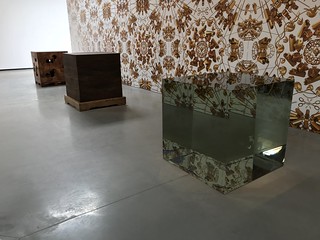
On two walls enclosing the stools are twelve very large works representing the twelve signs of the Chinese zodiac overlaid on world landmarks from major cities. These works read initially as paintings, but a closer examination reveals them to be constructed from LEGOs. One wonders if there is particular meaning in which animal overlays which city. The dragon overlays Beijing, with a small self-portrait of the artist worked in, swearing. A rather rabid looking dog overlays the White House. Hmm. On a third wall is a work entitled The Animal That Looks Like a Llama But is Really an Alpaca (2015), which is literally wallpaper. At first glance, it looks like classic French ormolu patterns, gilded objects in ornate designs. On closer inspection, one discovers that the objects are handcuffs and surveillance cameras, an ominous illustration of the artist's years of house arrest in his native China. Along this wall are five sculptural works, each a cube exactly one cubic meter in dimension, but each of different materials. Here Weiwei plays with the concept of a cubic meter, a standard measurement for shipping cargo, but each cube is of very different materials. One is wooden and forms an elaborate puzzle box. Another is a dark mass, which when you get close enough to see and smell it, turns out to be a huge block of tea. Another is perhaps the world's largest crystal, perfectly transparent, and bending light in all sorts of fun ways that beg for investigation. A solid white marble cube has brain coral-like carvings in it to give it texture. The fifth cube is a frame, made of exquisite blue-patterned porcelain. Near the front, Grapes (2017) takes a few more of those wooden stools, but reassembles them into an integrated spheroid, legs all radiating outward, looking almost like a creature that could start rolling. It's fascinating to look closely at how the stools were integrated, like a chain of Siamese twins, with the third leg of one being the first leg of another, and so on.
I was thrilled to enjoy these works of such a remarkable artist, and to enjoy them in an appropriately lit and capacious space, and frankly to have had the gallery nearly to myself for a time. Though I have to confess I'm still new to the private art gallery thing, and a bit intimidated. I mean, it's not a public museum, so isn't it really meant for people who might conceivably be thinking of purchasing thsee works? But in exhibitions like these, are the works even really on offer? I mean, some of them are monumental. If one is rich enough to buy something like Stools from a world-renowned artist, then I suppose one is rich enough to build a space to house it? Off to one side of the gallery entrance, there was a small desk where sat Jeffrey Deitch himself (I recognized the former MOCA director from photos in the LA Times) and a couple of assistants. I didn't approach them, and they didn't approach me. But at some point, I did notice that when certain other people entered, he would pop up and greet them. And at one point, I was close enough to overhear some conversation. They were breezily talking about who they'd met at Davos or the latest TED talk, or how they just had lunch with Frank Gehry. Deitch asked one woman if he had a current address for her. "Oh, well sometimes I'm in New York," she replied, "but sometimes I'm in the house in France, or in Switzerland. It's best just to mail me at the Foundation." Wow. Different circles than I'll ever run in. But I guess it's because of people like them that galleries like this can exist, and I can get to enjoy them.
Friday, October 19, 2018
Chichen Itza, King Tut, and PYT
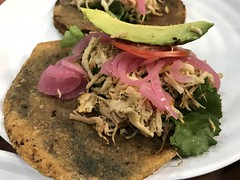
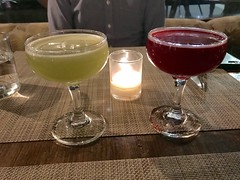
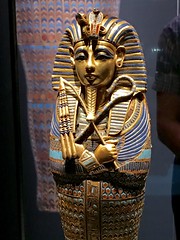
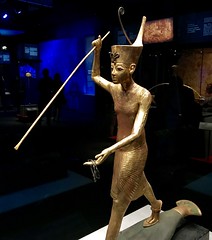
Another great "off Friday" exploring LA, today with the adding bonus of being joined by my husband who decided to take a day off. I introduced him to the Mercado La Paloma foodie food court by USC, where we lunched on a Yucatecan feast of panuchos, tacos de poc chuc and cochinita pibil. Then we wandered over to see the King Tut exhibit at the Calif Science Center. The exhibit features many great artifacts from the tomb, some of which have never before left Egypt. It is beautifully laid out, presenting the artifacts in the context of King Tut's journey through the underworld into the afterlife, the reason all these dazzling treasures were crafted and placed in his tomb. When the tomb was first being opened and Howard Carter first peered in, Lord Carnarvon eagerly asked, "do you see anything?" "Oh yes," he replied, "wonderful things!" We did indeed see wonderful things today. (The exhibit runs through Jan 6, so still time to catch it!) This evening, we went into DTLA for dinner at the vegetable-forward PYT. Even our cocktails featured veggies - a celery margarita and a bourbon with beet.![]() |
![]() |
![]() |
Friday, August 24, 2018
Long Beach: CambodiaTown and Judithe Hernández at the MoLAA
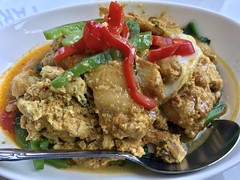
With another off-Friday opportunity to explore my city, I headed down to Long Beach. For lunch, Cambodian food was on the menu. In one of those quirks of human migration patterns, the stream of Cambodian emigrants in the wake of the 1979 fall of the Khmer Rouge regime ended up concentrating in Long Beach, and creating a CambodiaTown along Anaheim Blvd. Arguably ground zero of CambodiaTown has been a place called Sophy’s (or also called CambodiaTown Food & Music), a restaurant but also a bit of market and community center. I’d been tipped off by Eater.com that a dish called amok trey was a great intro into authentic Cambodian cuisine. Amok trey is made from catfish fillets rubbed with kroeung -- a curry paste, and steamed with red and green peppers -- and some leafy veg with a stalk (similar to Chinese broccoli). The curry paste has similar ingredients to Thai curry - lemongrass, galangal, chili, kaffir lime - but a bit more sour than Thai. This fish was mild, tender, and delicious.
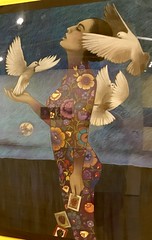
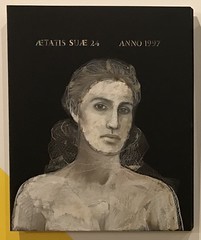
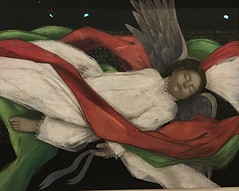
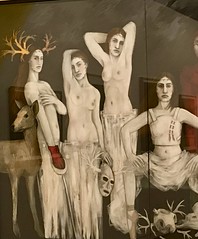
After lunch, my culture target was the Museum of Latin American Art, where a new exhibition of Judithe Hernández had just opened. I wasn’t familiar with the artist, but when I saw some of the striking images of her work, and when I learned that she was a cohort of Carlos Almaraz, whose work I’d really appreciated at a LACMA exhibit last summer, I knew I wanted to check it out. As the only female artist in the art collective Los Four, and one of the few female artists in the Chicano art movement at all, she developed a strong feminist identity expressed in her work. She works almost exclusively in pastel on paper, with figurative depictions of women, with a dream-like quality that conveys these women as archetypes to be read symbolically rather than portraits of specific actual women. A number of her works are set in vivid botanical landscapes, Rousseau-like jungle foliage or desert scapes, and some contain dream-like animals. This sort of magical realism will suggest comparisons to Frida Kahlo, but Hernández has her own clearly distinct style and vision. A number of the pieces express pointed commentary on contemporary events. One set, called the Juarez series, reflects on the spate of random murders of women and girls around Ciudad Juarez. There have been hundreds of these “feminicides” since 1993, with no apparent motive, just women violently killed, their bodies left in the desert. In The Unknown Saint, a ghostly woman on her back seems to float above a stand of cactus in the desert under a full moon night sky, a thin blood-red ribbon coiled around her grey neck and trailing off different directions into the expanse of desert. This large mural is hauntingly beautiful. In another part of the Juarez series, a trilogy of small portraits of women echoes a European Renaissance tradition of aetatis suae portraits, in which families with marriageable young daughters would have portraits painted, annotated with the age of the girl and the year, for circulation around society soliciting suitors. Here Hernández, in a biting riff on the classical form, has painted portraits of young women with their age and year of their untimely deaths. Another very recent work, reacting to then-candidate Trump’s comments on Mexican immigrants, draws on a Spanish Colonial tradition of dressing deceased infants in saintly garments. Her Death of the Innocents memorializes a young child lost to the dangers of attempts to cross the northern Mexican deserts to get the United States. The deceased child is dressed as a saint, with red and green sashes (colors of the Mexican flag), and holding a ribbon that says “we come but to dream”. Though mortality is certainly a prevalent theme in her work, it’s not entirely pervasive. Other works (like Jungle of Fire, The Birth of Eve, and Garden of Dreams) are vivid dreamscapes. Some are provocative in other ways. Les Desmoiselles d’Barrio is her feminist pastiche of Picasso's seminal work, Les Desmoiselles d'Avignon. Her desmoiselles are much more formidable, with luchadora (Mexican wrestling) masks, and some armed with rapiers. For Hernández, women have layers of masks. Even with their luchadora masks removed, these women's faces are identical, and appear stitched onto their heads.
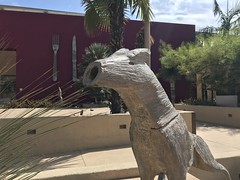
After being immersed in the colorful dreamlands of Judithe Hernández, I stepped into the sunlight of the Gumbiner Sculpture Garden, where a collection of modern sculpture by Latin artists is set amidst cactus and palms. A few particularly caught my eye. I liked Gaudi Esté’s Perro Nagual con cara de conejo (rabbit-faced dog spirit), a figurative bronze howling at the moon. In Williams Barbosa’s Danza no 1, the curve and sweep of the two tall red iron abstracts had be thinking “Fred and Ginger” before I even saw the title. Carlos Luna’s comic War-Giro looks like a goofy sheriff from the front with his skeleton exposed on the back. Gustavo López Armentia’s Objetos del Mundo (objects of the world) is a monumental fork and knife with hieroglyphic-like symbology (more worldly objects) carved into them when you look up close. All in all, definitely worth the short drive down to Long Beach. (See complete set of photos from the day here.)
After lunch, my culture target was the Museum of Latin American Art, where a new exhibition of Judithe Hernández had just opened. I wasn’t familiar with the artist, but when I saw some of the striking images of her work, and when I learned that she was a cohort of Carlos Almaraz, whose work I’d really appreciated at a LACMA exhibit last summer, I knew I wanted to check it out. As the only female artist in the art collective Los Four, and one of the few female artists in the Chicano art movement at all, she developed a strong feminist identity expressed in her work. She works almost exclusively in pastel on paper, with figurative depictions of women, with a dream-like quality that conveys these women as archetypes to be read symbolically rather than portraits of specific actual women. A number of her works are set in vivid botanical landscapes, Rousseau-like jungle foliage or desert scapes, and some contain dream-like animals. This sort of magical realism will suggest comparisons to Frida Kahlo, but Hernández has her own clearly distinct style and vision. A number of the pieces express pointed commentary on contemporary events. One set, called the Juarez series, reflects on the spate of random murders of women and girls around Ciudad Juarez. There have been hundreds of these “feminicides” since 1993, with no apparent motive, just women violently killed, their bodies left in the desert. In The Unknown Saint, a ghostly woman on her back seems to float above a stand of cactus in the desert under a full moon night sky, a thin blood-red ribbon coiled around her grey neck and trailing off different directions into the expanse of desert. This large mural is hauntingly beautiful. In another part of the Juarez series, a trilogy of small portraits of women echoes a European Renaissance tradition of aetatis suae portraits, in which families with marriageable young daughters would have portraits painted, annotated with the age of the girl and the year, for circulation around society soliciting suitors. Here Hernández, in a biting riff on the classical form, has painted portraits of young women with their age and year of their untimely deaths. Another very recent work, reacting to then-candidate Trump’s comments on Mexican immigrants, draws on a Spanish Colonial tradition of dressing deceased infants in saintly garments. Her Death of the Innocents memorializes a young child lost to the dangers of attempts to cross the northern Mexican deserts to get the United States. The deceased child is dressed as a saint, with red and green sashes (colors of the Mexican flag), and holding a ribbon that says “we come but to dream”. Though mortality is certainly a prevalent theme in her work, it’s not entirely pervasive. Other works (like Jungle of Fire, The Birth of Eve, and Garden of Dreams) are vivid dreamscapes. Some are provocative in other ways. Les Desmoiselles d’Barrio is her feminist pastiche of Picasso's seminal work, Les Desmoiselles d'Avignon. Her desmoiselles are much more formidable, with luchadora (Mexican wrestling) masks, and some armed with rapiers. For Hernández, women have layers of masks. Even with their luchadora masks removed, these women's faces are identical, and appear stitched onto their heads.
After being immersed in the colorful dreamlands of Judithe Hernández, I stepped into the sunlight of the Gumbiner Sculpture Garden, where a collection of modern sculpture by Latin artists is set amidst cactus and palms. A few particularly caught my eye. I liked Gaudi Esté’s Perro Nagual con cara de conejo (rabbit-faced dog spirit), a figurative bronze howling at the moon. In Williams Barbosa’s Danza no 1, the curve and sweep of the two tall red iron abstracts had be thinking “Fred and Ginger” before I even saw the title. Carlos Luna’s comic War-Giro looks like a goofy sheriff from the front with his skeleton exposed on the back. Gustavo López Armentia’s Objetos del Mundo (objects of the world) is a monumental fork and knife with hieroglyphic-like symbology (more worldly objects) carved into them when you look up close. All in all, definitely worth the short drive down to Long Beach. (See complete set of photos from the day here.)
Friday, June 22, 2018
FOOD: Gualaguetza
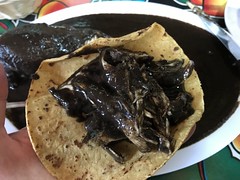
Today I lunched at Gualaguetza, a piece of Oaxaca on the corner of Koreatown (only in LA). It’s all about the mole here, a thick sauce made of chilis, nuts, spices, hours of cooking, and in the negro version, chocolate. When you sit down, tortilla chips come covered in a sweet rich mole coloradito with queso fresco. There’s Oaxacan chocolate mixed with atole (a hot ground corn drink) called champurrado. And the main event, a chicken breast in a pool of rich mole negro, with rice, and corn tortillas with browned spots from the comal. And of course the Copa Mundial on the big screen, fun to watch with a crowd. I watched the Swiss beat Serbia. This place will be crazy fun tomorrow morning when Mexico plays South Korea! I definitely want to come back and try some more things, as there's quite an array of Oaxacan specialties, including chapulines (fried grasshoppers!). I'm intrigued, but also squeamish. (In the film "City of Gold", there's a scene with Jonathan Gold and Ruth Reichl munching on a plate of chapulines at this very restaurant, and talking about how we'd best get more used to eating insects, as it's our future.) I'd also try their cafe de olla next time, which might be a better way to cut the richness of the mole. Truth be told, the champurrado, a dish I'd never tried before, wasn't my favorite. I do love atole and who doesn't love chocolate. But I just didn't find the combination to be complimentary. And certainly not the 2+2=5 that you get from chocolate and peanut butter, or chocolate and hazelnuts, or even Guinness stout and chocolate (an awesome gelato). Or of course chocolate and chili in this awesome mole.
Friday, June 15, 2018
FOOD: Tatsu Ramen
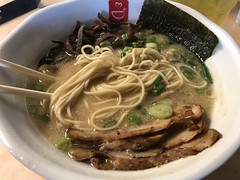
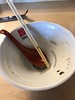
On a stretch of Sawtelle in West LA you can find dozens of Japanese restaurants with different specialties, one right next to another, up to six in a row in one strip mall. Of course there are places to get ramen. Today I tried the much-vaunted Tatsu. There was a line of people waiting, but this place processes people with Tokyo efficiency, starting with iPads on the sidewalk for automated self ordering, followed by text messaging to let you know when a table is available. I went for a bowl of “Old Skool” ramen, with slices of pork, woodear mushrooms, and green onions, all in a rich tonkotsu broth. The richness of the broth is a testament to the hours and hours that they boiled the pork bones. The noodles are thin but chewy and with a wheaty flavor, almost slightly undercooked, but that’s the traditional way it’s made in Fukuoka. I slurped up every last drop.
Subscribe to:
Posts (Atom)