Showing posts with label stage. Show all posts
Showing posts with label stage. Show all posts
Saturday, June 29, 2024
STAGE: A Strange Loop


Thursday, May 23, 2024
STAGE: The Rhythm of Mourning

Thursday, June 15, 2023
STAGE: A Transparent Musical

Saturday, February 20, 2021
STAGE: Matthew Bourne's Romeo & Juliet
George and I went to the ballet tonight, thanks to Center Theatre Group's Digital Stage program. Matthew Bourne’s choreography never fails to be breathtaking, and when combined with a creative reimagining of Shakespeare’s Romeo & Juliet set to Prokofiev’s dramatic score, the result is riveting. Two very talented and very young dancers, Cordelia Braithwaite and Paris Fitzpatrick, bring to life the star-crossed lovers. Their dance duets are charged with passion and energy, with effortless gravity-defying moves that make you wonder whether there aren’t hidden strings. Their fluidity is amazing, and in one remarkable scene they carry off their pas de deux in a prolonged lip-locked kiss. The tale is made contemporary, and reset in some kind of mental institution with an abusive guard, and it is a darker more twisted version of the classic tragedy. But the beauty of the music and the movement captivates with hope for the young lovers right up to their doomed end.
Saturday, February 15, 2020
STAGE: What the Constitution Means to Me
 Our Constitution, written over 200 years ago, is the most long-lived written constitution in history, and remains perhaps one of the few things nearly all Americans can agree on revering, even as we disagree sometimes vehemently on the specifics of its interpretation. That reverence and that tension are at the heart of the show What the Constitution Means to Me, an autobiographical memoir by Heidi Schreck, who recreates her experience as 15-year old girl delivering competitive speeches on the Constitution at VFW halls for scholarship prizes, then breaks into her present-day 45-year old self to make some more mature reflections on our founding document. Schreck performed her own play for a highly-regarded run in New York, while actress Maria Dizzia has very capably stepped into the role of “Heidi Schreck” for the touring production that we saw at the Mark Taper. In the first part, 15-year old Heidi breathlessly and enthusiastically expounds on her favorite amendments, the Ninth and the Fourteenth (admittedly some of my favorites too), and makes a personal connection (as was required by the contest rules) to her great-grandmother, a German immigrant mail-order bride. There is little to none of a “fourth wall” in this play. Heidi begins by addressing the audience, Shakespeare prologue style, asking us to engage in the re-enactment by pretending to be elderly men in a late 1980s VFW hall. While being “15-year old Heidi”, she occasionally pops out of character for a bit of commentary. This happens more and more, until at some point she drops the 15-year old altogether, and just talks to us directly as herself with 30 years more life experience. (There is some amusing playfulness with theatrical conventions around these transitions, like pointing out that she forgot to include a door in her recreation of the VFW stage, and poking fun at a secondary character who is stranded on the doorless stage when she decides, seemingly impromptu, to drop the fourth wall.) Here is where it gets more interesting as idealization of the Constitution gives way to a more mature realization of its imperfections and limitations as she confronts her own reproductive decisions, as she learns some shocking history of abuse endured by her mother, aunt, and grandmother, and as she rethinks what may really have befallen her immigrant great-grandmother who died at 36 of “melancholia”. The mature Heidi comes to question how well a 232-year old document can give women and other unprotected groups their due when the document doesn’t even mention them, and didn’t even originally envision them as included as citizens nor even as “the people”. At this point, the only logical next step is to stage a debate on the proposition to keep the Constitution or to abolish it and start over. A precocious actual 14-year old girl then comes on stage to engage in a lively debate with Heidi for the final part of the show, but not before putting the audience into the right frame of mind by dividing us with a thought-provoking show of hands. The debate is rapid-fire and compelling, and the winner, as judged by a random audience member, could be different on any given night. It certainly leaves you with something to think about. My favorite quote: "Justice Scalia said that he couldn't tell you what the Ninth Amendment meant if his life depended on it. And I guess it didn't." (The line is an early comic toss-off but with more profound meaning in the larger context of the play.)
Oh, and I forgot to mention the bonus: everyone in the audience was given a pocket Constitution to keep!
Saturday, January 25, 2020
STAGE: The Last Ship

Saturday, November 23, 2019
STAGE: The New One

Saturday, October 12, 2019
STAGE: Skintight

Friday, September 20, 2019
STAGE: Latin History for Morons

Saturday, July 27, 2019
STAGE: The Play That Goes Wrong

Saturday, March 23, 2019
STAGE: Lackawanna Blues

Saturday, March 09, 2019
STAGE: Cinderella

Sunday, February 24, 2019
STAGE: America Adjacent

Being the home of “the industry” and thanks to actor’s union
rules, LA is blessed with a bounty of 99-seat theatres, often providing high
quality productions. I was treated to some of that on Sunday at the Skylight Theatre
in Los Feliz. America Adjacent is set in a small one-bedroom apartment somewhere
near Hollywood, packed with six Filipino women and a couple of babies, all
confined to the apartment. The women are all pregnant or recently delivered, coming
to America so their children will have the advantage of US citizenship. While
such a play could have easily verged into polemic, this script (by Boni
Alvarez) focuses on the very human stories of these women, why they came, what
they hope, and how they cope with being confined in such close quarters. Their
backgrounds and situations vary. One is rural and naïve, one is religious, one
is more educated, some are conformists and peacemakers while others are risk takers
and rule breakers, but all share sacrificing for the sake of their children. It
is engaging and moving, and I am glad I saw it.

Tuesday, September 11, 2018
STAGE: Love's Labour's Lost
Rounded out our Oregon Shakespeare Festival with a rollicking production of Love’s Labour’s Lost. We anticipated fun when we laid eyes on the eccentric set, and the show filled the promise. Who knew the Bard wrote a rock musical? The costumes were clever too, playing on the color imagery in the language, all white at first, increasingly splashed with tempera paints, then all red in Act IV, and all black at the end. A fair amount of ad libbing suits this play, including a bit with a smartphone. Such good fun!


Sunday, September 09, 2018
STAGE: Romeo and Juliet (OSF)

Saturday, August 11, 2018
STAGE: Waitress
 The heroine of the musical Waitress is Jenna, who works at a diner in an unnamed southern town, and has a creative genius for making pies with fanciful names and unexpected combinations of ingredients. This show takes an unexpected combination of ingredients – an abusive husband, an unwanted pregnancy, extramarital affairs, women trapped by hard economic circumstances – and bakes all of that into an unexpectedly delicious feast for the eyes, ears, and heart. The choreography is impressive, with the cast dancing around and the diner’s tables, tray carts, and pantry shelves often playing moving parts in the dance. The Sara Bareilles tunes are charming with witty lyrics that define the characters and propel the story, and Desi Oakley as Jenna does a great job serving them up with impressive stylings like falls and runs near the end of big long notes. Charity Angél Dawson was sassy as Jenna’s friend and co-worker Becky, and shined in her big number “I Didn’t Plan It” at the top of Act Two. And Oakley has some lovely duets with Bryan Fenkart (Dr. Pomatter), particularly “A Really Good Bad Idea” at the end of Act One. Despite some dark and heavy themes, there’s enough sugar in this pie to balance it. I smiled a lot and laughed, including a couple tipping-head-back roaring laughs, at the same time as appreciating its more serious commitments, but it is dessert in the end. If you have a chance to catch this while it’s still at the Pantages (through Aug 26), we recommend it.
Saturday, May 05, 2018
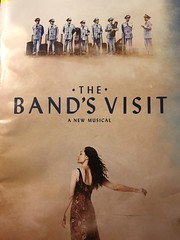
STAGE: The Band's Visit
Friday, May 04, 2018
STAGE: Come From Away
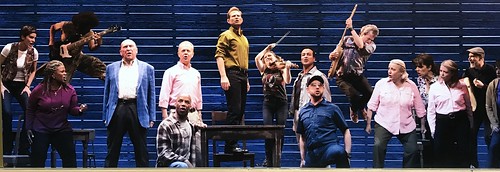
Another fantastic musical this evening, Come From Away. In the immediate aftermath of 9/11, dozens of airplanes were diverted to the small town of Gander, Newfoundland, a remote part of Canada, where a town of 7000 people unexpectedly hosted thousands of confused passengers for several days before US airspace was reopened. This moving and charming musical tells that story, as a great ensemble of a dozen actors plays several dozen roles. Who knew such a heartfelt evening of theatre, and such a heartwarming tale of hospitality could come from the world’s worst air travel experience. After the show hanging out at the stage door to greet the actors, we met a couple who traveled from Newfoundland to see this show. They were getting the cast to autograph a Newfoundland flag. Such nice people, just like in the show!
Thursday, May 03, 2018
STAGE: Dear Evan Hansen
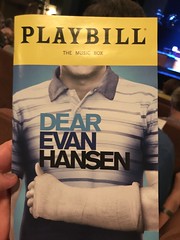
(Update 10/2018: We loved this show so much we saw it again when it came to LA.)
Sunday, August 16, 2015
STAGE: Bent

This play originally premiered in 1979, illuminating the previously little-known persecution of gays under the Nazis, and establishing the pink triangle as a reclaimed symbol of gay pride. Thirty-five years later, it remains as relevant as ever. One of the most frightening things was just realizing how quickly a liberal society can be taken over by jackboots. Germany in the early 1930s was not so different from America in the 1970s or even now for that matter, and yet how quickly complacent liberals fell under the boot. (I'm currently reading a book that tells a similar story of Tehran circa 1980.) I know that several memorable scenes from this play will haunt me: the SS bursting into Max and Rudy's apartment, when Max is forced to betray his own love, the amazing scenes of Max and Horst making love without moving or touching each other, and the electrifying end.
Subscribe to:
Posts (Atom)