Showing posts with label marriage. Show all posts
Showing posts with label marriage. Show all posts
Sunday, May 03, 2009
Clashes of Same-Sex Marriage with Religious Liberty
In this morning's LA Times, I found an interesting editorial by law professor Robin Wilson, called "The flip-side of same-sex marriage." In it, she argues that "it is possible to legalize gay marriage without infringing on religious liberty", though care must be taken to get the second part of that right. I agree with Prof. Robin Wilson that the enactment of marriage equality should be carefully balanced with religious liberty protections, and welcome her call to do so. When a pair of New Mexico photographers refused services for a same-sex wedding, and were fined for violating state anti-discrimination statutes, that was a clear unjust infringement of liberty. But this important dialog is not furthered by misinformation about the actual cases of conflict, and unfortunately Prof. Wilson trots out several overworked half-truths. That New Jersey church group who lost their property tax exemption status on a public pavilion that they refused to rent for a lesbian wedding? The tax exemption was granted for the pavilion expressly because the group promised to make it open to the public. They could either rent the pavilion selectively, or they could take the tax exemption and rent to everyone equally, but they couldn't have it both ways. The lost tax exemption was on the property tax for the pavilion only. The tax-exempt status of the religious group that owned it was never in question. The closing of Catholic Charities in Massachusetts? Catholic Charities was contracted by the state to provide adoption services. As a private entity, they would be free to discriminate according to their conscience, but by choosing to act as an agent of the state, they must treat all citizens equally. Latter-day Saints Family Services also provides adoption service in Massachusetts, exclusively to heterosexual couples, and has continued to operate since the advent of gay marriage, because they aren't funded by the state. Catholic Charities could have made the same choice, but chose not to. The crucial distinction that Prof. Wilson fails to account for is the difference between private entities and public entities (including entities acting on behalf of or subsidized by the state). Private entities should be entitled to considerable latitude for rights of conscience even when they conflict with values of equal treatment and non-discrimintion. For public entities, on the other hand, equal treatment and non-discrimination are paramount.


Wednesday, November 12, 2008
A DOMA Change We Can Believe In
With Obama heading to the White House and Democratic majorities in Congress, it seems hopeful that we may progress on federal legislative goals for gay equality in the next four years. Obvious top priorities are getting the Employment Non-Discrimination Act (ENDA) enacted, overturning the ban on gays in the military, and repealing or modifying the Defense of Marriage Act (DOMA). DOMA, passed in 1996, has two basic provisions. Part 1 provides that no state is required to recognize the same-sex marriages of another state, meaning that Alabama is not required to recognize same-sex marriages even if a couple traveled to Massachusetts and got a legitimate marriage license there. Part 2 specifies that the federal government shall not recognize same-sex marriages for any federal purpose, which means that even legally married same-sex couples in Massachusetts aren't entitled to spousal Social Security benefits, or tax exemptions for spousal inheritance, or any of the 1,138 marriage-related rights in federal law. There has been talk of repealing DOMA: Hillary Clinton said she would have repealed Part 2, and Barack Obama said he would repeal both parts. I had thought repeal was a great idea, but I'm now thinking that modification, rather than repeal, of both parts may be the right thing to do.
In reflecting on the wake of Prop 8 and the great marriage debate it stirred up, I am impressed how significantly the line of scrimmage has shifted. Even same-sex marriage opponents generally claim that they support equal rights, just not "redefining marriage". For example, the Mormon church, in a statement this week, said "the Church does not object to rights for same-sex couples regarding hospitalization and medical care, fair housing and employment rights, or probate rights, so long as these do not infringe on the integrity of the traditional family or the constitutional rights of churches." And in national polls, those who support same-sex marriage, combined with those who oppose it but support civil unions, comprise a growing majority. Politically, at the federal level, same-sex marriage opponents such as John McCain espouse a federalist ("leave it to the states") policy. A pragmatic approach to modifying DOMA would build on this consensus.
Concerning Part 2, rather than simply repeal it, it should be modified to recognize civil unions. The pragmatic compromise of civil unions currently exists in some form in at least four states (Vermont, California, New Jersey, and New Hampshire), and it would be consistent with the apparent consensus on providing equal legal treatment that these should be recognized as equivalent to marriage for the purposes of federal law. I think most Americans, regardless of their approval of gay marriage, would see the injustice of two life partners not having their earned Social Security benefits protect their partner in the event of one's death, or having a surviving partner have to pay a whopping "gift income" tax on half the value of a jointly held home. Thus Part 2 should be amended as follows:
Concerning Part 1, while some would proclaim same-sex marriage by federal fiat on all 50 states, I don't believe that is prudential at this time. I think it's better to give the controversial issue some breathing room by supporting the federalist position, that states should be allowed to determine their own policies. However, there is an important modification that should be made here. While states should be given latitude to set their own marriage policy for their residents, federal law should provide a guarantee of "safe passage" for visitors to the state. Nobody should ever again suffer the fate of Lisa Pond, who collapsed while vacationing in Florida and ultimately died in a hospital that actively prevented her partner from seeing her, directing her care, or obtaining her death certificate. I hope few Americans would see that as good public policy. Thus I propose the "Family Safe Passage Amendment" to DOMA Part 1. The distinction should be quite workable. Consider that each state has different license plates for automobiles, and different requirements for licensing cars. When I as a California resident drive my car into Arizona, I don't immediately have to take my car to get an Arizona state vehicle check and an Arizona license plate. That would be ridiculous if I'm only visiting. On a temporary basis, Arizona accepts a California-registered vehicle. However, after an appropriate period of time, if I'm still in Arizona, then I do have to register my car there, and bring it into conformity with local requirements. It should be the same for a marriage (or equivalent). If I have a California domestic partnership (a "marriage equivalent"), and I go into the emergency room while on a business trip in Virginia, my partner should be recognized appropriately at the hospital there, despite Virginia's own draconian marriage policies. Isn't that a change we can all believe in?
In reflecting on the wake of Prop 8 and the great marriage debate it stirred up, I am impressed how significantly the line of scrimmage has shifted. Even same-sex marriage opponents generally claim that they support equal rights, just not "redefining marriage". For example, the Mormon church, in a statement this week, said "the Church does not object to rights for same-sex couples regarding hospitalization and medical care, fair housing and employment rights, or probate rights, so long as these do not infringe on the integrity of the traditional family or the constitutional rights of churches." And in national polls, those who support same-sex marriage, combined with those who oppose it but support civil unions, comprise a growing majority. Politically, at the federal level, same-sex marriage opponents such as John McCain espouse a federalist ("leave it to the states") policy. A pragmatic approach to modifying DOMA would build on this consensus.
Concerning Part 2, rather than simply repeal it, it should be modified to recognize civil unions. The pragmatic compromise of civil unions currently exists in some form in at least four states (Vermont, California, New Jersey, and New Hampshire), and it would be consistent with the apparent consensus on providing equal legal treatment that these should be recognized as equivalent to marriage for the purposes of federal law. I think most Americans, regardless of their approval of gay marriage, would see the injustice of two life partners not having their earned Social Security benefits protect their partner in the event of one's death, or having a surviving partner have to pay a whopping "gift income" tax on half the value of a jointly held home. Thus Part 2 should be amended as follows:
In determining the meaning of any Act of Congress, or of any ruling, regulation, or interpretation of the various administrative bureaus and agencies of the United States, the word ‘marriage’ means a valid marriage or relationship substantially equivalent to marriage (e.g., a civil union) as recognized by law of the state of residence, and the word ‘spouse’ refers to a person who is a party to such marriage or substantially equivalent relationship.
Concerning Part 1, while some would proclaim same-sex marriage by federal fiat on all 50 states, I don't believe that is prudential at this time. I think it's better to give the controversial issue some breathing room by supporting the federalist position, that states should be allowed to determine their own policies. However, there is an important modification that should be made here. While states should be given latitude to set their own marriage policy for their residents, federal law should provide a guarantee of "safe passage" for visitors to the state. Nobody should ever again suffer the fate of Lisa Pond, who collapsed while vacationing in Florida and ultimately died in a hospital that actively prevented her partner from seeing her, directing her care, or obtaining her death certificate. I hope few Americans would see that as good public policy. Thus I propose the "Family Safe Passage Amendment" to DOMA Part 1. The distinction should be quite workable. Consider that each state has different license plates for automobiles, and different requirements for licensing cars. When I as a California resident drive my car into Arizona, I don't immediately have to take my car to get an Arizona state vehicle check and an Arizona license plate. That would be ridiculous if I'm only visiting. On a temporary basis, Arizona accepts a California-registered vehicle. However, after an appropriate period of time, if I'm still in Arizona, then I do have to register my car there, and bring it into conformity with local requirements. It should be the same for a marriage (or equivalent). If I have a California domestic partnership (a "marriage equivalent"), and I go into the emergency room while on a business trip in Virginia, my partner should be recognized appropriately at the hospital there, despite Virginia's own draconian marriage policies. Isn't that a change we can all believe in?
Friday, October 24, 2008
Every Major Newspaper in California Opposes Prop 8
So far as I can tell, every major newspaper in California has come out against Prop 8. Not just the supposedly liberal "big city" papers, but in more Republican strongholds like Orange County, San Diego and Contra Costa County, and in the inland cities like Fresno, Stockton, Redding, Bakersfield, and Tracy. I have yet to find a newspaper anywhere in California that has come out in favor of Prop 8.
- "Fundamental rights are exactly that. They should neither wait for popular acceptance, nor be revoked because it is lacking."
—Los Angeles Times endorses NO on Prop 8 - "it is only fair that it afford equal protection to all who choose to make loving lifelong commitments to one another. We recommend a "no" vote on Prop. 8."
—Orange County Register - "Should we use the state constitution to take the right to marry from a particular group of people? We believe that notion is wrong, and recommend a "no" vote on Proposition 8."
—Fresno Bee - "To approve Proposition 8 is to codify discrimination. Californians cannot let that happen."
—Stockton Record - "Californians need to move beyond the divisiveness that Prop. 8 has engendered and embrace tolerance and reconciliation. Live and let live. We recommend a NO vote on Prop. 8."
—Bakersfield Californian - "Just as an individual's sexual orientation is not a legitimate basis on which to deny housing or a job, it is not a legitimate basis on which to deny individuals the right to marry. Californians should reject the call to amend the state constitution to exclude some people from marriage. That would be a black mark on the constitution, just as past exclusionary acts remain a stain on California's history."
—Sacramento Bee - "Gay and lesbian couples deserve the same dignity and respect in marriage that heterosexual couples have long enjoyed. We urge a No vote on Proposition 8."
—San Diego Union-Tribune - "We strongly urge voters to carefully consider the harm Prop. 8 would do not just to gays, but to all Californians, and reject the initiative. "
—Contra Costa Times - "The idea of using a ballot measure to single out a certain group of Californians for denial of individual rights - based on their sexual orientation - would represent an ugly distortion of the very purpose of a constitution. ... Californians should reject Proposition 8."
—San Francisco Chronicle - "The state constitution should never be amended to limit Californians' right to their own personal and religious beliefs. It should scrupulously uphold equal rights under the law. That is what it now does, based on a state Supreme Court ruling this year affirming a right to same-sex marriage. Voters should not take the extraordinary step of amending the constitution to take a right away. They should reject Proposition 8."
—San Jose Mercury News - "The Star urges a "no" vote on Proposition 8, which would embed discrimination in the California Constitution."
—Ventura County Star - "Same-sex vows cause no harm to our families. The reasons given for Proposition 8 just don’t stand up to scrutiny."
—Redding Record Searchlight - "The decision to marry is those couples' business, and no one else's. There is no compelling public policy reason to reverse that arrangement, and voters should say no to Prop. 8."
—Riverside Press-Enterprise - "In our view, Proposition 8 is a misguided and unconstitutional proposal. We urge voters to reject Proposition 8."
—Napa Valley Register - "Same-sex marriage does not diminish marriage between a man and a woman. It's a basic civil right that everyone - regardless of gender - should have. The time has come. Therefore, we oppose Proposition 8."
—Palm Springs Desert Sun - "The freedom to marry is fundamental in our society, just like the freedoms of religion and speech. Our laws should treat everyone equally. No on 8."
—Tracy Press - "Even people with reservations about same-sex marriage should consider the import of voting against a legal right. We support the right under California law for gays and lesbians to marry. Vote no on Proposition 8."
—Santa Cruz Sentinel - "All loving, committed couples should have the right to marry, with all the benefits and obligations that relationship incurs. That's the law now in California, and it should remain the law."
—Merced Sun Star - "The arguments against same-sex marriages seem close to arguments against mixed-race marriages you'd hear back in the '60s. Hopefully we'll get beyond all that some day. Vote no on Proposition 8."
—Chico Enterprise-Record - "The California Supreme Court has quite rationally decreed that the state has no power to take away anyone's right to marry the partner of her or his choice. We agree. Vote "no" on Proposition 8 on Nov. 4."
—San Gabriel Valley Tribune - "Advocates of Proposition 8 offer several arguments, but none of them stand up to close scrutiny."
—Santa Rosa Press Democrat - "No sea aceptable imponer estas creencias a toda la sociedad y, mucho menos, cambiar la Constitución de California. Estamos con el NO a la Proposición 8."
—La Opinión - "Vote NO on Proposition 8"
—La Prensa San Diego - "8 NO. Our California Constitution guarantees the same freedoms and rights to everyone - no one group should be singled out or treated differently."
—Asian Week - "Reject Proposition 8. California is better than that."
—LA Daily News - "Who gets to define marriage? If it is the state, then constitutionally, we all must be treated the same."
—The Daily Breeze - "It is morally deficient to codify intolerance, and wrong to deprive certain citizens of basic rights on no higher grounds than the prejudice of others. But the presence among Prop. 8 detractors of major California companies like PG&E, AT&T, Google and Levi Strauss illustrates that this issue speaks to economics as well, if somewhat more quietly than to equity and civil liberty. Prop. 8 fails this test, too, pointing California toward a less promising future."
—San Francisco Business Times - "NO, NO, NO"
—San Francisco Bay Guardian
Friday, October 10, 2008
A Conservative, Virtue-Based Path to Same-Sex Marriage
The following was originally written as a letter in response to someone who felt that same-sex marriage was only about the selfish indulgence of base inclinations, while traditional marriage was modeled on the Christ-like virtues of self-sacrifice and selfless love of another.
I appreciated your thoughts about the purpose of marriage. I agree that marriage ought not to be about the fulfillment of selfish desires, but about the cultivation and practice of the virtues of altruism, serving others, and love (the "agape" kind as famously described in 1 Corinthians 13). Ideally, of course, we should be altruistic, loving and of service to all others, but being the fallible imperfect humans that we are, we can best only strive to come close to that in the context of one other person we devote our life to in marriage, and hope that the altruistic and loving tendencies that we practice within our own family might spill over a little bit into the rest of the people around us. Theologically, as you have expressed, a marriage of two fallible people should be a symbol and an imperfect reflection of the perfect love of God for his creation. God by his grace working through such marriages can inspire others and spread his grace.
The way I was raised, these ideas weren't spoken of much outside of the officiant's remarks at weddings, but I think I absorbed them more strongly by my parents' living example. I grew up with a picture in my head of what my life should be like, and there was no question that it should be centered around a marriage. Thus, at age 20, when I discovered that I was gay, the most difficult part was that my picture I'd always had, of what my life should be, seemed irreparably shattered, and there was nothing but an empty dark unknown in its place. Over time, blessed by the strong support of loving friends and family, I was able to integrate a new picture, one that preserved all of the essential values that I was raised with, but put together in a new way, in the kind of a life I would be able to live with integrity. That new picture also centered around a marriage, with all the same core values I was raised with, except that it involved two men rather than a man and a woman.
I realize that's a radical idea for you. It was a radical idea for me at one time too. But try to imagine my experience. You'll note I said I discovered that I was gay. It's certainly not something I chose. I was raised, like everybody else, thinking I was straight. I was shocked and resistant when I first realized that I wasn't straight. But I know now that being gay is profoundly who I am, and I know that I was created this way. Given that realization, there are four basic paths I could have taken:
(1) live a life of selfish hedonism
(2) marry a woman anyway, and force myself to live a "straight lifestyle"
(3) live a celibate life of monkish asceticism
(4) marry a man, and live in a completely traditional marriage aside from the gender of my spouse
Let's dismiss option 1. Hedonism would be completely untrue to who I am and the values I was raised with. I think we can agree it's not a good option.
Option number 2 is the naive solution, but we've seen too much wreckage from people who have tried that path. Marriage is challenging enough when our instinctive attractions are harnessed in the same direction as our higher goals. To lack that part of the "glue" in a marriage at the same time as attractions are pulling you in a different direction is an invitation for failure. Moreover, that choice is in conflict with the value of self-integrity (I would always being lying to myself and to others at some level), not to mention the value of putting my spouse before myself. How would that ever be fair to the woman involved, since there would always be some part of me I can't fully give her in the way she deserves, and she would be denied the opportunity to have a man who could love her in every dimension? That type of marriage is built on a rotten foundation.
Some would recommend option 3, celibacy, but that's a sad option for someone who finds themselves capable of loving commitment, to have every channel for expressing it with fidelity and integrity prohibited by legalistic moralists. I by no means wish to disparage those who find themselves called to a life of celibacy, which can be noble and rewarding. But it's frankly cruel and misguided to urge that life on those who are not called to it. I was created with a rare capacity to love another man, in the way that most men love women. None of us knows why. But wouldn't it be blasphemous to claim that God made a mistake in his creation, or that God were unable to work his grace through me as I am? I firmly believe that my capacity to love is something that can be used for good purposes, in ways that God would bless, and that it is a kind of blasphemy to squander God's gifts by letting them wither in us unused. Which leads me to option 4.
In thinking about marriage (and believe me, I have thought about it a great deal), I came to realize that there was nothing in the essential concept of it that two men couldn't undertake. Two men are as capable as a man and woman of exchanging vows of lifelong loving commitment, for richer or for poorer, in sickness and in health, and faithfully living out those vows. Two men are as capable as a man and woman of striving within their marriage to put the other first, striving to copy the example of our parents' faithful marriages, striving to be a good example for the younger generation. Two men as are capable as a man and woman of being a symbol and a vessel for God's grace.
That's the kind of marriage that George and I had in mind when we exchanged our marriage vows, and that we have been endeavoring to practice in the seven years so far that we've been living out those promises. The vows we exchanged were the same in content as yours or as any married couple, and equally solemn. Our marriage is no more a selfish indulgence in physical attractions than yours is. We're striving toward the same marriage ideal that you are, as best each of us can with the particular gifts and limitations with which God created us.
I appreciated your thoughts about the purpose of marriage. I agree that marriage ought not to be about the fulfillment of selfish desires, but about the cultivation and practice of the virtues of altruism, serving others, and love (the "agape" kind as famously described in 1 Corinthians 13). Ideally, of course, we should be altruistic, loving and of service to all others, but being the fallible imperfect humans that we are, we can best only strive to come close to that in the context of one other person we devote our life to in marriage, and hope that the altruistic and loving tendencies that we practice within our own family might spill over a little bit into the rest of the people around us. Theologically, as you have expressed, a marriage of two fallible people should be a symbol and an imperfect reflection of the perfect love of God for his creation. God by his grace working through such marriages can inspire others and spread his grace.
The way I was raised, these ideas weren't spoken of much outside of the officiant's remarks at weddings, but I think I absorbed them more strongly by my parents' living example. I grew up with a picture in my head of what my life should be like, and there was no question that it should be centered around a marriage. Thus, at age 20, when I discovered that I was gay, the most difficult part was that my picture I'd always had, of what my life should be, seemed irreparably shattered, and there was nothing but an empty dark unknown in its place. Over time, blessed by the strong support of loving friends and family, I was able to integrate a new picture, one that preserved all of the essential values that I was raised with, but put together in a new way, in the kind of a life I would be able to live with integrity. That new picture also centered around a marriage, with all the same core values I was raised with, except that it involved two men rather than a man and a woman.
I realize that's a radical idea for you. It was a radical idea for me at one time too. But try to imagine my experience. You'll note I said I discovered that I was gay. It's certainly not something I chose. I was raised, like everybody else, thinking I was straight. I was shocked and resistant when I first realized that I wasn't straight. But I know now that being gay is profoundly who I am, and I know that I was created this way. Given that realization, there are four basic paths I could have taken:
(1) live a life of selfish hedonism
(2) marry a woman anyway, and force myself to live a "straight lifestyle"
(3) live a celibate life of monkish asceticism
(4) marry a man, and live in a completely traditional marriage aside from the gender of my spouse
Let's dismiss option 1. Hedonism would be completely untrue to who I am and the values I was raised with. I think we can agree it's not a good option.
Option number 2 is the naive solution, but we've seen too much wreckage from people who have tried that path. Marriage is challenging enough when our instinctive attractions are harnessed in the same direction as our higher goals. To lack that part of the "glue" in a marriage at the same time as attractions are pulling you in a different direction is an invitation for failure. Moreover, that choice is in conflict with the value of self-integrity (I would always being lying to myself and to others at some level), not to mention the value of putting my spouse before myself. How would that ever be fair to the woman involved, since there would always be some part of me I can't fully give her in the way she deserves, and she would be denied the opportunity to have a man who could love her in every dimension? That type of marriage is built on a rotten foundation.
Some would recommend option 3, celibacy, but that's a sad option for someone who finds themselves capable of loving commitment, to have every channel for expressing it with fidelity and integrity prohibited by legalistic moralists. I by no means wish to disparage those who find themselves called to a life of celibacy, which can be noble and rewarding. But it's frankly cruel and misguided to urge that life on those who are not called to it. I was created with a rare capacity to love another man, in the way that most men love women. None of us knows why. But wouldn't it be blasphemous to claim that God made a mistake in his creation, or that God were unable to work his grace through me as I am? I firmly believe that my capacity to love is something that can be used for good purposes, in ways that God would bless, and that it is a kind of blasphemy to squander God's gifts by letting them wither in us unused. Which leads me to option 4.
In thinking about marriage (and believe me, I have thought about it a great deal), I came to realize that there was nothing in the essential concept of it that two men couldn't undertake. Two men are as capable as a man and woman of exchanging vows of lifelong loving commitment, for richer or for poorer, in sickness and in health, and faithfully living out those vows. Two men are as capable as a man and woman of striving within their marriage to put the other first, striving to copy the example of our parents' faithful marriages, striving to be a good example for the younger generation. Two men as are capable as a man and woman of being a symbol and a vessel for God's grace.
That's the kind of marriage that George and I had in mind when we exchanged our marriage vows, and that we have been endeavoring to practice in the seven years so far that we've been living out those promises. The vows we exchanged were the same in content as yours or as any married couple, and equally solemn. Our marriage is no more a selfish indulgence in physical attractions than yours is. We're striving toward the same marriage ideal that you are, as best each of us can with the particular gifts and limitations with which God created us.
Monday, October 06, 2008
Prop 8 Myths: Teaching Same-Sex Marriage in Schools
Myth: If same-sex marriage isn't overturned, public schools will be forced to teach kids about same-sex marriage
There are only a couple of places where marriage is even mentioned in the statutes regarding curriculum. Section 51890 of the Calif. Education Code outlines "comprehensive health education programs", in which "pupils will receive instruction to aid them in making decisions in matters of personal, family, and community health." Subjects include "family health and child development, including the legal and financial aspects and responsibilities of marriage and parenthood." In Section 51933, which outlines sexual health education curriculum, the specifications include the following:
Meghan Daum had an excellent op-ed piece in the LA Times about teaching marriage in schools. It's worth reading the whole thing, but here's the punchline:
There are only a couple of places where marriage is even mentioned in the statutes regarding curriculum. Section 51890 of the Calif. Education Code outlines "comprehensive health education programs", in which "pupils will receive instruction to aid them in making decisions in matters of personal, family, and community health." Subjects include "family health and child development, including the legal and financial aspects and responsibilities of marriage and parenthood." In Section 51933, which outlines sexual health education curriculum, the specifications include the following:
That's the law as it stands now, and there's no reason that this curriculum would change regardless of whether Prop 8 passes or fails. Teaching respect for marriage and committed relationships, and teaching about the responsibilities of marriage and parenthood are good lessons for students regardless of sexual orientation. As the LA Times editorial board said, in urging a NO on 8 vote, "Assertions that it would require schools to promote gay marriage are utter nonsense."
- Instruction and materials shall teach respect for marriage and committed relationships.
- Instruction and materials shall be appropriate for use with pupils of all races, genders, sexual orientations, ethnic and cultural backgrounds, and pupils with disabilities.
- Instruction and materials shall be age appropriate.
- All factual information presented shall be medically accurate and objective.
- Instruction and materials shall encourage a pupil to communicate with his or her parents or guardians about human sexuality.
Meghan Daum had an excellent op-ed piece in the LA Times about teaching marriage in schools. It's worth reading the whole thing, but here's the punchline:
And that's why students need marriage-ed. They need it because we're being taught to associate marriage not with permanent commitment but with social status, diamond rings, gifts, throwing a big party and, for women, wearing a dress that doesn't necessarily fit through the door. As a result, many teens of all sexual orientations (and many adults too) not only confuse sex with love, they confuse the long-term implications of marriage with the short-term gratification of wedding and honeymoon planning.
No matter what happens with Proposition 8, the way the education code is worded, it's unlikely that a lot of classroom time will ever get devoted to thinking deeply about marriage of any brand. That's a shame, because what students desperately need to be steered toward is not straight marriage or gay marriage but grown-up marriage. Now that would be radical.
Saturday, October 04, 2008
Prop 8 Myths: Churches and Same-Sex Marriage
Myth: If legal same-sex marriage is allowed to stand, churches will be forced to perform same-sex marriages.
This fear is unfounded. Freedom of religion is a bedrock principle of our nation, protected in the First Amendment of the US Constitution, and in Article I, section 4 of the California Constitution. The California Supreme Court was explicit on this point in their decision. Here is a quote from the Supreme Court's opinion:
Myth: Churches may lose their tax-exempt status if they don't perform same-sex marriages, or if they advocate against it.
Some churches are nervous these days because the IRS has been investigating whether they have crossed a line into political advocacy, which would jeopardize their tax-exempt status. A recent organized protest called "Pulpit Freedom Sunday" had a few dozen pastors around the country endorsing presidential candidates from the pulpit. But the federal law is clear on what churches may and may not do in the political arena, while keeping their tax-exempt status. Churches and their leaders may speak freely on issues of public policy, even on specific legislation, and may encourage their members to support or oppose specific legislation, so long as they are not supporting a particular political party or candidate for office. They may spend an "insubstantial" (typically taken to mean less than 10%) amount of their funds on issue advocacy. The law strikes a reasonable balance, giving churches wide latitude to speak out on issues that they believe have moral or religious ramifications, while keeping them out of full-throated politics. (And also remember that churches are free to embrace full-throated politics if they wish, just not with a taxpayer subsidy for their donations.) Thus, no church or religious group will have their tax status penalized for advocating for or against same-sex marriage, or for supporting or opposing a particular proposition.
Given that churches are free to advocate against same-sex marriage while remaining tax-exempt, they are certainly not going to lose their tax-exempt status for refusing to perform same-sex marriages, if that is their belief.
It should also be noted that tax-exempt status is a matter of federal law, determined by the IRS. Thus, changes in California state law regarding same-sex marriage could not possibly have any relevance to the federal matter of tax-exempt status.
Myth: A legal policy of recognizing same-sex marriage is an assault on religious beliefs.
Some people feel that California's recognition of same-sex marriage imposes a redefinition of a religious principle, and thus is interfering in religion. However, it must be recognized that the term "marriage" has been used for a religious ceremony and a legal status, which may be related, but are not the same thing. It's possible to go to city hall and get married legally but not religiously. It's also possible to have a religious marriage but not get a state license (elderly couples remarrying later in life sometimes do this to avoid the legal complications). It's also possible for a marriage to end at different times in the eyes of the church and the state. For example, the Catholic church does not recognize divorce, so Catholic couples may get a legal divorce, but still be married in the view of their church. The state has its definition of marriage, and the churches have their definitions, and they're not always completely in synch. But it's a workable arrangement for a pluralistic society like ours. Thus, the state is defining marriage for the state's own purposes, while the churches are free to define marriage in their own way. The state's recognition of same-sex marriage is not imposed on churches any more than the state's provision for divorce is imposed on churches that don't believe in divorce.
It also must be said that not all churches oppose same-sex marriage. Some churches perform same-sex wedding ceremonies, and welcome and affirm same-sex couples. National denominations including United Church of Christ, Unitarian Universalist Church, Reform Judaism and others bless same-sex marriages as a matter of denominational policy. Other denominations, including the Episcopalians, Methodists, Lutherans, and Conservative Judaism, while lacking national consensus, have some churches and some clergy who have blessed same-sex marriages. Thus, a legal policy that would outlaw same-sex marriage is a disparagement to those religious institutions. Why should those religious marriages not merit equal recognition to all other marriages?
Further, it should be noted that even some religious leaders who oppose religious same-sex marriage also oppose unequal legal treatment for same-sex couples. California's top Episcopal bishops (who are themselves divided on whether their church should actually perform same-sex marriages) all came out in opposition to Proposition 8. And while the Adventist General Conference opposes same-sex marriage, a petition of Adventists opposing Prop 8 on the principle of religious liberty (something Adventists are quite sensitive to) has drawn endorsements from many pastors, professors, and other Adventist leaders.
UPDATE: There is a good discussion of the "scary" court cases being hyped out of context by Prop 8 supporters, as well as Q&A about concerns from a Christian perspective on the website for Adventists Against Prop 8.
This fear is unfounded. Freedom of religion is a bedrock principle of our nation, protected in the First Amendment of the US Constitution, and in Article I, section 4 of the California Constitution. The California Supreme Court was explicit on this point in their decision. Here is a quote from the Supreme Court's opinion:
Finally, affording same-sex couples the opportunity to obtain the designation of marriage will not impinge upon the religious freedom of any religious organization, official, or any other person; no religion will be required to change its religious policies or practices with regard to same-sex couples, and no religious officiant will be required to solemnize a marriage in contravention of his or her religious beliefs. [Ca. Sup. Ct., S147999 (2008), p. 117]I would add that just as freedom of religion is still in effect, so too is freedom of speech. Churches continue to have full freedom to make their own decisions about whether to perform same-sex marriages, and to give voice to their own beliefs about the morality or immorality of same-sex marriage.
Myth: Churches may lose their tax-exempt status if they don't perform same-sex marriages, or if they advocate against it.
Some churches are nervous these days because the IRS has been investigating whether they have crossed a line into political advocacy, which would jeopardize their tax-exempt status. A recent organized protest called "Pulpit Freedom Sunday" had a few dozen pastors around the country endorsing presidential candidates from the pulpit. But the federal law is clear on what churches may and may not do in the political arena, while keeping their tax-exempt status. Churches and their leaders may speak freely on issues of public policy, even on specific legislation, and may encourage their members to support or oppose specific legislation, so long as they are not supporting a particular political party or candidate for office. They may spend an "insubstantial" (typically taken to mean less than 10%) amount of their funds on issue advocacy. The law strikes a reasonable balance, giving churches wide latitude to speak out on issues that they believe have moral or religious ramifications, while keeping them out of full-throated politics. (And also remember that churches are free to embrace full-throated politics if they wish, just not with a taxpayer subsidy for their donations.) Thus, no church or religious group will have their tax status penalized for advocating for or against same-sex marriage, or for supporting or opposing a particular proposition.
Given that churches are free to advocate against same-sex marriage while remaining tax-exempt, they are certainly not going to lose their tax-exempt status for refusing to perform same-sex marriages, if that is their belief.
It should also be noted that tax-exempt status is a matter of federal law, determined by the IRS. Thus, changes in California state law regarding same-sex marriage could not possibly have any relevance to the federal matter of tax-exempt status.
Myth: A legal policy of recognizing same-sex marriage is an assault on religious beliefs.
Some people feel that California's recognition of same-sex marriage imposes a redefinition of a religious principle, and thus is interfering in religion. However, it must be recognized that the term "marriage" has been used for a religious ceremony and a legal status, which may be related, but are not the same thing. It's possible to go to city hall and get married legally but not religiously. It's also possible to have a religious marriage but not get a state license (elderly couples remarrying later in life sometimes do this to avoid the legal complications). It's also possible for a marriage to end at different times in the eyes of the church and the state. For example, the Catholic church does not recognize divorce, so Catholic couples may get a legal divorce, but still be married in the view of their church. The state has its definition of marriage, and the churches have their definitions, and they're not always completely in synch. But it's a workable arrangement for a pluralistic society like ours. Thus, the state is defining marriage for the state's own purposes, while the churches are free to define marriage in their own way. The state's recognition of same-sex marriage is not imposed on churches any more than the state's provision for divorce is imposed on churches that don't believe in divorce.
It also must be said that not all churches oppose same-sex marriage. Some churches perform same-sex wedding ceremonies, and welcome and affirm same-sex couples. National denominations including United Church of Christ, Unitarian Universalist Church, Reform Judaism and others bless same-sex marriages as a matter of denominational policy. Other denominations, including the Episcopalians, Methodists, Lutherans, and Conservative Judaism, while lacking national consensus, have some churches and some clergy who have blessed same-sex marriages. Thus, a legal policy that would outlaw same-sex marriage is a disparagement to those religious institutions. Why should those religious marriages not merit equal recognition to all other marriages?
Further, it should be noted that even some religious leaders who oppose religious same-sex marriage also oppose unequal legal treatment for same-sex couples. California's top Episcopal bishops (who are themselves divided on whether their church should actually perform same-sex marriages) all came out in opposition to Proposition 8. And while the Adventist General Conference opposes same-sex marriage, a petition of Adventists opposing Prop 8 on the principle of religious liberty (something Adventists are quite sensitive to) has drawn endorsements from many pastors, professors, and other Adventist leaders.
UPDATE: There is a good discussion of the "scary" court cases being hyped out of context by Prop 8 supporters, as well as Q&A about concerns from a Christian perspective on the website for Adventists Against Prop 8.
Tuesday, September 30, 2008
An Open Letter to Fellow Californians: NO on Prop 8

My husband and I have written an open letter to our fellow California citizens, urging them to vote NO on Prop 8. In it, we explain what marriage means to us, what legal recognition of our marriage means to us, and what legal recognition of our marriage means to others.
If you find our letter helpful in thinking about this issue, we hope that you will talk about it with your friends and family, and send them the link to our letter.
We realize that you, our fellow Californians, are a diverse crowd with many different points of view. We've tried to explain our viewpoint in this letter, but we couldn't address every possible moral, religious, political and philosophical perspective. If you have questions, comments, or would like to discuss this further, we welcome respectful dialog with our fellow citizens. Please feel free to add your comments here on this blogpost.
If you find our letter helpful in thinking about this issue, we hope that you will talk about it with your friends and family, and send them the link to our letter.
We realize that you, our fellow Californians, are a diverse crowd with many different points of view. We've tried to explain our viewpoint in this letter, but we couldn't address every possible moral, religious, political and philosophical perspective. If you have questions, comments, or would like to discuss this further, we welcome respectful dialog with our fellow citizens. Please feel free to add your comments here on this blogpost.
Monday, September 29, 2008
A Gay Couple's Worst Nightmare
Sometimes opponents of same-sex marriage will argue that we don't need legal marriage if we can get all the same things from domestic partnership, or power-of-attorney paperwork. But it is not the same thing, as these true stories tragically illustrate:
- While on a family cruise leaving from Miami, Lisa Pond, a healthy 39 year-old, suddenly collapsed. She was rushed to Miami's Jackson Memorial Hospital with her partner Janice and three children following close behind. There, the hospital refused to accept information from Janice about her partner's medical history. Janice was informed that she was in an antigay city and state, and she could expect to receive no information or acknowledgment as family. A doctor finally spoke with Janice telling her that there was no chance of recovery. Other than one five minute visit, which was orchestrated by a Catholic priest at Janice's request to perform last rites, and despite the doctor's acknowledgement that no medical reason existed to prevent visitation, neither Janice nor her children were allowed to see Lisa until nearly eight hours after their arrival. Soon after Lisa's death, Janice tried to get her death certificate in order to get Life Insurance and Social Security benefits for their children. She was denied both by the State of Florida and the Dade County Medical Examiner.
- Just ask Bill Flanigan. Bill’s partner of five years, Robert Daniel, was admitted in critical condition to a Baltimore shock trauma center because of complications arising from AIDS. The two were on a family trip from California on their way to visit Bill’s sister in the Washington, D.C. area. Bill followed Robert’s ambulance to the hospital and rushed into the critical care unit. When he arrived, he asked to see Robert and confer with his doctors. Staff members shut him out. They said that only family could visit, and Bill didn’t count.
But, Bill insisted, what about my durable power of attorney for health care decisions? What about the fact that we are registered as domestic partners? (Bill and Robert carried around with them all the legal documentation they could to make sure their relationship would be respected.) The staff paid these things no mind. They let other patients’ family members in and out of critical care throughout the night, while Bill waited. He was never permitted to make the physicians aware of Robert’s wishes not to have life-prolonging treatment, and he was kept from Robert’s side. The nightmare the couple had tried to make sure would never happen came to pass.
Bill was allowed to see Robert only after Robert’s sister and mother arrived, hours later. By that time, Robert was unconscious, his eyes taped shut and a breathing tube – something Robert specifically did not want – down his throat. Robert died a few days later, without the two men ever having a chance to say goodbye. - Mary Beth Dyer and her partner, Fran, have been together for more than fifteen years. That didn't matter to the doctor who was assigned to Mary Beth's case when she was hospitalized with unexplained blood-loss in 2000. Mary Beth's father had to come from another city to speak with the physician and relay the information to Fran. Even though Fran was clearly the person who would take over caring for Mary Beth after her release, the doctor refused to talk to her. Mary Beth's father had to relay information from the doctor to Fran throughout Mary Beth's hospital stay.
- As mothers and partners, the protections of marriage are important to Jodi and Stacey. When Stacey was hospitalized in 2001, a nurse at a hospital in Baltimore prevented Jodi from seeing her. Jodi and Stacey fear they could be kept apart again should another medical crisis arise. Those fears are not unfounded. Last year, when Jodi and Stacey’s younger son was born, nurses at a state hospital in Baltimore were confused by Stacey’s relationship to the baby. This confusion delayed and compromised Stacey’s ability to make medical decisions for her prematurely born son. This was especially unnerving for Stacey, since birthmother Jodi was unavailable immediately following the delivery.
Twice, hospital staff have failed to recognize Jodi and Stacey’s relationship during a medical crisis. They do not want to endure a third time. Marriage is the only failsafe that will protect their family.
Sunday, August 24, 2008
Lawfully Wedded Husbands
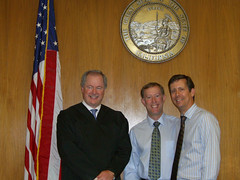 Yesterday morning, my husband and I drove down to the Los Angeles Metropolitan Courthouse where Judge Terry A. Bork, a friend of ours from church, legally married us. We had done the big wedding seven years ago, so we just wanted this to be a small dignified ceremony. (My parents were married in a judge's chambers, with just two couples as witness, so we were reflecting my family history.) It turned out perfectly. Terry put a lot of thought into the ceremony, to set it in the appropriate context with respect to our previous ceremony, and also to honor our well-loved late pastor Mitch Henson and his role in that. I also appreciated his comments on the responsibilities of marriage being not only to each other, but connecting us to those around us. As we gathered in the judge's chambers with our witnesses, Terry began the ceremony:
Seven years ago Tom and George made a commitment to each other. Although they have lived and honored that commitment, and although their friends and loved ones recognized and celebrated that commitment, it was made at a time when neither their church nor their state would recognize or sanction it.He continued with a thoughtful traditional ceremony:
A courageous pastor, Dr. Mitchell Henson, attended that ceremony that day, despite having received criticism for agreeing to do so, and at risk to his standing within his denomination. He did not perform a marriage that day, but he spoke movingly about--as he called it--"a radical gospel of acceptance of all." Quoting Jesus Christ from the Gospel of Matthew he read, "I say to you whatever you bind on earth will be bound in heaven. Whatever you loose on earth will be loosed in heaven…. For where two or more are gathered in my name, I am there in the midst of them."
He went on to state: "Christianity has traditionally lagged behind secular society in accepting. It's a sad fact that those who call themselves followers of the radical Christ often are self-serving and judgmental."
In actuality, it may be more accurate to say that many churches and the laws of the State of California have lagged behind forward-thinking pastors, such as Mitch Henson.
The California Supreme Court this year, in an opinion authored by Chief Justice Ronald George, interpreted our State's Constitution to include a personal, fundamental right to marry the person of one's choice. The Court determined that this decision is a fundamental aspect of personal autonomy and individual identity.
I am proud, as a Judge of the Superior Court of California -- sworn to uphold the California Constitution -- to perform this marriage ceremony for you today.
The purpose of our gathering together this morning, in the presence of these witnesses, is to join Thomas Rodrick Chatt and George Donald Scheideman III in matrimony. The act of uniting in matrimony is one of the oldest, most sacred and dearest ceremonies known to man.My lawfully wedded husband and I then kissed.
Marriage is an honorable estate, therefore is not to be entered into lightly or unadvisedly, but discreetly, soberly, reverently, and with true love.
Remember that love and loyalty are the foundation on which a relationship and a home are built. If the solemn vows which you are about to accept are kept, and if you steadfastly endeavor to lead honorable and worthwhile lives, the home that you have established will abide in peace, and the marriage will be lasting.
Marriage symbolizes the intimate sharing of two lives, yet this sharing should enhance -- not diminish, the individuality of each partner.
As you enter into this marriage you have all the right to demand and expect all of the happiness that any two people can find in this life. But all of your days will not be filled with sunshine and all of your paths will not be smooth, for that is not the way of life. You must also remember that in marriage you carry important responsibilities to each other, and to the world around you. Happiness includes demonstrating your love and commitment by meeting obligations to those whose lives are touched by yours.
No other human ties are more tender, nor vows more sacred that those which you are now about to assume.
Please join hands and face one another.
Will you George Donald Scheideman, III take Thomas Rodrick Chatt to be your husband, to love, honor, and cherish him, in sickness and in health, in prosperity and in adversity, and forsaking all others, be faithful to him so long as you both shall live? [I do.]
Will you Thomas Rodrick Chatt take George Donald Scheideman, III to be your spouse, to love, honor, and cherish him, in sickness and in health, in prosperity and in adversity, and forsaking all others, be faithful to him so long as you both shall live? [I do.]
May these two people keep this covenant which they have made. May they be a blessing and a comfort to each other, sharers of each other's joys, consolers in each other's sorrows, helpers to each other in all the vicissitudes of life. May they encourage each other in whatever they set out to achieve. May they, trusting each other, trust life and not be afraid. Yet may they not only accept and give affection between themselves, but also together have affection and consideration for others.
For as much as George Donald Scheideman, III and Thomas Rodrick Chatt have consented together in wedlock and have witnessed the same before these witnesses, and thereto have pledged their troth each to the other and have declared the same by joining hands, and by the authority vested in me as a Judge of the Superior Court of the State of California, I now pronounce you lawfully wedded husbands.
You have now entered upon life's most rewarding endeavor. May the blessings of Almighty God be with you. I am pleased to pronounce the commencement of your marriage.
Sunday, August 10, 2008
But To Be Frank, And Give It Thee Again
JULIET: What satisfaction canst thou have to-night?For the most part, marriage is like death or pregnancy, a status with no gray areas. Either you are married or you aren't. But when you really look into the technicalities, it turns out that marriage isn't quite so simple. Because it is a conglomeration of a social status, a religious rite, and a legal status, there are exceptional cases where people are married legally but not religiously, or religiously but not legally. One case where church and state diverge is with religions that prohibit divorce. Thus someone married in the Catholic church might get a legal divorce, making them single legally, but still married as far as the church is concerned. Those divorcees may even marry again, creating marriages that are recognized by the state, but not by their church. Less well known, some people choose to get married religiously but not legally. In his remarks at our wedding seven years ago, our pastor commented on vows before God versus vows before man, and observed that several times a year he would be approached by seniors in his congregation who had lost previous spouses and found a new partner to share the rest of their lives. Because of legal ramifications of wills, trusts, children and inheritances, they did not want legal marriage, but they did wish to be married before God.
ROMEO: The exchange of thy love's faithful vow for mine.
JULIET: I gave thee mine before thou didst request it: And yet I would it were to give again.
ROMEO: Wouldst thou withdraw it? for what purpose, love?
JULIET: But to be frank, and give it thee again.
For same-sex couples, we get the complexities of the legal vs religious vs social aspects of marriage, compounded by the complexities of legal recognition being afforded by degrees and in different times and places. If a same-sex couple marries in Canada or Massachusetts but then moves to another state, are they no longer married? (For that matter, if they even visit another state, does their marriage legally go on hiatus for the length of their vacation?) Then there are the same-sex couples who married in San Francisco in 2004, whose marriages were ultimately annulled. And those of us who are marrying in California now, whose status will be quite murky if Proposition 8 passes in November. So it's not always clear who may obtain a marriage license now, since you can't get a marriage license if you already are married. I think the official position is that if a same-sex couple were married in Canada or Massachusetts, they can't get married in California because they already are married. However, those who married in San Francisco, since those were officially voided, can now marry. In fact, we attended a marriage ceremony in June for some friends who had married in San Francisco. Legally speaking, they were marrying for the first time. Again.
In the famous balcony scene of Romeo and Juliet, she teases him that she can't give him a vow that she has already given. My husband and I now face that puzzlement for real. Seven years ago, we were married in a wonderful wedding ceremony, exchanging vows of lifelong loving commitment before God, family, and friends, but not the state. This has left us in one of those gray areas I spoke of. Whenever I am asked if I am married, I do my best to assess the context of the question, and give my best honest answer, which may be "yes", "no", or "it depends why you're asking". Socially, the answer is an unequivocal "yes". Legally, the answer is pretty clearly "no". Although even then, in the interest of full disclosure, I sometimes put an asterisk, since if the concern is e.g., mutual responsibility for debts, we have that as legally registered domestic partners. But the complexity of our status makes it feel strange to be marrying again. In our hearts and minds, we'll be simply renewing our vows. But for our upcoming legal ceremony, we need to exchange new vows, entering lawful wedlock for the first time.
The way I make sense of this is to realize that marriage is more than an agreement between two people. An essential aspect of marriage has always been that the vows are public (if not openly public, always attestable by a witness), because the agreement also involves a larger third party: God, family, society, and/or the state. In our original wedding ceremony, we explicitly incorporated the role of the assembled family and friends, asking them to give a "we do" in a vow to uphold and support us as a married couple. They agreed to do that essentially in exchange for our vows to each other. Those who love us give their support and recognition not simply because they love us, but because they are counting on us to uphold our vows, to take care of one another in sickness, to support one another in hardship. And those are the same sort of reasons that a state is legitimately involved in marriage. The state is the "safety net of last resort" for those who become unemployed, indigent, or too sick to care for themselves. In our society, families are the safety net of first resort, and the state counts on the formation of families by marriage to weave those safety nets. The state accords married couples certain "rights" because we promise to be there for one another in the face of hardships, one another's "first responders", rather than just being disconnected individuals depending on the state.
Our original vows were made before God, family and society, but not the state. Thus, we need to make new vows, similar in content, but with legal recognition and ramifications that make them distinct from the previous vows, and more importantly, for a different third party -- the state. To take up the terminology of the revised marriage licenses, you could say that our two marriages will involve the same "party A" and "party B", but a different "party C". When not being so philosophically analytical about it, I simply say this: we will be renewing our vows for the benefit of the State, who wasn't able to attend the first time.
We can suffer the giving and re-giving of vows, puzzling whether we can re-give a vow already given, because I trust my husband knows that the love that gives breath and life to the vows knows no such obstacles. As Juliet continued:
But to be frank, and give it thee again.
And yet I wish but for the thing I have:
My bounty is as boundless as the sea,
My love as deep; the more I give to thee,
The more I have, for both are infinite.
Monday, July 21, 2008
For Us, 7th Anniversary is the Paper Anniversary

According to tradition, the seventh anniversary is the copper anniversary, but for George and me, our seventh anniversary was the paper anniversary. We celebrated today by going down to the County Clerk (inside the Beverly Hills Municipal Courthouse) and obtaining a legal marriage license. Our friends Bill and Leo, who have been together twelve years, went with us, and they got a license too. When we got there, we saw a couple of dapper elderly gentlemen at the marriage license window, which made us smile to see. And I have to say, everybody there -- the clerks, the guards, other courthouse visitors -- were full of smiles, congratulations, and well-wishes for us. The forms had been revised so they no longer say "bride" and "groom", instead they now say "party A" and "party B". It took the clerk a moment to find our application, as I didn't remember which of us I had put down for "party A", but we got that sorted. (Just for the record, George is "party A".) After that, it was just verifying all the personal info on the document, providing identification, and writing a check for the fee. Simple as that. Next month, we'll have a very small private courtroom ceremony, and then we'll be legally married.
From the State of California's legal point of view, we'll be getting married for the first time next month. From our point of view, next month we'll be simply renewing our vows for the benefit of the State, who wasn't able to attend our wedding seven years ago. Since then, our relationship has undergone various legal evolutions in status. When we got married in July 2001, we executed mutual healthcare directives and financial powers of attorney, which were later recorded. And we registered as LA County Domestic Partners. Most people aren't aware that both LA County and the State of California maintain domestic partner registries, which are separate and independent statuses, each with their own benefits. When we married in 2001, the state registry was mostly just symbolic, whereas the county registry had a few actual benefits associated with it (e.g., hospital visitation rights). In 2003, the state registry made a major advance from symbolic to substantial, and so on Valentine's Day 2003, we became registered domestic partners with the state. In 2005, the state domestic partner status was made to be substantially equivalent to marriage (including responsibility for one another's debts, required court dissolution, etc), and there was a grace period when those who had registered under the previous definition could "opt out" of the new definition. So we have a number of dates on which our relationship marked an "upgrade" in legal status, and we will have one more next month, but we will always celebrate our anniversary as the day seven years ago today when we stood before God, family and friends, and exchanged mutual vows of lifelong loving commitment.
Tuesday, June 24, 2008
Remembering a 1993 Gay Wedding
In response to my friend Jeff Hersh's request, I have unearthed the comments I made at his wedding in 1993. Some things have changed a great deal (it's no problem today to register two grooms at Williams-Sonoma, for instance), but many fundamentals haven't changed.
Almost exactly fifteen years ago, I not only attended my first gay wedding, but I was asked to speak as part of the ceremony. The ceremony was well-attended by family on both sides, including cousins, nieces, nephews, and an 84-year old great-grandmother, about 120 people in all. The ceremony included speeches by both grooms, and by the judge who presided. It concluded with the grooms' signing of a calligraphed parchment which was a legal contract including exchange of durable powers of attorney, then duly notarized by a lesbian friend and notary public, and then signed by all guests in attendance as legal witnesses. And both grooms stomped on wine glasses simultaneously as the crowd cheered "Mazel Tov!".
In my introduction speech, I attempted to explain the full meaning of this event to this largely straight and Jewish gathering...
There is a movement in modern Judaism called the Reconstructionist movement. The Reconstructionists are like Reform Jews in that they do not accept tradition without questioning: they do not want rote ritual devoid of modern personal meaning. For them, "because the book says so" or "because my grandparents did it that way" are not sufficient reasons for religious practice. Yet many Reconstructionists end up looking like Conservative Jews, continuing a great many of the traditional practices by coming up with modern symbolic interpretations for the old ways. A Reconstructionist is someone who takes all of the items of their faith, and considers each one, whether it is truly meaningful or whether it should be abandoned---just as someone packing to move to a new home goes through each of their possessions and decides whether to keep it or whether to leave it behind.
To be gay is to be Reconstructionist about one's whole life. All of us---gay or straight, Jewish or not Jewish---receive from our culture ideas about how we will live our lives. We come to know the expectations of our society, as we see the examples of how our family and friends live, and as we learn the hopes and dreams they have for themselves and for us. And from this rich pool of ideas, we come to shape our own vision of how we will live our lives.
But some of us have a crisis point in our lives that calls everything into question. For the first 20 years of my life, I had always pictured myself growing up to lead a life not unlike my parents: being a career engineer like my father, falling in love with a woman, getting married, having children. Then I discovered that I was gay. Every hope, every dream, every idea I had ever had about how my life would unfold seemed shattered beyond repair. And there was nothing to replace it. Family, friends, society offered no examples, no visions of what a good life for a gay man might be like. Slowly, after months and years of coming out to friends and family, of discovering a whole gay community, and of discovering that some of my own friends were also gay (including the boy who grew up next door), I have rebuilt a positive vision of what my life could and should be like.
Thus, coming out as a gay man or woman means being a Reconstructionist in a radical way. It is more than moving to a new home and sifting through your old possessions. It is like having your home burn down to the ground. While losing your home and all your worldly possessions is obviously traumatic, it is also a unique opportunity to measure which things in your life are truly essential. When a new home is built out of the ashes, every piece is carefully considered and nothing is taken for granted. While the new home is necessarily different from the old one, old ideas which are still good are reconstructed in the new. Thus, Doug and Jeff, in constructing their vision of living as gay men, have chosen to incorporate the tradition of marriage and a wedding.
Unlike many couples, Doug and Jeff do not marry today because it was expected of them or encouraged. It was not. They will not live their lives as a married couple because it will be easy, a well-worn path of least resistance. It will not be easy. Some of you, like my mother, may have encountered some trouble trying to find their wedding gift registry at Williams-Sonoma. It seems their computers and their personnel get a bit flustered when there are two grooms and no bride. This is just a small taste of the hundreds of denials and discountenances that Doug and Jeff will face. They have given their decision to wed a great deal of reflection and consideration, and they are here today, not because it is easy or expected or encouraged, but only for the best of reasons. Despite the difficulties they may face, they freely and knowingly choose to celebrate their love and their lifelong commitment to each other in loving partnership. As friends and family, we are an important part of this ceremony. Since the state will not recognize this marriage, and society will not encourage it, we must vow to give them our encouragement, our love, and our support in their commitment.
Jewish tradition teaches us that we have a special purpose in this world called tikun olam, the completion of creation. The rabbis say that when G*d created the world, He intentionally created it unfinished, so that we would have this purpose in our lives: to complete the job of creation. The world is like a huge, brilliant, beautiful jigsaw puzzle that G*d created, but left for us to assemble. Only at the end of time will the puzzle be completed and the whole picture revealed, but through our lives, each of us will contribute a part, will put a piece in place, and another part of the picture will become clear. Doug and Jeff's marriage is a fulfillment of the Jewish mission of tikun olam. The satisfaction they have found in their union is the satisfaction of two puzzle pieces being put together. Just as two pieces assembled show more of the picture than either piece by itself, the union of these two men will contribute more to the world than could two individuals separately. And as the picture revealed by two assembled pieces increases the momentum to put more pieces together, Jeff and Doug's example will provide a light to others and contribute a new positive gay vision to our culture. Today in their marriage, we witness and we celebrate the further creation of the world.
Almost exactly fifteen years ago, I not only attended my first gay wedding, but I was asked to speak as part of the ceremony. The ceremony was well-attended by family on both sides, including cousins, nieces, nephews, and an 84-year old great-grandmother, about 120 people in all. The ceremony included speeches by both grooms, and by the judge who presided. It concluded with the grooms' signing of a calligraphed parchment which was a legal contract including exchange of durable powers of attorney, then duly notarized by a lesbian friend and notary public, and then signed by all guests in attendance as legal witnesses. And both grooms stomped on wine glasses simultaneously as the crowd cheered "Mazel Tov!".
In my introduction speech, I attempted to explain the full meaning of this event to this largely straight and Jewish gathering...
June 19, 1993
Croton-on-Hudson
There is a movement in modern Judaism called the Reconstructionist movement. The Reconstructionists are like Reform Jews in that they do not accept tradition without questioning: they do not want rote ritual devoid of modern personal meaning. For them, "because the book says so" or "because my grandparents did it that way" are not sufficient reasons for religious practice. Yet many Reconstructionists end up looking like Conservative Jews, continuing a great many of the traditional practices by coming up with modern symbolic interpretations for the old ways. A Reconstructionist is someone who takes all of the items of their faith, and considers each one, whether it is truly meaningful or whether it should be abandoned---just as someone packing to move to a new home goes through each of their possessions and decides whether to keep it or whether to leave it behind.
To be gay is to be Reconstructionist about one's whole life. All of us---gay or straight, Jewish or not Jewish---receive from our culture ideas about how we will live our lives. We come to know the expectations of our society, as we see the examples of how our family and friends live, and as we learn the hopes and dreams they have for themselves and for us. And from this rich pool of ideas, we come to shape our own vision of how we will live our lives.
But some of us have a crisis point in our lives that calls everything into question. For the first 20 years of my life, I had always pictured myself growing up to lead a life not unlike my parents: being a career engineer like my father, falling in love with a woman, getting married, having children. Then I discovered that I was gay. Every hope, every dream, every idea I had ever had about how my life would unfold seemed shattered beyond repair. And there was nothing to replace it. Family, friends, society offered no examples, no visions of what a good life for a gay man might be like. Slowly, after months and years of coming out to friends and family, of discovering a whole gay community, and of discovering that some of my own friends were also gay (including the boy who grew up next door), I have rebuilt a positive vision of what my life could and should be like.
Thus, coming out as a gay man or woman means being a Reconstructionist in a radical way. It is more than moving to a new home and sifting through your old possessions. It is like having your home burn down to the ground. While losing your home and all your worldly possessions is obviously traumatic, it is also a unique opportunity to measure which things in your life are truly essential. When a new home is built out of the ashes, every piece is carefully considered and nothing is taken for granted. While the new home is necessarily different from the old one, old ideas which are still good are reconstructed in the new. Thus, Doug and Jeff, in constructing their vision of living as gay men, have chosen to incorporate the tradition of marriage and a wedding.
Unlike many couples, Doug and Jeff do not marry today because it was expected of them or encouraged. It was not. They will not live their lives as a married couple because it will be easy, a well-worn path of least resistance. It will not be easy. Some of you, like my mother, may have encountered some trouble trying to find their wedding gift registry at Williams-Sonoma. It seems their computers and their personnel get a bit flustered when there are two grooms and no bride. This is just a small taste of the hundreds of denials and discountenances that Doug and Jeff will face. They have given their decision to wed a great deal of reflection and consideration, and they are here today, not because it is easy or expected or encouraged, but only for the best of reasons. Despite the difficulties they may face, they freely and knowingly choose to celebrate their love and their lifelong commitment to each other in loving partnership. As friends and family, we are an important part of this ceremony. Since the state will not recognize this marriage, and society will not encourage it, we must vow to give them our encouragement, our love, and our support in their commitment.
Jewish tradition teaches us that we have a special purpose in this world called tikun olam, the completion of creation. The rabbis say that when G*d created the world, He intentionally created it unfinished, so that we would have this purpose in our lives: to complete the job of creation. The world is like a huge, brilliant, beautiful jigsaw puzzle that G*d created, but left for us to assemble. Only at the end of time will the puzzle be completed and the whole picture revealed, but through our lives, each of us will contribute a part, will put a piece in place, and another part of the picture will become clear. Doug and Jeff's marriage is a fulfillment of the Jewish mission of tikun olam. The satisfaction they have found in their union is the satisfaction of two puzzle pieces being put together. Just as two pieces assembled show more of the picture than either piece by itself, the union of these two men will contribute more to the world than could two individuals separately. And as the picture revealed by two assembled pieces increases the momentum to put more pieces together, Jeff and Doug's example will provide a light to others and contribute a new positive gay vision to our culture. Today in their marriage, we witness and we celebrate the further creation of the world.
Sunday, June 22, 2008
Celebrating a Marriage and Marriages in General
 Despite unseasonably sweltering heat, West Hollywood Park was humming yesterday with the celebration of marriages on the first weekend that same-sex marriages are legal here in California. A great number of gay couples who have waited years for that opportunity were joyously seizing it. The City of West Hollywood anticipated the high demand, and set up a city park to handle the ceremonies. They had a registration tent, where several people who had been deputized by the County Clerk processed the marriage license paperwork, and then a half-dozen white canopies set up under the trees for ceremonies to take place.
It was in that setting that we were delighted and honored to witness the wedding of our friends Tom and Art, who have been together for 16 years. In some sense, they have been married for many years, and I witnessed their marriage in San Francisco in 2004 (those marriages were officially annulled by the court). And in that sense, today's ceremony was really a "renewal of vows" or a "state recognition ceremony". (Tom and Art viewed it as their second, and hopefully last, civil ceremony, and intend to have a church wedding with the big reception after November.) But despite those technicalities, and the inevitable sense of making a political statement, once it got down to it, it was clear to all of us there, including the participants, that this was a wedding, with all the same solemnity and all the joy of weddings everywhere. We all got choked up at the vows, and caught up in watching two people reaffirm their commitment to each other, and to an ideal celebrated by us all -- to love, honor, and cherish, for better or for worse, so long as they both shall live. There's something about the public declaration of a high noble purpose that strengthens and ennobles the declarers, and better enables them to reach their lofty aim. I think that's part of what makes weddings so emotional, that they are positively transformative.
That ideal, of a lifetime together through better and worse, is one of the highest and most celebrated in our culture. And there's nothing gay or straight about it. It is a human ideal, a calling of the values we were raised with, gay and straight alike. One thing that has struck me about the gay weddings I have seen is how not different they are from straight weddings. The content of the ceremony -- the promises and vows exchanged, the prayers, the blessing of the rings -- is identical. The form is entirely familiar. The joy, the solemnity, and the emotion are the same. The only notable differences are the additional emotion of long-awaited justice (in every ceremony last week, there was a big whoop when they got to the "by the power vested in me by the State of California" part), and in the duration of the relationships of most of the couples getting married. With most straight weddings, the vows are entered into with hope at the outset of their lifetime together. With most gay weddings (at this point in time, though it will change in the future), the vows entered into have substantial years of proof behind them backing up the hope for the future. Couples like Tom and Art (together 16 years), or our friends Steve and Scott (together 14 years) who married earlier in the week, or the many other couples we've seen in the papers who have shared decades (like the women in San Francisco who'd been together 55 years!), those couples know a thing or two about what it takes to stay together for better or for worse. And many of those in our community know too well about "in sickness and in health". Often at the beginning of a wedding ceremony, the celebrant will say something about how marriage is a solemn estate, not to be entered into lightly or unadvisedly. We know. Some of us have been practicing marriage for quite some time. And we do not enter into it lightly.
Wednesday, June 04, 2008
Justice Without Delay
In an atypically expedited action today, the California Supreme Court dismissed all motions holding up the implementation of their historical decision recognizing the fundamental right of gays to have our marriages to be accorded equal dignity by the state. They dismissed a motion to rehear the case (by the same 4-3 vote that decided it), and they unanimously declined to stay their decision pending the outcome of an initiative constitutional amendment scheduled for the November ballot. This means that licenses should start issuing as early as June 17.
Those who decried the Court "disregarding the will of the people" (a fundamental misunderstanding of how our constitutional form of government is supposed to work, which I have discussed before) are now indignant about the "arrogance" of the Court in not being able to wait until November to see the outcome of the election. These same people complain about the arrogant Court supposedly usurping the prerogative of the legislative branch, as well as the people, and "making policy decisions, not legal ones". I find that ironic. The Supreme Court has interpreted the Constitution as it stands today, which is exactly what their constitutional role is. Theirs is not to speculate about how the Constitution might be amended pending the outcome of future elections. That would be a political decision, not a legal one.
I found the same irony in reading the dissenting opinions, in the notion of present political powerlessness as a criterion for identifying a "suspect class". The dissenters urged that the Court should take notice of the legislative progress in advancing gay rights, and hold this against finding sexual orientation to be a suspect class. They also seemed to suggest that the Court should not step in to a matter where there had been active legislative advances. But such judgments, about progress and political power, are political judgments, not legal ones. The legal judgment should consider the law in question against the Constitution, pure and simple. Either the law is constitutional or it isn't. That decision should be timeless, and without regard to current political circumstances. Yet these same people (including the dissenting Justices) who cry that the Court overstepped its role and made a political decision, are wanting the Court take notice of political considerations. Whether gays are "powerless" or "powerful", whether the legislature is making sufficient "progress", those are not legal considerations. The Court, in reaching its decision, properly looked only to the constitutional law.
Even more strange, if the dissenters' suggestions to consider progress and power are taken seriously, the logical conclusion is that the Court should have recognized the infringement of fundamental rights when the question was first brought in the 1970s, when gays were powerless and there was no progress. Apparently, had the dissenting Justices been on the Court thirty-five years ago, they would have ruled in favor of gay marriage then, when the injustice was even more stark. But if it was unconstitutional then, it is unconstitutional now. Assuming you're not "overstepping". Tell me again who's making political decisions?
In any event, it's nice to know that all seven Justices are in agreement that justice delayed is justice denied.
Those who decried the Court "disregarding the will of the people" (a fundamental misunderstanding of how our constitutional form of government is supposed to work, which I have discussed before) are now indignant about the "arrogance" of the Court in not being able to wait until November to see the outcome of the election. These same people complain about the arrogant Court supposedly usurping the prerogative of the legislative branch, as well as the people, and "making policy decisions, not legal ones". I find that ironic. The Supreme Court has interpreted the Constitution as it stands today, which is exactly what their constitutional role is. Theirs is not to speculate about how the Constitution might be amended pending the outcome of future elections. That would be a political decision, not a legal one.
I found the same irony in reading the dissenting opinions, in the notion of present political powerlessness as a criterion for identifying a "suspect class". The dissenters urged that the Court should take notice of the legislative progress in advancing gay rights, and hold this against finding sexual orientation to be a suspect class. They also seemed to suggest that the Court should not step in to a matter where there had been active legislative advances. But such judgments, about progress and political power, are political judgments, not legal ones. The legal judgment should consider the law in question against the Constitution, pure and simple. Either the law is constitutional or it isn't. That decision should be timeless, and without regard to current political circumstances. Yet these same people (including the dissenting Justices) who cry that the Court overstepped its role and made a political decision, are wanting the Court take notice of political considerations. Whether gays are "powerless" or "powerful", whether the legislature is making sufficient "progress", those are not legal considerations. The Court, in reaching its decision, properly looked only to the constitutional law.
Even more strange, if the dissenters' suggestions to consider progress and power are taken seriously, the logical conclusion is that the Court should have recognized the infringement of fundamental rights when the question was first brought in the 1970s, when gays were powerless and there was no progress. Apparently, had the dissenting Justices been on the Court thirty-five years ago, they would have ruled in favor of gay marriage then, when the injustice was even more stark. But if it was unconstitutional then, it is unconstitutional now. Assuming you're not "overstepping". Tell me again who's making political decisions?
In any event, it's nice to know that all seven Justices are in agreement that justice delayed is justice denied.
Wednesday, May 21, 2008
Judicial Activism? Or Just Doing Their Job?
Some people cry "judicial activism" whenever they don't like the outcome of a Supreme Court decision, especially when the decision overturns longstanding laws. Some of these people have simply forgotten their high school civics classes. For them, let me offer a brief refresher on some key points.
The Bill of Rights exists to protect the rights of unpopular minorities from being trampled by majorities. Although we live in a democracy, the majority does NOT always rule. That would be a "mob-ocracy", something our founding fathers wisely feared, and which is why they created a system of government with many checks and balances, including a Bill of Rights. One of the crucial jobs of the courts, especially Supreme Courts, is to interpret the Constitution, and to overrule laws that would violate constitutional rights. Thus, when a challenged law violates constitutional rights, it does NOT matter that the law was duly enacted by the Legislature, or by an initiative statute by vote of the people. In such cases, it is the proper job of the court to find the law unconstitutional, and to strike it down. This is not "legislating from the bench", it is interpreting the constitution. It is not a violation of the separation of powers, it is the completely proper functioning of an independent judiciary within a properly functioning separation-of-powers system. This has been understood to be the case in our nation since Marbury v. Madison was decided by the U.S. Supreme Court in 1803, and is a most cherished and fundamental precedent.
When a law violates constitutional rights, it does not matter that the law has broad popular support, or that the law has substantial weight of history and tradition behind it. There are numerous instances in our history where it fell to the courts to rectify the longstanding codification of infringed liberties and unequal protection. It is precisely when a disparaged minority is aggrieved by tradition and popular opinion that it falls to the courts to protect them. It would be nonsensical and self-defeating for the courts, in such cases, to give any weight to tradition or to popular opinion. The only thing on the court's mind is and ought to be the constitution and the laws they are to interpret. Tradition and popular opinion have no place in the process. If it were otherwise, we would still have segregated schools, all-male juries, and bans on mixed-race marriages.
Admittedly, tradition and popular opinion are powerful forces, and it can be difficult to keep them in historical perspective. It is easy to forget that older decisions now widely accepted were once highly controversial. Now in 2008, most Americans are rightly embarrassed about our history of segregated schools half a century ago, and most Americans would be rightly shocked and appalled at the notion that police might burst into someone's bedroom and arrest them for having a mixed-race marriage, or for using contraception. But in 1951, when Oliver Brown challenged the segregated school system in Kansas, his cause was by no means a popular one. In an early morning in 1958, when Richard and Mildred Loving were awakened to police flashlights shining in their faces, and demands of "Mr. Loving, who is this black woman in your bed?", longstanding tradition was not on their side. In 1961, when Estelle Griswold was arrested for opening a birth control clinic in Connecticut, tradition and popular opinion weighed heavily against her. And certainly back in 1948, when Andrea Perez (a Mexican-American) and Sylvester Davis (a black man) were denied a marriage license in Los Angeles, few people saw the injustice. Half a century later, the injustice of these situations is widely recognized, and we can be thankful that judges at the time had the wisdom and the courage to take the side of the constitution even against tradition and popular opinion. Even so, one can recognize the justice of long-past controversies, while failing to recognize similar calls to justice in present-day controversies. As Chief Justice George quoted the U.S. Supreme Court, "times can blind us to certain truths and later generations can see that laws once thought necessary and proper in fact serve only to oppress."
It seems to me that those who cry "judicial activism" must either competely reject a long and proud tradition of judicial review, or explain why it was appropriate to disregard tradition and popular opinion in Perez v. Sharp, Brown v. Board of Education, Loving v. Virginia, Griswold v. Connecticut, and other celebrated cases, while deferring to tradition and popular opinion in whatever unpopular constitutional case is at hand.
The Bill of Rights exists to protect the rights of unpopular minorities from being trampled by majorities. Although we live in a democracy, the majority does NOT always rule. That would be a "mob-ocracy", something our founding fathers wisely feared, and which is why they created a system of government with many checks and balances, including a Bill of Rights. One of the crucial jobs of the courts, especially Supreme Courts, is to interpret the Constitution, and to overrule laws that would violate constitutional rights. Thus, when a challenged law violates constitutional rights, it does NOT matter that the law was duly enacted by the Legislature, or by an initiative statute by vote of the people. In such cases, it is the proper job of the court to find the law unconstitutional, and to strike it down. This is not "legislating from the bench", it is interpreting the constitution. It is not a violation of the separation of powers, it is the completely proper functioning of an independent judiciary within a properly functioning separation-of-powers system. This has been understood to be the case in our nation since Marbury v. Madison was decided by the U.S. Supreme Court in 1803, and is a most cherished and fundamental precedent.
When a law violates constitutional rights, it does not matter that the law has broad popular support, or that the law has substantial weight of history and tradition behind it. There are numerous instances in our history where it fell to the courts to rectify the longstanding codification of infringed liberties and unequal protection. It is precisely when a disparaged minority is aggrieved by tradition and popular opinion that it falls to the courts to protect them. It would be nonsensical and self-defeating for the courts, in such cases, to give any weight to tradition or to popular opinion. The only thing on the court's mind is and ought to be the constitution and the laws they are to interpret. Tradition and popular opinion have no place in the process. If it were otherwise, we would still have segregated schools, all-male juries, and bans on mixed-race marriages.
Admittedly, tradition and popular opinion are powerful forces, and it can be difficult to keep them in historical perspective. It is easy to forget that older decisions now widely accepted were once highly controversial. Now in 2008, most Americans are rightly embarrassed about our history of segregated schools half a century ago, and most Americans would be rightly shocked and appalled at the notion that police might burst into someone's bedroom and arrest them for having a mixed-race marriage, or for using contraception. But in 1951, when Oliver Brown challenged the segregated school system in Kansas, his cause was by no means a popular one. In an early morning in 1958, when Richard and Mildred Loving were awakened to police flashlights shining in their faces, and demands of "Mr. Loving, who is this black woman in your bed?", longstanding tradition was not on their side. In 1961, when Estelle Griswold was arrested for opening a birth control clinic in Connecticut, tradition and popular opinion weighed heavily against her. And certainly back in 1948, when Andrea Perez (a Mexican-American) and Sylvester Davis (a black man) were denied a marriage license in Los Angeles, few people saw the injustice. Half a century later, the injustice of these situations is widely recognized, and we can be thankful that judges at the time had the wisdom and the courage to take the side of the constitution even against tradition and popular opinion. Even so, one can recognize the justice of long-past controversies, while failing to recognize similar calls to justice in present-day controversies. As Chief Justice George quoted the U.S. Supreme Court, "times can blind us to certain truths and later generations can see that laws once thought necessary and proper in fact serve only to oppress."
It seems to me that those who cry "judicial activism" must either competely reject a long and proud tradition of judicial review, or explain why it was appropriate to disregard tradition and popular opinion in Perez v. Sharp, Brown v. Board of Education, Loving v. Virginia, Griswold v. Connecticut, and other celebrated cases, while deferring to tradition and popular opinion in whatever unpopular constitutional case is at hand.
Sunday, May 18, 2008
In Re Marriage Cases - The Opinion
I was back east on business when I got word of the landmark opinion of the California Supreme Court on "In Re Marriage Cases", and I eagerly read through the whole 121-page opinion as quickly as I could. While I was overjoyed to hear of the just outcome, I was even more delighted to read the solid reasoning behind it. One thing that struck me throughout was the Court's refusal to indulge in hairsplitting, semantics and sophistry from either side. In each aspect of the decision, it squarely addressed the real issues. This common-sense court calls a spade a spade.
While all parties in these cases agreed that there was a fundamental right to marry, they differed as to whether that right substantively meant marrying the person of your choice, or marrying the opposite-gender person of your choice. The exclusionists argued that a gay man and a straight man both have an equal right to marry a woman, so what are we complaining about? Nonsense, said the Court. Our right to marry the person of our choice is a fundamental aspect of our individual identity and personal autonomy, and saying a gay man has the right to marry a woman is no right at all. The Court repeatedly harkened back to Perez v. Sharp, the landmark 1948 California Supreme Court decision that overturned laws against interracial marriage. They noted that similar arguments were applied then: a person had the right to marry the person of their choice, any white man could choose his own white wife, and any non-white man could choose his own non-white wife. The logic was wrong then, and it's wrong now. Formulating a substantive right so narrowly that it inherently excludes a class of citizens is just discrimination in a semantic disguise, and the Court rightly rejected it.
The Court also dismissed the notion that sexual orientation discrimination was a form of gender discrimination. This argument is often made by gay marriage proponents, because gender discrimination is an established "suspect class" (meaning that courts guard against that kind of discrimination more stringently) while sexual orientation is not. Thus, in order to claim the more protected status, arguments are framed in terms of gender discrimination. A gay man could marry a woman, but not a man, the only difference being the gender of the spouse, so there's gender discrimination going on, or so the argument goes. Not so fast, said the Court. We all understand what gender discrimination is, it's when laws disfavor women and favor men, and that's not what's going on here. What's going on here is discrimination based on sexual orientation, not gender. The Court called a spade a spade. Fortunately, the Court went on to establish sexual orientation as a "suspect class" in its own right (a new precedent), worthy of the same protections as gender, race, and religion. In other words, the Court said that while there isn't any gender discrimination going on here, there is sexual orientation discrimination going on, and that's just as unconstitutional.
While the appellate court had reached the same conclusions about gender versus sexual orientation discrimination, they balked at recognizing sexual orientation as a suspect class, because of the requirement that it be based on an "immutable" trait. The "immutability" of sexual orientation is a matter of some factual dispute, and the appellate judges felt the trial record lacked appropriate fact-finding to reach a legal decision on that. The Supreme Court, applying some common sense, reasoned that they did not need to find scientific certainty of biological immutability for their legal purposes. They noted that religion is among the recognized "suspect classes", and nobody would claim that you're born a particular religion and can't choose to change. Rather, because a person’s religion is so integral an aspect of one’s identity, it is not appropriate to require a person to repudiate or change his or her religion in order to avoid discriminatory treatment. Sexual orientation, the Court recognized, is "immutable" in the same way that religion is.
On a technical side argument, the Court eschewed the hairsplitting that gay marriage proponents had been spinning in regard to "Prop 22", the 2000 ballot initiative that said "Only marriage between a man and a woman is valid or recognized in California." This initiative statute was passed at a time when Californians were afraid they might be forced to recognize out-of-state gay marriages (Hawaii was the big threat at the time), and the language was placed in the legal code at a point that was describing recognition of marriages from outside jurisdictions. Gay marriage proponents, splitting hairs, claimed that the placement of the language meant that it only applied to California's recognition of gay marriages from outside states, and thus it did not preclude the California legislature from legalizing gay marriage within the state. Twice, the California legislature has passed such a bill, and twice Governor Schwarzenegger has vetoed it, saying that it violates the will of the people as expressed in Prop 22. (His position was that either the people had to overturn their own initiative, or the Court had to rule it unconstitutional, but either way, it was not up to the Legislature.) The Supreme Court opinion fully validated the Governor's position. Even though they ultimately rejected "Prop 22" as unconstitutional, they took the time to note that Prop 22 would have been interpreted to govern all marriages in California, and not just out-of-state ones. The clear implication being that had the Governor signed the Legislature's gay marriage bills, the Court would have shot them down as being in conflict with Prop 22 (which being a voter initiative, would take precedence over legislative action). No hairsplitting for this Court.
Finally, the Court gave a robust and common-sense rejoinder to the question of what's in a name. The Court noted the overall context of the question at hand, in that California has created a legal category called "domestic partnership", which is open to same-sex couples, and which gives domestic partners all of the same rights and responsibilities as spouses. So, the Attorney General asked, if the state provides all of the same rights and responsibilities to same-sex domestic partners as it provides to opposite-sex married couples, and the only difference is the name ("domestic partnership" vs "marriage"), isn't that equal protection of the law? No, said the Court, as we have learned from history, "separate but equal" is not equal. By reserving to one class of persons and denying to another the name with strong traditional and symbolic significance, the Court said that the state was denying equal "dignity, respect, and stature", which are themselves a substantive part of the right to marry. Not only is this a strong symbolic disability, the Court found, but because of the historic disparagement of gay people, the creation of a parallel but separate status is likely to convey a "second class" status, and signal a difference in dignity and respect. Moreover, because the newly minted "domestic partner" status will not have the same recognition and familiarity of marriage, domestic partners are likely to encounter difficulties and complications in the practical exercise of even those rights which are legally conveyed. Demonstrating a substantive understanding of the realities of the situation, the Court recognized that this "mere" difference of nomenclature has far more impact than "just a name".
Thus it was that a Chief Justice with a reputation as a "careful jurist" and a "moderate Republican" was joined by three other judges (two of them Republican) in writing this:
While all parties in these cases agreed that there was a fundamental right to marry, they differed as to whether that right substantively meant marrying the person of your choice, or marrying the opposite-gender person of your choice. The exclusionists argued that a gay man and a straight man both have an equal right to marry a woman, so what are we complaining about? Nonsense, said the Court. Our right to marry the person of our choice is a fundamental aspect of our individual identity and personal autonomy, and saying a gay man has the right to marry a woman is no right at all. The Court repeatedly harkened back to Perez v. Sharp, the landmark 1948 California Supreme Court decision that overturned laws against interracial marriage. They noted that similar arguments were applied then: a person had the right to marry the person of their choice, any white man could choose his own white wife, and any non-white man could choose his own non-white wife. The logic was wrong then, and it's wrong now. Formulating a substantive right so narrowly that it inherently excludes a class of citizens is just discrimination in a semantic disguise, and the Court rightly rejected it.
The Court also dismissed the notion that sexual orientation discrimination was a form of gender discrimination. This argument is often made by gay marriage proponents, because gender discrimination is an established "suspect class" (meaning that courts guard against that kind of discrimination more stringently) while sexual orientation is not. Thus, in order to claim the more protected status, arguments are framed in terms of gender discrimination. A gay man could marry a woman, but not a man, the only difference being the gender of the spouse, so there's gender discrimination going on, or so the argument goes. Not so fast, said the Court. We all understand what gender discrimination is, it's when laws disfavor women and favor men, and that's not what's going on here. What's going on here is discrimination based on sexual orientation, not gender. The Court called a spade a spade. Fortunately, the Court went on to establish sexual orientation as a "suspect class" in its own right (a new precedent), worthy of the same protections as gender, race, and religion. In other words, the Court said that while there isn't any gender discrimination going on here, there is sexual orientation discrimination going on, and that's just as unconstitutional.
While the appellate court had reached the same conclusions about gender versus sexual orientation discrimination, they balked at recognizing sexual orientation as a suspect class, because of the requirement that it be based on an "immutable" trait. The "immutability" of sexual orientation is a matter of some factual dispute, and the appellate judges felt the trial record lacked appropriate fact-finding to reach a legal decision on that. The Supreme Court, applying some common sense, reasoned that they did not need to find scientific certainty of biological immutability for their legal purposes. They noted that religion is among the recognized "suspect classes", and nobody would claim that you're born a particular religion and can't choose to change. Rather, because a person’s religion is so integral an aspect of one’s identity, it is not appropriate to require a person to repudiate or change his or her religion in order to avoid discriminatory treatment. Sexual orientation, the Court recognized, is "immutable" in the same way that religion is.
On a technical side argument, the Court eschewed the hairsplitting that gay marriage proponents had been spinning in regard to "Prop 22", the 2000 ballot initiative that said "Only marriage between a man and a woman is valid or recognized in California." This initiative statute was passed at a time when Californians were afraid they might be forced to recognize out-of-state gay marriages (Hawaii was the big threat at the time), and the language was placed in the legal code at a point that was describing recognition of marriages from outside jurisdictions. Gay marriage proponents, splitting hairs, claimed that the placement of the language meant that it only applied to California's recognition of gay marriages from outside states, and thus it did not preclude the California legislature from legalizing gay marriage within the state. Twice, the California legislature has passed such a bill, and twice Governor Schwarzenegger has vetoed it, saying that it violates the will of the people as expressed in Prop 22. (His position was that either the people had to overturn their own initiative, or the Court had to rule it unconstitutional, but either way, it was not up to the Legislature.) The Supreme Court opinion fully validated the Governor's position. Even though they ultimately rejected "Prop 22" as unconstitutional, they took the time to note that Prop 22 would have been interpreted to govern all marriages in California, and not just out-of-state ones. The clear implication being that had the Governor signed the Legislature's gay marriage bills, the Court would have shot them down as being in conflict with Prop 22 (which being a voter initiative, would take precedence over legislative action). No hairsplitting for this Court.
Finally, the Court gave a robust and common-sense rejoinder to the question of what's in a name. The Court noted the overall context of the question at hand, in that California has created a legal category called "domestic partnership", which is open to same-sex couples, and which gives domestic partners all of the same rights and responsibilities as spouses. So, the Attorney General asked, if the state provides all of the same rights and responsibilities to same-sex domestic partners as it provides to opposite-sex married couples, and the only difference is the name ("domestic partnership" vs "marriage"), isn't that equal protection of the law? No, said the Court, as we have learned from history, "separate but equal" is not equal. By reserving to one class of persons and denying to another the name with strong traditional and symbolic significance, the Court said that the state was denying equal "dignity, respect, and stature", which are themselves a substantive part of the right to marry. Not only is this a strong symbolic disability, the Court found, but because of the historic disparagement of gay people, the creation of a parallel but separate status is likely to convey a "second class" status, and signal a difference in dignity and respect. Moreover, because the newly minted "domestic partner" status will not have the same recognition and familiarity of marriage, domestic partners are likely to encounter difficulties and complications in the practical exercise of even those rights which are legally conveyed. Demonstrating a substantive understanding of the realities of the situation, the Court recognized that this "mere" difference of nomenclature has far more impact than "just a name".
Thus it was that a Chief Justice with a reputation as a "careful jurist" and a "moderate Republican" was joined by three other judges (two of them Republican) in writing this:
we conclude that, under this state’s Constitution, the constitutionally based right to marry properly must be understood to encompass the core set of basic substantive legal rights and attributes traditionally associated with marriage that are so integral to an individual’s liberty and personal autonomy that they may not be eliminated or abrogated by the Legislature or by the electorate through the statutory initiative process. These core substantive rights include, most fundamentally, the opportunity of an individual to establish — with the person with whom the individual has chosen to share his or her life — an officially recognized and protected family possessing mutual rights and responsibilities and entitled to the same respect and dignity accorded a union traditionally designated as marriage. As past cases establish, the substantive right of two adults who share a loving relationship to join together to establish an officially recognized family of their own — and, if the couple chooses, to raise children within that family — constitutes a vitally important attribute of the fundamental interest in liberty and personal autonomy that the California Constitution secures to all persons for the benefit of both the individual and society. [In Re Marriage Cases, Cal. Sup. Ct. S147999, pp. 6-7]
Thursday, May 08, 2008
Marriage Quality Review Board, Anyone?
I recently got back in touch with David Benkof, an old colleague from the Institute for Gay and Lesbian Education. He used to write a gay history column that was syndicated in many publications, and I used to be on his editorial board, proof-reading and commenting on articles prior to publication. In recent years, he has committed himself to Orthodox Judaism, and while still identifying himself as bisexual, he is guided by Jewish law, and is writing columns advocating much more traditionalist positions. I've agreed to be on his informal editorial review cycle once again, which should be interesting. Even though I'll likely disagree with his positions more often, he's a bright guy with a unique perspective, and I hope we'll both learn from each other. I'll probably take the opportunity to respond to some of his pieces (post publication, of course) on my blog. Here's the first.
David likes to seek unexpected common ground between divergent viewpoints, and over at marriagedebate.com, he comes up with a challenge for same-sex marriage advocates. If we're serious about respecting and preserving the traditional values underlying marriage, David asks, can we all agree not to legitimize "Daddy-boy" relationships by including them in any future revision of the definition of marriage? He's referring not to any actual incestuous relationships, but to relationships between consenting adult males where there is a large age difference, where the partners may refer to each other as "Daddy" and "my boy", and where a little whiff of taboo might give them a kinky erotic charge. By playing up the resemblance to incest, David hopes that it will be a slam-dunk for all of us decent folks to agree to exclude those kinky Daddy-boy couples from the definition of marriage.
Alas, it is David who is unwittingly proposing a significant and dangerous alteration to the definition of marriage. Historically, the official (i.e., legal) definition of marriage has always been a matter of a few clearly adjudicable requirements: opposite gender, minimum age, no common grandparents, and not already married to someone else. Any consenting couple who met those qualifications could get a marriage license. Whether the groom was a known wife-beater, whether the bride was on her tenth marriage, whether the couple were separated by several decades and a vast income disparity, the state did not inquire. Traditionally, the state has humbly held that the marrying parties themselves were in a better position than the state to judge the appropriateness of the union. But now David proposes to change that, suggesting that perhaps the state does know better after all. In order to preserve the dignity of the hallowed institution, so that no inappropriate role models would gain the imprimatur of state-sanctioned marriage, it now seems necessary for the state to poke its nose under the connubial covers.
I don't know how exactly David imagines implementing his proposal. Would there be a state marriage quality board comprised of moral authorities who would interview marriage license applicants (along with their references, neighbors and co-workers) to pass judgment on each marriage? If so, would there be periodic reviews of existing marriages to make sure that the moral quality hadn't declined? Will this be narrowly tailored to only exclude those who actually get kicks out of pretending to violate a taboo, or would merely using the term "Daddy" be a prima facie violation? Should we impose a maximum age difference on all marriages just to be safe? Instead of a review board, perhaps there would simply be an affidavit as part of the marriage license application, asking the spouses to disavow any kinky business. If so, how would that be enforced? Could any citizen bring charges against a neighbor whose marriage was creating a moral hazard? Would they be criminal or civil?
Remind me again - how is this proposal conservative or traditional?
David likes to seek unexpected common ground between divergent viewpoints, and over at marriagedebate.com, he comes up with a challenge for same-sex marriage advocates. If we're serious about respecting and preserving the traditional values underlying marriage, David asks, can we all agree not to legitimize "Daddy-boy" relationships by including them in any future revision of the definition of marriage? He's referring not to any actual incestuous relationships, but to relationships between consenting adult males where there is a large age difference, where the partners may refer to each other as "Daddy" and "my boy", and where a little whiff of taboo might give them a kinky erotic charge. By playing up the resemblance to incest, David hopes that it will be a slam-dunk for all of us decent folks to agree to exclude those kinky Daddy-boy couples from the definition of marriage.
Alas, it is David who is unwittingly proposing a significant and dangerous alteration to the definition of marriage. Historically, the official (i.e., legal) definition of marriage has always been a matter of a few clearly adjudicable requirements: opposite gender, minimum age, no common grandparents, and not already married to someone else. Any consenting couple who met those qualifications could get a marriage license. Whether the groom was a known wife-beater, whether the bride was on her tenth marriage, whether the couple were separated by several decades and a vast income disparity, the state did not inquire. Traditionally, the state has humbly held that the marrying parties themselves were in a better position than the state to judge the appropriateness of the union. But now David proposes to change that, suggesting that perhaps the state does know better after all. In order to preserve the dignity of the hallowed institution, so that no inappropriate role models would gain the imprimatur of state-sanctioned marriage, it now seems necessary for the state to poke its nose under the connubial covers.
I don't know how exactly David imagines implementing his proposal. Would there be a state marriage quality board comprised of moral authorities who would interview marriage license applicants (along with their references, neighbors and co-workers) to pass judgment on each marriage? If so, would there be periodic reviews of existing marriages to make sure that the moral quality hadn't declined? Will this be narrowly tailored to only exclude those who actually get kicks out of pretending to violate a taboo, or would merely using the term "Daddy" be a prima facie violation? Should we impose a maximum age difference on all marriages just to be safe? Instead of a review board, perhaps there would simply be an affidavit as part of the marriage license application, asking the spouses to disavow any kinky business. If so, how would that be enforced? Could any citizen bring charges against a neighbor whose marriage was creating a moral hazard? Would they be criminal or civil?
Remind me again - how is this proposal conservative or traditional?
Monday, March 03, 2008
The Real Super Tuesday?
I'm keeping my fingers crossed that tomorrow may turn out to be the real "super Tuesday", with two decisions of great moment that could happen tomorrow. The first, of course, is the presidential primaries in Texas and Ohio (as well as Vermont and Rhode Island). Texas and Ohio have been called Hillary Clinton's "firewalls", and after being fought to a draw on February's "super Tuesday", and then suffering 11 consecutive losses since then, the conventional wisdom is that she needs to win both Texas and Ohio in order to have any hope of continuing. The Clinton campaign, in a seemingly inexorable retreating spin, keeps redefining success downward. The last I heard is that she'll claim victory if she wins the popular vote in Texas, even if she loses in the delegate count. My best hope is that Obama can win Texas, not only in delegates, but in popular vote. As Clinton's campaign slides into Huckabee territory, will she have the good grace to concede, as the seemingly valedictory notes of her close in the Austin debate hinted? Or will she drag us through to June in Puerto Rico, clutching at uglier tactics to get her way? The math is ever more daunting. And while Huckabee majored in miracles, Clinton majored in law, so her approach to surmount mathematical improbability may be to mount a lawsuit against the Texas Democratic Party over how delegates are selected. I'm sincerely hoping tomorrow's outcomes preclude all that.
The other decision of great moment happening tomorrow will take place in a San Francisco courtroom, where the California Supreme Court will hear the appeal of the consolidated gay marriage cases. Here I'm hoping that the Supreme Court will see fit to uphold the excellent opinion of the trial court judge, in unequivocally smacking down denial of gay marriage as unconstitutional. (That opinion from a Catholic Republican judge, mind you.) Tomorrow, the Supreme Court will hear oral arguments in the long-awaited case. Their opinion is expected to be announced within 90 days. If they do the right thing, my husband and I might celebrate our wedding anniversary in July by getting a bonafide California marriage license. (Under the circumstances, the seventh anniversary will be paper.) Equality California noted that the case was one of the most heavily briefed of any case in the court's history, with 20 counties and municipalities filing briefs in support. They also noted that 2008 was the 60th anniversary of Perez v. Sharp, when the California Supreme Court lead the nation by two decades in striking down its miscegenation laws as unconstitutional. Let's hope they continue that honorable distinction of being leaders in justice.
The other decision of great moment happening tomorrow will take place in a San Francisco courtroom, where the California Supreme Court will hear the appeal of the consolidated gay marriage cases. Here I'm hoping that the Supreme Court will see fit to uphold the excellent opinion of the trial court judge, in unequivocally smacking down denial of gay marriage as unconstitutional. (That opinion from a Catholic Republican judge, mind you.) Tomorrow, the Supreme Court will hear oral arguments in the long-awaited case. Their opinion is expected to be announced within 90 days. If they do the right thing, my husband and I might celebrate our wedding anniversary in July by getting a bonafide California marriage license. (Under the circumstances, the seventh anniversary will be paper.) Equality California noted that the case was one of the most heavily briefed of any case in the court's history, with 20 counties and municipalities filing briefs in support. They also noted that 2008 was the 60th anniversary of Perez v. Sharp, when the California Supreme Court lead the nation by two decades in striking down its miscegenation laws as unconstitutional. Let's hope they continue that honorable distinction of being leaders in justice.
Thursday, December 13, 2007
Fisking the Pope on Families
On Tuesday, the Pope published a message on "The Human Family, A Community of Peace". The politicized takeaway of some was that "Pope says abortion, gay marriage are 'obstacles' to world peace". (Andrew Sullivan frets that the Pope blames gay married couples for world war.) It's true enough that the Pope did say something that pretty clearly implies that, and I won't dispute that Benedict would intend that implication. The exasperating thing is that he's so close to being right about everything he says in his message. He just can't seem to see that gay families are valuable families for nearly all the same reasons straight families are. Let's look at the Pope's message:
Indeed, in a healthy family life we experience some of the fundamental elements of peace: justice and love between brothers and sisters, the role of authority expressed by parents, loving concern for the members who are weaker because of youth, sickness or old age, mutual help in the necessities of life, readiness to accept others and, if necessary, to forgive them. For this reason, the family is the first and indispensable teacher of peace. ... The family is the foundation of society for this reason too: because it enables its members in decisive ways to experience peace.Do gay spouses not love one another, care for one another, accept and forgive one another, just as straight spouses do? Do gay parents not love and teach their children as straight parents do? Do gay people not care for their family members in sickness or old age, just as straight people do? Indeed, every virtuous element of families that the Pope has enumerated here applies equally to gay families as to straight ones. (It may be said to apply somewhat less to childless families than to childful ones, but despite common confusion to the contrary, that is not a gay/straight issue.)
Consequently, whoever, even unknowingly, circumvents the institution of the family undermines peace in the entire community, national and international, since he weakens what is in effect the primary agency of peace. This point merits special reflection: everything that serves to weaken the family based on the marriage of a man and a woman, everything that directly or indirectly stands in the way of its openness to the responsible acceptance of a new life, everything that obstructs its right to be primarily responsible for the education of its children, constitutes an objective obstacle on the road to peace.Except for the over-specification of marriage as to a man and a woman, I can agree with all of this. As discussed above, gay families are as relevant as straight families in serving to exemplify and reinforce the fundamental elements of peace. Given that, following the Pope's logic then entails that anything that undermines the institution of the family (including gay families) undermines peace in the world. In other words, if the Pope would properly recognize gay families as valuable families, he would have said: "This point merits special reflection: everything that serves to weaken the family based on the marriage of two loving people (such as not giving all marriages their just legal recognition and societal support), everything that directly or indirectly stands in the way of its openness to the responsible acceptance of a new life (such as banning adoptions and foster care by gay parents), everything that obstructs its right to be primarily responsible for the education of its children (ditto the previous), constitutes an objective obstacle on the road to peace." Sure, I know what the Pope has in mind by "openness to the responsible acceptance of a new life", but the words he has chosen here captured the essential part of it. Who could possibly be more open to the responsible acceptance of a new life than gay parents who must make a monumentally intentional effort just to become parents?
The social community, if it is to live in peace, is also called to draw inspiration from the values on which the family community is based.Indeed. Some of the most inspirational examples are those who hold to the traditional marital values of lifelong loving commitment, not when it is easy, supported, and encouraged, but when it is hard, when it is discountenanced by society and by government, when our partners are sick and dying of disease without a cure. You want inspiration for values? Try Curtis Watson, rather than Britney Spears. The Pope is right about the crucial importance of the family to the larger community. Which is precisely why it is wicked to not be supporting all of us who wish to create and sustain families.
Knowledge of the natural moral norm is not inaccessible to those who, in reflecting on themselves and their destiny, strive to understand the inner logic of the deepest inclinations present in their being. Albeit not without hesitation and doubt, they are capable of discovering, at least in its essential lines, this common moral law which, over and above cultural differences, enables human beings to come to a common understanding regarding the most important aspects of good and evil, justice and injustice. It is essential to go back to this fundamental law, committing our finest intellectual energies to this quest, and not letting ourselves be discouraged by mistakes and misunderstandings.That's nearly perfect, but there's one crucial omission, which may tell the Pope's blind spot. I believe knowledge of the natural norm is inaccessible to those who reflect only on themselves. It is simply not possible to discern the essential vs the contingent, the common vs the distinct, without reflecting on all of nature and the glorious variety of the Creation. Without striving to understand the deepest inclinations present in other beings, one may mistake deep inclinations distinctly present in one's own being for the deepest ones common to our nature. Those of us who have experienced "coming out" can tell a thing or two about coming to understand "the inner logic of the deepest inclinations present in our being". We were not discouraged (or only temporarily so) by our prior misunderstandings of who we are. We -- out of necessity -- committed our finest intellectual energies to the quest of discovering the essential parts of the values we were raised with, the most important aspects of good and evil, justice and injustice. Our initial image of the good life, based on mistaking our parents' contingency for our essence, once shattered, forced us to reimagine a good life for us as God created us. And for many of us, this quest has lead us back to marriage, discarding the contingent part not found in our deepest inclinations (the man and woman part), and keeping the essential part, the lifelong loving commitment of two people. From my own quest, I am absolutely certain that gay marriages (like my own) and gay families embody all of the goodness that the Pope rightly sees in families, for they are families, just like any other in the essential aspects. And undermining them is indeed an obstacle on the road to peace.
Subscribe to:
Posts (Atom)