I've been a registered Republican for 27 years, ever since I first registered to vote in the 1980 presidential election. My initial decision was entirely tactical: I wanted to vote for John Anderson against Ronald Reagan in the Republican primary. Ever since then, it's largely been inertia that's kept me in the GOP, as I lacked any strong feeling of affiliation with either party, and with the closed primary system that had been effect in California until a decade ago, it seemed a form of self-disenfranchisement to not affiliate with one of the major parties. Now, however, with California's "modified closed primary", it seems reasonable to become unaffiliated with any party, as I can vote in the partisan primary of my choice (if the party allows). With that proviso, I can agree with KipEsquire that registering independent is an appropriate way to take a stand against the two party system.
As indicated in Kip's post, the open/closed primary issue is a bit of a mess. Here in California, we voters passed an initiative to have an "open primary" in 1996. That meant that voters could vote for any candidate in any party in the primary, regardless of their affiliation. In other words, if you're a Democrat, but the Democratic primary is not very competitive one year, you were welcome to vote in the Republican primary instead. Unfortunately, the US Supreme Court shot that down a few years later, holding that it violated the parties' freedom of association to be forced to allow non-members to vote in their primaries. In other states, however, closed primary systems, where only partisan-registered voters can vote in their party's primary, have also been shot down on association grounds. In particular, in Connecticut, the GOP wanted to allow independents to vote in their primary, but the state's closed primary system prevented that, and again the court held that the party's right of association was being violated. California currently has a "modified closed primary", in which each party gets to choose whether it will allow unaffiliated voters to vote their ballot. (Unlike the open primary, though, cross-over voting is still prohibited. The "modified closed primary" is only potentially a good deal for independents.) In the 2004 and 2006 elections, both the Dems and the GOP allowed independents to vote in their primaries. However, I just noticed that the filing deadline has passed for the upcoming presidential primary, and the GOP chose not to renew their invitation to independents. So it looks like only the Dems (and the American Independent party, in case anyone cares) will be open to California independents in February. I'm curious whether that was an intentional decision by the GOP, or they just missed the filing deadline. (The option needs to be explicity renewed for each election, 135 days in advance.) The Ron Paul forums are on top of this, but I didn't see any statement from the GOP. Plausible speculation is that party HQ is afraid if they let the independents vote the GOP ballot, too many of those votes would go to Ron Paul.
Personally, I liked the "open" or "blanket" primary that we had for a couple of election cycles, mostly because it was subversive of the two-party system. Constitutionally, I understand the freedom-of-association problem that the parties have with the open primary (as well as the strict closed one), and can even imagine a similar argument being made against the modified closed primary (i.e., what if a party wanted to allow its ballot to be offered to anyone, even if they were registered in a different party?). I think the fundamental problem is that if the parties are truly private associations, then why are public funds being spent to conduct "their" primary elections? Official elections are expensive affairs. If people want to form private associations to promote candidates, that's great, but why should taxpayers bear the cost of these associations conducting their private business of deciding who they want to promote? I say the constitutional solution to primary elections is to drop them altogether as a government-sponsored event. Or better yet, keep primaries as a chance to winnow the field, but keep it completely independent of the parties.
So, tomorrow I'll drop my registration in the mail officially declaring my independence from the party system. And look forward to the decreasing relevance of the D and R tags.
Monday, December 10, 2007


Friday, December 07, 2007
The Mormon Thing
There's been a bunch of buzz lately around Mitt Romney and whether America is ready to accept a Mormon for President, forcing him to do his version of John F. Kennedy's "I don’t take orders from the Pope" speech. Personally, I'm a bit bemused by the whole fuss. Sure, the Mormons have some official beliefs that look a little crazy to those of us on the outside, like some guy in the 1820s finding golden tablets hidden in upstate New York, magic glasses enabling him to read the ancient language, and so on. But if we were anthropologists looking in on western culture, rather than being so embedded in it as we are, would those beliefs seem much more crazy than a virgin birth, the parting of the Red Sea, a guy being swallowed alive by a large fish for several days, and many other things that most of us Americans don't blanch at? I can't really think of any good reason that one set of miraculous narratives should be more crazy than another. The only objective difference is distance in time and space, and some unexpressed but commonly held notion that supernatural events that happened on another continent a couple thousand years ago are somehow easier to accept than supernatural events that happened in this country just a couple centuries ago. As if the laws of nature may be more wobbly in ancient Israel or Egypt, but they're hard and fast in New York and Pennsylvania. It sounds a little irrational when it's put so starkly, because, well, it is irrational. But I think that's what most Americans really feel in their gut. So as far as that goes, I think it's unfair to beat Romney up with urim and thummim.
As to the question whether it's fair to judge a candidate by his religion, I think it depends on the candidate and it depends on the religion. I think it's certainly fair to want to understand how a candidate's religion influences his policy views and his character. It would be a mistake to say that religion is completely off the table. While the Constitution prohibits any "religious test" for public office, I think the Constitution implies a "theocracy test" for weeding out inappropriate candidates. Anyone whose policy views include establishing their religion with the force of government, enacting laws to enforce their religious values, or selecting judges based on their religious views, that candidate should be soundly rejected. So I want to understand that a candidate, even if personally religious, which is fine, has a healthy understanding of the proper role of religion in American government. (See JFK speech if a refresher is needed.)
As I said, it also depends on the religion. I should be up front about my own prejudices here: I would be a priori bothered by a candidate from some weird cult religion. If Romney were a Jehovah's Witness, a Christian Scientist, or a Scientologist, that would strongly put me off. And Romney's problem is probably that many Americans think of Mormonism as in the same bucket with the Witnesses, the Scientologists, and other cults. But I certainly don't. I've known enough Mormons to get a sense of what sort of people they are. And so far as one can generalize about such things, my experience is that Mormons are very decent people. I admit I find some of their beliefs wacky, but their values -- honesty, hard work, helpfulness to others, love of family -- are solid and upstanding. And I guess what impresses me most positively or negatively about religions are their cultural manifestations, the sort of people they produce. And if a belief in magic spectacles and golden tablets gets people to be honest, helpful and decent, well then, I won't quibble about the spectacles. To use one of those completely far-fetched hypotheticals to illustrate my feeling: if I had children, and if I were being suddenly taken away somewhere for a long time, and I had to leave my children in the care of one of four neighbors -- a Mormon family, a JW family, a Christian Science family, or a Scientologist family -- I would pick the Mormon family in a heartbeat, and I would feel pretty comfortable about it.
So I would certainly not be deterred from voting for a presidential candidate just because he is a Mormon. In fact, since I hold the prejudice that Mormons are generally decent people, Romney's religion is a net positive influence on me. Romney's problem, for me, is his transformation during this campaign into a man with no apparent willingness to hold to any principles and a complete willingness to pander. In my case, it's fair to say that Romney has lost my vote despite his being a Mormon.
As to the question whether it's fair to judge a candidate by his religion, I think it depends on the candidate and it depends on the religion. I think it's certainly fair to want to understand how a candidate's religion influences his policy views and his character. It would be a mistake to say that religion is completely off the table. While the Constitution prohibits any "religious test" for public office, I think the Constitution implies a "theocracy test" for weeding out inappropriate candidates. Anyone whose policy views include establishing their religion with the force of government, enacting laws to enforce their religious values, or selecting judges based on their religious views, that candidate should be soundly rejected. So I want to understand that a candidate, even if personally religious, which is fine, has a healthy understanding of the proper role of religion in American government. (See JFK speech if a refresher is needed.)
As I said, it also depends on the religion. I should be up front about my own prejudices here: I would be a priori bothered by a candidate from some weird cult religion. If Romney were a Jehovah's Witness, a Christian Scientist, or a Scientologist, that would strongly put me off. And Romney's problem is probably that many Americans think of Mormonism as in the same bucket with the Witnesses, the Scientologists, and other cults. But I certainly don't. I've known enough Mormons to get a sense of what sort of people they are. And so far as one can generalize about such things, my experience is that Mormons are very decent people. I admit I find some of their beliefs wacky, but their values -- honesty, hard work, helpfulness to others, love of family -- are solid and upstanding. And I guess what impresses me most positively or negatively about religions are their cultural manifestations, the sort of people they produce. And if a belief in magic spectacles and golden tablets gets people to be honest, helpful and decent, well then, I won't quibble about the spectacles. To use one of those completely far-fetched hypotheticals to illustrate my feeling: if I had children, and if I were being suddenly taken away somewhere for a long time, and I had to leave my children in the care of one of four neighbors -- a Mormon family, a JW family, a Christian Science family, or a Scientologist family -- I would pick the Mormon family in a heartbeat, and I would feel pretty comfortable about it.
So I would certainly not be deterred from voting for a presidential candidate just because he is a Mormon. In fact, since I hold the prejudice that Mormons are generally decent people, Romney's religion is a net positive influence on me. Romney's problem, for me, is his transformation during this campaign into a man with no apparent willingness to hold to any principles and a complete willingness to pander. In my case, it's fair to say that Romney has lost my vote despite his being a Mormon.
Thursday, December 06, 2007
Maccabees Of This Year
 As I have been lighting the Hanukkah candles this year, thinking about the Maccabees fighting to defend their faith and freedom, and about the miracle of the oil, which to me is a symbol for enduring spirit in the face of opposition and oppression, I cannot help but think about the Buddhist monks in Burma, and the other Burmese people who have risen up with them in protest of the Myanmar regime. (And I'll agree with President Bush to call that nation Burma, and not Myanmar, in pointed disrecognition of the illegitimate junta.) It has been amazing this year to see those brave people march in protest, get suppressed, beaten, and disappeared, only to have more rise up and protest some more. As we remember G-d who made miracles for our fathers in their years in this season, let us also think of those who are the Maccabees in this year, and pray for them to be rewarded with justice.
Monday, November 26, 2007
Star-Sighting Trifecta
George's mother has been visiting us for the holiday, so we've been showing her around town. This afternoon / evening, we took her to The Grove, a beautifully done shopping center in the Fairfax district that is especially decked out at Christmas time, with a gigantic live tree, Santa's sleigh and reindeer flying across the central court, and occasional flurries of snow generated when the dancing fountain plays "Let It Snow". It's also one of the best places we've found for star-sightings, and this evening we scored a trifecta. First, we saw "All My Children" soap star Cameron Mathison out with his "Dancing With The Stars" partner Edyta Sliwinska. The "Dancing With The Stars" finale was being filmed nearby, and they were out for some drinks after the show. Then we saw one of "The Bachelor" guys from a few seasons ago. We haven't followed that show closely enough to know whether the girl he was with was the one he chose. And then to wrap it up, we saw Paris Hilton come striding in, with a small flurry of camera flashes to greet her arrival. Gave George's Mom a great impression.
Sunday, November 11, 2007
FOOD: 15
Last night, we finally had an occasion to try out the new restaurant right in our neighborhood, simply called "15" (apparently a lucky number for the owners). The place used to be a pupuseria, and we enjoyed the food there, but it was definitely a dive, with uncomfortable plastic picnic-bench-style tables and a couple of video games for ambience. When the pupuseria closed, we wondered what would become of the space, and after a while, we noticed that it had been spruced up, given a nice paint job, and a few simple but nice accents put on the building. When we stepped inside, well, wow, this is so not the pupuseria anymore. The interior space is simple, but elegant, with red teak tables, comfortable black chairs, hardwood floors, and a classic bar along the back. As we perused the menu, I was quite impressed with the sophistication of the choices. There is some simpler family fare here, like mac and cheese, and burgers (though kobe beef with Maytag blue cheese, mind you, or portabello mushroom). But there was also quail stuffed with pears, salmon on a white bean puree, pork loin on turnip mash, and more. The meal that ensued lived up to the promise of the menu, in quality of ingredients (lots of fresh local produce here), skill of preparation, and class of service.
The proceedings started with a small thing that impressed me greatly. I asked about their whisky offerings, of which they had five or six, the usual popular choices, including Macallan and the Glenlivet single malts. When I asked for a glass of Macallan, our server asked if I wanted it neat, which I affirmed. I then overhead him discussing with the barman how a single malt is properly taken neat, and shouldn't be marred by ice. That’s absolutely correct, and yet so many places assume that you'll be wanting ice in your scotch. And then, as if I weren't already impressed enough, he brings with the glass of whisky a small pitcher of water, as he said, "for manners". True whisky connoisseurs know that just a little splash of water can improve the drink, not to water it down, but just enough to open up the oils. None of this was pretentiously done, it was just a simple touch, yet in my mind, this put them a notch above even the venerable Dining Room at the Huntington Ritz as far as knowing their whisky.
Both George and I were drawn to a roasted beet salad for our starter, a lovely plate of arrugula lightly dressed, with pieces of red and gold beets, topped with toasted goat cheese. The beets were delicately seasoned with a touch of citrus (ponzu?), something I'd never heard of before, but it worked perfectly. The goat cheese was coated in panko crumbs, and toasted, so it had a bit of crunch on the outside, but was very soft on the inside. (The panko didn't work for George's gluten allergy, but they were able to redo the salad for him with feta cheese.)
For mains, I went for the quail, which was absolutely delicious. The bird was perfectly cooked, with a nice crisp on the skin, moist meat, and the mild game flavor nicely complimented by the pear stuffing. The quail was partly filleted, "airline" cut, giving the nice presentation of a nearly-whole bird (as is customary with smaller game birds), but with surprisingly few bones to fuss with. (A truly whole game bird can require surgical dexterity with knife and fork.) It was served with a lovely smattering of lightly sauteed fresh vegetables, including baby asparagus, green and yellow summer squash, and brussels sprouts. George seemed similarly pleased with his pan-grilled salmon on white bean puree (which was but one of many gluten-free options he had to choose from).
We didn't get a chance to stay for dessert, as we were heading off to the theatre, but we definitely look forward to returning to 15 again. It has a comfortable neighborhood feel: we saw other neighbors in there, and we saw other diners recognizing other people who came in, giving it that very neighborhood feel (enhanced by being a single space, where most tables are in view of most other tables). The service was professional and classy without being at all stiff or pretentious. And the prices on the menu were very reasonable, especially for the quality being served. (Many entrees were $12-16, and we had a two-course meal for two with drinks for $60.) We're delighted to see a place like this come into Echo Park, and doing well. (15 is found at 1320 Echo Park Ave., just a half block north of Sunset.)
The proceedings started with a small thing that impressed me greatly. I asked about their whisky offerings, of which they had five or six, the usual popular choices, including Macallan and the Glenlivet single malts. When I asked for a glass of Macallan, our server asked if I wanted it neat, which I affirmed. I then overhead him discussing with the barman how a single malt is properly taken neat, and shouldn't be marred by ice. That’s absolutely correct, and yet so many places assume that you'll be wanting ice in your scotch. And then, as if I weren't already impressed enough, he brings with the glass of whisky a small pitcher of water, as he said, "for manners". True whisky connoisseurs know that just a little splash of water can improve the drink, not to water it down, but just enough to open up the oils. None of this was pretentiously done, it was just a simple touch, yet in my mind, this put them a notch above even the venerable Dining Room at the Huntington Ritz as far as knowing their whisky.
Both George and I were drawn to a roasted beet salad for our starter, a lovely plate of arrugula lightly dressed, with pieces of red and gold beets, topped with toasted goat cheese. The beets were delicately seasoned with a touch of citrus (ponzu?), something I'd never heard of before, but it worked perfectly. The goat cheese was coated in panko crumbs, and toasted, so it had a bit of crunch on the outside, but was very soft on the inside. (The panko didn't work for George's gluten allergy, but they were able to redo the salad for him with feta cheese.)
For mains, I went for the quail, which was absolutely delicious. The bird was perfectly cooked, with a nice crisp on the skin, moist meat, and the mild game flavor nicely complimented by the pear stuffing. The quail was partly filleted, "airline" cut, giving the nice presentation of a nearly-whole bird (as is customary with smaller game birds), but with surprisingly few bones to fuss with. (A truly whole game bird can require surgical dexterity with knife and fork.) It was served with a lovely smattering of lightly sauteed fresh vegetables, including baby asparagus, green and yellow summer squash, and brussels sprouts. George seemed similarly pleased with his pan-grilled salmon on white bean puree (which was but one of many gluten-free options he had to choose from).
We didn't get a chance to stay for dessert, as we were heading off to the theatre, but we definitely look forward to returning to 15 again. It has a comfortable neighborhood feel: we saw other neighbors in there, and we saw other diners recognizing other people who came in, giving it that very neighborhood feel (enhanced by being a single space, where most tables are in view of most other tables). The service was professional and classy without being at all stiff or pretentious. And the prices on the menu were very reasonable, especially for the quality being served. (Many entrees were $12-16, and we had a two-course meal for two with drinks for $60.) We're delighted to see a place like this come into Echo Park, and doing well. (15 is found at 1320 Echo Park Ave., just a half block north of Sunset.)
Saturday, November 10, 2007
Moral Capital
I was sorry to read that the Senate went ahead and confirmed a man for Attorney General who equivocates on whether torture is legal. That should be unequivocal, and it's a sorry state of affairs when people find that the least bit acceptable. The Democrats tried to take a stand on this point, but six of them (including one of mine -- shame on you, Senator Feinstein) joined with 47 Republicans in voting to confirm Mukasey. Alas, of the 40 Democrats who voted against confirmation, none of them felt strongly enough to raise a filibuster (which would have done it in, as the approval margin was nowhere near filibuster-proof).
At the start of President Bush's current term, he used to talk about all the "political capital" that he had. It's too bad that his administration wasn't more concerned with the moral capital that the United States used to have, before Guantanamo and Abu Ghraib, before our Constitution was dismantled at the altar of the omnipotent war powers of the President to fight the nebulous and unending "war on terror", before we became a country that endorsed and practiced torture. One might say that our current administration lacks a decent respect for the opinions of mankind. While Bush 43 proudly wields a reckless cowboy attitude about the rest of the world, I'm sure Bush 41 could tell his son a thing or two about the value of moral capital. In the First Gulf War, when we first started crossing the border into Iraq, hordes of Iraqi soldiers were willing to drop their arms and surrender to the Americans, confident in the knowledge that the Americans would treat them decently. That was when we had a well-earned reputation in the world for being the good guys. That was before Bush 43 (ill-advised by Cheney and his cabal) saw fit to throw our reputation away, to tarnish the shining city on the hill. Now our enemies won't be so willing to surrender, if the treatment they can expect from us is to be disappeared to Guantanamo, sleep-deprived and waterboarded.
Glad to see the Senate is doing their patriotic duty to restore the lost moral capital of our great nation. Senators, you're doing a heckuva job. Too bad you couldn't have brought this vote in time for Guy Fawkes Day.
At the start of President Bush's current term, he used to talk about all the "political capital" that he had. It's too bad that his administration wasn't more concerned with the moral capital that the United States used to have, before Guantanamo and Abu Ghraib, before our Constitution was dismantled at the altar of the omnipotent war powers of the President to fight the nebulous and unending "war on terror", before we became a country that endorsed and practiced torture. One might say that our current administration lacks a decent respect for the opinions of mankind. While Bush 43 proudly wields a reckless cowboy attitude about the rest of the world, I'm sure Bush 41 could tell his son a thing or two about the value of moral capital. In the First Gulf War, when we first started crossing the border into Iraq, hordes of Iraqi soldiers were willing to drop their arms and surrender to the Americans, confident in the knowledge that the Americans would treat them decently. That was when we had a well-earned reputation in the world for being the good guys. That was before Bush 43 (ill-advised by Cheney and his cabal) saw fit to throw our reputation away, to tarnish the shining city on the hill. Now our enemies won't be so willing to surrender, if the treatment they can expect from us is to be disappeared to Guantanamo, sleep-deprived and waterboarded.
Glad to see the Senate is doing their patriotic duty to restore the lost moral capital of our great nation. Senators, you're doing a heckuva job. Too bad you couldn't have brought this vote in time for Guy Fawkes Day.
Thursday, October 25, 2007
George Donald Scheideman, Farmer of Lodi
 Early Sunday morning we got the call that we'd been reluctantly expecting. George's father, George Sr., had passed away, quietly and at home. He had been declining for the past week or so, no longer eating, and we knew that the end was approaching. He was 88 years old, and he leaves behind his wife of 60 years, a son, a daughter, three sons-in-law, two grandchildren, several nieces and nephews, and numerous loving friends and relatives.
I've known George for seven years, and at the same time I never really got to know him. He had suffered a stroke a year or two before I met him, and although he still had his mind and his voice, he had lost a great deal of mobility, and was a much more subdued man than he had been. The only George I got to know directly was an elderly man who lived in a hospital bed set up in his home, aside from occasional wheelchair excursions to church, to his daughter's home, or to his own dining room for larger family gatherings. I'm not sure what he thought about me, this guy who just started showing up with "Georgie" (as my husband is known in his family to distinguish from his father) to all the family gatherings, but he seemed to just accept me. I was always greeted with a handshake, and was always included by name when he asked the blessing before a family meal (I was always touched by that). We never talked about much, as he was not long on conversation. He could hear and understand well enough, and could give appropriate answers, but he would usually say just enough to answer, and it was apparent that it was an effort to produce the words. Conversation with George really depended on the visitor to hold up most of it. My brothers-in-law could rally longer than I could, as they shared his interest in golf and football. (Me discussing the SF Giants is a painfully short conversation.) I have few memories of him initiating a topic of conversation. When he did, it was usually a paternal concern about the safety of our travel: "How was the road? You be careful. The road's dangerous." (It was sweet that he worried about us. Our mention in grace was usually along those lines too: "thank you Lord for bringing George and Tom safely to us".) Such was the George I got to meet personally. But it was very clear that that George was but a shadow of the George who had lived a good full 80 years before the stroke. That other George was someone I only got to know indirectly, in the reflected light of his family's stories, of old photos and films, of the traits he instilled in his children and the traits he shared with his siblings, and of the evidence of his community contributions.
To explain my understanding of who George was, it's necessary to back up and describe his home town, the town he lived in from age 2 until last Sunday. Lodi lies in central California's San Joaquin Valley, farming heartland. Though today it looks more like a growing suburb of 60,000+ residents, you don't have to drive far to see the vineyards and orchards that tell its deep agricultural roots. When the Scheideman family moved to Lodi in 1921, the population was a few thousand. Just a couple years earlier, at a parade for returning World War I veterans, A&W Root Beer was first sold (for a nickel at a roadside stand). It was the kind of American town Normal Rockwell would have recognized. A few things gave Lodi its distinct character: German immigrants, Seventh Day Adventists, and flame tokay grapes. The first German immigrants settled in Lodi in 1897, and many followed in the early decades of the 20th century. George's family moved there from Kansas. His father, also George, grew up in Kansas, but was actually born in the village of Norka, a German colony on the Volga River deep in Russia. (George B. Scheideman, as he was known in America, was actually christened as Johann Georg Scheidemann.) His mother, Rachel Reuscher, was born in Kansas, but both of her parents were also from Norka. The Scheidemans came, children, parents, grandparents, aunts and uncles, cousins, along with many other German immigrant families of similar origins. Into Lodi they brought their values of hard work, self reliance, strong close families, and tight-knit communities. And their devotion to their Christian faith, with their church being the center of their community. In particular, they were Seventh Day Adventists. I haven't figured out how they got involved in Adventism (which was an American innovation, and certainly not something they brought with them from the old country), but it is clear that the growth of the Adventist church in Lodi was linked with the growth of the German community. The first Adventist services in Lodi were held in a home in 1905, the first church was built the next year, and by 1908 a second church was built which became the "English" church, as the first church became the "German" church. In those early years, the services were all in German, and it wasn't until 1942 that they completely switched to English. Adventism is more than a religion, it is a culture, and many of its values -- close families and communities, strong generational ties and traditions -- fit perfectly with the German immigrant values. And to those family values, Adventism made its own unique contributions, including its distinctive emphasis on health, and on careers of service. An amazing proportion of Adventists go into a health or teaching profession (or both). It's a calling, often reinforced by family tradition. Find an Adventist community, and you're bound to find a school and a hospital. Thus Lodi Academy was founded in 1908 as a boarding school. The hospital would come later, in 1952, as these first generation German-immigrant Adventists were not doctors, they were farmers.
 And they took root and flourished in Lodi's fertile soil. Many things were farmed in Lodi, including wheat, watermelons, and fruit orchards, but the local pride was the Flame Tokay grape, a varietal nearly unique to the Lodi area. It is said that the variety developed its distinctive "flaming red" hue in Lodi's soil, and the skin of that grape grown elsewhere does not attain that color. The Flame Tokay was traditionally a table grape. It has good "structure" for wine (that is, a good balance of high sugar and high acidity), but a fairly neutral flavor, making it best suited as a blender in fortified or sparkling wines, rather than a standalone wine varietal. Those who know the taste of this grape prize it, but alas in the present day it is nearly extinct commercially, as the market for table grapes with seeds is nearly vanished. Meanwhile Lodi has cultivated a reputation for excellent zinfandel in recent years, leading local vineyards to rip out the old tokay vines and plant the more profitable zin instead. But in any case, for over a century, Lodi has been all about the grape. (One Lodi public high school is Tokay High, and Lodi High's team is the Flames.)
 Thus, George grew up the youngest of two sons and three daughters, on a vineyard on Stockton Street, with his grandparents on their vineyard on the same street. (According to the 1930 census, the Scheidemans owned their own farms, as one would expect of this self-reliant hard-working immigrant stock.) A bio of George would later say, "his father was a vineyardist, and George was raised with a thorough background in farming a vineyard." In other words, he was not unacquainted with digging an irrigation ditch, pruning a vine, or harvesting the grapes by hand using a small curved knife as they did it back then. Come September, one would expect the whole family to be involved in the harvest. The good Adventist parents made sure the children all got a good education. George graduated from Lodi Academy in 1938, and went on to attend Pacific Union College (an Adventist college in Angwin, California, just above the Napa Valley) and Stanford University. When the US entered World War II, the Scheideman family answered the call to civic service. George enlisted on 30 Jan 1942, and his brother Lee enlisted 6 months later. His sister Doris served as a nurse, and even his father registered at age 55. George served in the US Army medical corps, with much of his service in the China-Burma-India theater of war, in the 71st Field Hospital. He said it was like the TV show MASH, except much more transient and portable. (I once asked George what India was like, and mostly what he recollected was that it was oppressively hot.)
 After the war, George returned to Lodi where he successfully combined his college studies of business administration with his background in farming. With his partner Luke Tonn, he founded the East Side Fruit Growers, a cold storage and fruit shipping business. The storage plant, adjacent to a railroad siding at Kettleman Station in Lodi, enabled the fruit of Lodi's vineyards and orchards to be shipped by train to more distant markets. The East Side Fruit Growers established itself as a brand, along with other trade names such as "Pola-Kiss" emphasizing the freshness offered by their cold storage, which was state-of-the-art for the time. Their colorful labels marked many a fruit shipping crate.
  George made his trade not by farming himself, but as an "agri-businessman". He would buy farmers' crops in advance on contract, taking on the risk of whether it would be a good or bad year, but then owning all the upside market potential. His involvement in the local grape-growing industry lead to his service as a Commissioner of the California Table Grape Commission from 1968-1985. In his early years on the Commission, he had his work cut out for him, as the reputation of table grapes had suffered from the boycotts organized by the United Farm Workers, even after a labor contract was reached and the boycott officially called off in 1971. George often appeared on TV news programs when they wanted the viewpoint of the grape farmer. In 1979 he sold East Side Fruit Growers, and became "semi-retired", although he continued to be involved in the local grape business. He was recognized by the Lodi District Chamber of Commerce as Agriculturist of the Year for 1981, a commendation that was echoed in a resolution by the California Assembly.
  George's career was impressive, but even more impressive are the many ways he served his community. It seems like every time I visited Lodi, I would learn of another civic institution that George was involved in. We would see the physical "fruits" of his service all over town. "There's the bank that Dad was on the Board of Directors of," my husband would point out. On another trip, "there's the hospital. Dad was Chairman."
And the school board. And the church. It was amazing. There was the Farmers and Merchants Bank of Central California. It's one of the major banks in the greater Lodi area, and during the years that George served on the board of directors, the bank expanded out of Lodi and into nearby communities of Galt, Elk Grove, and Stockton. Such was their respect for him that they asked George to stay on the board for a couple of years after his stroke. Then there's the hospital. In 1952, Lodi Memorial Hospital was established, named in honor of fallen World War II veterans. George served on the hospital board from the late 1960s thru the 1980s, and was Chairman from 1982 to 1987.
 During his tenure on the board, the hospital undertook several significant expansions, including an $8.5 million expansion adding 47,000 square feet (about a 50% increase in capacity) in 1982. While George was Chairman, the hospital successfully transitioned into the era of intermediary payors like Blue Cross and HMOs, and remained viable at a time when many hospitals were failing (Medicare and Medicaid were chronically underfunded in the 1980s, driving hundreds of hospitals under). Then there's the school. George was chairman of the school boards for both the Lodi SDA Elementary School and the Lodi Academy. George's children attended the Academy, as he himself had. (It's the sort of place long on family tradition, where the parents of your classmates were probably classmates of your parents. And the Scheideman family originally came to Lodi so their children could attend the Academy.) The Academy originally included a boarding school, with its own dairy and printing press, but times changed and demand for the boarding aspect decreased. By 1968, Lodi Academy was exclusively a day school. In recognition of his accomplishments and contributions, George was named Lodi Academy Alumnus of the Year in 1992. Then there's the church. George was a lifelong member of the Fairmont SDA Church (or its previous incarnations as the Lodi-German church and the Hilborn church). The present church on Fairmont Avenue was dedicated in 1960, and underwent major renovations in 1993. George served on many church committees over the years, including the Building committee (which his father had also served on) overseeing the church's construction and renovation. It should come as no surprise that George was also a longtime member of the local Rotary Club.
 My husband had always described his father as a grape farmer, but when we were putting together the obituary for the newspaper, his mother objected to describing him as a farmer. "He wasn't a farmer," she insisted, "he was an agri-businessman." I see her point. But I think in a metaphorical sense, he really was a farmer. But he didn’t farm grapes so much as he "farmed" the grape business. And he tilled his community as a farmer tills the soil. In fact, George "planted" a lot of things in the fertile soil of Lodi's community, and made them flourish. He was a farmer of community institutions. He cultivated a bank, a hospital, two schools and a church. (Those were not vines he himself planted, but he cultivated the old vines that had been planted before him, and made them thrive and produce new fruit.) And he cultivated a family. He sustained a loving and devoted marriage of 60 years, and he raised three children in whom he cultivated the Adventist German-immigrant farmer values that had been bred into him. I'd say he truly was a farmer of Lodi.
Saturday, October 06, 2007
FILM: Outsourced
 Saw a charming film this evening called Outsourced. As the title suggests, the story begins with Todd Anderson, a Seattle-based manager of a direct sales call center whose staff gets laid off, and he gets shipped off to India to train his replacement. The story turns on Todd's adventures in learning about India, as he tries to get his new staff of Indians to learn about America. The company sells tacky items like Uncle Sam and red-white-blue eagle statuettes, or as Todd says to his new manager-trainee, "we sell American kitsch to rednecks", which of course immediately leads to inquiries about "what is kitsch?" and "what are rednecks?". The movie has a lot of fun with the cultural discovery theme, and has a scenic eyeful of Indian life, showing both the beauty and the disparities. Josh Hamilton does a nice job of the initially overwhelmed and frustrated American, who eventually wakes up to the beauty around him. An outspoken telemarketer named Asha (Ayesha Dharker) has a lot to do with his eventual epiphany, but Todd learns something from everyone around him, including the street urchin who keeps stealing his cell phone. I really enjoyed going along on this journey.
Friday, October 05, 2007
Chevre Fig Gelato
Ever since we had the good fortune to have the best gelato shop outside of Italy open up right in our neighborhood, it's become part of our Friday night routine. Pazzo Gelato in Silver Lake gets the freshest farmer's market ingredients to make the most wonderfully fresh tasting strawberry, the mintiest mint. Their Venezuelan chocolate sorbetto is stunningly dark and rich, capturing all the flavor of the criollo cacao beans, and you can't help but be amazed that there's no dairy in it. Their nut flavors are especially rich, so hazelnut or pistacchio is always a treat, as well as our beloved almond-fig. Another favorite of mine is "mad jack", which is Madagascar vanilla with Jack Daniels in it. Last night, there was a bevy of new flavors, including root beer and a couple of chevre-based gelatos, one with figs and one with berries. I went for the chevre with figs (they're in season, and I love fresh figs), and the compliment with the creamy and slightly sour-salty taste of the goat cheese was just marvelous. I love figs, I love cheese, and I love gelato. The combination of the three was inspired and sublime. The only downside to this gelato shop is the difficulty in narrowing down all the marvelous options to only two flavors.
Thursday, October 04, 2007
Connecting Trees in Colonial New England
Earlier this year, I discovered a great genealogy website called WeRelate.org that combines the features of a wiki with the structured data that you want for family histories. The wiki concept is great for genealogy, because you really want to collaborate with other people with overlapping research interests. I've been putting info about various families I'm researching, but just recently, I've had the fun of finally connecting with trees that other people have put in. I'd been working on my mother-in-law's Slater ancestors, who go back to colonial New England, and I recently got a treasure trove of info on the early history of that family, who trace to a British emigrant who came to the Massachusetts Colony about 1680. One of the things I love about genealogy is just glimpsing history through personal experiences. The new info I got included a very detailed biography of one John Slafter, who lived 1739-1819, and was one of the founders of the town of Norwich, Vermont. At that time, the area was completely wild frontier, part of the colony of New York, and as land was being claimed, it was called the "New Hampshire grants". In this case, a group of men from Mansfield, Connecticut formed a corporation to claim land there and start a town. John Slafter spent several summers going up there, exploring, clearing land, and making it habitable. Eventually, he brought his wife up from Connecticut and they had eight children there. Although when the revolutionary war broke out in 1776, the English from Canada were stirring up the local Indians to make life extra dangerous for those living on the frontier, so John sent his then-pregnant wife back down to Connecticut for a while to be safer with her parents. She made the 150-mile journey on canoe with two small children in tow, while John stayed behind to defend the homestead, organize the local defense, and confiscate the property of "tories". It's easy to forget that even New England was once the wild frontier. If that sort of thing interests you like it does me, read the full story here.
So it turns out that John Slafter's wife was Elizabeth Hovey, and somebody else had already done a bunch of research on the Hovey family. So I linked up the pages, and immediately got several generations further back. Her ancestor Daniel Hovey was born in 1618 in Essex, England, and came over to Massachusetts in the first few years after the Mayflower. "My" John Slafter had a daughter Christiana, who married a man named Seaver. Turns out somebody else researching Seavers had already put a page up for her, which I linked to, and linked into a whole other tree. So now that Seaver researcher suddenly gets seven generations further back on some of his maternal lines. It's really fun to see the WeRelate website living up to its promise of linking researchers in collaborating on documenting all our history, one family at a time.
So it turns out that John Slafter's wife was Elizabeth Hovey, and somebody else had already done a bunch of research on the Hovey family. So I linked up the pages, and immediately got several generations further back. Her ancestor Daniel Hovey was born in 1618 in Essex, England, and came over to Massachusetts in the first few years after the Mayflower. "My" John Slafter had a daughter Christiana, who married a man named Seaver. Turns out somebody else researching Seavers had already put a page up for her, which I linked to, and linked into a whole other tree. So now that Seaver researcher suddenly gets seven generations further back on some of his maternal lines. It's really fun to see the WeRelate website living up to its promise of linking researchers in collaborating on documenting all our history, one family at a time.
Sunday, September 30, 2007
MUSIC: Glendale City Church Inaugural Organ Concert
 This afternoon brought the long-awaited inaugural recital for the new organ at Glendale City Church. (Actually, those of us who attend the church have been having previews for months, but this was the formal inauguration.) The new organ is quite an impressive instrument, a 4-manual, 150-rank Colby/Harrah symphonic organ, a combination of digital technology and real pipes. Kemp Smeal, Glendale City's organist, showed it off to great advantage in an impressive program, opening with Edmundson's majestic Toccata on "Von Himmel Hoch" and closed with the exquisite Prelude and Fugue sur le nom d'Alain by Duruflé. We were treated to Bach, including the Prelude and Fugue in E Minor ("the wedge fugue"), a multi-stylistic interpretation of "Amazing Grace", and even "Somewhere Over The Rainbow" as an encore.
  Throughout, Kemp literally pulled out all the stops, showing off the pipes, the trumpets, the reeds, strings, and even bells at different times. There were moments when the whole sanctuary rumbled. I think my favorite part, though, was when Kemp had the congregation sing along in the traditional and stately hymn "All Creatures of Our God and King", including a special "additional" verse written especially for organ dedications.
There are many good reasons we love attending Glendale City Church, but it sure doesn't hurt that our congregation takes the music program so seriously. We have a top notch choir and organist (and now a top-notch organ!), and there are times I pinch myself, thinking wow, this is as fine a quality performance as you'd get in a concert hall. But I guess since so many of the great works have been created in a sacred context, there's something very appropriate about that. Great music is a blessing.
OPERA: Fidelio
Wow! Just got home from a breathtaking Los Angeles Opera performance of Beethoven's Fidelio. The music is unmistakably Beethoven, beautiful and heroic, and the theme of his only opera is a suitably heroic theme: the wife of a "disappeared" political prisoner who disguises herself as a young man to find and rescue her husband. The heroine is positively inspirational in her first aria, after she's just overheard the corrupt governor and the jailer talking about killing a secret prisoner, when she sings:
Soprano Anja Kampe was tremendous as the trouser-role heroine, with a voice that soared to all of Beethoven's lofty humanistic heights. She was marvelously paired with tenor Klaus Florian Vogt as her noble-souled imprisoned husband, whose golden pure voice dispelled darkness, and their voices blended so sweetly in their duets. There were many lovely trios and quartets, with bass Matti Salminen as the good-hearted jailer, soprano Rebekah Camm as his daughter, and tenor Greg Fedderly (well known to us here in LA) as the jailer's assistant, and a couple of memorable choruses. Some of the quartets could have been from a Rossini or Mozart comedy (though with distinctive Beethoven texture and harmonies), and this opera starts on a light note, seeming to be a comedy about crossed love interests and hidden identity (he loves her, but she loves "him", who's really a "her"), before elevating to its more serious and inspirational theme. The music throughout is sublime, and we got the added bonus of the Leonore #3 overture as an interlude between scenes of the second act. The beautiful music and gorgeous voices were enhanced all the more by an excellent staging job, with a well-designed set, and some excellent lighting techniques to conjure up the darkness of a Spanish prison and the cold depths of a Spanish cell without actually being too dark to see (a mistake that has detracted from other productions). The use of projections on a translucent screen was used to great effect. When the triumphal finale came to its magnificent end, the audience rose to its feet in applause for two full curtain calls.
Come hope, let not the last bright starIt is amazing how this story, so informed by Beethoven's experiences with the hope and terror of the French Revolution, and the hope and subsequent new terror of Napoleon, has so many contemporary echoes. Thoughts of Guantanamo, and of Burmese monks, kept crossing my mind as I watched. There is a great moment where, upon seeing one of the secret prisoners, and not yet knowing whether or not this one is her husband, she resolves to risk her life to save him, "whoever he is". The world could do with more of that. After seeing this opera, if I had a daughter, I would name her Leonore.
In my anguish be obscured!
Light up my goal, however far,
Through love I shall still reach it.
I follow my inner calling,
Waver I shall not,
Strength I derive
From faithfulness and love.
Soprano Anja Kampe was tremendous as the trouser-role heroine, with a voice that soared to all of Beethoven's lofty humanistic heights. She was marvelously paired with tenor Klaus Florian Vogt as her noble-souled imprisoned husband, whose golden pure voice dispelled darkness, and their voices blended so sweetly in their duets. There were many lovely trios and quartets, with bass Matti Salminen as the good-hearted jailer, soprano Rebekah Camm as his daughter, and tenor Greg Fedderly (well known to us here in LA) as the jailer's assistant, and a couple of memorable choruses. Some of the quartets could have been from a Rossini or Mozart comedy (though with distinctive Beethoven texture and harmonies), and this opera starts on a light note, seeming to be a comedy about crossed love interests and hidden identity (he loves her, but she loves "him", who's really a "her"), before elevating to its more serious and inspirational theme. The music throughout is sublime, and we got the added bonus of the Leonore #3 overture as an interlude between scenes of the second act. The beautiful music and gorgeous voices were enhanced all the more by an excellent staging job, with a well-designed set, and some excellent lighting techniques to conjure up the darkness of a Spanish prison and the cold depths of a Spanish cell without actually being too dark to see (a mistake that has detracted from other productions). The use of projections on a translucent screen was used to great effect. When the triumphal finale came to its magnificent end, the audience rose to its feet in applause for two full curtain calls.
Wednesday, September 26, 2007
Shame on Jena
Everybody seems to be shocked, shocked that racism is alive and well in the deep South. If the events as summarized byMegan McArdle are accurate, this is truly appalling. That sort of institutional racism ought to be so long over. At least a few people in that town (like the school principal who got overruled by the school board) see clearly, but an apparent majority of the Jena townsfolk seem to be so benighted that they can't even see their own racism. Talk about a log in your eye.
Friday, September 21, 2007
BOOKS: Crisis of Abundance
On a non-fiction kick lately, I read Arnold Kling's Crisis of Abundance, in which he clinically diagnoses the problem with America's healthcare system. I believe he's hit the nail on the head in pointing out the irresistable forces and immovable objects that shape America's healthcare dilemma (or rather, "trilemma"), namely, (1) unfettered access (we should have access to any treatment that the patient and doctor agree may be beneficial), (2) insulation from cost (patients and doctors should not have to factor cost into their decisions), and (3) affordability (the healthcare system should be efficient and not require an inordinate amount of public resources). We currently have (1) and (2), with (3) running further and further out of reach. Kling's been thinking about this for a good while now, and he has some keen observations. Some of the key points he raises:
So what is Kling's prescription? He lays out some innovative and sensible recommendations, starting with matching appropriate funding sources to groups based on their needs. His relevant demographics break us down into the very poor, the very sick, and the rest of us. (He also gets into the different but predictable needs of the elderly, and the special needs of the "permanently sick", e.g., those with diabetes, but the three broad categories are the gist of it.) He shows how if the government paid for the very poor, if catastrophic insurance (i.e., really high deductibles) paid for the very sick, and if the rest of us paid for a moderate and predictable amount of medical expenses out of pocket, we could all be paying a lot less and get a more efficient system. He has some intriguing ideas about new forms of insurance, and some other good recommendations like establishing a Medical Guidelines Commission (i.e., somebody who would care to figure out how often various procedures really are worthwhile). Now you know that if someone from the Cato Institute is advocating both a new government spending program (albeit in place of some existing ones) and a new government commission, then he really does think it would be better than what we have now, or the other alternatives floating around.
- insurance vs "insulation". A viable insurance market is one in which consumers pay a premium in exchange for financial protection against an unlikely but severe risk (e.g., an auto accident, or your house burning down). What we call medical insurance in America today is really more like "insulation" rather than insurance. We are protected from all costs, including routine and predictable ones. This tends to foil the normal market mechanisms, because consumers are completely disconnected from their actual costs. Kling makes this amusing analogy: suppose we had something called "food insurance", where you (or your employer) paid a regular premium, an in exchange, you can eat for free as much and as often as you want at any restaurant (or maybe any restaurant in your "network"). How well would that work? Do you think that would encourage the highest quality restaurants? Do you think people would see the connection between eating with abandon and their rising premiums?
- lack of cost-benefit analysis. In our medical system today, neither the doctor nor the patient gives any thought to cost-benefit analysis of various treatments and procedures. Most everyone would agree that people ought to get treatments that are necessary, and should not seek treatment that is unnecessary or whose cost and/or risk clearly outweigh a small benefit. But Kling argues that the majority of treatments fall in some gray area in between clearly necessary and clearly not worthwhile. Unfortunately, our current system doesn't incentivize doctors or patients to care about cost-benefit trade-offs.
- rise of premium medicine. He describes America's growing consumption of what he calls "premium medicine", meaning increased use of specialists, advanced diagnostic techniques, and surgeries. In many cases, expensive diagnostics make little or no difference in treatment and outcome. Yet the doctor has no incentive to be concerned with cost-benefit analyses, he's more incentivized to take the extra precaution to avoid any possible malpractice exposure. And the patient says, sure, let's have the MRI if it increases my chances of health as much as a lottery ticket increases my chances of riches, who cares what it costs because I'm not paying for it. So part of this goes back to not caring about the cost. But Kling sees that as compounded by a cultural component, having to do with higher patient expectations and more availability of technology and specialists, and doctors wanting to meet patients' high expectations.
So what is Kling's prescription? He lays out some innovative and sensible recommendations, starting with matching appropriate funding sources to groups based on their needs. His relevant demographics break us down into the very poor, the very sick, and the rest of us. (He also gets into the different but predictable needs of the elderly, and the special needs of the "permanently sick", e.g., those with diabetes, but the three broad categories are the gist of it.) He shows how if the government paid for the very poor, if catastrophic insurance (i.e., really high deductibles) paid for the very sick, and if the rest of us paid for a moderate and predictable amount of medical expenses out of pocket, we could all be paying a lot less and get a more efficient system. He has some intriguing ideas about new forms of insurance, and some other good recommendations like establishing a Medical Guidelines Commission (i.e., somebody who would care to figure out how often various procedures really are worthwhile). Now you know that if someone from the Cato Institute is advocating both a new government spending program (albeit in place of some existing ones) and a new government commission, then he really does think it would be better than what we have now, or the other alternatives floating around.
Monday, September 17, 2007
FILM: Stardust
 Saturday night we saw Stardust. It's been out for a while, which is a good sign these days when films are often so short-lived on the big screen. I'd been hearing good things about it and we were not disappointed. Everybody compares it to The Princess Bride, and I can see why. It has that same winning combination of a good fairy-tale adventure story with a self-conscious sense of humor. The plot has enough moving pieces in it to keep it quite interesting (though not overwhelming), and enough turns to keep it not entirely predictable (even though I did figure out the gist of the end before it unfolded, it was still great to see how it would unfold). The actors all do a great job: Michelle Pfeiffer is divinely wicked as the vain witch Lamia, and Robert de Niro is a crack-up as a cross-dressing gay pirate. (Yeah, his gay play is flamingly stereotypical, but it's what the sensibility of the film calls for.) Clair Danes is a nice balance of sweet and spunky as the "damsel in distress", and Charlie Cox is perfectly charming as the village boy turned hero. Peter O'Toole takes a nice little turn as the vicious dying king, and his seven equally ruthless sons (including Rupert Everett and Mark Strong) provide some great dark comic moments. The film has no shortage of villains, all racing to get a piece of Clair Danes, and it squeezes in a bit of heart and inspiration, all while not taking itself too seriously and allowing us to have a good laugh while enjoying the story. Very fun!
Thursday, September 13, 2007
DeathStar Lands In Downtown LA
The other week, I was at a reception on the 18th floor of the California Plaza, and enjoyed great views over downtown Los Angeles. Looking eastward, I saw an empty city block with some cranes on it, in front of a huge metallic framework. "What's that going to be when it's done?" I asked.
"Well, the empty block is the site of the new LAPD headquarters, and that monolith behind it is the new CalTrans building. But they're not working on that. It's already done."
"Er, are you sure?"
The building is appallingly imposing in scale and cold in demeanor. Imagine a VHS cassette box, standing up on its long edge, and you've got the proportions. Now imagine those proportions 13 stories tall, twice as wide, but only one-fourth as deep. Now imagine it made of cold gray steel, with no apparent windows, the façade like a giant steel plate with no features other than a few braille-like bumps. Standing in front of it (or is it the back?) is like standing at the base of an aircraft carrier, except that it's a bit more glossy. On closer inspection, there are a few interesting details on the edges, but they are lost in the overall Orwellian nightmare impression. It's just too hard to get past the psychic assault of that immense flat gray wall. It looks like it would leech all the happiness out of anyone who entered it, like the sort of place people go into and never come out of. A place only dementors or the Borg could love.
As if the ugly exterior weren't bad enough, it seems the building suffers in functionality as well as form. Even though the imposing face appears to have no windows, in actuality it's all windows with some sophisticated system of screening panels that filter the light, repositioning themselves automatically based on how much light there is. Unfortunately, I guess they didn't bother to try the concept out on a smaller scale before spending all the money to install them on two 200'x400' walls, because it turns out that the effect of the screened light inside is so nauseous and dizzying that they can't put any desks within 10 feet of the windows. (That's approximately 65,000 square feet of office space rendered unusable.) Then there is the side of the building covered in solar panels to provide some of the building's electricity. Unfortunately, it's the skinny side of the building that faces the sun, so it only generates 5% of the building's electrical needs, whereas it might have generated closer to 30% if the building had been oriented or proportioned differently. (To his credit, it should be said that the building was reported to have been constructed on a very tight budget and schedule, which are also an important part of architect's job from the client's perspective. And the requirements for office space given the footprint were a formidable challenge.)
It's not that I'm anti-Modernist. I'm delighted to see some bold modern additions to Los Angeles' increasingly exciting downtown. Love the Frank Gehry concert hall, love the Rafael Moneo cathedral. It's not that I dislike Thom Mayne (the architect of the CalTrans building). From the photos I've seen, his US Courthouse in Eugene is seriously cool, as is his university rec center in Cincinatti. That just makes it all the more a shame that Mayne's most prominent contribution to his home town is so dismal.

"Well, the empty block is the site of the new LAPD headquarters, and that monolith behind it is the new CalTrans building. But they're not working on that. It's already done."
"Er, are you sure?"
The building is appallingly imposing in scale and cold in demeanor. Imagine a VHS cassette box, standing up on its long edge, and you've got the proportions. Now imagine those proportions 13 stories tall, twice as wide, but only one-fourth as deep. Now imagine it made of cold gray steel, with no apparent windows, the façade like a giant steel plate with no features other than a few braille-like bumps. Standing in front of it (or is it the back?) is like standing at the base of an aircraft carrier, except that it's a bit more glossy. On closer inspection, there are a few interesting details on the edges, but they are lost in the overall Orwellian nightmare impression. It's just too hard to get past the psychic assault of that immense flat gray wall. It looks like it would leech all the happiness out of anyone who entered it, like the sort of place people go into and never come out of. A place only dementors or the Borg could love.
As if the ugly exterior weren't bad enough, it seems the building suffers in functionality as well as form. Even though the imposing face appears to have no windows, in actuality it's all windows with some sophisticated system of screening panels that filter the light, repositioning themselves automatically based on how much light there is. Unfortunately, I guess they didn't bother to try the concept out on a smaller scale before spending all the money to install them on two 200'x400' walls, because it turns out that the effect of the screened light inside is so nauseous and dizzying that they can't put any desks within 10 feet of the windows. (That's approximately 65,000 square feet of office space rendered unusable.) Then there is the side of the building covered in solar panels to provide some of the building's electricity. Unfortunately, it's the skinny side of the building that faces the sun, so it only generates 5% of the building's electrical needs, whereas it might have generated closer to 30% if the building had been oriented or proportioned differently. (To his credit, it should be said that the building was reported to have been constructed on a very tight budget and schedule, which are also an important part of architect's job from the client's perspective. And the requirements for office space given the footprint were a formidable challenge.)
It's not that I'm anti-Modernist. I'm delighted to see some bold modern additions to Los Angeles' increasingly exciting downtown. Love the Frank Gehry concert hall, love the Rafael Moneo cathedral. It's not that I dislike Thom Mayne (the architect of the CalTrans building). From the photos I've seen, his US Courthouse in Eugene is seriously cool, as is his university rec center in Cincinatti. That just makes it all the more a shame that Mayne's most prominent contribution to his home town is so dismal.
Wednesday, September 12, 2007
Wiki wiki
The name "wiki", used to describe a community-maintained content management system (Wikipedia being the most famous example), comes from the Hawaiian word for "quick". Tom Chatfield (no relation :-)) of Prospect Magazine makes this observation about how fast Wikipedia gets updated (hat tip Andrew):
Ever wondered how fast a page updates on wikipedia nowadays? It took all of three minutes after Roger Federer’s victory in the US Open for this to appear on his biography there:Earlier this year, I had my own experience with the amazingly rapid updating of Wikipedia. A day or two before we were to leave on our vacation to Spain, I was trying to figure out the logistics of getting from Madrid's airport to our hotel in the city. Rick Steves' guidebook informed that the metro connected directly to terminal 2, and a hook-up was expected to the new international terminal 4 sometime in 2007. So I figured I would check Wikipedia to see what it said about Madrid-Barajas Airport, and it said simply that the Metro runs to terminal 2 and terminal 4. Wanting to get independent confirmation, I Googled, and discovered that indeed the connection was open to T4. In fact, the ribbon-cutting ceremony had occurred, oh, a few hours previous. So the ribbon had barely hit the floor before someone had updated Wikipedia. We were some of the first arriving passengers to use the new metro station, and Wikipedia already had the scoop. Wiki wiki indeed.In the 2007 US Open, Federer beat 3rd seed Novak Djokovic in the final in straight sets 7-6, 7-6, 6-4 WOOHOOOOOOOOOOOOOOOOOOOOOOOOOOO!!!!!!.And within the time it took me to copy and paste that extract, the offending exclamation had been removed. Clearly, there’s no such thing as too many editors.
Oprah, Obama. Obama, Oprah.
So Oprah has decided to throw her considerable influence behind Obama for President. Just this weekend, she already raised some serious bucks ($3 million) at a shindig at her Santa Barbara home. But the bigger contribution will be her influence. Lady O reaches over 8 million people on TV, and millions more via her magazine, website, and other media. She's never endorsed a candidate before, and it seems she may be willing to seriously go to bat for him. Not clear yet whether she would take an active role in his direct campaign, or simply do her own thing (as a 527). Either way, this is great news for the distinguished gentleman from Illinois (and in my opinion, great news for America).
I haven't heard yet if Letterman (or Uma Thurman) had any comment.
I haven't heard yet if Letterman (or Uma Thurman) had any comment.
Sunday, September 09, 2007
STAGE: Confessions of a Mormon Boy
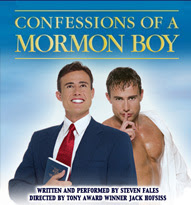 This afternoon we were treated to a one-man autobiographical show called Confessions of a Mormon Boy. It's the poignant story of a boy on track to be the perfect Mormon -- missionary leader, BYU grad, married with two kids -- except for the nagging problem that he is gay. Steven Fales, the writer/actor/protagonist, tells his story engagingly, with a healthy blend of humor and pathos, of his struggle to be straight -- trying all sorts of counseling and reparative therapy -- to his eventual excommunication from his church, divorce from his wife, and exile from the only life he knew. The latter phase of his life leads to New York City and a dark path of being an escort, doing drugs, and living a life of decadence, before bottoming out, and ultimately, a revelation of self-acceptance. Given this history, Fales could be forgiven for falling into polemics or bitterness, but he rises above those temptations, keeping the story focused on his personal experience and development, and keeping his delivery genuine and heartfelt. He has obviously done a lot of soul-searching, and the play offers some great insights and profound quotes. (One that sticks in mind: after being excommunicated by a horrible tribunal, Fales hears the voice of God in his head saying "I know who you are, and I am bigger than all of this.") The minimal staging -- a bench and a few costume changes -- is used to good effect, and the primary narrative style of talking to the audience is broken up by well-enacted vignettes. While gay people who have suffered an unhealthy religious upbringing will recognize a lot in Fales' story, I don't think you need to be Mormon or gay to appreciate the self-examined humanity in his tale. (The play is running at the Elephant Lab Theatre through September 30.)
FILM: The Bubble
 We had enjoyed gay Israeli filmmaker Eytan Fox's previous film Walk on Water, so we were eager to see his new one, The Bubble (or "ha-Buah" in Hebrew). It is a vivid and moving view of life in Israel, as seen through the eyes of three young friends who share an apartment in Tel Aviv, and the dramatic chain of events put into play when one of them falls in love with a Palestinian. The opening sequence shows a West Bank checkpoint, and the tension of Israelis imposing necessary security measures on Palestinians entering into Israel, who suffer hassles, indignities, and sometimes worse, even those who are innocent. This serves as a checkpoint of perspective against the lives of the protagonists in Tel Aviv, where they are relatively insulated from danger, and can pursue liberal activism, hang out in trendy cafes, dance to good music (the film has a great soundtrack), and live their "Sex In the City"-style personal dramas. This is life in "the bubble". After Ashraf, the Palestinian boy, hooks up with Noam (one of the flatmates), he assumes an Israeli identity for a while, but must eventually return to his family in Nablus, providing a view into a very different life in the West Bank. The bubble eventually bursts in unexpected and dramatic ways, as the relationship between these star-crossed lovers unfolds. The characters and events in this film obviously carry heavy political symbolism, but they don't collapse under its weight. The filmmaker keeps the characters real and believeable, and there are only a few plot/character points molded for allegorical necessity that require much willing suspension of disbelief. We found ourselves swept up by the story, enlightened by a glimpse of the tension underlying daily life in Israel, and the realization that we here in America are truly the ones living in a bubble.
Saturday, September 08, 2007
Some Calculating, Some Ignorant, All Pandering
Two different candidate quotes on page 14 of this morning's LA Times were the sort that made me want to retort. First, I see the headline "Clinton rejects raising age for Social Security benefits". Apparently, this is yet another Clinton gambit to position herself as "more experienced" than Obama. (Ironically, when it was the nuclear kerfuffle, Clinton chastised Obama for taking options off the table, but with Social Security, he's apparently naïve for leaving things on the table.) According to the article:
Then in the next story, I read about Fred Thompson's ignorant comments about same-sex marriage:
Two examples of pandering. Clinton knows better. Thompson is just ignorant. Either way, these illustrate why Obama looks so refreshing.
Clinton aides drew attention to a television interview Obama gave in May, where he refused to rule out raising the retirement age or boosting payroll taxes to ensure Social Security remains solvent over the next few decades.This is just plain pandering. Clinton is a smart wonk, and she's undoubtedly aware of the dimensions of the Social Security disaster-in-waiting. There are only three ways to address the problem: have workers pay more (raise taxes), have retirees get less (reduce benefits), or change the ratio of workers to retirees (raise the retirement age). While it's unpopular to talk about cutting benefits or raising the retirement age, that's frankly what needs to be done. I'm much more impressed with Obama, who is willing to tell us what we need to hear, than Clinton, who, like most politicians, is just saying what she thinks we want to hear. (Sure, Clinton was addressing the AARP. But Obama isn't afraid to address hot topics, regardless of the context of his speech, as he showed earlier in the year when he spoke about merit pay in addressing the NEA.)
"Everything should be on the table," Obama told ABC News' George Stephanopoulos in that interview.
In her speech, Clinton took the position that certain solutions should be off-limits.
"I'll tell you, putting everything on the table is not the answer," she said. "Raising the retirement age is not the answer. Cutting benefits is not the answer."
Then in the next story, I read about Fred Thompson's ignorant comments about same-sex marriage:
Denouncing judges in Iowa, Massachusetts and other states for decisions opening the way to same-sex marriage, Thompson called for constitutional amendments to curb judges' power to do so.Um, better check your facts, Fred. Although it's been vetoed by the governor, the California Legislature has approved same-sex marriage not just once, but twice, as of yesterday. (Of course, Thompson might be excused for not knowing about yesterday's news, if other newspapers buried it as the LA Times did.) In Massachusetts, although gay marriage was ushered in by their high court, it has been effectively ratified by the legislature in voting down a proposed amendment to override the court decision.
"What we're seeing here is a totally judicially created problem," he told a crowd in Sioux City.
"You know how many states have affirmatively approved gay marriage? State legislatures? Zero."
Two examples of pandering. Clinton knows better. Thompson is just ignorant. Either way, these illustrate why Obama looks so refreshing.
Thursday, September 06, 2007
Restroom Round-Up
What to think about Senator Larry Craig's "disorderly conduct" in the airport men's room? I admit I felt some schadenfreude(*) at seeing such a die-hard anti-gay legislator suffer such an ironic fall. (The man scored a complete zero on the HRC gay policy report card. That's not just incidentally anti-gay, that requires real focus.) But the episode elicits a complex mix of reactions.
Is Craig guilty? You bet. His immediate reactions unquestionably belie his guilt. There are a number of unbelievable aspects to Craig's version of the story. For example, he says he has a "wide stance" when going to the bathroom, and may have unknowingly put his foot into the next stall. Right. I don't think anyone has that wide of a stance. Moreover, Craig wasn't standing, he was sitting. But the real clincher for me was his immediate reaction when the officer flashed his badge and asked him to leave. Craig said "No!". Think about that. An innocent person would never have said "No!", they would have said "Huh??". But as soon as Craig saw the badge, he knew exactly what he was being busted for. Why? Because he knew what he was doing in that restroom, and it wasn't the nominal innocent purpose. And then this business of the guilty plea, hoping to make it go away quietly, without even talking to an attorney? Is that the reaction of a falsely accused Senator? I think not. Why on earth would Craig have attempted to just handle this himself without consulting with legal and political advisors? There's only one reason. He was scared to death to talk to anybody about it. Guilty, guilty, guilty.
Was there really any crime committed? I don't think so. While I'm certain that Craig's intentions for using that restroom are everything that he's denying, I don't see how that amounts to a crime. What he is being accused of is sticking his foot and his hand slightly into the next stall. While most would find this behavior bizarre and off-putting, I doubt most would view it as criminal. The charge behind the charge comes from the meaning behind these coded rituals, making them something akin to winking at someone. But is winking a crime? Insofar as these actions were coded communication, they were a more subtle equivalent of of going up to someone in a restroom and baldly saying "you're hot, I'd like to give you a blow job". But even that, while many would find it quite disturbing, is not criminal. Freedom of speech, you know. One might argue that Craig was looking to have sex right there in the public facility, which would be illegal. Admittedly, but things never got that far, did they? Perhaps in Minnesota they do things differently, but generally one can't be charged for something one merely intends to do, but doesn't actually follow through with. Making a larger point, Arianna Huffington asks whether such sting operations aren't an obvious misallocation of law enforcement resources (especially in an airport, where far more ominous potential crimes weigh heavily on all our minds).
Is Craig a victim of anti-gay animus? Indeed he is. The double-standard is painfully apparent. We have the contrast in Craig's fellow Senator, David Vitter, who just a couple months ago was exposed as having used the services of a prostitute in DC. Apparently, heterosexual prostitution is a forgiveable sin, as nobody is looking for Vitter to resign. But what Craig did was "so reckless and repulsive as to demand an immediate exit" (in the words of Hugh Hewitt). This contrast has been pointed out, and various excuses are offered, such as that no charges have been brought against Vitter, or that Vitter's offenses were years ago. But let's cut the crap. This is about the gay stigma. What has been Craig's most vehement public denial? "I am not gay." Note that he seems far less concerned with countering charges that he has been having sex outside of marriage, or engaging in extra-marital affairs via particularly seedy avenues. One gets the distinct impression that if Craig could somehow trade his peccadillo for Vitter's, he'd put his name on the DC madam's list as fast as you can tap your foot. (Hilary Bok also is right to point out the double-standard of men vs. women suffering sexual harrassment.)
What's the appropriate Christian response to this sort of thing? I think we saw that last year with Ted Haggard. He confessed (eventually), and he was forgiven by his family and church, not rejected by them. Contrast that with Craig, who is embracing denial, and the likes of Mitt Romney, who quickly threw Craig under the bus. Bill Clinton (who knows a thing or two about peccadillos) was far more charitable: "Well, first of all, I think we ought to recognize that this is a very traumatic time for him and his family. And whatever happens or doesn't, most of his political career was behind him. So whatever your party, we should be hoping that he and his family can work through this in a way that leaves them as whole as possible. I think that that is more important than the politics of this."
(*) If you don't know what schadenfreude is, then you need to go see Avenue Q.
Is Craig guilty? You bet. His immediate reactions unquestionably belie his guilt. There are a number of unbelievable aspects to Craig's version of the story. For example, he says he has a "wide stance" when going to the bathroom, and may have unknowingly put his foot into the next stall. Right. I don't think anyone has that wide of a stance. Moreover, Craig wasn't standing, he was sitting. But the real clincher for me was his immediate reaction when the officer flashed his badge and asked him to leave. Craig said "No!". Think about that. An innocent person would never have said "No!", they would have said "Huh??". But as soon as Craig saw the badge, he knew exactly what he was being busted for. Why? Because he knew what he was doing in that restroom, and it wasn't the nominal innocent purpose. And then this business of the guilty plea, hoping to make it go away quietly, without even talking to an attorney? Is that the reaction of a falsely accused Senator? I think not. Why on earth would Craig have attempted to just handle this himself without consulting with legal and political advisors? There's only one reason. He was scared to death to talk to anybody about it. Guilty, guilty, guilty.
Was there really any crime committed? I don't think so. While I'm certain that Craig's intentions for using that restroom are everything that he's denying, I don't see how that amounts to a crime. What he is being accused of is sticking his foot and his hand slightly into the next stall. While most would find this behavior bizarre and off-putting, I doubt most would view it as criminal. The charge behind the charge comes from the meaning behind these coded rituals, making them something akin to winking at someone. But is winking a crime? Insofar as these actions were coded communication, they were a more subtle equivalent of of going up to someone in a restroom and baldly saying "you're hot, I'd like to give you a blow job". But even that, while many would find it quite disturbing, is not criminal. Freedom of speech, you know. One might argue that Craig was looking to have sex right there in the public facility, which would be illegal. Admittedly, but things never got that far, did they? Perhaps in Minnesota they do things differently, but generally one can't be charged for something one merely intends to do, but doesn't actually follow through with. Making a larger point, Arianna Huffington asks whether such sting operations aren't an obvious misallocation of law enforcement resources (especially in an airport, where far more ominous potential crimes weigh heavily on all our minds).
Is Craig a victim of anti-gay animus? Indeed he is. The double-standard is painfully apparent. We have the contrast in Craig's fellow Senator, David Vitter, who just a couple months ago was exposed as having used the services of a prostitute in DC. Apparently, heterosexual prostitution is a forgiveable sin, as nobody is looking for Vitter to resign. But what Craig did was "so reckless and repulsive as to demand an immediate exit" (in the words of Hugh Hewitt). This contrast has been pointed out, and various excuses are offered, such as that no charges have been brought against Vitter, or that Vitter's offenses were years ago. But let's cut the crap. This is about the gay stigma. What has been Craig's most vehement public denial? "I am not gay." Note that he seems far less concerned with countering charges that he has been having sex outside of marriage, or engaging in extra-marital affairs via particularly seedy avenues. One gets the distinct impression that if Craig could somehow trade his peccadillo for Vitter's, he'd put his name on the DC madam's list as fast as you can tap your foot. (Hilary Bok also is right to point out the double-standard of men vs. women suffering sexual harrassment.)
What's the appropriate Christian response to this sort of thing? I think we saw that last year with Ted Haggard. He confessed (eventually), and he was forgiven by his family and church, not rejected by them. Contrast that with Craig, who is embracing denial, and the likes of Mitt Romney, who quickly threw Craig under the bus. Bill Clinton (who knows a thing or two about peccadillos) was far more charitable: "Well, first of all, I think we ought to recognize that this is a very traumatic time for him and his family. And whatever happens or doesn't, most of his political career was behind him. So whatever your party, we should be hoping that he and his family can work through this in a way that leaves them as whole as possible. I think that that is more important than the politics of this."
(*) If you don't know what schadenfreude is, then you need to go see Avenue Q.
Tuesday, September 04, 2007
A Wisconsin Boy Dreams of Marriage
Excellent editorial in the Milwaukee Journal-Sentinel last week written by a high school senior. Money quote:
Hi Jonathan,
I just read your editorial in the Journal-Sentinel (courtesy of link from Andrew Sullivan), and I wanted to send my congratulations to you for having the courage to speak out (and so eloquently!). I hope that you have hope in equal measure to your courage. For what it's worth, I can well recall feeling very much like you did when I first came out some 25 years ago. When I first came to the realization that I was gay, I felt as if all of my lifelong dreams of family and marriage were torn to shreds in front of my face, with nothing to replace them. It took a while for me to integrate a new dream, very similar to the old one, informed by all the same values I was raised with, but with another man instead of a woman to share my life with. Now, though we lack state recognition, I have a very wonderful husband and six happy years of being married. We had a relatively traditional wedding, exchanging vows surrounded by family and friends. It can happen -- it will happen for you, and by the time it does, you may even be able to get that wedding license. In the 25 years since I came out, I have seen amazing changes in America's acceptance of homosexuality. There's still a ways to go, but we're moving in the right direction, and there's no turning back. Know hope.
Best regards,
Tom Chatt
I believe in the sanctity of marriage; in fact, it's a tradition I aspire to emulate. For me, marriage is more than just a word; it's the embodiment of an idea to which I am deeply loyal. Marriage sanctifies the love and commitment that form the basis of a strong, morally upright family.I emailed him this response:
"Civil union," by contrast, is a sterile and relatively meaningless term. Those who support civil unions and oppose gay marriage, including nearly all of the Democratic presidential candidates, fail to understand that nobody views marriage in terms of government benefits.
Marriage is really about carrying on an honorable and meaningful tradition. The benefits are superfluous. The word is indispensable.
Hi Jonathan,
I just read your editorial in the Journal-Sentinel (courtesy of link from Andrew Sullivan), and I wanted to send my congratulations to you for having the courage to speak out (and so eloquently!). I hope that you have hope in equal measure to your courage. For what it's worth, I can well recall feeling very much like you did when I first came out some 25 years ago. When I first came to the realization that I was gay, I felt as if all of my lifelong dreams of family and marriage were torn to shreds in front of my face, with nothing to replace them. It took a while for me to integrate a new dream, very similar to the old one, informed by all the same values I was raised with, but with another man instead of a woman to share my life with. Now, though we lack state recognition, I have a very wonderful husband and six happy years of being married. We had a relatively traditional wedding, exchanging vows surrounded by family and friends. It can happen -- it will happen for you, and by the time it does, you may even be able to get that wedding license. In the 25 years since I came out, I have seen amazing changes in America's acceptance of homosexuality. There's still a ways to go, but we're moving in the right direction, and there's no turning back. Know hope.
Best regards,
Tom Chatt
Wednesday, August 29, 2007
Lying About Leaving
As should be clear from the previous post, I'm not sorry to be saying goodbye to Alberto Gonzales, perhaps the worst Attorney General we've ever had. However, I do feel compelled to cut him some slack from a particular charge that is being bandied about. It seems that reporters were asking over the weekend whether Gonzales was going to resign, and Gonzales, thru his press secretary, denied the rumors, even though they were in fact true. I read blogs that complained about him "going out appropriately with one last lie", and even the veteran reporter Daniel Schorr centered his commentary today on this lie as an epitomy of the dishonor we've sunk to expect from government officials. While I am appalled as anybody at Gonzales' dishonest testimony to Congress, in this particular instance, I just don't get what's wrong. This is what anybody does when leaving a job, and it seems to me completely standard, above-board protocol.
If you're leaving a job, you have some private conversations about it with your boss, and if your leaving might be the cause of any disruption, you agree with your boss when and how you're going to break the news to everybody else. If somebody happens to ask you prematurely whether you're leaving, you don't just jetison the plans you've made about the timing of your departure announcement. If you're particularly skillful, you might adroitly evade the question. (Note that Gonzales has not proven himself skillful in this manner.) Since a clumsy evasion may be taken as an admission, to be safe, it may be best to deny what you know to be true. It's a lie to be sure, but a harmless one, since the truth will come out in due time. Sometimes lying is a necessary part of tact and decorum. It should be noted that the person who asks such a question is being rude, since one knows a priori that it's not a question that the questionee could appropriately answer, and it puts the questionee in an awkward position. Such a rude questioner doesn't deserve an honest response.
The name of Alberto Gonzales may justly be piloried for a great many injuries to the reputation of the US Government, but denying on Sunday what he announced as planned on Monday is not one of them.
If you're leaving a job, you have some private conversations about it with your boss, and if your leaving might be the cause of any disruption, you agree with your boss when and how you're going to break the news to everybody else. If somebody happens to ask you prematurely whether you're leaving, you don't just jetison the plans you've made about the timing of your departure announcement. If you're particularly skillful, you might adroitly evade the question. (Note that Gonzales has not proven himself skillful in this manner.) Since a clumsy evasion may be taken as an admission, to be safe, it may be best to deny what you know to be true. It's a lie to be sure, but a harmless one, since the truth will come out in due time. Sometimes lying is a necessary part of tact and decorum. It should be noted that the person who asks such a question is being rude, since one knows a priori that it's not a question that the questionee could appropriately answer, and it puts the questionee in an awkward position. Such a rude questioner doesn't deserve an honest response.
The name of Alberto Gonzales may justly be piloried for a great many injuries to the reputation of the US Government, but denying on Sunday what he announced as planned on Monday is not one of them.
Monday, August 27, 2007
Rats From A Sinking Ship
Hearing about Alberto Gonzales resigning so close on the heels of Karl Rove, I thought to myself, was ever the phrase "rats fleeing a sinking ship" so apt? Rove, whose achievement was to make American politics more bitterly polarized than ever, and Gonzales, whose achievement is nicely summarized by Hilary Bok:
Alberto Gonzales helped to destroy the good name of our country. He wrote the legal opinions that allowed the administration to disregard laws it did not wish to follow, and in so doing did real damage to the structure of our government and to the separation of powers. He took a department that was, by all accounts, superb, and trashed it. And by being so transparentl interested only in advancing the interests of George Bush at the expense of the laws he swore to uphold, the Constitution, and the national interest, he deepened cynicism about government at a time when we badly needed leaders worthy of our trust and our confidence.Listening to Gonzales' brief farewell remarks, I threw up in my mouth a little when he spoke of "public service". Public dis-service, more like.
Sunday, August 19, 2007
Inn Love, Maybe, But Not Inn Business
 We were looking for a place to stay in the northern San Diego County town of Fallbrook, for a family event. Turns out that Hollywood couple Tori Spelling and Dean McDermott have opened a bed-and-breakfast inn in Fallbrook, and are using it as a vehicle for a reality TV show on the Oxygen network called Inn Love. I did some reading up on it, and it turns out that the place has gotten some nice reviews from those who have stayed there, though others had reported difficulty even getting a response to inquiries about staying there. Tori has been reported as insisting that the place is not a gimmick, and that they really do want to make a go of the inn business. (As all the Hollywood gossips were wagging about how she was shorted on inheritance from her late father, and on the outs with her mother, she may really be looking for an honest income.) Thinking it would be fun, we decided to check it out. As a business, their website, which for us as for most people, is the first impression, leaves a lot to be desired. There are no photos or descriptions of the inn's rooms, no address or location, no prices, not really any information at all. The one-page website has rather low-budget graphic design, and the only means of contact for more information is an email address (which is not even a clickable link). We sent an inquiry to that email address several days ago, but never received a reply. If they really do want to make a go off the inn business, they really should start with the basics. Like spending a modest amount of money on a real website. And answering their email. Color me uninnpressed.
FOOD: Murano
 Props on the new Murano Ristorante on the west end of Melrose. We were invited there by our neighbors for a celebration of their daughter's graduation from The Art Center College of Design. (Congratulations, Alex and Addison!) What an appropriate place to do it. The trendy new eatery, located in the shadow of the Pacific Design Center, in the heart of LA's design district, is strikingly done, using mostly white and clean modern lines, setting off the Murano glass chandeliers in reds and classical shapes. The bar features an archipelago of low white rectangular islands and benches for spontaneous social configurations, where we mixed before dining. Dinner was hosted in a private back room, around a large square table configuration with four people on a side, a most convivial way to arrange a party of sixteen. That kind of attention to detail, not only in the visual design, but in the "social architecture", is much appreciated. In another signature "attention to detail", once everyone is seated, women in black dresses are offered black napkins in place of the white ones, so as not to get any white lint on their dress. Happily, they did not forget that restaurants are about food (one can't take these things for granted, especially in trendy glam spots like this), and chef Kristi Ritchey (lately of Pinot Blanc, Patina Group's Napa Valley venue) is doing great things in the kitchen. I started with a fresh salad of endive and water cress, in a gorgonzola dressing, accompanied by candied walnuts and fresh mission figs. It was beautifully arranged and a fine way to start a summer meal. This fresh greenery nicely introduced the earthy flavors of my spinach and wild mushroom ravioli, accented with ground walnuts and white truffle oil. The ravioli were savory and superb. I also had a taste of the perfectly-prepared flatiron steak, cut in strips full of marinated beef flavor. This fine meal was finished with a rich flourless chocolate cake, decadently topped with vanilla gelato and cherries. The restaurant's owners, Robin Gans and Sandy Sachs of GirlBar fame, along with Jeffrey Sanker of White Party fame, are experienced pros at dance clubs and entertainment events, but I believe this is their first foray into restaurants. Well done!
Sunday, August 12, 2007
FOOD: Zabaglione
This evening we had a family birthday celebration at Buon Gusto, an Italian restaurant in North Hills near where my parents live. I was excited to see zabaglione on the dessert menu, a rare treat. When informed that the zabaglione had to be ordered ahead, I knew that this was the real deal and not the made-ahead pseudo-zabaglione that some places pass off. A proper zabaglione requires attention, skill, and effort to get it right, and absolutely cannot be made ahead. (Which is why so few places offer it.) Done right, it uses only eggs (whites and yolks separated), sugar, and marsala, with a lot of air whipped into it, and gently heated so as not to cook the egg yolk. The result is a very frothy custard perfumed by the sweet wine, served in a goblet and savored with a spoon. At Buon Gusto, they pulled it off perfectly, and it was divine. Bravo!
FILM: Hairspray
 I have to admit I was a bit reluctant about going to see the new Hairspray movie this evening. Not that I didn't love the original film and the Broadway musical, just that I worried whether a new film couldn't live up to its inspirations. (Or that it could even live up to the charming one-man rendition of it by Mark Indelicato on Ugly Betty.) And I was also having trouble wrapping my mind around John Travolta filling the size 14 pumps of Harvey Fierstein or Bruce Villanch. Turns out I worried for naught. This new version totally rocks. It is a delightful 1950's kitsch-o-rama (haven't seen so many cars with fins since visiting Havana), and instead of being "stagey", the film takes full advantage of its medium to deliver creative visuals during the energetic numbers. The newly-minted star Nikki Blonsky had me at "oh oh oh" as she danced through the streets of working class Baltimore singing good morning and arriving triumphantly at school on top of a garbage truck. And to my surprise, Travolta gave Edna Turnblad a vulnerability that really grew on me. Queen Latifah delivered a star turn (but I expected no less), and Michelle Pfeiffer was excellently frosty as the scheming villainess you love to hate. Christopher Walken (whom I usually think of as a villain-type) was a mensch of a dad and showed some nice footwork in a charming dance sequence with Travolta. Zac Efron was perfect (and adorable!) as an Elvis-in-training heartthrob, and James Marsden (speaking of adorable) with his wholesome good looks and big white smile was a great dance show host Corny Collins. Amanda Bynes was very fun as Tracy's lollipop-sucking sidekick Penny, with the majorly uptight mother (Allison Janney). Elijah Kelley added great moves as Seaweed, and Jerry Stiller had a nice turn as Mr. Pinkey. The cast was all excellent, but I give the real congrats to director Adam Shankman who did an outstanding job of so creatively re-realizing this fun story. It was a rollicking romp for the eyes as well as the ears.
Saturday, August 11, 2007
STAGE: Zanna Don't
 Last night we joined a couple of friends to see "Zanna Don't", a musical being staged in one of the many tiny theatres hidden around Silver Lake. Small theatre can be hit or miss, but at only $20-30 a pop (as opposed to upwards of $100 these days for a big theatre musical show), it's worth the risk to find the hidden gems. Fortunately, LA is chock full of very talented actors and singers, so you can encounter high-quality talent performing even in a 60-seat house. In the case of the West Coast Ensemble production of "Zanna Don't", we were handsomely rewarded and consistently delighted. This show delivers foot-tapping tune after tune, propelling a whacky but engaging story that had me grinning ear to ear almost the whole time. The premise rests on the story setting in the high school of Heartsville, a wholesome midwestern community in an inverted universe where everyone is gay and heterosexuality is the love that dare not speak its name. In this world, the chess champion is the big man on campus, and being in the high school musical is way socially cooler than being on the football team. The play mines the humor inherent in its theme very creatively, with many elaborations that surprise and amuse, but never wear it down to one-gag repetition. Amidst the laughs, a couple of numbers ("Don't Ask, Don't Tell" and "Do You Know What It's Like?") plumb some unexpectedly serious and moving undertones about what it means to have to hide and lie about love. Prancing through this fanciful backdrop like some cross between Tinkerbell, Cupid, and Olivia Newton-John in Xanadu is the title character Zanna, whose magical mission is to make sure everyone (except himself?) finds love. That sounds over-the-top (which it is), but don't let the Xanadu reference fool you. Zanna Don't is more than just a gimmick to string together a bunch of fun tunes, and the second act surprises, not just in the denouement, but in the way it deepens.
The cast were all strong, with fine comic acting, singing, and dancing all around. Danny Calvert (Zanna) moved magically and had some serious pipes. Rebecca Johnson (Kate the overachiever) and Natalie Monahan (Roberta the lesbian with attitude) have the moves, voices, and expressiveness perfect for this kind of musical comedy. Brent Schindele (Steve the quarterback) and Brian Maslow (Mike the chess champ) were both talented and well-cast (Maslow was an understudy but we didn't feel shorted). Brian Weir, Justine Valdez, and Matthew Rocheleau complete the talented cast, skillfully juggling multiple character roles. Given the very limited size of the theatre, a special kudos to Christine Lakin and Paul Nygro for their choreography, and the backstage folks who were able to make much with little. This play has been running on Off-Broadway for years, where it probably has a bit more budget behind it, but this production successfully packs all the magic into a tiny local space. You'll find the Lyric-Hyperion Theatre on the corner of the same name, just a couple blocks east of Casita Del Campo or west of Trader Joes. Fun, fun, fun. I'd enjoy seeing it again.
Subscribe to:
Posts (Atom)