Friday, February 08, 2019

ART: Ai Weiwei and Yayoi Kusama at the MAF

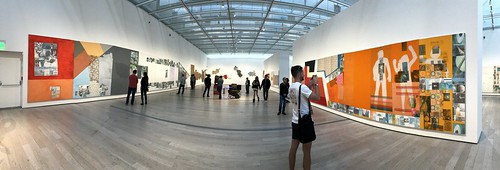
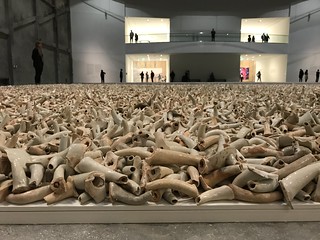
After lunch in Koreatown, in another of my off-Friday pairings of food and art explorations, I got to see a couple of impressive art installations at the Marciano Art Foundation. (If you haven’t yet been to the MAF, it’s a fantastic recent addition to the LA modern art scene, completely free including parking, but you need to make online reservations, and it’s currently booked out about a month out.) The first was a set of massive installations by Ai Weiwei. I’ve gotten to know this artist in the last year, not only through a previous exhibition, but also through his impressive documentary film Human Flow, about refugees and mass migrations, and it’s interesting to see the themes that connect his works. He is fascinated with scale and replication, and one of the things he likes to do is create large installations comprised of large numbers of the same kind of object, inviting you to look at an overall mass, contemplating vastness and large numbers, but at the same time to look closely at individuals and see what appear to be replicas actually have individual differences and characteristics. In the previous exhibit, he did that with antique Chinese stools filling a large open gallery. The Marciano offered an even bigger space to fill, and he’s filled it with two installations of this sort. One, called Spouts, is a nearly 2000-square foot rectangle filled with the spouts of antique porcelain teapots. These are broken fragments of pottery from various Chinese dynasties, some as much as 1000 years old. The shapes and colors vary, though they’re mostly shades of white and ivory. Given that the artist has spent time in Chinese prison and under house arrest, one can imagine this mass of teapot “mouths” to be a comment on the freedom of speech for all the people in China. The other, called Sunflower Seeds, is an even bigger square, over 4000 square feet, filled with sunflower seeds. Not real ones, but lifesize porcelain replicas. There are about 50 million of them, made by over 1600 artisans in Jingdezhen, a town with a long tradition of porcelain craftswork. Thinking about the fact that each of these seeds was handmade by an artisan, and looking at this vast field of millions of them, makes you think about the value of handicraft and the price of labor in China.
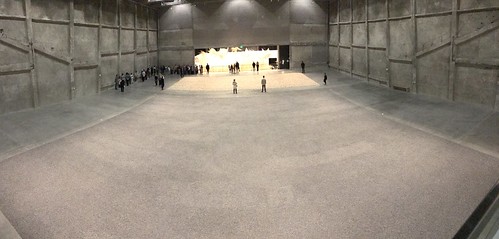
The large field in fore are the 50 million porcelain sunflower seeds. The ivory rectangle beyond that are the antique teapot spouts.
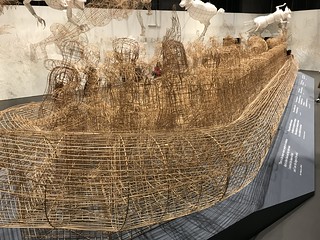
Beyond these two fields is another space that houses a bunch more works by Ai Weiwei, these works all made of bamboo and silk, using the techniques of traditional Chinese kite-making. In the center of the space is the featured Life Cycle, a lifesize large inflatable Zodiac-style boat filled with human figures, made entirely of slender bamboo sticks. If you’ve seen his film, or if you’ve seen any documentary footage of refugees crossing the Mediterranean Sea trying to reach Europe, you will recognize the scene immediately. These are the sort of boats refugees often use, filled to dangerous overcapacity. Sometimes they even capsize. The figures in this boat are all facing inward, and you can see that the center is filled with figures too. A child peers over the front. The transparent bamboo construction of the figures makes them ghostly, just outlines of people, hard to make out. These boats often make their desperate runs at night. After a while you notice that while most of the figures are human, every so often the artist has topped a human body with the head of animals from the Chinese zodiac, an ox here, a rooster there. Perhaps that’s a play on Zodiac, the most common maker of these inflatable boats. Perhaps it suggests the hope that there might be some guiding spirits or angels traveling with these desperate boats. In any case, it’s a powerful piece.
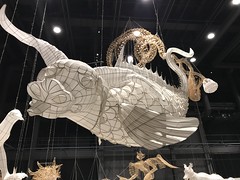
Surrounding the Life Cycle, on the walls around it, and suspended in the rafters above it, are a myriad of bamboo-and-silk kite-like works. The ones flying above are all fantastic mythical creatues drawn from an ancient Chinese mythological text called the Shanhaijing. These creatures have arms and wings, fins and tails, some have multiple heads. The white silk creatures lit up against very high rafters that disappear into darkness create a fantastic effect, like constellations floating in a night sky. The works along the wall draw on myth, on modern art, and on themes from the artist’s life and work. In one section I smiled to recognize the three-legged stools echoing another work I had seen last fall.
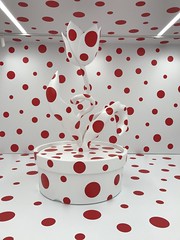
This alone would have been treat enough, but on another floor, MAF was hosting another large scale installation by a fascinating artist. Yayoi Kusama, the Japanese artist whose amazing Infinity Room has been such a hit at The Broad, has another immersive installation here. This one is entitled With All My Love For The Tulips, I Pray Forever. The title gives you a hint of the playful fantasy to expect. This work comprises several monumental potted tulips in a large room, where the tulips themselves, along with the entire room – walls, ceiling, floor – have been painted bright white with large bright red polka dots. It is a fantastic effect, and as you don shoe coverings to be able to walk into this joyful artwork, I think it is impossible not to smile. With absolutely everything in your field of view the same bright colored pattern, Kusama plays with your sense of depth and dimension, while the fancifully shaped oversize tulips create a Wonderland effect. Just how big are those tulips? Wait, have I shrunk? With nothing around you but bright dots, fantastic flowers, and smiling spectators, this exhibit most definitely sparks joy.
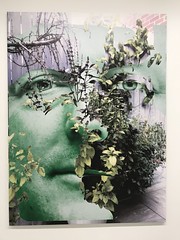
Beyond this, there was still more to explore. The MAF has a large permanent collection that they rotate through exhibition, and judging by the very recent dates on some of the works I saw today, they are actively continuing to expand their collection. Mimi Lauter has a gorgeous 8-panel abstract painting in brilliant peacock hues. A wall full of different colored mirrored windows forms the “clockwork for oracles” by Ugo Rondinone. Photographer Catherine Opie has a fascinating series of intimate photos from inside Elizabeth Taylor’s home (not of Ms. Taylor, just of her home and her stuff). Urs Fischer has created a series of intriguing self-portraits spliced onto scenery, using cuts and color washes and creative construction. These are just some of the highlights. This museum is really such a treat.
FOOD: Galbi at Sun Nong Dan in Koreatown

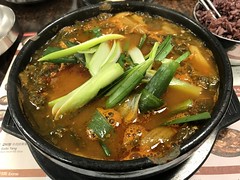
Today I lunched at the famous Sun Nong Dan in Koreatown. It lies in a strip mall at 6th and Alexandria, amdist a handful of restaurants, each with distinct specialty dishes. I tried the oo guh ji galbi tang, a bubbling pot of hot chili broth with some beef short rib and “dried cabbage” (seemed more like collard greens). It came with some nice banchan -- chili scallions, kimchi, chili turnips. I’d heard that the galbi jjim is the thing to get, but I need to bring friends next time, cause the smaller serving size feeds three or more. It was pretty awesome seeing it at other tables when they topped it with cheese and melted it with a blowtorch.

Saturday, February 02, 2019

FILM: The Wife

We had missed this last fall, but with Oscar nominations out, it's back on the big screen, and I'm glad we got the chance to see it. Everyone has been buzzing about Glenn Close's performance in The Wife, and rightly so. Jonathan Pryce is also brilliant as her husband, the Nobel-winning writer, but even if the title hadn't clued us in that we should be watching her, Close's character Joan, tautly rendered and slowly revealed, would command our attention. This fascinating character story examines what it takes to be a great writer, but examines it by showing us this moment of winning the Nobel, and the life that lead up to it. One of the scenes, where Joan spontaneously agrees to have a drink with a persistent would-be biographer (Christian Bale) who is trying to wheedle dirt out of her, reminded me of a similar scene from years ago of Olympia Dukakis in Moonstruck, where she rebuffs a proposed affair, "because I know who I am."  Likewise, Joan knows who she is. There's a writerly line from James Joyce that crops up a few times in this film, "His soul swooned slowly as he heard the snow falling faintly through the universe and faintly falling, like the descent of their last end, upon all the living and the dead."  The film culminates in Stockholm in December for the Nobel ceremony, and there are just enough graceful set shots of the stark beauty of that city in winter. In a shot near the end, there is a close-up of Joan's face, and through the window behind her, we see the snow falling faintly, just the way Joyce said it would. I haven't read the book that this film came from, but I'm sure it must have been quite a job to adapt such inherently literary, non-cinematic material. Yet it is deftly done, with fine acting conveying much beyond the words.

Monday, January 28, 2019

BOOKS: Boy Erased

Often it works well to see the movie first and then read the book, as a book has scope to describe so much more, especially what’s going on inside people’s heads. Boy Erased was absolutely such a book. I really enjoyed the film, but I also left with some unsatisfied curiosity about his internal journey of self-understanding. The film showed us what it was like to suffer through the fraudulent travesty that is “ex-gay ministry”. The book filled in more, not only of that experience, but of what it was like to grow up a boy in a close faith community, and by coming out as gay, lose not only his community but his faith. His account was impressionistic, not strictly following a timeline, but a chain of memories and reflections in a stream of consciousness. It was an emotionally faithful way to convey the sense of someone whose life picture was shattered, and he’s picking up the pieces and trying to make sense of how they might fit together again. Many of these memories he’s undoubtedly replayed countless times in his head, sometimes reinterpreting old things in new ways. I’m glad he had the integrity to get through it and tell this remarkable story.

Saturday, January 26, 2019

FILM: BlacKkKlansman

BlacKkKlansman is the horrifying and riveting story of audacious rookie cop Ron Stallworth, the first black cop in the Colorado Springs Police Department in the 1970s, and his stunning infiltration of the Klu Klux Klan, with the help of a Jewish partner. The film is all the more impactful for being, as the film itself declares in an opening title, “based on some fo’ real, fo’ real shit.” The story initially touches on his challenges being the first black cop in the police department, and being assigned to go under cover at black nationalist rallies. The film nicely captures the 1970s era and its racial dynamics. Though the film has a period feel, the dynamics are uncomfortably familiar. Stallworth’s “double consciousness” about being a black cop becomes even more fraught when he starts dating the president of the local college black students organization. But the film really gets intense when Stallworth starts to infiltrate the KKK, posing on the phone as a racist who wants to join them, but forgetting to use an alias instead of his real name. When the local Klansmen want to meet him in person, he has to recruit a colleague to pose as the “white racist Ron Stallworth”. The two “Ron Stallworths” work hard to keep their stories straight, but the wheels come dangerously close to coming off the rails. It doesn’t help that the white colleague also happens to be Jewish, and if the KKK hate anyone as much as the blacks, it’s the Jews. When the grand wizard David Duke himself (uncannily portrayed by Topher Grace) comes into town to preside over Ron’s Klan initiation ceremony at the same time as the black student organization is hosting a revered civil rights icon (and creating a tempting terrorism target for the Klansmen), the intensity and suspense in this film go to 11. Here director Spike Lee has created a masterful extended sequence of the two mindbogglingly concurrent but dissonant scenes – the Klan ceremony and the civil rights leader’s speech – sometimes cutting back and forth and sometimes showing both split-screen. It fires on multiple levels at once, with the dissonance of the two diametric views of national justice compounding on the double procedural suspense of the terror plot and the undercover operation ready to unravel at any moment. I was breathless. The denouement is equally brilliant, managing to be both profoundly satisfying and provocatively jarring. Just when you might be tempted to feel a comfortable distance from another era when times were different, Spike Lee throws ice cold water in your face, saying “that was then, but that is also now.”

Saturday, January 19, 2019

FILM: Green Book

The film Green Book is named for the Negro Motorist Green Book, a publication something like a special Auto Club guide for black people that allowed them to travel safely across America during the Jim Crow years. (Gay people my generation and older will be familiar with the concept from Damron or Spartacus Guide books.) Those of us lucky enough never to have suffered Jim Crow laws may not have thought about the pragmatic burdens for people of color making road trips in that era, finding a place to stay, or eat, or whole towns best to avoid. This film shows us all of that in uncomfortable detail, but in the course of a very engaging road trip story with two intriguing characters. Dr. Don Shirley (superbly portrayed by Mahershala Ali), a black man, is a renowned concert pianist with exquisite diction in multiple languages and a rather affected manner. Tony Vallelonga (perfectly embodied by Viggo Mortensen) is an Italian-American night club bouncer who gets hired by Dr. Shirley to be his driver and bodyguard on a concert tour across the Midwest and South in 1962. What transpires between those two in the course of that trip is an education for them both, and a fascinating story to watch. It’s a great reminder as a nation of where we have come from, a prompt for thinking of present struggles we still need to work through, and an inspiration for how that progress is slowly won through personal interactions across our divides.

Saturday, January 12, 2019

FILM: On The Basis Of Sex

Not one but two films this year illustrate what a fascinating and dramatic life Ruth Bader Ginsberg has lived. In June, we loved RBG the documentary, but last night we really enjoyed On The Basis Of Sex, a dramatization of formative episodes in her early years. The film begins with a great shot of a sea of young white men in dark suits striding into Harvard Law School, and then amidst them, one woman in a blue dress. We get to see young Ruth in law school, and what it was like being one of a handful of women in one of the first years women were admitted at all. Including a scene where the dean of the law school asks her to explain why she chose to go to law school and take up a spot that could have been given to a man! We heard some of these same stories in the documentary, but it’s something else to see them dramatized. We see her own experiences of sex discrimination challenges and indignities in her own early job search, her being a law professor at Rutgers teaching progressive young students in the 1960s, and then her first case with the ACLU that was the genesis of her later amazing career in a string of cases challenging gender discrimination. But the heart of the film is the whole family dimension, the amazing way that she and her husband Marty supported each other, and their relationship with their growing daughter and son, for whom Ruth and Marty wanted to set a great example as well as make a better world. While the climax is a dramatic courtroom procedural, strong in its own right, it gains even more emotional heft from the family and love story behind it.

Friday, January 11, 2019

ART: La Cienega Gallery Crawl: Kwame Brathwaite, Dana Weiser, Farrah Karapetian

There’s a stretch of La Cienega Blvd, just south of the 10 but above Washington, lined with single-story brick buildings lacking windows, a light industrial look that wouldn’t draw attention. But a closer look and it turns out that many of those are small private art galleries, and this is a whole art district, its non-descript walls concealing a great variety of creative work just waiting to reward those who venture in. I’d driven past it countless times, but the KCRW Art Talk podcast urged me to check it out. I was glad I did.

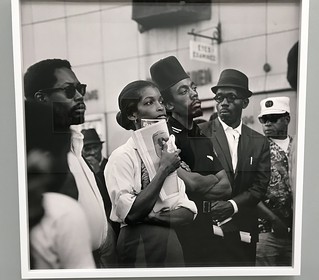
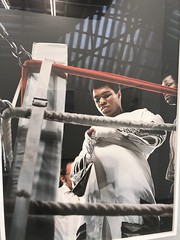
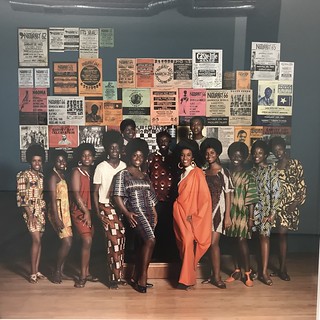
The first gallery I’d ventured into was Philip Martin, featuring an exhibit called “Kwame Brathwaite: Celebrity & Everyday”. This retrospective looks at the early part of the American photographer’s career in the 1960s and 70s when he came to prominence organizing pageants of exclusively black models, and popularizing the phrase “black is beautiful”. The show included a good selection of works representing his photos of celebrities, of models, and of Harlem street life. The model photos are full of beautiful African-American women posing in 1960s African-inspired fashions, proudly claiming their natural beauty and heritage. Many of the celebrity photos, in contrast, are unposed and unstaged, catching candid and sometimes even vulnerable moments. He catches a surprisingly vulnerable glimpse of Muhammad Ali in a boxing ring. James Brown is on stage, with the light in the photo catching him in a moment of soulful expression, a synesthetic image that almost makes you hear the note he is singing. At Garvey Day parades in Harlem, Brathwaite’s eye is more on the crowd than on the parade itself, catching fascinating arrays of spectators and just people on the street, and conveying a mood, the feel of the street.


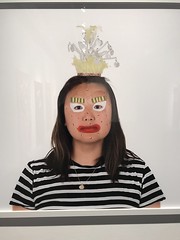
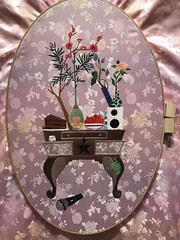
Just up the street, Walter Maciel Gallery was showing “If There Were Tigers” by Dana Weiser. The work shows a young artist who has thought deeply about her identity, as well she might, being ethnically Korean but adopted by a white family in Minnesota. In a series of works, she has taken traditional Korean hanbok dress material and traditional Korean folk art patterns of embroidery, but infused it with themes and objects from her American life. Some may appear as a traditional still life at first glance, but then you notice the speaker, the sunglasses, or the toy helicopter. They are thoughtful and playful at the same time. One captivating piece called “Mystical Lineage” contemplates unknown ancestors as traditional costumes worn by invisible bodies. Another more provocative series are self-portraits entitled “Enacting My Koreanness”, in which she recreates some traditional masks in make-up on her own face, very expressive about perceived expectations. (I couldn’t help but think about Margaret Cho’s bit about Asian chicken salad.)


Across the street at Von Lintel Gallery, Farrah Karapetian’s “Collective Memory” installation evoked her memories of LA’s last lesbian bar, the recently closed Oxwood Inn. This immersive show not only included highly rendered photography, photograms, and works incorporating text, but also a glass pool table, a glass brick wall, and recreated parts of a bar and a restroom. The glass brick wall had some graffiti on it, and black sharpies nearby invited the gallery viewer to add to the art. (With some active encouragement from the gallery staff, I added my own bit of graffiti.) Red neon lighting enhanced the sense of place being created. This gallery turned nightclub memory provided an atmospheric showcase for Karapetian's works.

FOOD: Destroyer

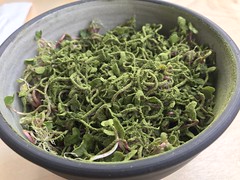
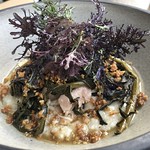
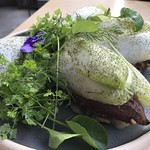
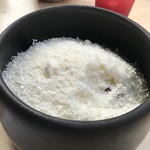
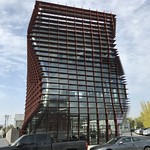
If you're daunted by a $$$$ tasting menu at Vespertine, fortunately you can sample some of Chef Jordan Kahn's inventive cuisine at the much more casual Destroyer across the street. As you're standing in line to place your order (yes, it's that casual), you can peruse the menu, projected on the wall, divided into categories of "cold", "hot", "sweet", and "ready". And while you'll recognize nearly all of the individual words and ingredients in the menu descriptions, the way they are composed will be completely unfamiliar. Smoked egg cream? Pickled mushroom? Roasted strawberry? Berries paired with meats and vegetables? You just need to pick something you're not allergic to, and trust in the mad genius of the chef. When the food arrives, it mostly comes in ceramic bowls, and you learn that Kahn likes to layer things, with a top cover so that all is not revealed at once. It adds to the sense of discovery that you can't immediately recognize what you're looking at, and you probably have to dig under one ingredient to see the rest. You ordered chicken and it appears they brought you a salad? Dig down. Under those spiky greens (spigarello), you'll pull up forkfuls of tender chicken confit with a flavor that's really good, but you can't quite put your finger on it. That's because you've never before tasted what happens when chicken is mixed with heirloom grits and roasted strawberries. Another bowl arrives, and it too looks like a salad. But plunge in, and you'll find beef tartare lurking beneath those radish sprouts, with pickled mushrooms and smoked egg cream. A third bowl arrives, a dark bowl with a heap of creamy white powder that looks like a bowl full of finely grated parmesan. A tentative taste of the mysterious substance and you discover that it is cold, like snow, and has a little bite, as if snow were made not of water but of frozen horseradish cream. Catching on to the game, you dig under the snow drift to discover chunks of beets. But wait, there's something sweet too. It's blackberries. And that crunchy bit? Pumpkin seeds. You contemplate the comparison of vegetable sweetness with fruit sweetness, punctuated by pumpkin seeds and spiked by creamy horseradish. And the frozen horseradish snow keeps the whole thing chilled, which, you realize, affects the brightness of the taste, because it would be different if it were all warm. The roasted yams come on a plate with avocado, but you don't see either of those things right away, because the avocado is covered by yogurt and the yams are carefully concealed under endive leaves, along with a handful of fresh green herbs and a flower, in a very Instagrammable presentation. Kahn has referred to his flagship Vespertine as a spacecraft, and as you gaze across the street at that remarkable architecture, you begin to see why. But as you enjoy the delicious tastes of things you'd never have imagined meeting in the same bowl – vegetables and fruits, cooked and raw – you also realize he's transporting you to a whole new planet, fundamentally composed of known elements, but in otherworldly formations. (Fittingly, this whole neighborhood in the northeast corner of Culver City is filled with dot-com hipster ultramodern architecture, so as eye-popping as Spacecraft Vespertine is, it's not out of place.) Go with a sense of discovery.

Saturday, January 05, 2019

FOOD: Bestia

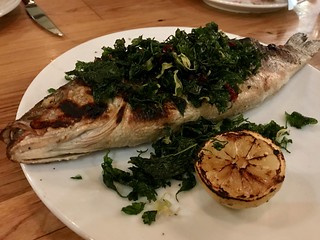
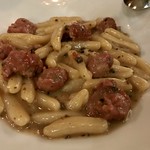
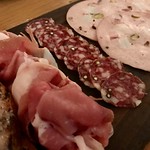
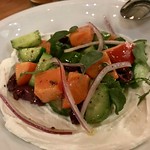
When friends told us they had snagged a reservation at Bestia, we jumped at the chance to join them. The setting is quintessential DTLA Arts District, in an old warehouse in the shadow of the 7th Street bridge, its name painted on corrugated tin, an industrial skylit patio, a line of people outside, and a buzzy vibe inside. The menu reflects daily market variations and offers rustic Italian cooking, mostly simple preparations letting exceptional ingredients perfectly cooked speak for themselves. Much is house-made, as showcased on the salumi board featuring two kinds of salumi (one with a peppery bite, the other more mild), prosciutto, mortadella (studded with pistachios, and so not your childhood sandwich meat), and a spreadable pate on grilled bread. Housemade sausage gives a warm meatiness to the cavatelli alla norcina, thick little ropes of ricotta pasta, graced with black truffle and grana Padano. A refreshing wintry salad combines cucumbers with Fuyu persimmons, fresh dill, mint, and marjoram, on a smear of mascarpone. Chicken gizzards were pan-roasted to perfection, tossed with roasted beets and endive, and topped with shaved capra sarda (a goat cheese). Charred Brussels sprouts have a hit of lemon and Aleppo pepper. A whole branzino is perfectly grilled with charred seasoned skin and moist white flesh, with fried herbs on the outside, and bright baby greens stuffed inside where they essentially steamed. Even the cocktails were redolent of the rustic Italian kitchen. My old fashioned had lardo-infused bourbon with a big chunk of smoked ice. And we were guided to a very crisp Sicilian white wine to compliment the fish. We shared two desserts. Generous chunks of Hachiya persimmon and pistachios colored and flavored a creamy rice pudding, while a crumbly dark cacao crust cradled a rich chocolate budino, which we chased with a Quinta do Infantado LBV.

Thursday, December 27, 2018

FOOD: Omar's Xinjiang Halal

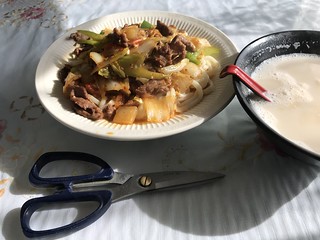
Xinjiang, which literally means “new frontier”, is an autonomous province in the far northwest of China, along the Silk Road, the center of waves of cross-cultural pollination from Persia, Mongolia, Turkic tribes, and the neighboring ‘Stans. One of the main ethnic groups there are the Uyghurs, an Islamic people. This being LA, its own cultural cross-roads, of course there’s a restaurant for Halal Uyghur food. And of course I heard about it on KCRW's Good Food show. So I went to check it out. Delicious! I went for the “lag man”, thick hand-rolled noodles served in a hot broth with celery, peppers, and slices of lamb redolent with cumin and chili (modest heat but not tongue-scorching). The noodles are soft and chewy, thick enough that the bowl comes with shears to tame them. For traditional beverage, I took the milk tea, which comes served in a bowl with ladle-like spoon. It was like a really good chai, but with a distinctive hit of salt. A unique blend of broth and tea. For dessert, there’s a house made yogurt which was lovely, naturally sweet from the milk and without a strong fermentation tartness. I want to come back and try more! As an added bonus, while I was eating, who else came in but Evan Kleiman with her KCRW show team including Nick Liao and Abbie Fentress Swanson who produced the Uyghur segment. I was a bit starstruck, but said a quick hello and thanks - so cool to meet them!

Sunday, December 16, 2018

ART: Rauschenberg's 1/4 Mile

A visiting friend provided a great excuse to check out Robert Rauschenberg's "The 1/4 Mile or 2 Furlongs" at LACMA. Rauschenberg was a renowned late 20th century American artist whose work was exemplified by assemblage of photographs, printed matter, and found objects, combined with overpainting. "The 1/4 Mile or 2 Furlongs" is a single work comprising 190 panels, plus some sculptural objects and some audio tracks, which if laid out linearly would actually be almost 1/4 mile long. The work grew over the course of 17 years (1981-1998) and is kind of a self-contained retrospective of the artist's career, with references to many of his other major works and showing an evolution of styles and phases, a creative array of visual stimulation running the gamut from murky to boldly colorful, and from purely abstract geometrics to human and natural forms. It was intriguing to contemplate the variety of colors and forms in the various panels and other bits and pieces, and also intriguing to think of it as one huge work rather than 200 individual works, and just how that makes you view it differently. I found myself thinking more about order, relationship, and juxtaposition as we wandered through it.

Saturday, November 24, 2018

FILM: The Favourite

What a sassy, saucy period drama about two clever strong-willed women who contested the position of the Queen’s favorite. While men may have thought they were pushing the women around, it was these women who ruled England. Creatively based on a real historical rivalry, The Favourite provides intrigue worthy of Game of Thrones (and protagonists every bit as formidable as Daenerys and Cirsei), but also tempered with a wry sense of humor at times. Rachel Weisz and Emma Stone are both breathtaking in their performances of these incisively-written characters, complimented by Olivia Colman’s fragile, mercurial Queen Anne. The visuals are lush of the Jacobean opulence, while reminding you that even the most powerful were never too far from the mud, and the sanitation and medicine were more medieval than modern. The direction, along with an intense soundtrack (sometimes more sounds than music), was impressive and made for some memorable scenes. The rivals’ conversations over pigeon-shooting had subtext you could cut with a knife, and the scene of Emma Stone’s honeymoon night is startingly funny. The ending was unexpected (compounded by my knowing just enough of the actual history to be confused), but the sort that forces you to go back and rethink what you thought about all of the characters. As in Game of Thrones, there is unexpected nuance to all of them, and even those who may seem black-or-white are grayer than you first think.

Monday, November 12, 2018

BOOKS: Letter To My Palestinian Neighbor

Yossi Klein Halevi’s “Letters To My Palestinian Neighbor” is an extremely thoughtful and personal plea for dialogue from an Israeli Jew wanting to reach out to his Palestinian neighbors. Halevi lives on a hill in Jerusalem with a view from his apartment to another hill across the way where Palestinians live, a very short distance away as the land lies, yet vastly separated by politics, not to mention a physical wall. He imagines a neighbor on that other hill, and what he would like to tell him about his own life and beliefs. Halevi is a religious Jew and devoted to Israel, but also very open-hearted towards the Palestinians, among whom he had traveled and made some friendships in the years before it became no longer possible for a Jew to travel safely in the West Bank. He has written other books about those travels, but in this book, he starts from the premise that any hope for reaching a common understanding has to begin with hearing each other’s stories and really understanding where the other is coming from. This book is his attempt to start that conversation, articulating in a very personal and sensitive way the Jewish Israeli perspective, including some great insights on the Jewish connection to the land of Israel, the sense of being a distinct Jewish people, and the tensions inherent in a Jewish democratic state. Many of his letters are written on a particular holiday, and begin with his observations on that holiday. He does an amazing job of staking out his positions in a way that is very honest, personal, and non-confrontational, always keeping in mind a respect for the Palestinian he is addressing. Even though these letters are not written to a specific known person, his device is to imagine a specific hypothetical neighbor on that other hill, and to address that neighbor personally, one on one, rather than being more generic. The device works well, I think, to keep his letters very personal and heartfelt. I learned a lot from this book, both about Judaism and about Israeli politics. While the situation remains grave, the fact that there are Israelis like Yossi Klein Halevi strengthens my hope for a path forward.

Saturday, November 10, 2018

FILM: Boy Erased

Boy Erased is a well done film, tightly written, with strong performances from its leads, particularly Lucas Hedges as a 19-year old Baptist preacher’s son in small town Arkansas who attempts a Christian ex-gay conversion therapy program. It’s hardly a spoiler alert to say that the program doesn’t work, but the core of the film is showing what actually goes on inside those soul-sucking places, interspersed with flashbacks of experiences that lead him there. While it could have easily slid into tendentious exposé, this film avoids that danger by presenting its characters with complexity. The boy goes into the program willingly, wanting to change, and his parents are not monsters, but loving parents who want the best for him. The evolution of their family dynamic provides the emotional frame to drive the storyline. The other participants in the program also provide a thoughtful variety of attitudes and reactions. Parts of this film are horrifying to watch (and could well be triggering for anyone who’s actually been subjected to these programs), but it’s ultimately satisfying and leaves you with hope that even LGBT kids from fundamentalist families in small-town Arkansas can turn out all right.

Saturday, November 03, 2018

FILM: Bohemian Rhapsody

Absolutely epic! This film totally rocked!

Friday, November 02, 2018

Dia de los Muertos Festival in Grand Park DTLA

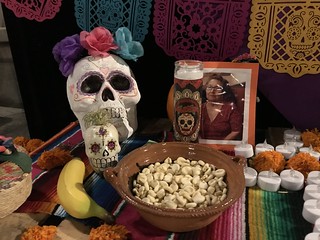
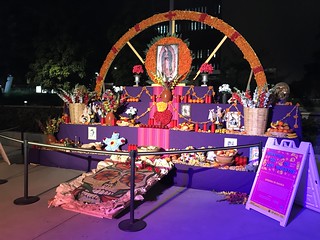
After dinner downtown, George and I wandered up to Grand Park where a Dia de los Muertos festival has been going on. The park is filled with offrendas, altars to departed loved ones piled with photographs, favorite foods, flowers, and memories. The first large, colorful one we came upon was by the local Oaxacan community. A few were personal, to a single person or family. But most of them were made by various civic groups, connecting specific remembrances to general themes, like one from a Latino LGBT group remembering those who had been ostracized by their family and had died way too young. Some extended the theme outside its original cultural roots, like one from a local group of Yemeni immigrants remembering their family members who have died back in war-torn Yemen. It reminded me a bit of the AIDS Quilt, in the power of a large scale built up out of particulars. So many photos of beloved grandparents or those cut off young, each with their own story. And it was also wonderful to see the people wandering the park engaging with these offrendas. Many of them were dressed up, in white skeleton faces, black dresses and suits, women with marigolds in their hair. I saw a father with a young son, the little boy in skeleton face and red hoodie, looking just like the kid from Coco, and the little boy was at an altar reading a placard with the story of the person pictured. It was so sweet. So glad that we came upon this. (View photo album.)

Samgyetang and Ai Weiwei

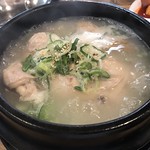
Today’s off-Friday explorations took me to Koreatown for lunch, and then to the Ai Weiwei: Zodiac exhibition at the new Jeffrey Deitch Gallery. In Koreatown, as I’ve learned, many of the really good places have one dish that they specialize in, and which may be all they offer. Today was one of those. Buil Samgye Tang (the signage was mostly in Korean) serves only samgye-tang, a chicken rice soup loaded up with all sorts of roots and herbs that are meant to cure colds and hangovers and assure good health. The basic model is a hot iron pot of boiling broth with a ginger-and-garlic-stuffed whole young chicken, rice, mung beans, jujube (a Korean date), and ginseng. The more deluxe versions add various other folk pharmaceuticals such as milk vetch (an herb) and ground deer antlers. A bowl of sea salt on the table allows you to season to taste. And as if a whole chicken rice pot isn’t enough, the meal comes with a traditional Korean plate of banchans to start – kim chee, pickled turnips, chicken gizzard bites, and crudites with a spicy-sweet soy paste. Ginger tea is served to wash it all down. The Korean staff were assiduously polite, with lots of smiling and bowing. 

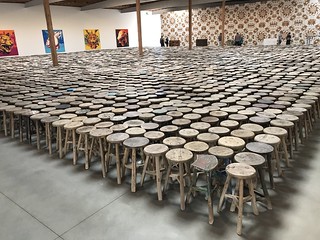
After lunch, I headed to the new Jeffrey Deitch Gallery in Hollywood. The gallery is in a former warehouse space that has been lightened up with paint and indirect natural light for optimal viewing in one very large space. Which is just what the featured Ai Weiwei work, Stools (2013), required. The work comprises nearly 3,000 wooden stools from the Ming and Qing dynasties collected from northern China. Most of the stools have the same basic three-legged design with a round seat, but every so often one varies in shape, design, or material. There are subtle differences in dimension, age, wear, and so on. The work fills an area 72-feet square. It gives the impression of a crowd where at first everyone in the crowd looks the same, but then you start to notice subtle differences. Its vastness invites you to engage with it from all sides, and to approach it at different levels, the pattern of its ordered arrangement creating all sorts of lines. It's surprising what a simple concept can do.
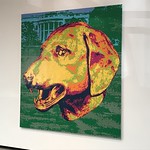
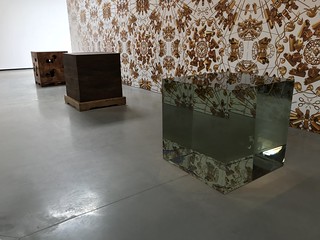
On two walls enclosing the stools are twelve very large works representing the twelve signs of the Chinese zodiac overlaid on world landmarks from major cities. These works read initially as paintings, but a closer examination reveals them to be constructed from LEGOs. One wonders if there is particular meaning in which animal overlays which city. The dragon overlays Beijing, with a small self-portrait of the artist worked in, swearing. A rather rabid looking dog overlays the White House. Hmm. On a third wall is a work entitled The Animal That Looks Like a Llama But is Really an Alpaca (2015), which is literally wallpaper. At first glance, it looks like classic French ormolu patterns, gilded objects in ornate designs. On closer inspection, one discovers that the objects are handcuffs and surveillance cameras, an ominous illustration of the artist's years of house arrest in his native China. Along this wall are five sculptural works, each a cube exactly one cubic meter in dimension, but each of different materials. Here Weiwei plays with the concept of a cubic meter, a standard measurement for shipping cargo, but each cube is of very different materials. One is wooden and forms an elaborate puzzle box. Another is a dark mass, which when you get close enough to see and smell it, turns out to be a huge block of tea. Another is perhaps the world's largest crystal, perfectly transparent, and bending light in all sorts of fun ways that beg for investigation. A solid white marble cube has brain coral-like carvings in it to give it texture. The fifth cube is a frame, made of exquisite blue-patterned porcelain. Near the front, Grapes (2017) takes a few more of those wooden stools, but reassembles them into an integrated spheroid, legs all radiating outward, looking almost like a creature that could start rolling. It's fascinating to look closely at how the stools were integrated, like a chain of Siamese twins, with the third leg of one being the first leg of another, and so on.

I was thrilled to enjoy these works of such a remarkable artist, and to enjoy them in an appropriately lit and capacious space, and frankly to have had the gallery nearly to myself for a time. Though I have to confess I'm still new to the private art gallery thing, and a bit intimidated. I mean, it's not a public museum, so isn't it really meant for people who might conceivably be thinking of purchasing thsee works? But in exhibitions like these, are the works even really on offer? I mean, some of them are monumental. If one is rich enough to buy something like Stools from a world-renowned artist, then I suppose one is rich enough to build a space to house it? Off to one side of the gallery entrance, there was a small desk where sat Jeffrey Deitch himself (I recognized the former MOCA director from photos in the LA Times) and a couple of assistants. I didn't approach them, and they didn't approach me. But at some point, I did notice that when certain other people entered, he would pop up and greet them. And at one point, I was close enough to overhear some conversation. They were breezily talking about who they'd met at Davos or the latest TED talk, or how they just had lunch with Frank Gehry. Deitch asked one woman if he had a current address for her. "Oh, well sometimes I'm in New York," she replied, "but sometimes I'm in the house in France, or in Switzerland. It's best just to mail me at the Foundation." Wow. Different circles than I'll ever run in. But I guess it's because of people like them that galleries like this can exist, and I can get to enjoy them.

Friday, October 19, 2018

Chichen Itza, King Tut, and PYT

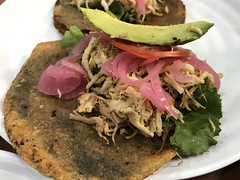
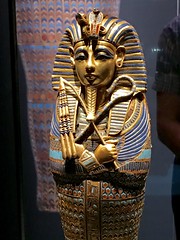
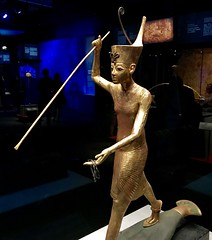
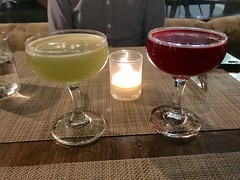
Another great "off Friday" exploring LA, today with the adding bonus of being joined by my husband who decided to take a day off. I introduced him to the Mercado La Paloma foodie food court by USC, where we lunched on a Yucatecan feast of panuchos, tacos de poc chuc and cochinita pibil. Then we wandered over to see the King Tut exhibit at the Calif Science Center. The exhibit features many great artifacts from the tomb, some of which have never before left Egypt. It is beautifully laid out, presenting the artifacts in the context of King Tut's journey through the underworld into the afterlife, the reason all these dazzling treasures were crafted and placed in his tomb. When the tomb was first being opened and Howard Carter first peered in, Lord Carnarvon eagerly asked, "do you see anything?" "Oh yes," he replied, "wonderful things!" We did indeed see wonderful things today. (The exhibit runs through Jan 6, so still time to catch it!) This evening, we went into DTLA for dinner at the vegetable-forward PYT. Even our cocktails featured veggies - a celery margarita and a bourbon with beet.
Wednesday, October 03, 2018

Why Kavanaugh Shouldn't Be Confirmed

I’d been wanting to write something about my take on the Kavanaugh hearings, but this thoughtful conservative in The Atlantic has gone and written my essay for me. Judicial temperament, credibility, the appropriate standards for the question before the Senate - he hits all the points I’ve been mulling.

Saturday, September 29, 2018

FILM: A Simple Favor

What a wild ride! A Simple Favor was fun, funny, clever, with good twists and turns, you just don’t really know who’s doing what to whom until the very end. Anna Kendrick is always good, but Blake Lively - wow! And Henry Golding, great performance hot on the heels of Crazy Rich Asians. Think Body Heat, Vertigo, or Double Indemnity for the vlog age.

Tuesday, September 11, 2018

STAGE: Love's Labour's Lost

Rounded out our Oregon Shakespeare Festival with a rollicking production of Love’s Labour’s Lost. We anticipated fun when we laid eyes on the eccentric set, and the show filled the promise. Who knew the Bard wrote a rock musical? The costumes were clever too, playing on the color imagery in the language, all white at first, increasingly splashed with tempera paints, then all red in Act IV, and all black at the end. A fair amount of ad libbing suits this play, including a bit with a smartphone. Such good fun!

FOOD: Coquina (Ashland OR)

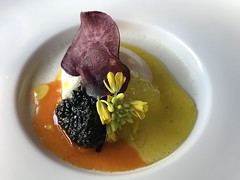
Another extraordinary dinner in Ashland. Everything was plated like artworks and such innovative dishes of seasonal local ingredients. Started with a fennel custard with wild sturgeon roe, quark (a fresh yogurt cheese), Pernod gelée, beet chips, arugula blossoms, and crispy shallots. A simple chilled artichoke soup with crème fraîche and artichoke chips was silky smooth and full of flavor. Burrata was served with slow-roasted tomatoes and prosciutto with aged balsamic. Our main was a sous vide duck breast with figs, baby potatoes, beech cap mushrooms, pickled ramps (no doubt house-pickled from the spring), with three different puddles of flavor, including a foie/olive purée, a balsamic vinaigrette, and a mustard seed gastrique. Our desserts were a cynar panna cotta with candied artichokes and caramel hazelnuts, and a chocolate truffle tort with cherries and raspberries. (You wouldn’t expect artichoke and cynar - an Italian herbal/artichoke aperitif - to be good in a dessert, but candied and with vanilla, it was an unexpected delight.) This was all complimented with local wines from Goldback, a Grenache rosé and a Rhône blend Cuvée. (We are lightweight drinkers, good for one glass each, and they were lovely to suggest that we could split glasses, so we could have a bit of rosé with the appetizers and the heavier red with our main.)

Sunday, September 09, 2018

STAGE: Romeo and Juliet (OSF)

Just back from a marvelous production of Romeo and Juliet at the Oregon Shakespeare Festival’s Elizabethan Theatre. Very well acted, beautifully staged. That beautiful language, and so heartbreaking no matter how many times you see it. "My bounty is as boundless as the sea, my love as deep, for both are infinite."

Saturday, September 08, 2018

FOOD: Amuse (Ashland OR)

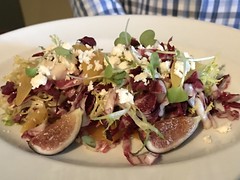
Fantastic first dinner in Ashland at Amuse, a French-inspired bistro featuring local ingredients. Started with an amuse of beet “caviar” on crostini with fresh tarragon. The bread service (including nice gluten-free crackers for George) came with thyme butter and a tasty pepperade of cured peppers, onions, fennel. I started with a carrot soup with cumin and coriander, while G had a beet salad with goat cheese and figs. I had a succulent roast game hen in truffle butter with pole beans and Tokyo turnips, while G had a wild mushroom risotto with zucchini and arugula pesto. They had some really good southern Oregon wines. My Upper Five “Oso Grande” was a Grenache/Syrah /Tempranillo blend, a nice compliment to the truffles, while G had a lovely roussanne/ marsanne/ viognier. (Didn’t hurt that they served in appropriate Riedel crystal glasses.) For dessert, I took the pavlova with fresh blue and blackberries from a local farm, while G had a caramel pot de crème. And the check came with figs in ganache as a mignardise. Quite impressed with this place!

Friday, September 07, 2018

BOOKS: Interpreter of Maladies

Jhumpa Lahiri’s “Interpreter of Maladies” is a charming collection of short stories, some set in her ancestral Bengal region of India, but more often about Bengali immigrants in North America. (Some will recognize her as the author of “The Namesake”, which was also made into a movie.) Her stories often keenly illustrate the tensions of people who have one foot in the old world and one foot in the new, or those between generations of immigrants. Typically the story is told from the perspective of a particular character, and in several, that character is a child. She has a lovely skill of capturing a child’s observations of adult relationships around them. In other stories, characters implicitly wrestle with the meaning of marriage. The nine stories are all very well told, with thoughtfully developed characters, and an enjoyable read.

Saturday, September 01, 2018

FILM: Crazy Rich Asians

What a pleasure to see Crazy Rich Asians. Not only a charming rom com with very likeable attractive leads, some interesting complications, good side characters, and plenty of laughs, tears, and heart-warming scenes, plus the bonus of some good food porn, travel porn, and fashion porn, but on top of all that you get some thoughtful glimpses of tensions between immigrant generations, between old world values and American values, between love and family, between sacrifice and self-fulfillment. Constance Wu is spot on as the Rachel, the heroine, a Chinese-American economics professor at NYU, smart, down to earth, and mostly confident though that is tested. Newcomer Henry Golding is perfectly handsome and charming as Rachel’s boyfriend Nick. Michelle Yeoh is flawless as Nick’s fierce tiger mother, with a nuanced performance that conveys so much with just a look. This film has layers, including nuances of Asian culture that are not elaborated, but add richness to those who will pick up on them. There’s a pivotal scene toward the end of the movie where the heroine confronts her boyfriend’s mother over a game of mahjong. I was very curious about the deeper symbolism that I suspected lay in those tiles and how the mahjong game unfolds. Gotta love the Internet -- I found a great blog post (caution: heavy spoilers!) that explains it, and it does enrich an already wonderful story.