Saturday, March 17, 2018
FILM: Love, Simon


Friday, March 09, 2018
ExploreLA: Korean Tofu Soup and the Marciano Art Foundation
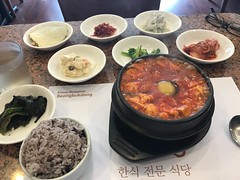
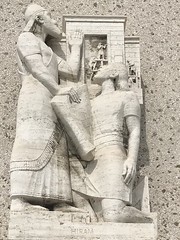
After lunch in Koreatown, today’s off-Friday adventure took me to check out the new Marciano Art Foundation on Wilshire. Maurice and Paul Marciano, the brothers who founded the Guess clothing business, were avid supporters of the contemporary art scene in Los Angeles, and wanted to share their collection with the public. They bought the old Scottish Rite Masonic Temple on Wilshire, which was basically abandoned since 1994, and have repurposed it as a modern art museum while preserving features of the historic building. Before going inside, I wandered around the outside of the building, a mostly windowless giant travertine box adorned with enough mysterious Masonic symbology to inspire Dan Brown’s next Robert Langdon novel. A series of monumental travertine sculptures depict a curiously diverse set of figures including Imhotep, Zerubabel, Hiram, the “Saints John”, someone “de Reims”, Christopher Wren, and George Washington. A giant mosaic mural depicts the history of temple building, with an equally curious selection of cities starting with Jerusalem, Babylon, Acre, and Rome, and ending with Boston and Sacramento. (Sacramento? Apparently the first Grand Lodge in California was established there in 1850.) The building was constructed in 1961, designed by artist and architect (and Mason) Millard Sheets, who was famous for his mosaic murals including many Home Savings bank buildings throughout southern California.
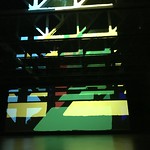
Inside the building, the many large spaces of the old temple have been nicely repurposed for display of the Marcianos’ collection and other exhibitions, many of which are quite large and need this kind of space. On the first floor, the cavernous hall that used to be the theater has been given over to a special exhibition called Reality Projector. Artist Olafur Eliasson designed this dynamic work specifically for this space. The vast three-story hall is empty like a warehouse, with concrete floors and exposed steel rafters, and is dark when you enter, illuminated only by the projection of abstract shapes in primary colors on the far wall. The shapes slowly move across the wall, intersecting each other in a way that gives depth in the sense that some shapes seem to be in front of or behind others, and the shapes are transiently obscured by large moving shadows. The projected light intentionally hits the exposed rafters as well, using them as a fragmented, layered screen. You’re invited to sit on a bench in the back of the room, or wander into the middle, or just drop down on the concrete and sit or lie down and watch this oddly fascinating light show pass by, like clouds on a windy day, if the clouds were painted by Ellsworth Kelly or Piet Mondrian. All of this is accompanied by a soundtrack of indistinct ambient noises and sounds. The combinations of shapes and colors seemed random and non-repeating, and I actually stayed in there a fair while, and revisited later on an upper mezzanine overlook.
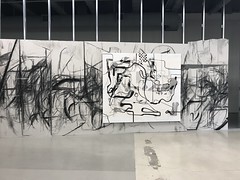
On the second floor is another special exhibition called “Line Packers”, featuring the work of two German artists, Peppi Botrop (1986-) and Albert Oehlen (1954-). Botrop, who hails from the Ruhr region of Germany (picture an old coal and steel industrial area, something like the German equivalent of Allentown, Pennsylvania), made a series of works alluding to those roots, using large slabs of Fermacell (an industrial material used like sheetrock in institutional buildings), charcoal to make dark visceral lines, and then carving and scraping the sheetrock. Oehlen, beginning in 1992, created a series of works exploring the possibilities of computer drawing, with sheets of black on white graphics printed from a Texas Instruments computer, lightly enhanced with black paint. Multi-artist exhibitions will often talk about the “dialog” between works of different artists exhibited adjacent to each other. But here, they’ve done something I’d never seen before: they created an actual mash-up of these two artists’ works, displaying them on top of each other, in a way that invites not only comparison but a contemplation of relationship and visual continuity between these two artists of different generations.
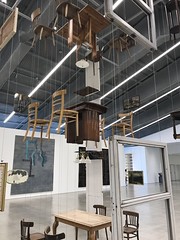
On the third floor is the permanent collection of the Marciano Foundation, mostly paintings with a few sculptures, with a large well-lit space suiting the large scale of most of the works. Many of the works are quite abstract, explorations of texture as much as color and shape. One artist, Jennifer Guidi, has a series made of paint mixed with sand that she could layer on the canvas thickly, and then poke, scrape, and mound up in interesting ways. The sort of works that you want to regard from a distance for their visual impression, and then look at up close and from the side to admire the technique. Then there are other works that are a bit more representational, or at least symbolic. Two giant works by Lari Pittman are filled with bold colors and a fascinating medley of recognizable forms and really good Rorschach tests that made me want to figure out what all is going on in them. Another large mural by George Condo seems at first just to be a bunch of lines, until as you look, more and more organic shapes – eyes, teeth, arms, coats and ties – begin to emerge from the apparent chaos. Perhaps my favorite work was a large sculpture in the center of the large main gallery that was essentially a bunch of furniture and home goods suspended in air by wires. The playful Architecture Without Architects by Damián Ortega is like a CAT scan of a multistory apartment building. Imagine three apartments, one above the other, with all of the walls, floors, and ceilings removed, but all of the furniture, lights, and stuff magically floating in place. Doors float without their door frames, with doormats floating in front of them, and perhaps a pair of shoes on a mat. Paintings float as if hung on invisible walls. Flowers in vases, glasses of water, and cigarettes in ashtrays rest on tables floating in space. I found it amusing and fascinating.
The mezzanine, between the ground and “second” floor, is also worth a stop. That’s where I found the balcony overlook for a second look with a new perspective at the Reality Projector light show. There’s also a fun mural along all four sides of the atrium lobby by Alex Israel, celebrating the streets and sidewalks of Los Angeles, with all sorts of native plants befitting an atrium, but also parking meters, newsstands, street signs, and other urban ephemera. It’s charming. The other thing worth a peek on this level is the library, where they have a bunch of artifacts from the Masonic temple on display, including the funny hats, costumes, and more mysterious symbology.
This exciting new addition to the LA art museum scene is open Wed-Sun. Admission is free and the parking is free too (check that out, Getty Foundation!), but you should reserve a timeslot by getting a free ticket on their website. Line Packers is on display through June, and Reality Projector through August. Check it out! (See full album of photos here.)
Saturday, February 24, 2018
ExploreLA: Myung In Dumplings and Robert Irwin at the Sprüth Magers Gallery
Fun off-Friday explorations. Lunch of Korean dumplings at Myung In in K'town. A variety of delicious steamed and fried dumplings, and those "wang mandoo" gigantic soft doughy bao stuffed with ground pork, shrimp, and veggies! Then wandered down to Mumu Bakery, where they make these filled brioche -- fresh and warm, sweet and flaky, filled with cream cheese or red bean or nutella or apple-mango. Then for some art, we headed to the Sprüth Magers Gallery in mid-Wilshire, where a Robert Irwin installation has taken over the whole place. They knocked out interior walls, opened up exterior windows, and put in these white scrims with black boxes. This simple device has a fascinating effect that just makes you want to walk all around and view it from all different angles just to see how the translucent boxes juxtapose in different ways.


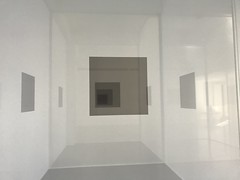 See complete photo album here.
Friday, February 09, 2018
ExploreLA: An Afternoon In India (via Chino Hills and Artesia)
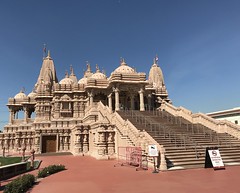
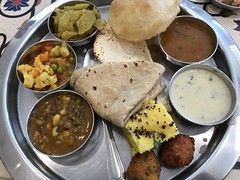
After exploring the temple, I drove to the "Little India" neighborhood of Artesia to have lunch at Rajdhani, a place known for thali, which is like the Gujarati version of dim sum. Thali is literally the word for the metal tray with little metal bowls that servers come around and endlessly fill with soups and stews and breads and rice. There was a spicy lentil curry soup with peanuts, a yogurt soup with herbs, fried green mango, cauliflower and peas, beans. All veg of course. And breads to soak it all up - puffy fried puris and flat rotis. After lunch I wandered the neighborhood to check out the shops with saris and other fashions, “cash and carry” markets with exotic produce, spices, and all sorts of stuff. So awesome to go to India for a day. I love LA.
(See complete photo album here.)
Friday, February 02, 2018
Why I'm Captivated by Romil and Jugal

Wednesday, January 24, 2018
TV: Romil and Jugal

(Update: After watching 9 episodes without translation, I discovered there's an option for English captions by hitting a button on the lower right corner of the browser.)
Friday, January 19, 2018
Nobody Knows The Day Or The Hour
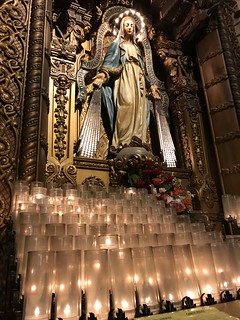
ExploreLA: Holbox and St. Vincent de Paul

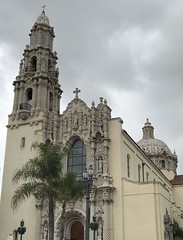
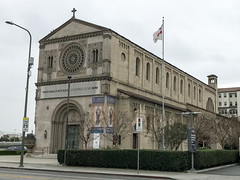
After spending time appreciating the beauty of this sacred space, I wandered just a block up Adams to see how St. John's, the Episcopal Cathedral of Los Angeles, would compare. Also built in 1925, and also grand in its way, though more restrained in its Romanesque Revival style. Its basic structure is more rectangular and austere, though it has some lovely ornamentation etched into its stone. A banner declares it a "house of prayer for all people", though apparently not at all days or hours, as, unlike the Catholic church, it did not appear to be open on a Friday afternoon. I'll have to find another time to discover what the interior looks like.
(See full album of photos from this day.)
Saturday, January 06, 2018
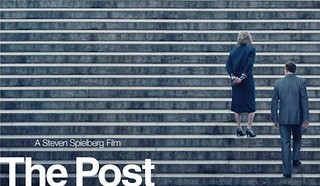
FILM: The Post
Saturday, December 16, 2017
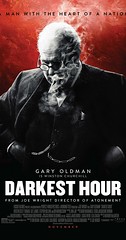
FILM: Darkest Hour
Tuesday, November 28, 2017
FILM: Call Me By Your Name

Saturday, November 11, 2017
FILM: God's Own Country

Saturday, August 19, 2017
About those Confederate monuments

Let's be frank. Those monuments are not about honoring a valorous general, and they're certainly not about his honorable post-war deeds. Most (not all, but most) of those monuments were erected during the Jim Crow era as a way to send a message to southern blacks to know their place. At the same time, reverence for a Confederate battle flag was invented as a more genteel daytime cloak for those who wear sheets and robes at night. And the monuments are just a coded form of a burning cross with the plausible deniability of “heritage”. People have varying degrees of conscious complicity in this, but this form of “Southern pride” is at best a kind of collective willful amnesia about the ugly message being sent here. Look too closely through the veneer of nostalgia, and at its most charitable interpretation the message is “we liked it better before the war, and we wish we could go back to that”. Think it through, and it's hard to avoid the implication: “unchained blacks have no place here”.
Those who think it's really more innocent than that need to ask themselves a number of questions. If this is not about valorizing the Confederacy itself, why all the monuments to Jefferson Davis, the not particularly competent president of the Confederacy? Or Roger Taney, the Supreme Court Justice who gave us the ignoble Dred Scott decision? General Lee may be statue-worthy, but what's up with those guys? Why were so many of these monuments erected in the 1910s, 20s, 30s, and even the 1950s? What do you suppose it really meant to erect such monuments in the 1950s? And why statues for every general and colonel in the Civil War? Is there a reason those men should be honored way more than southern generals in other wars? Why are there overwhelmingly more statues of Lee than there are of Admiral Nimitz or Black Jack Pershing, both southerners? And if it's about the singular importance of the Civil War in our history, why are there way more statues of Lee than there are of Grant in the north? And if it's about “southern pride”, then why aren't southerners anywhere near as proud of their great explorers (Lewis and Clark), authors (Faulkner, Harper Lee, Tennessee Williams), inventors and scientists (George Washington Carver, McCormick Bros, Michael DeBakey), and other honor-worthy people (Helen Keller, Chuck Yeager)? There is clearly a peculiar fixation on Confederate leaders that is not just about “history” and “heritage”. We need to call this out for what it is.
When Hungary finally broke free of Communism, Budapest was adorned with monumental statues of Lenin, Marx, and other Communist heroes. They rightly wanted no longer to give those a place of honor in their city, so they built a place called Memento Park on the outskirts of town, where all of these old Communist monuments are on display in a kind of outdoor museum, where that part of their history can be preserved, but with the proper detachment and no inappropriate place of honor. That's what we need to do with all of this Jim Crow era “heritage”. Segregated water fountains are part of that same heritage too, and a few of those should be preserved as well, in museums, for history sake. Confederate flags and Confederate monuments should be viewed no differently than segregated water fountains.
Meanwhile, we need a reboot, “Southern Pride 2.0”. There is much worth honoring that has come from the South (see list above of statue-worthy Southerners, of which that is only a start). Let's honor that, and ditch this disingenuous nostalgia for a “peculiar institution”.
Sunday, April 16, 2017
Remembering Fred Borsch
I was saddened to read of the passing of Fred Borsch, whose mark left on the world is beautifully described in this LA Times obituary. I loved the story of him bringing the Archbishop of Canterbury into one of LA's sketchiest neighborhoods to give him a new perspective. I was acquainted with Rev. Borsch at Princeton, where he was the Dean of the Chapel when I studied there in the early 1980s, and his son Ben was a classmate. He was a kind, gentle-spoken man who did indeed ask people to call him Fred. If you picture someone like Father Mulcahy on the old MASH TV series, you wouldn't be far off. But I think he made a mark wherever he went. I will always be grateful that, under the sponsorship of the Borsch's Office of the Chapel, a space in the basement of Murray-Dodge Hall was set up to create a café, where tea and fresh baked goods and occasional live music were on offer, but more importantly, an alternative social space for people who for various reasons didn't entirely fit into Princeton's regular social scene. That doesn't sound like any big thing today, but it's hard to project ourselves back to a time before there was any Starbucks, before there was a ubiquitous Internet, and before Princeton had a Gay and Lesbian Center (actually before Princeton even had a real student center at all). Back then, that café was a haven for, among others, a whole circle of students tiptoeing to terms with their homosexuality. It was quietly subversive and essential. And looking back, I think that Borsch probably understood that even better than I did at the time.
Flash forward 20 years to 2001, and I just missed meeting Borsch again, although I discovered his handprints when I moved to Echo Park, a now trendy but then rather edgy barrio near downtown Los Angeles. As an Angeleno, I had been well aware of the construction in the 1990s of the controversial Catholic Cathedral of Our Lady of the Angels downtown, a dramatic modernist architectural landmark. But it wasn't until I moved to Echo Park that I became aware of the Episcopal Cathedral Center of St. Paul, also constructed in the 1990s, a modest set of buildings that wouldn't draw particular attention to drivers-by let alone international tourists. I think the Catholic and the Episcopal churches both have strong traditions of "high church" majesty as well as social justice. But I find it emblematic that while then-Archbishop (now Cardinal) Mahoney was building his grand edifice on the hill downtown, Archbishop Borsch was rolling up his shirtsleeves and getting to work in the barrio. I've been to services in both places, and there's no question which one feels more warm and welcoming to me.
The world is a notably better place for Fred Borsch having been in it.
Sunday, February 19, 2017
This Is Not Fake News, The President Really Did This, And It's Outrageous
This is NOT fake news, it really happened, and it is appalling. The President has signed several acts into law. One of them, recognizing that immigrant citizens more often vote for the opposition party, makes it much more difficult to become naturalized. Another, aimed at the potential danger posed by immigrants, gives the President sweeping power to incarcerate or deport any non-citizen that the President deems "dangerous to the peace and safety of the United States". The last and most alarming one curtails the rights of American citizens by prohibiting assembly "of the people with any intent to oppose any measure or measures of the government of the United States" and making it a crime to "write, print, utter, or publish" any "false, scandalous and malicious writing or writings against the Government of the United States". That last law, which makes criticizing the government a crime punishable by fines and jail time, was written to be used against the press, which the President has declared to be the "enemy of the American people".
This is not fake news, it is real. Real history. The president who signed these laws was John Adams, and this actually happened in 1798. But the parallels to today are both frightening and instructive. The Federalists (the conservative party of their day, lead by Hamilton) were in control of Congress, and the Democratic-Republicans (the party of Jefferson and later Jackson) were on the outs. Adams was despised by Jefferson's party, and had an uneasy relationship with his own party from whom he was independent and considered a bit unpredictable. Newspapers were highly politicized, with right-wing news and left-wing news furiously putting their spin on events, and there was a fair amount of "fake news" flying around. Politicians considered newspapers to be patriots or traitors, depending on which politician and which newspaper. The Federalists were pushing for war with France, seeing the French Revolution as a sheer terror, while the Democratic-Republicans saw the French Revolution as the people rightfully rising up to overthrow a tyrannical aristocracy and monarchy. There was a great fear of immigrants from France in America, and the influence they could have on our own young country. It was in this context that the infamous Alien and Sedition Acts came into being. Under the Sedition Act, a number of prominent left-wing publishers and even one Congressman were fined and jailed. (Alas, the notion of going to court to challenge the constitutionality of a law hadn't yet been invented.)
The Sedition Act had a sunset clause and was allowed to expire in 1800. However, in the fever pitch of World War I, another Sedition Act was made law in 1918, making it a crime to use any "disloyal, profane, scurrilous, or abusive language" about the US Government, its flag, or its armed forces. The act was used against a number of party leaders and labor leaders before it was repealed in 1920. One piece of the 1798 legislation, the Alien Enemies Act, still remains on the books today. This was used as the basis of authority for the notorious Executive Order 9066 in 1942, ordering the internment of Japanese-American citizens. (That happened 75 years ago today.)
The original Alien and Sedition Acts and their subsequent reincarnations are generally considered shameful black marks in our history, overreactions to fear. It should be clear to any good student of history that we are on this same path yet again.
Tuesday, February 14, 2017
Keeping Terrorism In Perspective
It is our human nature to be poor judges of relative risk. Something in our instinct gives way too much signficance to rare extraordinary events. We have all met people who are afraid of air travel, terrified at the prospect of a plane crash. This is a sympathetic but completely irrational fear. The odds of dying in a plane crash are vanishingly small. In 2013, 3 billion passengers flew in planes and 210 people died in plane crashes. Fewer people die in plane crashes than are struck by lightning. In contrast, over a million people died in motor vehicle accidents. And ironically, nearly all of those afraid of flying don't think twice about getting into a car. It is a quirk of our brains that our "gut reaction" to the relative danger of flying versus driving is wildly out of proportion. The same is true for our gut reaction to terrorism. Since 9/11, terrorism has claimed the lives of an average of 18 Americans per year. While each and every death is regretable, when making public policy, it is imperative to keep things in proper perspective. Death by terrorist attack is significantly less likely than being killed by lightning strike, and as has been wryly observed, more Americans are killed by toddlers with firearms than are killed by terrorists. While we need to take the threat of terrorism seriously, we also need to avoid the trap of being overtaken by fear. Indeed, stoking our fear is the goal of terrorists, and ultimately their most powerful weapon. If the terrorists inspire us to incur undue costs, burdens, and limitations, then they will have won.

I am not advocating that we abandon counterterrorism measures altogether. But I do advocate two things: First, let's take a deep breath and keep terrorism in perspective, and second, when we do address terrorism, let us assess the effectiveness and the cost/benefit of the measures we take. For keeping proper perspective, we should keep in front of us the relative risk of what we are addressing. Consider: 18 Americans die per year on average due to terrorism, while 990 Americans were shot by police officers in 2015. About 1100 Americans die from extreme heat or cold each year, over 11,000 Americans were killed by firearms (not counting suicides, which add about twice as many more), 147,000 Americans died of chronic lower respiratory disease (mostly tobacco-related), an estimated 250,000 Americans died from medical errors, and over 600,000 Americans died of heart disease. While mortality is not the only dimension that should be considered, these proportions are worth keeping in mind when we make policy decisions about how much money our nation should spend addressing each problem.
We need to be asking questions such as "is it worthwhile to spend $1.2 billion per year to operate body scanners at airports?" A 2011 assessment of risks, benefits, and costs of homeland security measures published in the journal Homeland Security Affairs argued that "a great deal of money appears to have been misspent and would have been far more productive—saved far more lives—if it had been expended in other ways." What's worse, they note that some counterterrorism measures may actually claim more lives than they save: "Increased delays and added costs at U.S. airports due to new security procedures provide incentive for many short-haul passengers to drive to their destination rather than flying, and, since driving is far riskier than air travel, the extra automobile traffic generated has been estimated to result in 500 or more extra road fatalities per year." Fifteen years after 9/11, we need to take a hard look at risks, costs, and benefits.
When we do decide to invest in counterterrorism measures, it is important that we look to the data to guide rational decisions about which measures to take. At the moment, focus on radical Islam is sucking up all the oxygen in the room. But is that even the right focus? In the 15 years since 9/11, America has suffered 277 killings from 120 extremist events. The majority of those deaths (158 / 57%) and events (89 / 74%) were perpetrated not by Islamist extremists, but by far right extremists, like the Charleston church massacre, the Wisconsin Sikh temple shooting, and the Colorado Springs Planned Parenthood shooting. Why doesn't the White House give us a list of those events? Even if we think that jihadist terrorism deserves special importance, why scapegoat immigrants? If we look at all of those who committed domestic jihadist terrorist acts since 9/11, the vast majority (84%) were US citizens or permanent residents, with the majority of them being native born citizens. And if you look at those who actually committed deadly attacks, they were entirely US citizens or permanent residents, not a single refugee among them. Even if you look to the countries where these terrorists' parents came from, you don't find the "usual suspects". As has been widely noted, not a single deadly attacker since 9/11 has come (or even had their parents come) from any of the seven countries targeted by the recent executive order. Looking at the data, it's hard not to conclude that the executive order is utterly misguided pandering to fear. What's worse is that the scapegoating of immigrant communities will actually hinder our ability to prevent attacks in the future. The most successful prevention of jihadist attacks has proceeded from intelligence provided by informants in ethnic communities who share the language and the culture and are in the best position to provide valuable information. If we continue on a path of baseless demonizing of immigrants and Muslims, we will alienate the trust and good will of the people we need most to help keep us safe.
As a school boy I first learned the famous FDR saying "the only thing we have to fear is fear itself", but it is only in the past year that I have truly come to appreciate what he meant. Our nation is at a crucial juncture where we must decide whether we will be a nation of facts or a nation of fear. Our finest leaders have always been the ones who have appealed to our highest ideals, not those who appeal to our basest instincts. Osama bin Laden's goal with the 9/11 attacks was to inspire such fear in the American people that we would bankrupt ourselves in expensive and productivity-choking extraordinary measures, and that fear would drive us to surrender our freedoms for "security", and to abandon our prosperity by retreating behind walls. After 15 years and bin Laden's death, for the first time I worry that he may yet succeed.
Tuesday, January 24, 2017
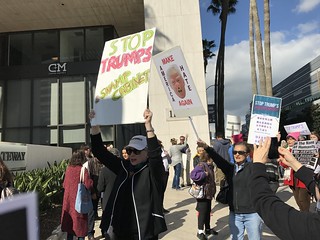
Action Report: Stop Trump's #SwampCabinet Rally
Sunday, January 22, 2017
ACA: The Dog Caught The Car
Like a dog chasing a car, the GOP has been barking about repeal of the Affordable Care Act (ACA, or "ObamaCare") for years, but now that the dog has caught the car, the Republicans have no idea what to do. They don't know how to repeal the ACA, and moreover, they don't even really know why they want to repeal the ACA. Do they want to go back to allowing insurance companies to deny coverage for pre-existing conditions? Or do they want to go back to allowing insurance companies to have lifetime caps? ("Sorry you need that life-saving medicine, but you've hit a lifetime cap so we're not going to pay for it anymore.") Maybe it's the part about allowing parents to cover their children up to age 26 that they want to eliminate? Or maybe they want to go back to the Medicare "donut hole", so that seniors might be on the hook for thousands of dollars in medication costs? Do they hate that more than 20 million people who previously couldn't obtain insurance now have coverage? Or that states are saving hundreds of millions of dollars in uncompensated care because fewer uninsured people are using emergency rooms as last resorts? Maybe they don't like the primary care coverage, which helps reduce costs in the long run? Or maybe they don't like the mental health and substance abuse treatment coverage, that allows people to get into rehab programs rather than just showing up at the hospital when they overdose. (And note to the smug morally superior folks who might think substance abuse is a problem for "those other people": google "opioid epidemic".) Pretty much every feature of ObamaCare is popular when people are surveyed about it. When it comes down to it, the only thing people truly hate about ObamaCare is the name. Here's a pro tip for members of Congress: Americans don't really hate ObamaCare, what they really hate is disruption in their health care. If over 20 million people lose their insurance because the ACA is repealed, and if millions more lose benefits they currently have from the ACA, those people are going to blame this Congress. You break it, you own it.
Friday, January 20, 2017
Highlights of President Trump's Inaugural Address (Annotated)
- "The wealth of our middle class has been ripped from their homes and then redistributed across the entire world" (by my Treasury nominee)
- "Americans want great schools for their children" (but my Sec Education nominee will dismantle them)
- "Every decision ... will be made to benefit American workers and American families" (as my Sec Labor nominee takes away worker protections)
- "there is no room for prejudice" (so my Attorney General will make sure that minorities access to vote is unprotected)
- "We will seek friendship and goodwill with the nations of the world" (well Russia anyway; China, Europe, and others not so much)
- "Protection will lead to great prosperity and strength" (because tariffs worked out so well in the 1930s)
- "our government is controlled by the people" (by a minority of people in carefully gerrymandered districts)
- "And now we are looking only to the future" (but willfully ignoring the environmental cataclism predicted by our scientists)
- "Every decision on foreign affairs will be made to benefit American workers and families" (but my Sec State will focus on benefit to Exxon)
- "We stand at the birth of a new millennium, ready to harness the energies, industries and technologies of tomorrow" (like coal, Arctic oil)
- "there was little to celebrate for struggling families all across our land" (so my 1st act: raise mortgage costs for struggling families)
Wednesday, January 18, 2017
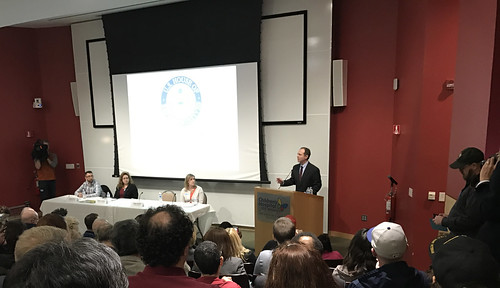
Action Report: Congressman Schiff Forum on ACA
Subscribe to:
Posts (Atom)