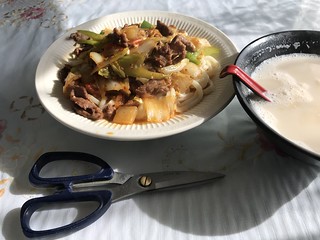
Xinjiang, which literally means “new frontier”, is an autonomous province in the far northwest of China, along the Silk Road, the center of waves of cross-cultural pollination from Persia, Mongolia, Turkic tribes, and the neighboring ‘Stans. One of the main ethnic groups there are the Uyghurs, an Islamic people. This being LA, its own cultural cross-roads, of course there’s a restaurant for Halal Uyghur food. And of course I heard about it on KCRW's Good Food show. So I went to check it out. Delicious! I went for the “lag man”, thick hand-rolled noodles served in a hot broth with celery, peppers, and slices of lamb redolent with cumin and chili (modest heat but not tongue-scorching). The noodles are soft and chewy, thick enough that the bowl comes with shears to tame them. For traditional beverage, I took the milk tea, which comes served in a bowl with ladle-like spoon. It was like a really good chai, but with a distinctive hit of salt. A unique blend of broth and tea. For dessert, there’s a house made yogurt which was lovely, naturally sweet from the milk and without a strong fermentation tartness. I want to come back and try more! As an added bonus, while I was eating, who else came in but Evan Kleiman with her KCRW show team including Nick Liao and Abbie Fentress Swanson who produced the Uyghur segment. I was a bit starstruck, but said a quick hello and thanks - so cool to meet them!
Thursday, December 27, 2018
Sunday, December 16, 2018
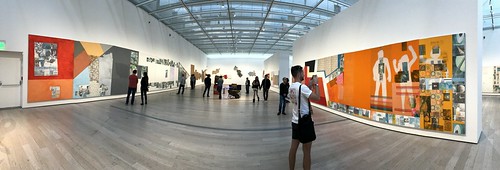
ART: Rauschenberg's 1/4 Mile
A visiting friend provided a great excuse to check out Robert Rauschenberg's "The 1/4 Mile or 2 Furlongs" at LACMA. Rauschenberg was a renowned late 20th century American artist whose work was exemplified by assemblage of photographs, printed matter, and found objects, combined with overpainting. "The 1/4 Mile or 2 Furlongs" is a single work comprising 190 panels, plus some sculptural objects and some audio tracks, which if laid out linearly would actually be almost 1/4 mile long. The work grew over the course of 17 years (1981-1998) and is kind of a self-contained retrospective of the artist's career, with references to many of his other major works and showing an evolution of styles and phases, a creative array of visual stimulation running the gamut from murky to boldly colorful, and from purely abstract geometrics to human and natural forms. It was intriguing to contemplate the variety of colors and forms in the various panels and other bits and pieces, and also intriguing to think of it as one huge work rather than 200 individual works, and just how that makes you view it differently. I found myself thinking more about order, relationship, and juxtaposition as we wandered through it.
Saturday, November 24, 2018
FILM: The Favourite
What a sassy, saucy period drama about two clever strong-willed women who contested the position of the Queen’s favorite. While men may have thought they were pushing the women around, it was these women who ruled England. Creatively based on a real historical rivalry, The Favourite provides intrigue worthy of Game of Thrones (and protagonists every bit as formidable as Daenerys and Cirsei), but also tempered with a wry sense of humor at times. Rachel Weisz and Emma Stone are both breathtaking in their performances of these incisively-written characters, complimented by Olivia Colman’s fragile, mercurial Queen Anne. The visuals are lush of the Jacobean opulence, while reminding you that even the most powerful were never too far from the mud, and the sanitation and medicine were more medieval than modern. The direction, along with an intense soundtrack (sometimes more sounds than music), was impressive and made for some memorable scenes. The rivals’ conversations over pigeon-shooting had subtext you could cut with a knife, and the scene of Emma Stone’s honeymoon night is startingly funny. The ending was unexpected (compounded by my knowing just enough of the actual history to be confused), but the sort that forces you to go back and rethink what you thought about all of the characters. As in Game of Thrones, there is unexpected nuance to all of them, and even those who may seem black-or-white are grayer than you first think.
Monday, November 12, 2018
BOOKS: Letter To My Palestinian Neighbor
Yossi Klein Halevi’s “Letters To My Palestinian Neighbor” is an extremely thoughtful and personal plea for dialogue from an Israeli Jew wanting to reach out to his Palestinian neighbors. Halevi lives on a hill in Jerusalem with a view from his apartment to another hill across the way where Palestinians live, a very short distance away as the land lies, yet vastly separated by politics, not to mention a physical wall. He imagines a neighbor on that other hill, and what he would like to tell him about his own life and beliefs. Halevi is a religious Jew and devoted to Israel, but also very open-hearted towards the Palestinians, among whom he had traveled and made some friendships in the years before it became no longer possible for a Jew to travel safely in the West Bank. He has written other books about those travels, but in this book, he starts from the premise that any hope for reaching a common understanding has to begin with hearing each other’s stories and really understanding where the other is coming from. This book is his attempt to start that conversation, articulating in a very personal and sensitive way the Jewish Israeli perspective, including some great insights on the Jewish connection to the land of Israel, the sense of being a distinct Jewish people, and the tensions inherent in a Jewish democratic state. Many of his letters are written on a particular holiday, and begin with his observations on that holiday. He does an amazing job of staking out his positions in a way that is very honest, personal, and non-confrontational, always keeping in mind a respect for the Palestinian he is addressing. Even though these letters are not written to a specific known person, his device is to imagine a specific hypothetical neighbor on that other hill, and to address that neighbor personally, one on one, rather than being more generic. The device works well, I think, to keep his letters very personal and heartfelt. I learned a lot from this book, both about Judaism and about Israeli politics. While the situation remains grave, the fact that there are Israelis like Yossi Klein Halevi strengthens my hope for a path forward.
Saturday, November 10, 2018
FILM: Boy Erased
Boy Erased is a well done film, tightly written, with strong performances from its leads, particularly Lucas Hedges as a 19-year old Baptist preacher’s son in small town Arkansas who attempts a Christian ex-gay conversion therapy program. It’s hardly a spoiler alert to say that the program doesn’t work, but the core of the film is showing what actually goes on inside those soul-sucking places, interspersed with flashbacks of experiences that lead him there. While it could have easily slid into tendentious exposé, this film avoids that danger by presenting its characters with complexity. The boy goes into the program willingly, wanting to change, and his parents are not monsters, but loving parents who want the best for him. The evolution of their family dynamic provides the emotional frame to drive the storyline. The other participants in the program also provide a thoughtful variety of attitudes and reactions. Parts of this film are horrifying to watch (and could well be triggering for anyone who’s actually been subjected to these programs), but it’s ultimately satisfying and leaves you with hope that even LGBT kids from fundamentalist families in small-town Arkansas can turn out all right.
Saturday, November 03, 2018
Friday, November 02, 2018
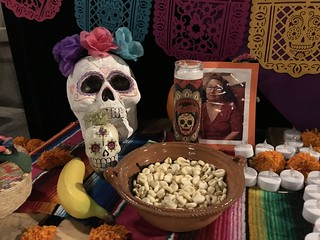
Dia de los Muertos Festival in Grand Park DTLA
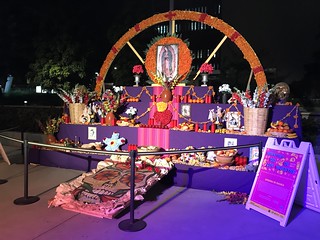
After dinner downtown, George and I wandered up to Grand Park where a Dia de los Muertos festival has been going on. The park is filled with offrendas, altars to departed loved ones piled with photographs, favorite foods, flowers, and memories. The first large, colorful one we came upon was by the local Oaxacan community. A few were personal, to a single person or family. But most of them were made by various civic groups, connecting specific remembrances to general themes, like one from a Latino LGBT group remembering those who had been ostracized by their family and had died way too young. Some extended the theme outside its original cultural roots, like one from a local group of Yemeni immigrants remembering their family members who have died back in war-torn Yemen. It reminded me a bit of the AIDS Quilt, in the power of a large scale built up out of particulars. So many photos of beloved grandparents or those cut off young, each with their own story. And it was also wonderful to see the people wandering the park engaging with these offrendas. Many of them were dressed up, in white skeleton faces, black dresses and suits, women with marigolds in their hair. I saw a father with a young son, the little boy in skeleton face and red hoodie, looking just like the kid from Coco, and the little boy was at an altar reading a placard with the story of the person pictured. It was so sweet. So glad that we came upon this. (View photo album.)
Samgyetang and Ai Weiwei
Today’s off-Friday explorations took me to Koreatown for lunch, and then to the Ai Weiwei: Zodiac exhibition at the new Jeffrey Deitch Gallery. In Koreatown, as I’ve learned, many of the really good places have one dish that they specialize in, and which may be all they offer. Today was one of those. Buil Samgye Tang (the signage was mostly in Korean) serves only samgye-tang, a chicken rice soup loaded up with all sorts of roots and herbs that are meant to cure colds and hangovers and assure good health. The basic model is a hot iron pot of boiling broth with a ginger-and-garlic-stuffed whole young chicken, rice, mung beans, jujube (a Korean date), and ginseng. The more deluxe versions add various other folk pharmaceuticals such as milk vetch (an herb) and ground deer antlers. A bowl of sea salt on the table allows you to season to taste. And as if a whole chicken rice pot isn’t enough, the meal comes with a traditional Korean plate of banchans to start – kim chee, pickled turnips, chicken gizzard bites, and crudites with a spicy-sweet soy paste. Ginger tea is served to wash it all down. The Korean staff were assiduously polite, with lots of smiling and bowing.
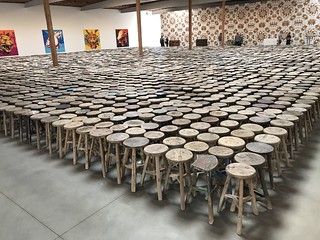
After lunch, I headed to the new Jeffrey Deitch Gallery in Hollywood. The gallery is in a former warehouse space that has been lightened up with paint and indirect natural light for optimal viewing in one very large space. Which is just what the featured Ai Weiwei work, Stools (2013), required. The work comprises nearly 3,000 wooden stools from the Ming and Qing dynasties collected from northern China. Most of the stools have the same basic three-legged design with a round seat, but every so often one varies in shape, design, or material. There are subtle differences in dimension, age, wear, and so on. The work fills an area 72-feet square. It gives the impression of a crowd where at first everyone in the crowd looks the same, but then you start to notice subtle differences. Its vastness invites you to engage with it from all sides, and to approach it at different levels, the pattern of its ordered arrangement creating all sorts of lines. It's surprising what a simple concept can do.
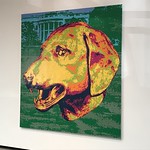
On two walls enclosing the stools are twelve very large works representing the twelve signs of the Chinese zodiac overlaid on world landmarks from major cities. These works read initially as paintings, but a closer examination reveals them to be constructed from LEGOs. One wonders if there is particular meaning in which animal overlays which city. The dragon overlays Beijing, with a small self-portrait of the artist worked in, swearing. A rather rabid looking dog overlays the White House. Hmm. On a third wall is a work entitled The Animal That Looks Like a Llama But is Really an Alpaca (2015), which is literally wallpaper. At first glance, it looks like classic French ormolu patterns, gilded objects in ornate designs. On closer inspection, one discovers that the objects are handcuffs and surveillance cameras, an ominous illustration of the artist's years of house arrest in his native China. Along this wall are five sculptural works, each a cube exactly one cubic meter in dimension, but each of different materials. Here Weiwei plays with the concept of a cubic meter, a standard measurement for shipping cargo, but each cube is of very different materials. One is wooden and forms an elaborate puzzle box. Another is a dark mass, which when you get close enough to see and smell it, turns out to be a huge block of tea. Another is perhaps the world's largest crystal, perfectly transparent, and bending light in all sorts of fun ways that beg for investigation. A solid white marble cube has brain coral-like carvings in it to give it texture. The fifth cube is a frame, made of exquisite blue-patterned porcelain. Near the front, Grapes (2017) takes a few more of those wooden stools, but reassembles them into an integrated spheroid, legs all radiating outward, looking almost like a creature that could start rolling. It's fascinating to look closely at how the stools were integrated, like a chain of Siamese twins, with the third leg of one being the first leg of another, and so on.
I was thrilled to enjoy these works of such a remarkable artist, and to enjoy them in an appropriately lit and capacious space, and frankly to have had the gallery nearly to myself for a time. Though I have to confess I'm still new to the private art gallery thing, and a bit intimidated. I mean, it's not a public museum, so isn't it really meant for people who might conceivably be thinking of purchasing thsee works? But in exhibitions like these, are the works even really on offer? I mean, some of them are monumental. If one is rich enough to buy something like Stools from a world-renowned artist, then I suppose one is rich enough to build a space to house it? Off to one side of the gallery entrance, there was a small desk where sat Jeffrey Deitch himself (I recognized the former MOCA director from photos in the LA Times) and a couple of assistants. I didn't approach them, and they didn't approach me. But at some point, I did notice that when certain other people entered, he would pop up and greet them. And at one point, I was close enough to overhear some conversation. They were breezily talking about who they'd met at Davos or the latest TED talk, or how they just had lunch with Frank Gehry. Deitch asked one woman if he had a current address for her. "Oh, well sometimes I'm in New York," she replied, "but sometimes I'm in the house in France, or in Switzerland. It's best just to mail me at the Foundation." Wow. Different circles than I'll ever run in. But I guess it's because of people like them that galleries like this can exist, and I can get to enjoy them.
After lunch, I headed to the new Jeffrey Deitch Gallery in Hollywood. The gallery is in a former warehouse space that has been lightened up with paint and indirect natural light for optimal viewing in one very large space. Which is just what the featured Ai Weiwei work, Stools (2013), required. The work comprises nearly 3,000 wooden stools from the Ming and Qing dynasties collected from northern China. Most of the stools have the same basic three-legged design with a round seat, but every so often one varies in shape, design, or material. There are subtle differences in dimension, age, wear, and so on. The work fills an area 72-feet square. It gives the impression of a crowd where at first everyone in the crowd looks the same, but then you start to notice subtle differences. Its vastness invites you to engage with it from all sides, and to approach it at different levels, the pattern of its ordered arrangement creating all sorts of lines. It's surprising what a simple concept can do.
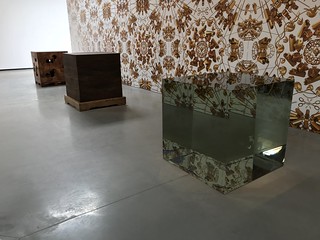
On two walls enclosing the stools are twelve very large works representing the twelve signs of the Chinese zodiac overlaid on world landmarks from major cities. These works read initially as paintings, but a closer examination reveals them to be constructed from LEGOs. One wonders if there is particular meaning in which animal overlays which city. The dragon overlays Beijing, with a small self-portrait of the artist worked in, swearing. A rather rabid looking dog overlays the White House. Hmm. On a third wall is a work entitled The Animal That Looks Like a Llama But is Really an Alpaca (2015), which is literally wallpaper. At first glance, it looks like classic French ormolu patterns, gilded objects in ornate designs. On closer inspection, one discovers that the objects are handcuffs and surveillance cameras, an ominous illustration of the artist's years of house arrest in his native China. Along this wall are five sculptural works, each a cube exactly one cubic meter in dimension, but each of different materials. Here Weiwei plays with the concept of a cubic meter, a standard measurement for shipping cargo, but each cube is of very different materials. One is wooden and forms an elaborate puzzle box. Another is a dark mass, which when you get close enough to see and smell it, turns out to be a huge block of tea. Another is perhaps the world's largest crystal, perfectly transparent, and bending light in all sorts of fun ways that beg for investigation. A solid white marble cube has brain coral-like carvings in it to give it texture. The fifth cube is a frame, made of exquisite blue-patterned porcelain. Near the front, Grapes (2017) takes a few more of those wooden stools, but reassembles them into an integrated spheroid, legs all radiating outward, looking almost like a creature that could start rolling. It's fascinating to look closely at how the stools were integrated, like a chain of Siamese twins, with the third leg of one being the first leg of another, and so on.
I was thrilled to enjoy these works of such a remarkable artist, and to enjoy them in an appropriately lit and capacious space, and frankly to have had the gallery nearly to myself for a time. Though I have to confess I'm still new to the private art gallery thing, and a bit intimidated. I mean, it's not a public museum, so isn't it really meant for people who might conceivably be thinking of purchasing thsee works? But in exhibitions like these, are the works even really on offer? I mean, some of them are monumental. If one is rich enough to buy something like Stools from a world-renowned artist, then I suppose one is rich enough to build a space to house it? Off to one side of the gallery entrance, there was a small desk where sat Jeffrey Deitch himself (I recognized the former MOCA director from photos in the LA Times) and a couple of assistants. I didn't approach them, and they didn't approach me. But at some point, I did notice that when certain other people entered, he would pop up and greet them. And at one point, I was close enough to overhear some conversation. They were breezily talking about who they'd met at Davos or the latest TED talk, or how they just had lunch with Frank Gehry. Deitch asked one woman if he had a current address for her. "Oh, well sometimes I'm in New York," she replied, "but sometimes I'm in the house in France, or in Switzerland. It's best just to mail me at the Foundation." Wow. Different circles than I'll ever run in. But I guess it's because of people like them that galleries like this can exist, and I can get to enjoy them.
Friday, October 19, 2018
Chichen Itza, King Tut, and PYT
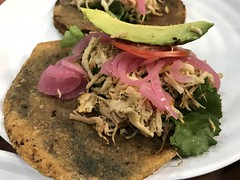
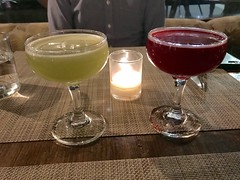
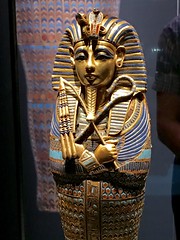
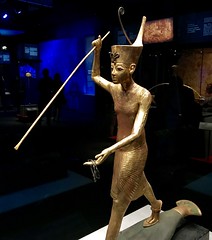
Another great "off Friday" exploring LA, today with the adding bonus of being joined by my husband who decided to take a day off. I introduced him to the Mercado La Paloma foodie food court by USC, where we lunched on a Yucatecan feast of panuchos, tacos de poc chuc and cochinita pibil. Then we wandered over to see the King Tut exhibit at the Calif Science Center. The exhibit features many great artifacts from the tomb, some of which have never before left Egypt. It is beautifully laid out, presenting the artifacts in the context of King Tut's journey through the underworld into the afterlife, the reason all these dazzling treasures were crafted and placed in his tomb. When the tomb was first being opened and Howard Carter first peered in, Lord Carnarvon eagerly asked, "do you see anything?" "Oh yes," he replied, "wonderful things!" We did indeed see wonderful things today. (The exhibit runs through Jan 6, so still time to catch it!) This evening, we went into DTLA for dinner at the vegetable-forward PYT. Even our cocktails featured veggies - a celery margarita and a bourbon with beet.![]() |
![]() |
![]() |
Wednesday, October 03, 2018
Why Kavanaugh Shouldn't Be Confirmed
I’d been wanting to write something about my take on the Kavanaugh hearings, but this thoughtful conservative in The Atlantic has gone and written my essay for me. Judicial temperament, credibility, the appropriate standards for the question before the Senate - he hits all the points I’ve been mulling.
Saturday, September 29, 2018
FILM: A Simple Favor
What a wild ride! A Simple Favor was fun, funny, clever, with good twists and turns, you just don’t really know who’s doing what to whom until the very end. Anna Kendrick is always good, but Blake Lively - wow! And Henry Golding, great performance hot on the heels of Crazy Rich Asians. Think Body Heat, Vertigo, or Double Indemnity for the vlog age.
Tuesday, September 11, 2018
STAGE: Love's Labour's Lost
Rounded out our Oregon Shakespeare Festival with a rollicking production of Love’s Labour’s Lost. We anticipated fun when we laid eyes on the eccentric set, and the show filled the promise. Who knew the Bard wrote a rock musical? The costumes were clever too, playing on the color imagery in the language, all white at first, increasingly splashed with tempera paints, then all red in Act IV, and all black at the end. A fair amount of ad libbing suits this play, including a bit with a smartphone. Such good fun!
FOOD: Coquina (Ashland OR)
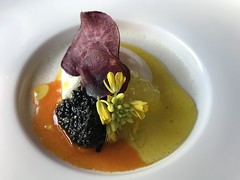
Another extraordinary dinner in Ashland. Everything was plated like artworks and such innovative dishes of seasonal local ingredients. Started with a fennel custard with wild sturgeon roe, quark (a fresh yogurt cheese), Pernod gelée, beet chips, arugula blossoms, and crispy shallots. A simple chilled artichoke soup with crème fraîche and artichoke chips was silky smooth and full of flavor. Burrata was served with slow-roasted tomatoes and prosciutto with aged balsamic. Our main was a sous vide duck breast with figs, baby potatoes, beech cap mushrooms, pickled ramps (no doubt house-pickled from the spring), with three different puddles of flavor, including a foie/olive purée, a balsamic vinaigrette, and a mustard seed gastrique. Our desserts were a cynar panna cotta with candied artichokes and caramel hazelnuts, and a chocolate truffle tort with cherries and raspberries. (You wouldn’t expect artichoke and cynar - an Italian herbal/artichoke aperitif - to be good in a dessert, but candied and with vanilla, it was an unexpected delight.) This was all complimented with local wines from Goldback, a Grenache rosé and a Rhône blend Cuvée. (We are lightweight drinkers, good for one glass each, and they were lovely to suggest that we could split glasses, so we could have a bit of rosé with the appetizers and the heavier red with our main.)
Sunday, September 09, 2018
STAGE: Romeo and Juliet (OSF)

Just back from a marvelous production of Romeo and Juliet at the Oregon Shakespeare Festival’s Elizabethan Theatre. Very well acted, beautifully staged. That beautiful language, and so heartbreaking no matter how many times you see it. "My bounty is as boundless as the sea, my love as deep, for both are infinite."
Saturday, September 08, 2018
FOOD: Amuse (Ashland OR)
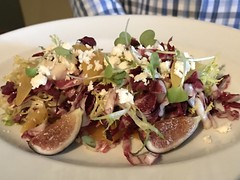
Fantastic first dinner in Ashland at Amuse, a French-inspired bistro featuring local ingredients. Started with an amuse of beet “caviar” on crostini with fresh tarragon. The bread service (including nice gluten-free crackers for George) came with thyme butter and a tasty pepperade of cured peppers, onions, fennel. I started with a carrot soup with cumin and coriander, while G had a beet salad with goat cheese and figs. I had a succulent roast game hen in truffle butter with pole beans and Tokyo turnips, while G had a wild mushroom risotto with zucchini and arugula pesto. They had some really good southern Oregon wines. My Upper Five “Oso Grande” was a Grenache/Syrah /Tempranillo blend, a nice compliment to the truffles, while G had a lovely roussanne/ marsanne/ viognier. (Didn’t hurt that they served in appropriate Riedel crystal glasses.) For dessert, I took the pavlova with fresh blue and blackberries from a local farm, while G had a caramel pot de crème. And the check came with figs in ganache as a mignardise. Quite impressed with this place!
Friday, September 07, 2018
BOOKS: Interpreter of Maladies
Jhumpa Lahiri’s “Interpreter of Maladies” is a charming collection of short stories, some set in her ancestral Bengal region of India, but more often about Bengali immigrants in North America. (Some will recognize her as the author of “The Namesake”, which was also made into a movie.) Her stories often keenly illustrate the tensions of people who have one foot in the old world and one foot in the new, or those between generations of immigrants. Typically the story is told from the perspective of a particular character, and in several, that character is a child. She has a lovely skill of capturing a child’s observations of adult relationships around them. In other stories, characters implicitly wrestle with the meaning of marriage. The nine stories are all very well told, with thoughtfully developed characters, and an enjoyable read.
Saturday, September 01, 2018
FILM: Crazy Rich Asians
What a pleasure to see Crazy Rich Asians. Not only a charming rom com with very likeable attractive leads, some interesting complications, good side characters, and plenty of laughs, tears, and heart-warming scenes, plus the bonus of some good food porn, travel porn, and fashion porn, but on top of all that you get some thoughtful glimpses of tensions between immigrant generations, between old world values and American values, between love and family, between sacrifice and self-fulfillment. Constance Wu is spot on as the Rachel, the heroine, a Chinese-American economics professor at NYU, smart, down to earth, and mostly confident though that is tested. Newcomer Henry Golding is perfectly handsome and charming as Rachel’s boyfriend Nick. Michelle Yeoh is flawless as Nick’s fierce tiger mother, with a nuanced performance that conveys so much with just a look. This film has layers, including nuances of Asian culture that are not elaborated, but add richness to those who will pick up on them. There’s a pivotal scene toward the end of the movie where the heroine confronts her boyfriend’s mother over a game of mahjong. I was very curious about the deeper symbolism that I suspected lay in those tiles and how the mahjong game unfolds. Gotta love the Internet -- I found a great blog post (caution: heavy spoilers!) that explains it, and it does enrich an already wonderful story.
Friday, August 31, 2018
FOOD: Officine Brera
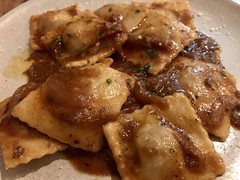
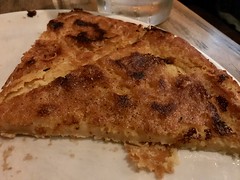
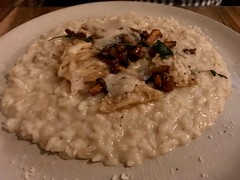
Eating at Officine Brera in the DTLA Arts District always transports us back to fond memories of our trip to Tuscany. The vast room, an old warehouse space (very Arts District), has a modern vibe, and a nice view of the open kitchen, including their wood-burning ovens. (You can see the wood piled up by the front door.) They make some wonderful grilled meats and fish, and one of the ovens has a big crank / pulley thing for lowering down very large roasts. But they also make some terrific pastas. George often goes for the risotto, which tonight was carnaroli superfino rice with foraged mushrooms and Moliterno al tartuffo (a sharp aged pecorino – sheep’s milk cheese – from Sardinia, with veins of black truffle). I went for a new menu item, a venison ravioli with Nebbiolo-braised red onions and arrosto sauce (gravy from the roast). The meat was deliciously dark and rich, and it took me back to a dinner I had in Monteriggioni (an ancient Tuscan walled town) – that dinner was wild boar, but similar dark rich meat and sauce. We’d started this dinner with a light summer aperitif called “the Roz”, a flute of Plymouth gin, blackberry thyme sage shrub, lemon, and prosecco. And we always start with some farinata, a Tuscan chickpea crepe that we were delighted to discover in Florence, as it’s naturally gluten-free. Here at Brera, it is nicely blistered in their wood-burning oven. (It’s not on the menu, you just have to know to ask.) There was a salad of greens, grilled nectarine, lardon bits, chanterelles, and pistachios. And for dessert, a meringue with macedonia of summer fruit including more nectarines and amarena cherries. And of course an espresso.
FOOD: Pizzeria Mozza
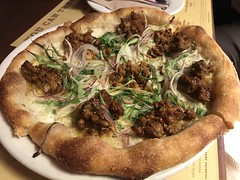
Lunch at the famous Pizzeria Mozza: fennel sausage, mozzarella and cream, with slivered scallions and red onion. Thin crust bed that gets thick with beautifully blistered bubbles at the edge. House-made sausage is dollops of deliciously seasoned and cured ground meat (no need for casing just to put it on pizza). Green and red onions are sliced ultra thinly and lightly roasted, softened but still with a little bite and snap. GTK: reservations are scarce but if you’re content to sit at the bar, you can walk in at noon with no wait.
Saturday, August 25, 2018
FOOD: Orsa & Winston
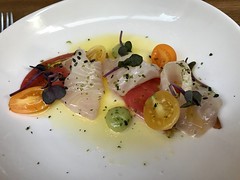
This evening we were treated to the tasting menu at Orsa & Winston in DTLA. If you imagine how a chef with TexMex roots, trained in the classical European tradition, would prepare a Japanese omakase menu using mostly local ingredients from the local farmers market, that’s what you’ll get at Orsa & Winston. As Jonathan Gold said, “It tastes like Italy, Japan, and Spain. It tastes like Los Angeles.” The meal commenced with an amuse bouche of black sesame tofu topped with kombu and smoked trout roe, a rich dark bite set in a lovely blue-and-white patterned bowl. First course was a kanpachi (amberjack) crudo, fresh and mild, in a light yuzu dressing with red and yellow heirloom tomatoes and a couple little dollops of avocado, making a colorful array across a plain white plate. Next up was a duck foie gras au torchon, garnished with huckleberries, white figs, and labneh, with toast to spread the smooth rich pâté on. The “second course” (as is traditional with tasting menus, a “six course menu” ends up being more like ten) was a chilled summer melon soup, sweet cantaloupe-colored juice poured over some Hokkaido scallops, slivers of jicama, and little pieces of oro blanco grapefruit and cucumber. Third was a piece of seared aji (mackerel) with seared baby corn, malabar spinach, and a chopped walnut bagna cauda. (Yeah, I don’t know what all that stuff is either, and we often consult Google while decoding menus. Bagna cauda is a Piedmontese dipping sauce made from olive oil blended with garlic and anchovy. Don’t let the anchovy put you off. It’s all blended in, just good tasty dressing, here with chopped walnut added.) Fourth up was a “satsuki rice porridge”, like a risotto but with a short-grained plump Japanese rice and seasoning, with slices of abalone, pieces of geoduck (a long-necked clam), and Santa Barbara uni (sea urchin). Fifth, the meat course, was a Sonoma lamb T-bone with cannellini beans, cherry tomatoes, maitake mushrooms, some dark leafy green, and some minced castelvetrano olives. A palate cleanser of coconut sorbetto with passionfruit pulp was a lovely light segue into dessert, which was a peach clafoutis with a hearty dollop of crème fraiche Chantilly. (If you’re again diving for Google, a clafoutis is a custardy batter mixed with fruit and baked, so that unlike a pie or a cobbler, the fruit is baked right into the pastry. To be appropriately decadent, we did the wine pairings, which were really interesting. Though all Italian and French, the varietals and regions were mostly unfamiliar ones: a folle blanche from the Loire was very tart to pair with the crudo, a lagrein from the Dolomites made a dark rosato with berry notes that made a lovely compliment to the melon soup, and a dry white sciaglin from Venezia-Giulia made for pasta and aged cheese paired nicely with the rice porridge and shellfish. The desert wine was a moscato from Sicily where they press the grapes earlier, not letting them turn into raisins as is more typically done, for a light sweetness instead of a more typical syrupy moscato. It was lovely with the light pastry, fruit, and cream. We parted happy from good company and the tastes of Los Angeles in our bellies, feeling lucky to live in this city. (See full set of photos here.)
Subscribe to:
Posts (Atom)