Friday, August 30, 2019
BOOKS: Shortest Way Home


Exploring Westwood Memorial Park
 For years I had heard about this quiet little cemetery hidden behind tall buildings in the middle of Westwood, which boasts the graves of many Hollywood luminaries, perhaps the most notable being Marilyn Monroe. You really have to know that it's there, because it isn't visible from any street, and the only entrance is a modestly marked driveway between two buildings. There's a nice lawn area in the center with all flat stones, and some columbariums and a few mausoleums around the edges. Marilyn, as I learned, is in an above-ground niche which you can locate by looking for a niche with lots of lipstick kisses on it. While Marilyn's niche may have a kiss or two, it is the adjacent niche belonging to Hugh Hefner that's covered in kisses. It seems that Hefner laid out big bucks to be forever beside his first Playboy centerfold, even though the two never actually met in life. There are a lot of stories here. In another above ground niche, I found Truman Capote interred with Joanne Carson, ex-wife of Johnny Carson. They were apparently best friends, and Capote died in a room at Carson's home where he did a lot of his writing. It's not clear to me whether his ashes are actually in there, as I found at least one story claiming that his ashes were sold at auction by Carson's estate. Some stones celebrate comedians who gave us laughs to their very end. Rodney Dangerfield's grave is inscribed "there goes the neighborhood", while Merv Griffin's grave says "I will not be right back after this message". Some graves, like Don Knotts, have lovely graphical tributes. Some, like Bob Crane and his wife and Hogan's Heroes co-star Sigrid Valdis, have entire obituaries with photos. Others, like Donna Reed, are very simple and easy to miss. I found many stars just on my random walk, but I need to go back, as there were many that I missed, including Natalie Wood, Fanny Brice, Dean Martin, Jack Lemmon, Eva Gabor, Billy Wilder, Carroll O'Connor, Walter Matthau, George C. Scott, and more.
ART: Sarah Lucas: Au Naturel at the Hammer
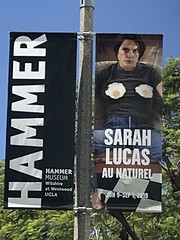
A Hammer Museum retrospective of the British artist Sarah Lucas entitled "Au Naturel" showcases her playfully provocative explorations of sex. As the title suggests, naked bodies, or at least parts of them will be shown here, some more abstract and some less so. A series called "bunnies" involves panty hose which have been stuffed to resemble women's legs seeming to sprout from office chairs, which also have protrusions that could be bunny ears although they are rather phallic in appearance and seem to be diving toward the crotch of the legs. These creatures are all arranged around and on a "snooker" table (like billiards), and the stockings are colored to match the snooker balls. It somehow manages to be erotic, whimsical, and thoughtful all at the same time. As you try to make sense of it, you can't help but think about the relationship between woman and office chairs, or how women can be seen in the "male gaze" as just crotches and legs, or how this all relates to snooker halls. And what is up with those "bunny ears"? They're clearly phallic, but they also breast-like in some ways. This kind of challenge pervades the show, rich with thoughtful symbolism. In another room, a life-size Christ on the cross is constructed entirely of cigarettes. Christ looks down on a giant plaster phallus mounted atop a pile of car wreckage. The phallus is aimed at a wallpaper print of a woman's midsection wearing only knickers, with a raw chicken suggestively placed. After the initial shock, one might start to think about sexuality, danger, death, and commodification. In this Freudian space, of course, a cigarette is never just a cigarette. It's a cancer stick, it's a phallus, and it's a cliche post-coital pleasure. Of course since Lucas's creatures generally comprise only below-the-neck body parts, they smoke out of other orifices. Wandering through this show might make you smile and might make you a little uncomfortable at the same time, but it's certainly worth engaging with.

Saturday, August 24, 2019
FILM: Where'd You Go, Bernadette?

Friday, August 23, 2019
Sonoratown, St Vincent Court, The Last Bookstore, and Biddy Mason Park
 With the 2019 Masa Madness Tortilla Tournament down to its Suave Sixteen, I was reminded that I had yet to taste the winner of last year’s tournament, the legendary flour tortillas of Sonoratown. So this morning I headed to DTLA to rectify that. Arriving at 11:05am, I found there was already a line out the door and down the street, but it was a beautiful morning and the delicious aroma from the grill wafted out onto the street to give those of us in line a hint of tastes to come. The reward came on a plate with a taco de costilla (grilled slices of beef rib), a chorizo quesadilla, and a small bean and cheese burrito. I appreciated that the items are modestly sized, enabling me to sample three different expressions of their flour tortillas without being too much of a pig. Yes, flour tortillas are what it’s all about here, in the style of Sonora (northern Mexico), pressed thin, supple, and made extra delicious with generous brown stripes from the grill. An excellent complement to the grilled beef with a hint of mesquite smoke, and the crispy chorizo with its chile heat. This was all enjoyed with an horchata (they use coconut milk to make the rice starch creamier) and norteño music. Close your eyes and you could be in the chef’s hometown of San Luis Rio Colorado, just south of the Arizona border. Open your eyes, and see the line of people a multicolored array of Hispanic, African, Asian, Middle Eastern, and European ancestry, and you know you’re in LA.
 After brunch, I explored a few DTLA sites I’d heard about. If you’re walking along 7th St between Broadway and Hill, there’s a mid-block service alley that at some point got transformed into a kitschy little faux European street called St. Vincent Court. The alley is paved in brick, and it is lined with brightly painted shopfronts with sidewalk tables and chairs. It’s as if you stepped through a portal from DTLA to Solvang, but less specific about which European country, with bits of Italian, French, German all quaintly jumbled. Behind the cute storefronts lie a couple of delis, a half-dozen kebab places (I’m guessing that the clientele from the surrounding jewelry markets must be heavily middle-Eastern), a pizzeria, and Café Bonjour (with its hospitable Asian proprietor), where I took an espresso and enjoyed watching the life on this quirky little street.
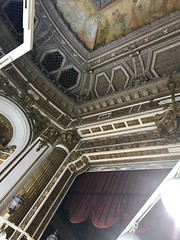 I wandered up to Broadway, and took a peek at the old Warner Brothers Theater. Broadway is full of the remains of once-grand movie houses, and you can see remnants of the marquees and the terrazzo in the sidewalk. What used to be the Warner Brothers Theater is now the Theater Jewelry Exchange, a marketplace of jewelry shops and stalls. But walk into the stalls and look up, and you can see the ornate ceiling of the classic movie palace. Here and there you can spot brass fixtures and chandeliers. The big red curtain is even still there. It’s an odd juxtaposition with its present use, stalls set up where the audience would have sat 80 years ago.
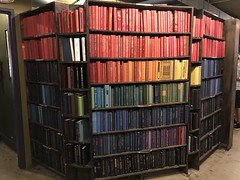 At 5th and Spring, I came to The Last Bookstore, an impressive independent bookstore occupying a good quarter of a downtown block on two floors, filled with new and used books, the shelves peppered with comfy chairs. (Admittedly, it’s not Powell’s, but it’s pretty good.) It has some fun curiosities as well: a tunnel made of old books stacked into a long arch, an old bank vault housing the horror section, and several shelves of “decorative books”, organized by color and size.
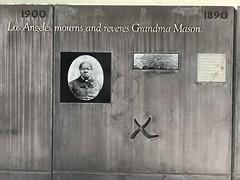 In the block between Spring and Broadway and 3rd and 4th, I found an open space amidst the buildings with some plantings, a fountain, some nice places to sit, and a long granite wall memorializing a rather remarkable woman named Biddy Mason. She was born a slave in Mississippi in 1818, followed with her owner’s family on a Mormon migration to Utah and then California, where she petitioned for and won her freedom. She worked in Los Angeles as a nurse and midwife, delivering hundreds of babies. She saved diligently and invested in real estate near downtown Los Angeles (including the land where this small park is), making a small fortune, and becoming a major philanthropist as well as a co-founder of the First African Methodist Episcopal Church of Los Angeles and the first elementary school for black children in Los Angeles. The granite wall has a timeline of the 1800s with events in Biddy Mason’s life aligned with events in the growth of this part of Los Angeles. What an impressive woman!
Saturday, August 17, 2019
FILM: Blinded By The Light
 Blinded By The Light tells us the story of Javed Khan, a Pakistani-British teen living in the English town of Luton in the late 1980s, whose dreams of being a writer clash with his parents’ more traditional values. When he discovers an unexpected source of inspiration in the songs of Bruce Springsteen, it propels him on a path to finding success and finding himself. The film is straightforward dramatic cinematography interspersed with a few musical numbers where the characters of the film burst into song and dance (like Rocketman), and a few music video-like sequences with lyrics captioned on screen, devices which effectively convey how powerfully the Boss's lyrics speak to Javed. The film captures the time of 1980s Thatcherite Britain when Wham and the Pet Shop Boys were bursting on the music scene and the Nationalist Front was rousing ugly anti-immigrant demonstrations. The film is mostly light, but doesn't mask the ugliness of the nationalists confronting the Pakistani immigrants in their town. In one particularly powerful scene, a wedding party crosses paths with an NF march which turns into a small riot, as a giant billboard of Margaret Thatcher with the slogan "Unite England / Vote Conservative" looks down over the mayhem. While the plot elements are broadly familiar and unsurprising, the story is told from a very fresh and original perspective, with endearing performances, and is a pure joy to watch it unfold.
Friday, August 09, 2019
The Velaslavasay Panorama and the Cristo del Arbol de la Calle 22
So on Friday, I checked out a few of LA’s lesser known attractions. The Velaslavasay Panorama is a kind of a throwback to a previous century before movies, when some creative artists recreated the travel experience by means of a large 360-degree panoramic painting, augmented with model-train-like scenic dioramas in front of the painting. If you remember the old “America The Beautiful” 360-degree movie at Disneyland, these panoramas are something like that, but with a painting rather than a movie. The experience is enhanced with dynamic lighting and a soundtrack, so that as you wander around the panorama, you hear ambient sounds – people talking, birds, crickets, street noise, passing trains – and over the course of a half-hour you might see day turn to night and back again. It’s quaint and charming (think of the Disneyland Railroad diorama), and for people 100 years ago who didn’t have benefit of the Travel Channel, the device can give you a surprisingly decent sense of place. The currently installed panorama is of Shengjing, a city in the Northeast of China, as it was circa 1920. It had been installed in an old Chinese restaurant in Hollywood, but the whole thing has been installed now at the Union Theatre in West Adams, itself a bit of local history: built in 1910 as one of the first movie houses, it was later used as a play house, and then a hall for the tile workers’ union local. The main theatre space still looks as it did in 1920, with an old organ about to accompany the silent film, and a side stage for a puppet show at intermission. The panorama is above. You enter via a spiral staircase that comes up in the middle, where you suddenly find yourself atop a hill in the middle of northern China. After enjoying the panorama, the funky Asian garden in back, and another diorama of an Arctic trading post, I was about to head home when I learned I was only a couple blocks away from the Cristo del Arbol de la Calle 22. Of course I had to see what that was. Apparently, on a modest West Adams residential street, there was an old dead tree between the sidewalk and the curb that some guy looked at and saw possibility. So he carved the crucified Jesus out of the tree. From the waist down, you still see the tree trunk, but above you see a nice folk art carving of Jesus, two branches in the perfect configuration for his outstretched arms, painted with stigmata. It’s become a local shrine, with a protective covering, and offerings of flowers and toys left for Jesus of the Tree of 22nd Street.


Wednesday, August 07, 2019
BOOKS: Becoming

Saturday, July 27, 2019
STAGE: The Play That Goes Wrong

Tuesday, July 23, 2019
FILM: Straight Up

Saturday, July 20, 2019
FILM: The Farewell

Friday, July 19, 2019
FOOD: Anniversary tasting menu dinner at Auburn
Auburn is a new tasting menu restaurant, recently opened in the space on Melrose that used to be Hatfield’s and the legendary Citrus before that, giving it much to live up to. But with good buzz, I thought it would be a fitting place for an anniversary dinner. The space harkens Citrus in its balance of stylish refinement and California patio casual. Done in modernist Scandinavian tones (light wood and glass), the main dining room has an open skylight in the center with an acacia tree and live greenery, and other skylights keep the room bathed in beautiful natural light. The kitchen is wide open so you can see the woodfire stove in one corner and you can watch the bustling team of molecular gastronomists not only cooking the food but arranging it artistically so that every dish is perfectly Instagrammable. (George noticed that their aprons had little breast pockets for three different sizes of tweezers.) Rather than completely dictate your meal, as tasting menus usually do, Auburn lets you chart your own course by offering twelve dishes on any given day and letting you choose your own way through four, six, or nine courses from the twelve on offer. We opted for the six-course, which felt about right (and ended up being an enjoyable 3.5 hour dinner). Of course there are wine pairings, with a curated option or a more adventurous private sommelier consultation option. We just went for the curated option, which was a plenty interesting array of wines thoughtfully chosen to pair with each course.
 We began the meal with two amuses bouches. One was a tiny corn tartelette in a little buckwheat crust (or a gluten-free lettuce wrap for George) topped with microgreens and tiny flowers. The other was essentially chicharrones (cracklings) made from pork rind sliced very thin so that they came out crispy but light and delicate. Bread arrived shortly after, a beautiful artisanal sourdough small round for me and gluten-free bread specially made by the pastry chef for George, along with a delicious avocado butter with a tart pool of minced shiso in oil. Our first wine came, a crisp minerally vinho verde which conjured a memory of a seaside cliff top in Portugal where we dined on freshly caught fish. Vinho verde is a lovely fish wine, but here it was complementing our first cold starter, a bowl of julienne curls of cucumber and nectarine with oxalis leaves, wetted with verbena kombucha, and with lightly set curds. The mild tartness of the curds set off the cool freshness of the cucumber. Our second wine was a white garnacha with a fruity floral nose from the bit of viognier blended in. Our second course was a cold stone bowl holding delicate hiramasa crudo with thin slices of purple radish, mulberries, and tiny sprigs of citrus fern, swimming in a pool of bright green cold celery broth. After the fish was gone, I spooned up every drop of that celery broth. On the third course we diverged. George took another cold dish, Brandywine tomatoes and Santa Barbara box crab meat with nasturtium leaves and a seaweed lemon granita, paired with a getariako txakolina, a lightly effervescent wine with green apple notes from the Basque coast near San Sebastian. Meanwhile I moved on to warm dishes. Black cod fresh from the Channel Islands was cooked in brown butter, giving it a light butter-browned crust, served in a sauce made from butter and stock of the fish bones smoked over embers, topped with watercress microgreens, matched with a chardonnay from Chablis with round acid and fruit. I was glad to have a hunk of bread to soak up every last bit of that sauce. For our fourth courses, George had the cod while I took a succulent koji-aged Liberty duck breast with large grilled cherries, their sweetness offset by mustard seeds and a bed of mustard greens, nicely complemented by a Langhe Nebbiolo with its own cherry notes. For our fifth, we diverged again. George took a dry-aged ribeye steak, plated in a rich dark pool with morel mushrooms, kombu, and Australian black truffle, with a glass of deep fruity reserva rioja. Me, I was intrigued by a savory cheese course: Époisses, a very soft and pungent cheese from Burgundy, was warmed a poured over roasted sunchokes, a brilliant pairing further enhanced with a microplane shower of black truffle. Sunchoke, like artichoke, can be a challenge for wine pairing, notwithstanding pungent cheese and truffles, but this was beautifully solved with an Arbois vin jaune, an unusual wine from the Jura mountains between Burgundy and the Swiss border, matured under a yeast film, giving it its distinctive amber color and a flavor like a dry fino sherry. We converged for our last course, a dessert with some unexpected savory elements that worked well: a dollop of fresh tart yogurt in a shallow pool of dark caramel, the syrup deglazed with mushroom stock and a splash of pernod, and garnished with tiny delicate candied fennel fronds. With this, we imbibed a ratafia champenois, a fortified wine made from Champagne must, with raisiny notes that complemented the mushroom caramel nicely. Finally, as I sipped an espresso, we were brought mignardises of little candied rhubarb batons with tiny yellow flower petals to close our grand celebratory meal.
Friday, July 12, 2019
ART: Allure of Matter: Material Art From China @ LACMA
The new exhibition at LACMA “The Allure of Matter: Material Art From China” showcases a wealth of creativity from Chinese artists working in a variety of materials from porcelain and wood to tobacco, ash, and human hair. It seems audacious to try to make a sculpture of a spreading fire, but that’s what Liu Jianhua has done in “Black Flame”, working in porcelain to make eight thousand black “tongues” of flame of varying height placed around the floor of the first gallery I entered as if the room were on fire. Crossing the room with these black flames on both sides reminded me of the videos of people last summer fleeing Paradise, California with flames on both sides of the road. On one wall of this room were three large white rectangles entitled “Blank Paper”, which looked like just that except that they too were made of porcelain. These two works filled the room, in an interesting conversation between black and white, dynamic and static, timeless and fleeting. The center of another large room was mostly occupied with a very large orange-and-white “tiger skin” shag rug, though when I approached, I did a double-take to realize that artist Xu Bing had created this “rug” from carefully arranging thousands of cigarettes. “1st Class” not only creates a fascinating play of color as you look at it from different angles, seeing alternately the white and orange cigarette paper or the darker tobacco seen from “head on”, but it also suggests a conceptual play of consumerism (a mansion-size rug nominally made of possibly endangered animal pelts) as a carcinogen. A couple of other works by Xu also feature tobacoo, including a traditional Chinese scroll painting of a village and river, with a single forty-foot long cigarette running down the middle of it with the end having burnt and stained the painting. Chen Zhen, an artist battling cancer, perhaps inspired by chemotherapy or ancient Chinese medicine, crafted some beautiful crystal sculptures that turned out to be internal organs, an anatomy textbook rendered in sparkling transparent crystal. Song Dong’s “Traceless Stele”, a blank metallic slab monument equipped with water and paintbrushes invites its viewers to engage with it, dipping the paintbrushes into water and drawing or writing inscriptions on the monument which last only a moment before the water evaporates, as you contemplate the nature of temporal existence. One artist has collected human hair from all over the world to weave it into a flag symbolizing multi-cultural harmony, while another artist has collected ash from burnt incense in a temple and painstakingly sorted it by color and coarseness in order to create “paintings” on canvas from it. Yet another artist collected roof tiles from traditional homes that were being demolished in Beijing, and attached to each a black and white photo of a scene from the site where each tile was collected, to create a kind of concrete quilt memorializing neighborhoods that no longer exist. Some of these works could be understood just by looking at them, while others were more conceptual, requiring reading the description to understand the significance of the materials and the process. So many of them were fascinating. I found myself raptly engaged in several of them, and revisited a few. (As so often, a hat tip to KCRW's Edward Goldman for the recommendation.)

Thursday, July 04, 2019
July 4th, 2019

Saturday, June 22, 2019
FILM: Late Night

Saturday, June 15, 2019
FILM: Booksmart
 Booksmart was nothing profound, but it had some hearty laughs and we enjoyed the coming-of-age story, a well-worn and well-loved genre made fresh from a post-millenial perspective, and with some inventive twists. It was a bit like The Hangover but in high school and with female leads, and with the mildly raunchy farce tempered with a touch of John Hughes sensibility getting under the surface of teenage emotions. It was kind of a cool statement that the two main characters were a heavy-set girl and a lesbian, and neither of those things were the slightest bit of an issue for them, nor for anyone else. It was very iGen. Not to mention acing the Bechdel test. (Speaking of tests: I had to look up one esoteric detail which may confuse millenials or parents of millenials, but apparently the SAT has recently ended their 11-year experiment with 2400 top scores and has gone back to 1600.)
Monday, May 13, 2019
Morocco and Sevilla Itinerary (May 2019)
We had a fantastic 2-week trip to Morocco and Sevilla. While we usually travel completely independently, on this trip we used a company called Morocco Explored to arrange a private driver for most of the trip, as well as some local guides, some of the local experiences, and lodging outside the bigger cities. We're so glad we did. We wouldn't have had access to some of the best experiences without them.
 Day 2 - Marrakech
City tour with a local guide, showing us the Mellah (Jewish quarter) market, the Saadian tombs (our first encounter with grand classical Islamic architecture with its colorful tile work, intricate carved cedar wood, and ornate carved plaster), the Koutoubia mosque, and foray deep into the "souks" (shop-filled alleys) to encounter classic crafts (weavers at looms, cloth dyers, wood carvers, herbal apothecaries) being practiced much as they were centuries ago, and still-used remnants of 15th century urban life such as neighborhood fountains (water sources) and community ovens.
 Day 3 - Marrakech
On our own to explore the new Yves-St-Laurent museum, the vibrantly colorful Majorelle Gardens (French painter Jacques Majorelle has a distinctively intense shade of blue officially named after him), the dazzling Bahia Palace (even more extravagant array of tile, wood, and plaster design work), and the Jewish cemetery (an impressive remnant of the sizable Jewish community that thrived here).
 Day 4 - Crossing the High Atlas to Ait Benhaddou
We begin the car part of our journey with a nice 4-wheel drive vehicle and a private driver arranged by Morocco Explored. We drove up and over the 7400' Tizi n'Tichka pass (some visible peaks still had snow in May), going from the rainy green side to the dry side, where we saw dramatic desertscapes that reminded of Arizona and Utah. In a remote spot, we encounter our first "kasbah", Telouet, an impressive semi-ruin of a reddish-brown mud-brick desert fortress with remnants of opulence hidden inside. We stop to visit a bootleg salt mine. And the highlight at the end of the day, the ancient "ksar" (earthen clay village) of Ait Ben Haddou, a picturesque and evocative UNESCO World Heritage site. (Hotel 1 night arranged by Morocco Explored at Ksar Ighnda.)
 Day 5 - "Ourza-wood", Berbers, and Nomads
In the morning we visited Egypt, Israel, China, and Tibet, which is to say that we visited Atlas Studios in Ourzazate, the "Hollywood of Africa", where we saw huge film sets for all sorts of big productions from Gladiator to James Bond films. For lunch, our driver arranged the special experience of having lunch in the home of a Berber family in the Dades Valley. In the afternoon, we visited Mars, which is to say that we went off road into some amazing red rock terrain, where we encountered some totally off-the-grid nomads who live in caves, raise sheep and chickens, and welcomed us into their cave for a cup of mint tea! (Hotel 1 night arranged by Morocco Explored at La Perle du Dades.)

 Day 6 - Tinghir, Todra Gorge, and a Camel Trek to a Desert Camp in the Erg Chebbi
Tour the town of Tinghir with a local guide, meeting local farmers in community gardens, and visiting a carpet collective where we end up buying a carpet. Explore the dramatic rock formations of Todra Gorge. While crossing the desert, inspect ancient underground waterways called "khettaras". Arrive at the edge of the Erg Chebbi late in the day for a sunset journey by camel through the mesmerizingly beautiful golden sand dunes to a luxury desert camp. Enjoy Berber music around the campfire after dinner. (Lodging 1 night arranged by Morocco Explored at Bivouac Azawad.)
 Day 7 - On the Road to Fes: Fossils, Palmeries, Macaques
Watch the sunrise over the dunes, then ride the camels back out. Today is a long driving day to Fes, but lots of interesting stops, and stunning geography as we cross the stark High Atlas then the lush green Middle Atlas. We shopped for fossils and bought dates in Rissani, admired the oasis palmeries of the Ziz Valley, had an awesome lunch at a "boucherie" (meat market), and went through a forested mountain area where we saw a bunch of macaque monkeys and fed a few of them. (Hotel for 2 nights in Fes at Riad El Yacout.)
 Day 8 - Fes
A full day in Fes, with a local guide to lead us through the labyrinthine medina. Fes is the ancient capital of crafts, many of which are still practiced as they have for centuries. We visited a tile and ceramics factory where we saw how they make those intricately shaped tile pieces for mosaics, and we visited a tannery where men trample hides with their feet in giant vats of colorful dyes. We went through the food market, saw medersas and mosques, and dodged donkeys and carts in the bustling lanes as if it were still the 14th century.

 Day 9 - Meknes and Volubilis on the road to Chefchaouen
We drive across the verdant valley from the Middle Atlas to the Rif Mountains, and into the Rif. In the morning, we visit Meknes where we visit the Bou Inania Medersa, a gem of Marinid Islamic architecture (tile, carved wood, ornate plaster) dating from 1341, and the vast royal stables of Moulay Ismail. In the afternoon, we explore Volubilis, the remains of an ancient roman city, where we wander among evocative columns and arches, discover beautiful mosaic floors, and discern the plan of a whole city from the foundations and outlines of homes, public buildings, and streets and squares. Arrive in Chefchaouen shortly before sunset denotes the beginning of Ramadan. (Hotel for 2 nights in Chefchaouen at Casa Sabila.)
 Day 10 - Chefchaouen - the Blue City
A full day on our own to explore this uniquely charming and beautiful "blue city", where nearly all of the plaster walls in the old medina have been painted or washed in shades of blue. It is a feast for the eyes, and you'll take a thousand pictures. The town spills down the side of a mountain, alongside a clear stream coming from a mountain spring. It's a delight just to wander the lanes. The town is just big enough to be interesting, but small enough that you can't get too lost for long. Late in the day, we hike up to the old Spanish Mosque to watch the sunset over the blue city. As we descend, we hear the evening call to prayer marking the end of the first day of Ramadan fasting.
 Day 11 - Quick look at Tetouan, Ferry to Spain
Today is a travel day with a mix of cars and boats. We drive out of the Rif toward the coast for a quick visit to Tetouan, the "white city", with a small historic core that felt like a Moroccan version of Nice. Then on to Tangier, where we said farewell to our wonderful driver, and hopped on a ferry for a 1-hour ride from Africa to Europe. We grab lunch in the Spanish coastal town of Tarifa, then a private car picks us up and drives us to Seville, passing by the impressive Rock of Gibraltar and through a scenic national park. (Hotel for 4 nights in Sevilla at Legado Alcazar.)

 Day 12 - Sevilla
Full day to explore this magnificent city. Explore the Alcázar, a complex of royal palaces and gardens, a stunning example of Mudéjar architecture, similar to the palaces of Morocco with exquisite tile, carved cedar, and ornate plaster. Visit Seville's cathedral, dating from the 15th century, the largest Gothic cathedral in the world. Climb its famous Giralda tower, originally a minaret fashioned after the Koutoubia Mosque in Marrakech. Take a horse-drawn carriage tour of the city, a mode of transport that seems perfectly fitting for these historic surroundings. The timeless feeling is further enhanced as we were here during the Feria de Abril, a week-long traditional civic festival held two weeks after Easter. All over town, we were seeing women in flamenco-style dresses and men in traditional attire. They looked completely in place in a horse-drawn carriage.
 Day 13 - Córdoba Day Trip
A morning visit to the Plaza de España, a Beaux Arts wedding cake of a building, a remnant of the 1929 World's Fair, with a canal with boats along its front. Then take the high-speed train to spend the rest of the day exploring Córdoba — its Jewish quarter with a synagogue dating from 1315; the awesome Mezquita, a sprawling cathedral built into the remains of a large mosque; a Roman bridge and arch; a picturesque river with old mills along it; and the Alcázar de los Reyes Cristianos, a medieval fortress with beautiful Moorish-style gardens.
 Day 14 - Sevilla
A day to explore the noble houses of Seville. The Palacio de las Dueñas, the stately home of the Dukes of Alba is filled with exquisite furnishings, art, and family touches that gives you a sense of how the top 1% of Seville of centuries past and present lived and lives. The Palacio de la Condesa de Lebrija is an equally marvelous home with the distinction of being filled with the late countess's fantastic collection of Roman mosaics, Asian art, and European masters, a museum-worthy personal collection. The Casa de Pilatos is an Italian renaissance ducal palace adorned with Roman statues and busts, and decorated with a wealth of azulejo (Spanish glazed tile).
Day 1 - Marrakech
Arrive Marrakech early afternoon. Get settled in our beautiful home for the next three nights, the Riad Le Clos des Arts, inside the old medina (historic walled core of the city). Take the rest of the day to just wander the medina, getting the feel of its bustling lanes and alleys, and getting our first look at the Jemaa el-Fna, a vast open square filled day and night with carts, street vendors, musicians, fortune-tellers, snake-charmers, and more.Day 2 - MarrakechDay 3 - MarrakechDay 4 - Crossing the High Atlas to Ait BenhaddouDay 5 - "Ourza-wood", Berbers, and NomadsDay 6 - Tinghir, Todra Gorge, and a Camel Trek to a Desert Camp in the Erg ChebbiDay 7 - On the Road to Fes: Fossils, Palmeries, MacaquesDay 8 - FesDay 9 - Meknes and Volubilis on the road to ChefchaouenDay 10 - Chefchaouen - the Blue CityDay 11 - Quick look at Tetouan, Ferry to SpainDay 12 - SevillaDay 13 - Córdoba Day TripDay 14 - Sevilla
Day 15 - Travel Home
Fly home from Seville. No direct flights from here to the US, but it's served by many airlines and a short hop will get you to a larger connecting airport.
Notes In Retrospect
Overall, I think we were very happy with this itinerary. Really good sampling of Morocco, and very interesting to pair it with Sevilla which has so much shared history and cultural heritage in common (Andalusia in southern Spain was essentially part of Morocco for five centuries). Very happy with our decision to use Morocco Explored to provide a driver and arrange parts of the trip. Their suggestion to take a full three days to get from Marrakech to the camel trek was a good one — there were many unexpected highlights in that stretch that we'd have totally missed just planning our own trip independently. I wouldn't have changed any of it. If we'd have spent more time in Morocco, we might have added Essaouira, which looks to be a lovely coastal town, and easily could have filled an extra day in Marrakech and/or Fes. Some ask why we skipped Casablanca and essentially skipped Tangier. My impression from what I'd heard and read is that those are more modern cities without the same concentrated historic and cultural richness of Marrakech or Fes. On the Spanish side, with another day or two, we might have made forays to Jerez (sherry!) and Gibraltar or a beach day on the Malaga coast. And of course if you haven't seen the rest of Andalusia (Granada, Ronda, the white hill towns) as we had, that would also fit in very nicely. For timing, May was quite good. We had a few hot days getting to 90-ish, but most of the trip was nice 80s temperatures, even in the desert. It was neat to have just a little overlap with Ramadan to experience that, and being in Seville during the Feria (two weeks after Easter) was very fun.
Tuesday, May 07, 2019
Experiencing Ramadan
At the end of the first day of fasting, we had hiked up to the Spanish mosque for beautiful sunset views over Chefchaouen (the "blue city") and were making our way down when we heard the adhan al-maghrib (evening call to prayer).
One particularly cool part of our amazing Morocco trip is that we got to experience the beginning of Ramadan. While we heard the five times daily call to prayer all during our trip, this one here was special, as it marked the sunset after the first full day of fasting. During Ramadan, Muslims fast from sunrise to sunset. They eat a crazy early morning meal at around 3:30am, and then don’t eat or drink again until after sundown. The fast is typically broken first with dates, then harira, a spicy tomato noodle soup. During the afternoon of the first day of fasting, we kept smelling this great cooking smell but couldn’t pin it to a restaurant. We later learned it was coming from all the homes cooking harira. As with the call to prayer, the timing of Ramadan is based on astronomical definitions. It begins when the moon is first sighted after the new moon. Because this is done old-school, by actual sighting, it creates some uncertainty about when exactly it will start and end. It really just depends. Last Sunday, there was anticipation — Ramadan might start tonight, but it depends if we see the moon. As it turns out, many Muslim countries saw the moon on Sunday night and began their fast, but the Moroccans did not see the moon, so their month of fasting didn’t begin until Monday night. And Monday night, when they did see the moon, what a commotion! Around 2am, folks parade around town beating drums and blowing horns, rousing everyone for the pre-dawn meal. At about 3:30am, there’s a special Ramadan edition call to prayer. And as we learned, the commotion isn’t restricted to the first night, it goes on all month. The second night, it seemed like even more drumming and horns. The kids stay up late, and the whole town shifts into a nightlife cadence. Felt a bit like our New Years Eve or Fourth of July. So cool to get to experience this!
Saturday, May 04, 2019
Lunch at a boucherie cafe on the road to Fes (Morocco)
At this small town diner in central Morocco, you pick out your cuts of meat from the butcher, bring them to the guy running the grill on the sidewalk, pick out some tagine veggies from where those are simmering, get some grilled tomatoes and onions, some bread, and you have a great meal! Lunch at Cafe Melouya in Zaida, Morocco


Friday, May 03, 2019
Camel trek across the Erg Chebbi dunes


The camps are a few miles into the dunes, and it takes a good hour and a half to get there by camel, plenty long enough to get a serious experience of traveling by camel, but not too long. And fortunately for my non-camping husband, the camp was richly appointed for a bunch of tents in the middle of the desert. Our private tent was larger than most hotel rooms, and not only had a queen size bed, a furnished sitting area, and a couple of lamps, but also an en-suite tent bathroom with toilet, sink, shower, and hot and cold running water. The floors and even the outdoor walkways were covered with Moroccan woven carpets. There was even wifi. A circus-sized tent in the center served as the dining hall, where we were served a thoroughly decent multi-course dinner. Later, the staff made a small campfire, and then performed some traditional Berber music and singing for us, and a bit of dancing around the fire. On some nights in these desert camps, the stars are said to be spectacular, but that aspect was denied us by lingering clouds.


Subscribe to:
Posts (Atom)