Sunday, April 28, 2019

Arrival in Marrakech: the Medina and the Riad


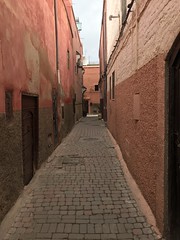
Marrakech is unlike anything we had experienced before it, part Manhattan and part 14th century. At its heart is the medina, the ancient historic core surrounded by walls. The reddish-brown clay used on all the walls gives the "red city" its characteristic visual palette. Its main thoroughfares are lined with shops and buzzing with people at all hours, but barely wide enough to step to one side when a cart or a donkey comes through. Motor vehicles are supposedly prohibited, and while scooters flout this abundantly, cars just physically wouldn't fit. Thus when we arrived from the airport, our car brought us to the edge of the medina, where we found a guy with a cart (picture an extra-large wheelbarrow) to take our luggage, and we proceeded the rest of the way on foot to where we would spend the next few nights. The medina is dense and maze-like, and off of the main streets are derbs (alleys) which wind like residential capillaries off of the commercial arteries.
A derb near our hotel
In the derbs, you begin to notice a fundamental aspect of Islamic architecture: tall walls with doors but scant windows. Muslims like the privacy of their homes, which traditionally have minimal outward-facing windows -- small, screened, and mostly on upper floors. The medina buildings are mostly two or three stories tall, and while the doors are often lovely, there is no other decoration or detail outside. Curb appeal is not a thing here. But if you are starting to wonder if Moroccans have no sense of beauty in their homes, step through one of those doors and prepare to be amazed. The traditional riad is arranged around an open courtyard in the center, with everything open to the light and beautifully appointed. If the family were well off, you might find beautiful tile, carved cedar wood, and intricate plaster work decorating the home. The riad, with its many rooms around the courtyard, would have been home to a large extended family. We also heard the notion that families would live more in the upper floors in the summer and in the lower floors in the winter (or was it the other way around?), a seasonal migration within the home. Today many riads, like Le Clos des Arts, our home for the next few nights, have been converted into beautiful boutique hotels. The effect is so dramatic, stepping from the bustling main road, to the quiet narrow derb with its plain walls, then into the amazing beauty of the riad.
Riad Le Clos des Arts
Riad Le Clos des Arts - Marrakech
Riad Le Clos des Arts in Marrakech
Riad Le Clos des Arts - Marrakech

Thursday, April 04, 2019

FOOD: Nightshade

Nightshade is quintessential Arts District: a cool space blossoming in an old industrial building, a bit of a speakeasy vibe because there’s no signage on the street, you just have to know to walk down an alley behind the Hauser & Wirth gallery complex, along what looks like a loading dock ramp to find the door. The food is a distinctive Asian-inspired LA cuisine, taking inspiration from Chinese, Japanese, Korean, Thai, and Vietnamese cuisines, applying it to the bounty of local farmers markets, and just being creative in delicious and beautiful ways. Sharing plates is the way to go here, and it worked out great with six of us we could taste much of the menu. A Baja kanpachi crudo came with shiso leaves and kohlrabi, and was covered by mandolin-sliced discs of kimchi radish, arranged like fish scales. Hokkaido scallops, graced with fresh sprigs of coriander, rested in a pool of coconut vinaigrette. Beef tartare was blended with “egg yolk jam”, sesame seeds, and kochukaru (a coarse-ground Korean chili powder), giving the traditional dish a zippy flavor, and topped with floral sprouts for color and texture. The tom yum onion makes quite a presentation, looking like an onion that was rearchitected by Frank Gehry before being tempura-battered and fried, served with an unexpectedly airy light green froth of coconut milk and tom yum flavors (lemongrass, kaffir lime). Carrots of multiple colors were tamarind-glazed, served in a carrot top emulsion, and topped with toasted coconut and fresh herbs. Sunchokes were sliced and roasted to a soft mellow perfection, complimented with a strawberry sesame mole, and color-accented with a bright green herb and bright yellow edible flower petals, delighting the eye as well as the tongue. A large bowl of koshihikari congee (rice porridge, made from a short-grain Japanese rice) came with distinct mounds of pork “floss”, scallions, carmelized shallots, and crispy bits, along with an “onsen” egg (soft-cooked, Japanese spa style), to give a pleasing presentation (and an Instagram moment) before you blend it all up. The normally mild porridge was amped up with XO, a Hong Kong condiment made from dried seafood, chili, onion, and garlic. The mapo tofu “lasagna” intricately layers pork “ragu” between sheets of tofu, creating a satisfying comfort food located somewhere between Bologna and Chengdu (though it reminded me more of zha jiang mian than the fiery hot pot mapo tofu). The deliciously piquant Szechuan hot quail on Japanese milk bread is what would have happened if Howlin’ Ray grew up in Chengdu instead of Nashville. Finally, an off-menu rib roast was marinated in soy sauce and spices, and cooked to perfect crisp char on the outside while still juicy medium rare inside, and served with butter lettuce leaves, house pickles, mint leaves, and a creamy dressing. Then came the desserts, fanciful creations with bit of molecular gastronomy (cold fusion?). A guava ice was paired with cream cheese, served in a chilled stone-cold marble bowl, and topped with a slab of white chocolate made to resemble marble. A coconut mousse is encased in lime granita, with bits of pineapple and nata de coco (cubes of coconut gel), an eye-catching green mound served in a bowl made to resemble a coconut shell, thus putting the lime in the coconut visually as well as flavorfully. Tangerine ice was somehow crafted into concentric Fiestaware bowls, placed atop a remarkable almond sorbet. This fantastically creative meal is draws from many Asian cuisines, but is distinctively LA.
roasted sunchokes in strawberry molé

Tuesday, March 26, 2019

BOOKS: The Forgiven

I picked up The Forgiven by Lawrence Osborne because I was looking for books about Morocco in anticipation of our upcoming trip, and this was highly recommended. It stood out from some of the other obvious choices because it wasn’t set in Tangier. Now that I’ve finished it, I have mixed feelings about it, and I don’t think it was a great choice for getting excited about a trip to Morocco. Most of the novel takes place in a renovated ksour (fortified Berber village) on the edge of the Sahara, at a party thrown by a decadent gay couple. The premise is interesting enough: while driving to the party, a British couple accidentally hits and kills a young Berber fossil seller, then toss his corpse in the back of their car and head on their way. The book is most interesting when we get flashbacks of the young man’s life, and in the ultimate encounter between the British doctor and the father of the young man he killed, and in the way it makes you ponder the morality of the characters’ actions. My biggest problem was that I disliked all of the main characters, and had little investment in what became of them, other than curiosity to see how the plot unfolded. And the general representation of Europeans and Americans visiting Morocco was so grotesquely decadent and imperialist that it made me cringe in embarrassment as a soon-to-be tourist. But the good parts (the ones away from the party) and the unexpected ending, worthy of an O. Henry story, made me not regret finishing this harsh morality play.

Monday, March 25, 2019

Neil deGrasse Tyson: Cosmic Collisions

This evening was my first time seeing rock-star astrophysicist Neil deGrasse Tyson, and I have to say, he held forth on his topic of the evening, "Cosmic Collisions", for over two hours straight and the time flew by. Even the children were completely engaged. I know because I was sitting next to some. Of course talking about the myriad ways that objects in space can collide gives ample opportunity for cool lessons and for videos with eye-popping sights and thunderous sounds. (Yes, I know, there is no sound in space. But there is sound when large meteors land on earth and shatter windows in buildings.) And in between the explosions, I actually learned a few things I didn't know, such as why sometimes several craters are all lined up (broken up meteor pieces hitting the same point at different times as the planet spins), or why the craters on the Moon are all perfectly round even though probably caused by an angled impact (caused by explosion on impact, whose blast radius is equidistant in all directions). Fun stuff!

Sunday, March 24, 2019

Meet Mayor Pete

Wow, I am seriously impressed with this up-and-coming presidential candidate, Pete Buttigieg. He is seriously smart, has a lot of great ideas, and expresses them in a very positive way that I think could rise above the divisiveness. If you haven’t heard of him yet, he’s the mayor of South Bend, Indiana (the home of Notre Dame). He’s progressive and openly gay, but in addition to speaking openly about his husband, he speaks openly about his Christian faith and about his military service in Afghanistan. In a very red state, in a city in the manufacturing belt, this guy was elected to his second term as mayor with over 80% of the vote. I think he has the potential to appeal broadly and to lead the country in a way that won’t leave 49% of us steaming in resentment. (Yes, his name is a bit of a tongue-twister. It’s pronounced BOOT-edge-edge.) This CNN town hall with him at SXSW is a good introduction:

Saturday, March 23, 2019

STAGE: Lackawanna Blues

Ruben Santiago-Hudson’s one-man (plus guitarist) show Lackawanna Blues is a remarkable performance, an engaging memoir in which he recreates the scenes and characters of his growing up in an extraordinary boardinghouse in 1950s upstate New York. With an absent father and a mother barely in the picture, Ruben was effectively raised by “Nanny”, an indomitable woman who ran several boarding houses and a car service, who played angel of mercy to countless humans and animals in need, and who seemed to run her own 1950s “underground railroad” from her native Virginia to Lackwanna when the metal of the rust belt was gleaming new and industrial jobs were plentiful. Nanny is the heart and soul of the play, but given definition by the great variety of characters who populated the boardinghouse, and their stories. With minimal sets and props, just with changes in voice and posture, Santiago-Hudson brings to life a kaleidoscope of characters on stage, painting a vivid picture of how these people were, and how they appeared in the eyes of a young boy. Through most of this, Chris Thomas King sits on a stool on the side, playing out the blues music of Bill Sims Jr., providing the soundtrack for this story as well as the occasional sound effect. Santiago-Hudson’s delivery is subtly and deftly married to the music, mostly natural speech but sometimes falling into rhythmic patter, and occasionally punctuated by a harmonica solo, but at every point authentic blues. By the end of the play, you felt like Nanny’s boardinghouse was a kind of family, and you’d just got to meet them all. This point was brought home by a gallery of actual photographs, a family album of sorts, on display in the lobby, which so many of us in the audience lingered after the show, delighted to see photos of people we felt like we’d gotten to know.

Saturday, March 16, 2019

FILM: Giant Little Ones

Just when you thought there was nothing new to be done with coming out stories, Giant Little Ones takes the genre to Gen Z, with its putative openness to sexual fluidity tested against the societal need to categorize and label people, and the perennial emotional gauntlet that is high school. While not nearly as sunny and tidy as last year’s Love Simon, it drove its fresh and unpredictable plot through more complex and at times darker terrain to an emotionally satisfying ending, provided you’re willing to let the characters love without labels (as the tagline of the film suggests). The film benefits from some sensitive and authentic performances from young actors Josh Wiggins as the main character Franky and Taylor Hickson as Tash, his best friend’s sister, with some playful but sensitive dimension added by Niamh Wilson as Franky’s gender-non-conforming friend Mouse. Writer-director Keith Behrman shows a sensitivity to high school dynamics and the many ways of not fitting in that called to mind John Hughes films like Pretty in Pink.

Friday, March 15, 2019

FOOD: Bowery Bungalow

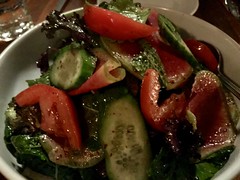
The Bowery Bungalow is a nice space in a converted bungalow just behind Sunset Junction, serving modern Middle Eastern cuisine. We were welcomed with a cumin-rich lentil soup amuse bouche and glasses of sangria. We started with a fatoush salad, a heap of interesting greens with pieces of tomato, cucumber, and mandolin-sliced watermelon radishes in a sumac vinaigrette. Charred broccolini came in a sweet-tangy Aleppo pepper sauce with dates and almonds. Fried cauliflower was dusted in dukkah and covered in rich tahini sauce. Beef tenderloin “shishkatori” kebabs were well seasoned and grilled to perfection. Turmeric chicken fried rice was a nice blend of flavors and textures with roasted chick peas, almonds, and golden raisins. Middle Eastern style coffee was poured from an ornate pitcher into an equally ornate demitasse. And a chocolate pot de crème came with fresh whipped cream and a fantastically light halveh (sesame confection). (See pics here.)

ART: Charles White Retrospective at LACMA

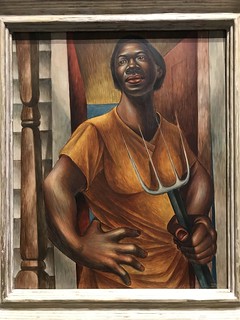
Today at LACMA I became acquainted with an extraordinary artist I had not known before. Charles White (1918-1979) was an African-American artist who grew up in Chicago during the Depression, but also lived in New Orleans, New York, Mexico City, and ultimately Los Angeles. He worked in a variety of paintings, murals, graphic print works, woodcut, with influences ranging from WPA projects to Diego Rivera and Soviet social realism, all filtered through his own distinctive African-American experience. His subjects are always human figures, generally very expressive, evocative, soulful. A woman with a pitchfork stands on her porch in “Our Land”, like a black American Gothic, a look of satisfaction in her hard work. A man and woman show utter hopelessness in “There Were No Crops This Year”. White served in WWII, and a couple of the works showed the complex feelings of black soldiers, proud to serve their country but uncertain whether their country would return their respect. Many works show iconic figures like Harriet Tubman and Frederick Douglass, often with imagery of Old Testament prophets, pointing the way to the promised land. I lingered over so many of his works, captivated by their emotional power and their visual dynamism. Interestingly, before I entering this exhibit, I visited the sculpture garden to see some of my favorite works by Rodin, and with those works fresh in mind I saw many similarities with White’s paintings: powerful evocative human figures, dramatically oversized hands, the same ennobled despair and resolution chiseled into faces. I don’t know if White would have ever seen Rodin’s Burghers of Calais, but his take on the 20th century African-American experience would have an interesting dialog with those 14th century French victims of the Hundred Years War sculpted by Rodin. (See complete pics from my visit to LACMA.)

FOOD: Ramen Tatsunoya comes to Silver Lake

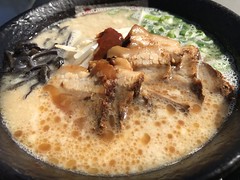
From the Hakata district of the port city of Fukuoka on the nothern side of the island of Kyushu in Japan comes a particular style of ramen called tonkotsu ramen. It is made from boiling pork bones for hours on end to make a rich umami-laden broth, and adding thin noodles traditionally firm in the center. Tatsunoya Ramen comes from Fukuoka, with its first US outpost being a spot in Old Pasadena which is always mobbed. Just recently, they have added a Silver Lake location, and the secret is not quite out yet, as you can still get in without waiting. I can attest that the broth is rich, the noodles are al dente, and with some slices of pork belly, a bit of green onion, and kombu added, it is a richly satisfying and flavorful bowl. Close your eyes and you could be in Fukuoka. Open your eyes, and you're enjoying this delicious ramen on a lovely sunny terrace looking across Sunset Blvd to the murals of Micheltorena Elementary.

Saturday, March 09, 2019

STAGE: Cinderella

I had seen Matthew Bourne's Cinderella twenty years ago when it opened, and was delighted to see it again. The choreography is riveting, a perfect match to the jaunty and evocative Prokofiev music. The dancers seemed at times to defy gravity and physiology, sometimes floating in air, sometimes bending at odd angles, other times bending fluidly as if they were a liquid being poured from one space to another. All of it served to wordlessly convey the characters in the story, from the creepy unctuousness of the step-brothers and the imperious evil of the step-mother, to the reticence turned blossoming of Cinderella and the desperation of the pilot after he’s lost her. The Cinderella story is of course well known, but it has been creatively re-set into London 1940, where Cinderella (who has step-brothers as well as step-sisters) meets a handsome RAF pilot and then they get separated in the confusion of the Blitz. The staging is fantastic, beautifully conjuring WWII London, complete with the sounds of bombers flying overhead and air raid sirens. The Act II ballroom scene is a marvelous showcase of dancing followed by a beautiful pas de deux between Cinderella and the pilot. The “angel” (the fairy godfather?) has some breathtaking moves. What a feast for the eyes and ears.

Friday, March 08, 2019

X'tiosu and Hsi Lai Temple: Lunch on the border of Lebanon and Oaxaca, afternoon in Taiwan

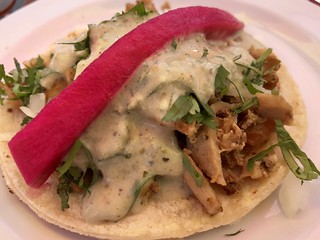
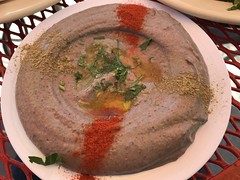
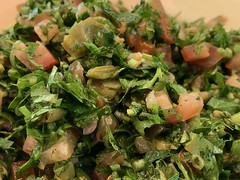
For lunch, I traveled to the border of Lebanon and Oaxaca (actually Boyle Heights), where a new restaurant called X'tiosu Kitchen has popped up recently. A couple of brothers came from Oaxaca, cut their cooking chops in Lebanese restaurants in Santa Monica, and now are fusing those skills with their native flavors to create "comida libanesa estilo oaxaqueña". That turns out to be a chicken shawarma taco, with a double layer of corn tortillas to give the heft of a pita, grilled chicken, a bright pickled turnip, and the rich tahini sauce dancing with a hot smoky salsa made from chile de arbol and guajillo peppers. That means that their tabbouleh blends lots of fresh parsley and tomato with nopalitos (cactus) instead of bulgur. It means hummus is whipped from black beans instead of chick peas, and graced with olive oil, paprika, and cumin. It means you're lucky to live in Los Angeles, where magic like this can happen.

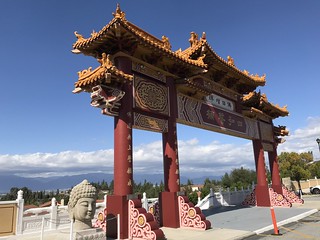
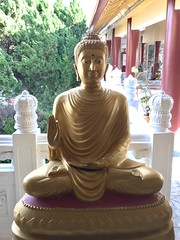
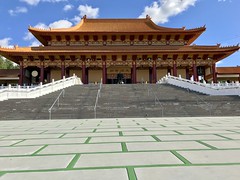
After lunch, I went to Taiwan for the afternoon (actually Hacienda Heights). The spectacular Fo Guang Shan Hsi Lai Temple is built dramatically into a hillside, so that you ascend through a series of temple structures, symbolic of the Buddhist journey of enlightenment. From the height of the main temple, looking out over the golden rooftops of the other structures, and further out over a brilliant blue sky with dramatic clouds, I felt like I could have been in Tibet if not Taiwan. I wandered the gardens and grounds filled with fantastic images of buddhas, boddhisatvas, and other revered figures. I saw monks in their robes, and watched people praying. I lit some incense as I saw others doing. Several helpful people offered to answer any questions. I stepped inside the main temple and marveled at literally thousands of buddhas. On the opposite wall facing you as you enter are three gigantic buddhas. As your eyes adjust, you realize that the columns are made up of stacked niches, about 2-foot square, each with its own buddha figure in it. Then you realize that the walls between the columns are filled with even smaller niches, each with buddhas in them, and each with a unique name. The whole experience was fantastically serene, which I suppose is the goal. I am so lucky to live in LA, and have the world in my city!

Thursday, March 07, 2019

FOOD: Farewell to PYT

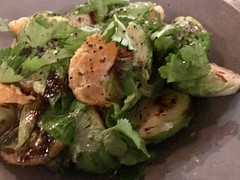
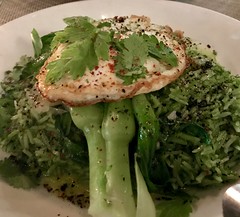
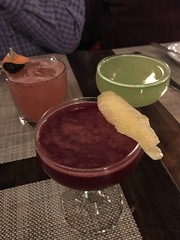
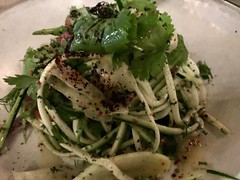
The inevitable downside of LA’s hot dynamic restaurant scene is that restaurants, even good ones, will close. On Thursday, we ate a farewell meal on the last night of service at PYT, Chef Josef Centeno’s restaurant that lead the charge on the wave of vegetable-forward cuisine in LA. When Jonathan Gold compiled a list of the top 10 dishes of 2016, nearly half of them were vegetables, and one of them was Centeno’s roasted turnip, roasted for hours in a salt casing wrapped in a hoja santa leaf. I never got to try the turnip, as they had moved on to other delicious vegetables in their changing seasonal menu. I was hoping they might have brought it back for their last hurrah, but no luck. What we enjoyed instead was very fine consolation. We started an amuse bouche of oro blanco segments in a puddle of charred shallot oil, sprinkled with dukkah, singing on our tongues with various notes of sweet, acid, and umami. Here, even the cocktails showcase vegetables. Our table sampled the Beet It (beet, bourbon, kombucha, lemon, sugar), the Cara Cara Crush (rye whiskey, raspberry, orange juice, ginger), and a Celery Margarita (tequila, celery, lime, agave). We began with a kanpachi crudo (the only animal protein in our meal) in a bright carrot-turmeric aguachile that I wanted to soak up every drop of. For salads, we had a zucchini “noodle” slaw with chimichurri spice, pomegranate, and lemon, and roasted baby beets with chicory greens in a buttermilk-oregano vinaigrette that added a novel tang to the sweet beets. Then came the main part of the meal – all vegetables. Grilled cauliflower and romesco were made earthier by a truffle cream, punctuated by yuzu zest. Charred Brussels sprouts were bathed in brown butter vinaigrette and coriander leaves, with a sweet acid punch from satsuma mandarin segments. Green piri-piri rice, its herbaceousness reinforced with fresh herbs, came with bok choy and an over-easy egg for richness. And a crispy eggplant was battered in cornmeal (gluten-free!) and mozzarella, served in a tangy-sweet tomato-plum sauce. Anyone who thinks you can’t make a full hearty meal of vegetables hasn’t eaten here. For dessert, we enjoyed a rich thick peanut budino in a salty caramel cream with candied pepitas and coconut.


We’re sad that that would be our last meal at this innovative and delicious venue, but are glad for the impact it has had on LA’s food scene. Chef Centeno still has at least three other restaurants within a stone’s throw of this one (someday perhaps the corner of 4th and Main St will be named Josef Centeno Square), and he has said that his best vegetable-forward dishes may migrate to Orsa & Winston, his more upscale tasting menu restaurant. The chef said the closure was not due to the business going down, but to getting a great offer on the space. Rumors are that the people behind Lock and Key (a Koreatown speakeasy) and Nightshade (new pan-Asian spot in the Arts District) plan to open something here. The dynamism of our food scene means things keep changing, so we’ll be eager to see what comes next.

Tuesday, March 05, 2019

FILM: Roma

I had heard a broad range of reactions from friends who’d seen Roma, from “beautiful” to “like watching paint dry”, and I think it depends what you want from a film. If you’re looking for a clever plot, laughs, or great action, you’ll find Roma very unsatisfying. But if you appreciate a film that shows you a slice of life in a way that really makes you think, or if you appreciate a film that genuinely evokes a time, a place, a mood, then you’ll find much to appreciate. And if you’re the sort of film fan who loves the art of film -- someone who loved Linklater’s Boyhood, who reveled in the opening scene of Altman’s The Player, who can discourse on the technique of Orson Welles and Alfred Hitchcock -- you’ll be loving this film from its opening scene: water repeatedly surging and receding across some unlocatable pavement, eventually coming to stillness reflecting an opening onto a piece of sky in which an airplane slowly flies across. One viewer’s masterpiece is another viewer’s paint drying. Me, I appreciated watching the paint. Some of the scenes were almost painterly, like “Pageant of the Masters” in their composition, and yet completely natural. I found everything worked to create a complex impression. There was the sense of childhood, its innocence, and the nostalgia of its recollection for the children in this family, as you watch them being happy and oblivious as serious things happen to the adults they love and feel close to. You can sense the director being reflective of his own childhood experiences in that time and place. There was the ambiguous relationship of the nanny to the family, some fuzzy place between employee-servant and beloved family member, both attached and detached. There was the comfort of this home and this neighborhood, with social and political unrest just scraping the side of the car occasionally as they ride through their lives. And it was beautiful.

Saturday, March 02, 2019

OPERA: The Clemency of Titus

We thoroughly enjoyed the soprano-fest at LA Opera’s The Clemency of Titus. It was the last opera Mozart wrote, and it was scored not only for two sopranos for the female roles, but a soprano castrato and a soprano en travesti (cross-dressing) playing two male roles. In modern times, since castrati are in short supply, those two “trouser roles” are sung by mezzo-sopranos. With soldierly costumes and fake beards, they were quite effective and affecting. There were some lovely duets between the “men” and the women, and one between the two “men”. The orchestration included harpsichord and some period instruments called basset clarinet and basset horn, each of which had a featured “duet” with a soprano. The voices were all strong. Elizabeth DeShong, demonstrated great range and emotion as Sesto, a young Roman nobleman who is goaded by the object of his love to turn against his dear friend. Guanqun Yu was vibrant and beguiling as Vitellia, the conniving beauty who manipulates Sesto to evil ends. Russell Thomas’ rich tenor voice rang true as the virtuous Emperor Titus who, Camelot-style, who is betrayed both personally and in his ideals by those he most trusts and loves. The opera was commissioned for the occasion of the coronation of King Leopold II of Bohemia in 1791, mindful of the terrors in France, wanting to encourage the new Holy Roman Emperor with themes of noble and benevolent leadership. Some details of the historical Titus, who was a magnanimous emperor, are shown in the opera: when subjects give him gold to build a great statue in tribute to him, he requests that the riches instead be diverted to needy citizens in his realm recently affected by natural disaster. A number of themes and notes in the opera had unexpected relevance in contrast with our own current experience of national leadership. As we’ve come to expect to be spoiled by with LA Opera, not only did we get top notch singers, orchestra, and chorus, but also gorgeous set design and costumes, evoking the grandeur of a fantasy of Imperial Rome, in splendor and opulence, and later in flames and ruin. (Fun fact: La Clemenza di Tito premiered in 1791 at the Estates Theatre in Prague, which I’ve had the pleasure to visit, and which is the only theatre still standing where Mozart performed.)

Sunday, February 24, 2019

STAGE: America Adjacent

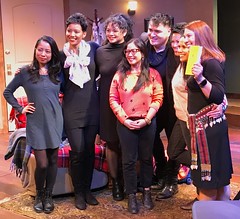
Being the home of “the industry” and thanks to actor’s union rules, LA is blessed with a bounty of 99-seat theatres, often providing high quality productions. I was treated to some of that on Sunday at the Skylight Theatre in Los Feliz. America Adjacent is set in a small one-bedroom apartment somewhere near Hollywood, packed with six Filipino women and a couple of babies, all confined to the apartment. The women are all pregnant or recently delivered, coming to America so their children will have the advantage of US citizenship. While such a play could have easily verged into polemic, this script (by Boni Alvarez) focuses on the very human stories of these women, why they came, what they hope, and how they cope with being confined in such close quarters. Their backgrounds and situations vary. One is rural and naïve, one is religious, one is more educated, some are conformists and peacemakers while others are risk takers and rule breakers, but all share sacrificing for the sake of their children. It is engaging and moving, and I am glad I saw it.

On Sundays, Skylight Theatre presents a conversation series immediately after the show, and this Sunday’s guest was none other than Jose Antonio Vargas, whose book Dear America I had just read. Being a Filipino undocumented immigrant, he clearly had much to relate to in this play, and talked about the experience of being “TNT”. The Tagalog phrase tago ng tago, which means being in constant hiding (literally “hiding and hiding”), abbreviated TNT, is slang for an undocumented person. Until you hear stories like these women or Vargas being TNT, you don’t appreciate the psychological toll it can take. In the conversation, several people also spoke of how powerful it was for them to see a play with Filipino actors playing Filipino characters, not something often seen. (As a gay man of a certain age, I can relate to that.)

Saturday, February 23, 2019

FOOD: Redbird

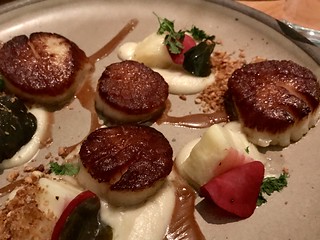
We enjoyed a marvelous dinner at Redbird with some friends, which is the best way to do it, as sharing plate meals work well here, and the staff will deftly time them into nice rounds of courses. Our starter round began with a salad of little gems with avocado wedges, smoked bacon, and a buttermilk blue cheese vinaigrette. It’s a great salad, similar to a classic steakhouse wedge salad in its crisp body, but with more interesting lettuce, more interesting dressing, and the avocado and smoked bacon to amp up the flavor and texture complexity. Roasted baby red beets were served chilled with chèvre, citrus, pistachios, again taking a standard and adding something special. Likewise with the seared shishito peppers, with a dusting of toasted quinoa for crunch and bottarga (an Italian cured fish roe) for salty zing. A superbly fresh hamachi crudo was seasoned with hijiki (a dried sea herb), minced Asian pear, minced ginger, and a housemade ponzu balancing salt with a bit of sweet. As a bonus, with a group of six, there will likely be someone else who wants to share that one thing that doesn’t appeal to most, and so two of us enjoyed a large halved marrow bone topped with snails in a rich brown bordelaise sauce and served with grilled sourdough toast. In the second round of courses, we enjoyed scallops perfectly browned in brown butter on celery root purée with sunchokes. Lobster risotto with fines herbes was distinguished with a Meyer lemon cream. Small garnet yams were roasted and then made extraordinary with tart pomegranate arils, dukkah (a middle Eastern nut-and-spice blend), and honey. A 24-ounce bone-in Red Wattle (heirloom breed) pork chop made a dramatic presentation, pre-sliced but still with the bone and bits, along with taleggio polenta, and arugula with hazelnuts. Gemelli (loosely twisted hand-rolled pasta ropes) was spicily sauced with braised goat, rapini, fresno chili to add heat, and breadcrumbs and poached egg to mellow it out. Brussels sprouts came with a red curry aioli and chicharrones. And the sommelier steered us to a 2014 Lutum Santa Rita Hills pinot noir that beautifully complimented this feast. Finally, for dessert we share a couple of sweet bites. A flourless chocolate cake was rich but not heavy, and punctuated by pomegranate arils. A light crustless cheesecake was brightened by passionfruit and topped with pistachio brittle. (See all the pics here.)

FILM: Oscar-Nominated Animated Shorts 2019

In recent years, we’ve discovered the pleasure of seeing the Oscar-nominated short films when the Academy Awards are coming around. Usually we’ll catch the live action and the animated shorts, but this year we didn’t have time to catch both, and some friends tipped us off that the live actions were brutally heavy this year. So animation is it was, and what a great crop this year! The first two shorts both, in the span of 10 minutes each, moved me to warm sweet tears. Bao, the Pixar entry, draws a poignant and humorous sketch of a Chinese mother who raises a son and then is reluctant to let him go when he’s grown up. Using food as a metaphor, it includes some beautifully rendered images of food and cooking. Late Afternoon (from Ireland), in simple hand-drawn lines and colors, shows the experience of an old woman whose memories are becoming slippery as she slides down memory holes like falling into water. Animal Behaviour wasn’t high art, but was an amusing gag about a counseling support group spanning the animal kingdom from a slug who can’t let go of a co-dependent relationship to an ape in denial about anger management issues. Then came the lushly painted Weekends, the subjective experience of a young boy being shuttled back and forth between separated parents, with gorgeous imagery that wordlessly brought emotions to life. One Small Step sweetly tells the story of a girl raised by a single father finding the determination to follow her dreams to the stars. Those were the five official nominees, but they usually throw in a couple of bonus shorts to fill out a feature-length program. Wishing Box was another gag offering stronger on amusement than artistry but certainly a good laugh. Tweet-Tweet, on the other hand, was more deserving of nomination – a CGI offering that entranced me with its simplicity and beautiful imagery, showing the cycle of life as a dance along a tightrope lead by a small bird.

Monday, February 11, 2019

BOOKS: Dear America

Jose Antonio Vargas’s memoir Dear America is a very timely and compelling coming out story. Growing up, he just assumed he was like everyone else, and at age 16 when he discovered the truth about himself, it really unmoored him and he wondered what his future could be like. He buried himself in being a top student and extracurricular overachiever, hoping to hide his secret. (Many gay men will recognize “best little boy in the world” syndrome.) Staying in the closet would take a big emotional toll on him, even as he went on to an impressive career as a journalist, including winning a Pulitzer. Vargas happens to be gay, but that’s not the crux of his story. His life has been shaped by discovering that he was an undocumented immigrant. This book should be essential reading for all engaged Americans. So often our current debates about immigration are based in abstractions and stereotypes, without knowing the actual people affected by our policies. Vargas opens a window onto the life of an undocumented person in America by telling his own story. It is illuminating, and at times moving and surprising. This book is not a political essay, it is a personal memoir. But as we gay people have learned, sharing your own story can be the most compelling argument of all.

Friday, February 08, 2019

FOOD: Botanica in Silver Lake

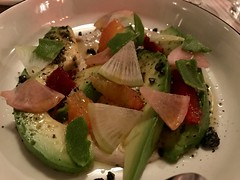
Botanica in Silver Lake is another great example of the vegetable-forward cuisine going on in LA. It’s not pure vegetarian – meat and fish is on offer for those who want it – but you could make a great hearty meal without it, especially if you came with friends and did sharing plates. It's also extremely gluten-free friendly. Market-fresh ingredients are paired here with Middle Eastern notes like tahini, za’atar, and sumac. We went with a neighbor and had this great meal. The fresh market vegetables started with the cocktails: mezcal was paired with beet juice, lime, and cilantro; Spanish vermouth was splashed with blood orange juice and soda. Little gem lettuce was complimented with pistachios, smoked California cheddar, and a balsamic vinaigrette. Avocado and citrus was sliced and served with mint leaves on a light smear of hummus. Broccoli di cicco was prepared with Calabrian peppers and fresno chilies, fresh basil and mint, and miso. Chicken is seasoned with za’atar (a middle Eastern herb blend) and served with wilted greens and caramelized carrots on a carrot purée. Roasted cauliflower is fragrant with turmeric yogurt and punctuated with crunchy candied pepitas. Lamb kofte kebabs (grilled seasoned ground meat) are covered in an herb salad and served on a smear of dill-sumac yogurt. Fort dessert we enjoyed the wine-roasted apples in sweet vermouth with cashew-date purée, and a rich tahini dark chocolate mousse brownie topped with sesame-whiskey caramel whipped cream and cocoa nibs. We left very satisfied with all these delightfully intriguing flavors. (See complete set of photos here.)

ART: Ai Weiwei and Yayoi Kusama at the MAF

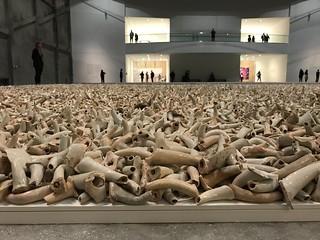
After lunch in Koreatown, in another of my off-Friday pairings of food and art explorations, I got to see a couple of impressive art installations at the Marciano Art Foundation. (If you haven’t yet been to the MAF, it’s a fantastic recent addition to the LA modern art scene, completely free including parking, but you need to make online reservations, and it’s currently booked out about a month out.) The first was a set of massive installations by Ai Weiwei. I’ve gotten to know this artist in the last year, not only through a previous exhibition, but also through his impressive documentary film Human Flow, about refugees and mass migrations, and it’s interesting to see the themes that connect his works. He is fascinated with scale and replication, and one of the things he likes to do is create large installations comprised of large numbers of the same kind of object, inviting you to look at an overall mass, contemplating vastness and large numbers, but at the same time to look closely at individuals and see what appear to be replicas actually have individual differences and characteristics. In the previous exhibit, he did that with antique Chinese stools filling a large open gallery. The Marciano offered an even bigger space to fill, and he’s filled it with two installations of this sort. One, called Spouts, is a nearly 2000-square foot rectangle filled with the spouts of antique porcelain teapots. These are broken fragments of pottery from various Chinese dynasties, some as much as 1000 years old. The shapes and colors vary, though they’re mostly shades of white and ivory. Given that the artist has spent time in Chinese prison and under house arrest, one can imagine this mass of teapot “mouths” to be a comment on the freedom of speech for all the people in China. The other, called Sunflower Seeds, is an even bigger square, over 4000 square feet, filled with sunflower seeds. Not real ones, but lifesize porcelain replicas. There are about 50 million of them, made by over 1600 artisans in Jingdezhen, a town with a long tradition of porcelain craftswork. Thinking about the fact that each of these seeds was handmade by an artisan, and looking at this vast field of millions of them, makes you think about the value of handicraft and the price of labor in China.
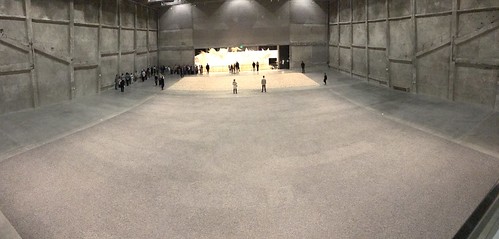
The large field in fore are the 50 million porcelain sunflower seeds. The ivory rectangle beyond that are the antique teapot spouts.
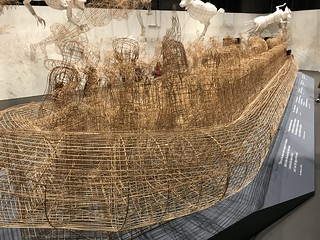
Beyond these two fields is another space that houses a bunch more works by Ai Weiwei, these works all made of bamboo and silk, using the techniques of traditional Chinese kite-making. In the center of the space is the featured Life Cycle, a lifesize large inflatable Zodiac-style boat filled with human figures, made entirely of slender bamboo sticks. If you’ve seen his film, or if you’ve seen any documentary footage of refugees crossing the Mediterranean Sea trying to reach Europe, you will recognize the scene immediately. These are the sort of boats refugees often use, filled to dangerous overcapacity. Sometimes they even capsize. The figures in this boat are all facing inward, and you can see that the center is filled with figures too. A child peers over the front. The transparent bamboo construction of the figures makes them ghostly, just outlines of people, hard to make out. These boats often make their desperate runs at night. After a while you notice that while most of the figures are human, every so often the artist has topped a human body with the head of animals from the Chinese zodiac, an ox here, a rooster there. Perhaps that’s a play on Zodiac, the most common maker of these inflatable boats. Perhaps it suggests the hope that there might be some guiding spirits or angels traveling with these desperate boats. In any case, it’s a powerful piece.
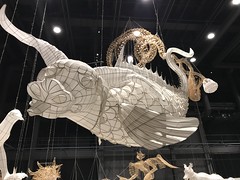
Surrounding the Life Cycle, on the walls around it, and suspended in the rafters above it, are a myriad of bamboo-and-silk kite-like works. The ones flying above are all fantastic mythical creatues drawn from an ancient Chinese mythological text called the Shanhaijing. These creatures have arms and wings, fins and tails, some have multiple heads. The white silk creatures lit up against very high rafters that disappear into darkness create a fantastic effect, like constellations floating in a night sky. The works along the wall draw on myth, on modern art, and on themes from the artist’s life and work. In one section I smiled to recognize the three-legged stools echoing another work I had seen last fall.
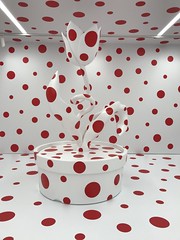
This alone would have been treat enough, but on another floor, MAF was hosting another large scale installation by a fascinating artist. Yayoi Kusama, the Japanese artist whose amazing Infinity Room has been such a hit at The Broad, has another immersive installation here. This one is entitled With All My Love For The Tulips, I Pray Forever. The title gives you a hint of the playful fantasy to expect. This work comprises several monumental potted tulips in a large room, where the tulips themselves, along with the entire room – walls, ceiling, floor – have been painted bright white with large bright red polka dots. It is a fantastic effect, and as you don shoe coverings to be able to walk into this joyful artwork, I think it is impossible not to smile. With absolutely everything in your field of view the same bright colored pattern, Kusama plays with your sense of depth and dimension, while the fancifully shaped oversize tulips create a Wonderland effect. Just how big are those tulips? Wait, have I shrunk? With nothing around you but bright dots, fantastic flowers, and smiling spectators, this exhibit most definitely sparks joy.
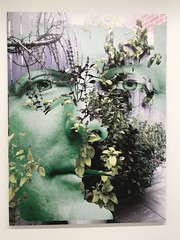
Beyond this, there was still more to explore. The MAF has a large permanent collection that they rotate through exhibition, and judging by the very recent dates on some of the works I saw today, they are actively continuing to expand their collection. Mimi Lauter has a gorgeous 8-panel abstract painting in brilliant peacock hues. A wall full of different colored mirrored windows forms the “clockwork for oracles” by Ugo Rondinone. Photographer Catherine Opie has a fascinating series of intimate photos from inside Elizabeth Taylor’s home (not of Ms. Taylor, just of her home and her stuff). Urs Fischer has created a series of intriguing self-portraits spliced onto scenery, using cuts and color washes and creative construction. These are just some of the highlights. This museum is really such a treat.
FOOD: Galbi at Sun Nong Dan in Koreatown

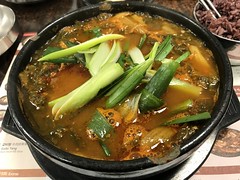
Today I lunched at the famous Sun Nong Dan in Koreatown. It lies in a strip mall at 6th and Alexandria, amdist a handful of restaurants, each with distinct specialty dishes. I tried the oo guh ji galbi tang, a bubbling pot of hot chili broth with some beef short rib and “dried cabbage” (seemed more like collard greens). It came with some nice banchan -- chili scallions, kimchi, chili turnips. I’d heard that the galbi jjim is the thing to get, but I need to bring friends next time, cause the smaller serving size feeds three or more. It was pretty awesome seeing it at other tables when they topped it with cheese and melted it with a blowtorch.

Saturday, February 02, 2019

FILM: The Wife

We had missed this last fall, but with Oscar nominations out, it's back on the big screen, and I'm glad we got the chance to see it. Everyone has been buzzing about Glenn Close's performance in The Wife, and rightly so. Jonathan Pryce is also brilliant as her husband, the Nobel-winning writer, but even if the title hadn't clued us in that we should be watching her, Close's character Joan, tautly rendered and slowly revealed, would command our attention. This fascinating character story examines what it takes to be a great writer, but examines it by showing us this moment of winning the Nobel, and the life that lead up to it. One of the scenes, where Joan spontaneously agrees to have a drink with a persistent would-be biographer (Christian Bale) who is trying to wheedle dirt out of her, reminded me of a similar scene from years ago of Olympia Dukakis in Moonstruck, where she rebuffs a proposed affair, "because I know who I am."  Likewise, Joan knows who she is. There's a writerly line from James Joyce that crops up a few times in this film, "His soul swooned slowly as he heard the snow falling faintly through the universe and faintly falling, like the descent of their last end, upon all the living and the dead."  The film culminates in Stockholm in December for the Nobel ceremony, and there are just enough graceful set shots of the stark beauty of that city in winter. In a shot near the end, there is a close-up of Joan's face, and through the window behind her, we see the snow falling faintly, just the way Joyce said it would. I haven't read the book that this film came from, but I'm sure it must have been quite a job to adapt such inherently literary, non-cinematic material. Yet it is deftly done, with fine acting conveying much beyond the words.